How to Deal with Trump? Here's the 'Deal-Maker's Playbook'

marsbitОпубликовано 2026-03-11Обновлено 2026-03-11

Введение

The Kobeissi Letter outlines a consistent 10-step "conflict playbook" used by former President Trump in geopolitical and trade disputes, from Iran to tariffs. It begins with verbal pressure and strategic posturing, often followed by "Friday night surprise" actions to allow market digestion. Markets initially bet on quick deals, but Trump’s "forever war" rhetoric reverses optimism, forcing repricing. A conditional de-escalation signal (like Trump’s recent Iran comments) emerges when structural market stress (oil >$90, stocks down 5%) or political costs mount. Eventually, deals are struck, triggering violent market reversals due to defensive positioning. Three scenarios are projected for the next 2-4 weeks, all pointing to an eventual agreement—Trump’s conflicts consistently end with deals, not prolonged war.

Every conflict involving Trump follows the same script.

According to Xinhua News Agency, Trump spoke about the Iran conflict in Miami on the 9th: he believes the conflict will end "soon," but "not" this week. This statement sounds ambiguous, but if you've been tracking his approach to handling geopolitical conflicts, you'll recognize it as a familiar signal—negotiation terms are quietly taking shape.

This is precisely the seventh step described by The Kobeissi Letter—the emergence of conditional de-escalation signals. After the market has already begun seriously pricing in a "longer fight," conditional cooling rhetoric appears—not a retreat, but a test of whether the opponent and the market can withstand the next stage of escalation.

In a report dated March 3, The Kobeissi Letter, an independent U.S. macro market research newsletter, systematically reviewed every geopolitical and trade conflict involving Trump since his inauguration in January 2025, from tariff wars, the arrest of Venezuela's Maduro, and Greenland negotiations, to the current Iran conflict. The negotiation logic Trump follows in handling these conflicts is highly consistent.

This research compiles a complete 10-step "conflict script" for Trump's approach to conflicts: from verbal pressure and posturing, to a preference for making key moves on Friday nights, to the spread of risk premiums across stocks, bonds, and commodities, and finally ending with a "deal" that triggers violent market repricing. For the next 2 to 4 weeks, the institution outlines three scenarios, with the outcome likely still being an agreement—but before that, the market may have to endure another round of pain.

Step One to Step Three: From Verbal Pressure to the "Friday Night Surprise"

Trump's conflicts often don't start with the first missile or the first tariff notice, but with linguistic pressure to "make a deal."

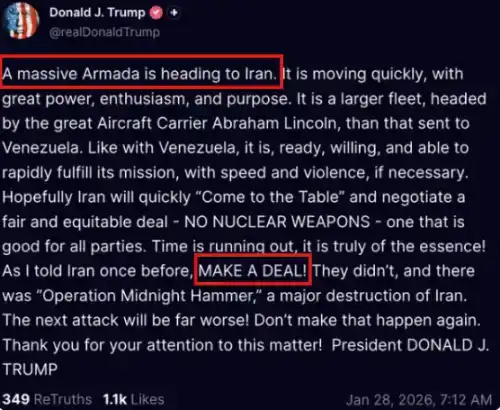
The Kobeissi Letter defines the starting point of Trump's conflict mode as verbal pressure. Taking the Iran conflict as an example, the first strike on Iranian nuclear facilities occurred on February 28, but as early as two months prior, Trump had repeatedly posted on Truth Social that "a massive fleet is heading towards Iran" and continuously urged Iran to "make a deal."

The institution points out that this pattern was equally clear in the Venezuela and EU tariff events: Trump announced the closure of Venezuelan airspace more than a month before taking action against Venezuela; before imposing tariffs on the EU, he continuously threatened Denmark and claimed it was "time" to acquire Greenland.

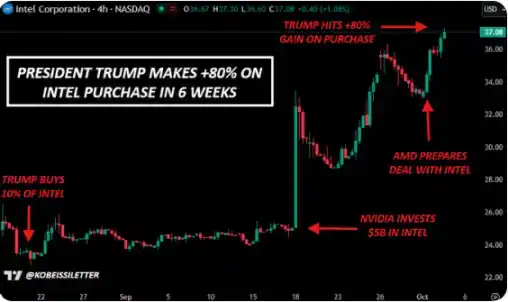
The second step is strategic posturing and demonstration of strength, including visible preparatory actions like military deployments and public ally coordination, aimed at enhancing credibility without triggering full-scale conflict. The institution cites Trump's meeting with Intel CEO Lip-Bu Tan in August 2025 as an example—prior to this, Trump had publicly demanded his "immediate resignation," after which both sides reached an agreement for a 10% government stake. This investment recorded over 80% paper gains in less than two months.

The third step is the signature "Friday Night Surprise." The Kobeissi Letter's statistics show that Trump's major actions are highly concentrated from Friday night to early Saturday morning, including: the June 21 U.S.-Israel joint airstrike on Iranian nuclear facilities, the September 1 strike on drug boats in the Caribbean, the October 10 threat of 100% tariffs on China, the November 29 closure of Venezuelan airspace, the December 25 military action in Nigeria, and the February 28 airstrike on Iran.

Why always act on Friday night? The report suggests that if major news breaks during trading hours, liquidity dries up instantly, algorithmic programs amplify volatility, and intraday panic intensifies. Announcing on Friday evening gives investors, institutions, and governments the entire weekend to digest the information.

More importantly, Trump is highly sensitive to severe market volatility—he needs a time window to observe market reactions and leave room for possible negotiations. According to this script, after acting on Friday night, Trump often begins hinting at the possibility of a "deal" before the Sunday futures market opens. In the case of Iran, that signal did not come.

Step Four to Step Six: How the Market Gets "Educated"

After the third step, the research divides the market's typical reaction into three layers:

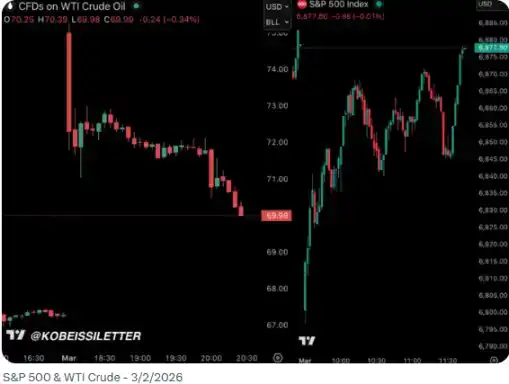
Step Four: The shock occurs, but the market initially bets on a "quick deal." The report describes a common path: severe volatility occurs during the Sunday night session (18:00 EST), but by the time the Monday cash market opens, some of the moves are "reversed," as investors assume Trump loves deals and the conflict won't drag on. The research cites the March 2 movement as an example: WTI crude oil erased about 70% of its gains at one point, and the S&P 500 even turned green, but these moves were subsequently reversed, with oil hitting new highs and stocks hitting new lows.

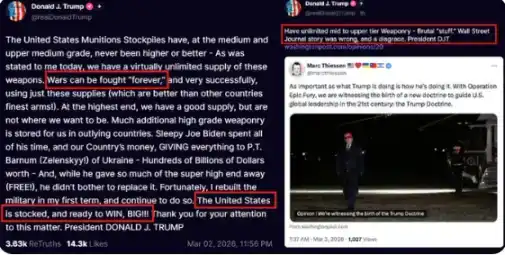
Step Five: Trump uses rhetoric like "we can fight forever" to burst the market's optimism. After investors buy the dip, the market is often hit with a counter-punch. On March 2, Trump publicly stated that "the war can go on forever" and that the U.S. has "unlimited mid-to-high-end weapons." The Kobeissi Letter believes this "forever" type of statement is more of a negotiation tactic, showing the bearable upper limit, but does not equate to a genuine desire for a prolonged war.

Step Six: The market begins formally pricing in a "longer duration." As of the report's writing on March 3, Brent crude oil prices broke above $85/barrel for the first time in nearly two years; the Dow Jones Index fell over 1100 points in a single day; stocks fell to weekly lows, and defensive capital outflows accelerated. This stage marks a structural shift in market psychology—"The first dip is bought because investors expect an agreement is coming; the second dip is bought because investors believe the escalation is temporary; the third dip is when positions begin to change structurally."

Step Seven to Step Eight: De-escalation Signals and the Market Feedback Loop

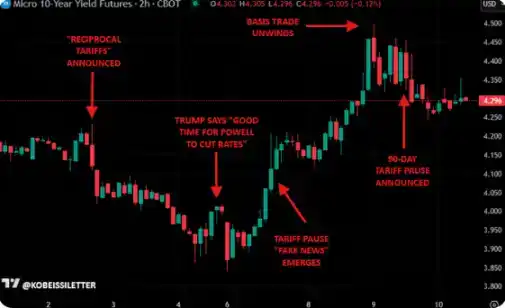
Step Seven is the emergence of conditional de-escalation signals, which corresponds to the stage of Trump's latest statement on the 9th. The Kobeissi Letter emphasizes that the time window between Step Six and Step Seven is "highly uncertain"—in the early 2025 tariff war, this transition took months, ultimately catalyzed by a rapid surge in U.S. Treasury yields before tariffs were "paused" on April 9.

The institution points out that the historical catalysts prompting Trump to back down have either been the target actively seeking to "make a deal" or a structural break in the market. On the Iran issue, this catalyst would be the collapse of the Iranian government or some event with structural implications for the U.S. and global economy.

Step Eight is the feedback loop between the market and politics. The financial market itself has become part of the negotiation environment, as oil prices, stock markets, and inflation expectations in turn influence the political narrative.

Trump has three policy priorities: being a "peace president," suppressing inflation, and lowering U.S. gasoline prices. From this, it follows that: rising oil prices, if prolonged, directly conflict with his goals, especially in a critical midterm election year.

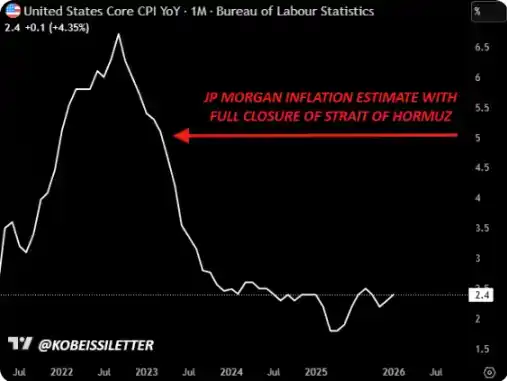
According to JPMorgan estimates, a blockade of the Strait of Hormuz could push oil prices to $120-$130/barrel and cause U.S. CPI inflation to soar to around 5%. Based on this, the institution set three key monitoring thresholds: Brent crude sustaining above $90/barrel, a stock market decline of 5% or more, and a gasoline price increase of over 10%. "When these thresholds are breached, the probability of negotiation-related headlines appearing increases significantly."

Step Nine to Step Ten: Agreement Reached and Violent Repricing

Step Nine is agreement reached and narrative framing. The Kobeissi Letter points out that every major confrontation within Trump's framework ultimately ends with a narrative of "maximum pressure in exchange for concessions," whether it's trade deals with China, the EU, India, corporate negotiations with Intel or in the rare earths sector, or the multiple conflicts Trump helped end in 2025.

On the Iran issue, the institution believes that if the Iranian government does not collapse, the final agreement might involve a ceasefire linked to nuclear issues, a regional security arrangement with enforcement mechanisms, or a sanctions adjustment plan conditional on compliance benchmarks. "The specific architecture is far less important than the timing and narrative framework."

Step Ten is violent market repricing and declaration of political victory. The Kobeissi Letter emphasizes that market repricing after an agreement is announced is often sudden rather than gradual, because investors are generally in defensive positions by then—energy exposure is high, equity risk has been compressed, and volatility remains elevated due to latent uncertainty.

Once uncertainty dissipates abruptly, these positions are rapidly unwound. The institution cites historical cases from April, August, October 2025 and January 2026, noting that each time tariffs were paused or a framework agreement was announced, stocks surged sharply, while oil prices plummeted rapidly as expectations for the reopening of shipping channels were established.

Three Paths for the Next 2-4 Weeks: "The Deal Will Be Back on the Table"

The Kobeissi Letter outlines three scenarios for the next two to four weeks.

Scenario One: Escalation briefly intensifies, oil prices rise, stocks fall, then negotiation language suddenly appears, and the market reverses sharply due to overly defensive positioning.

Scenario Two: The conflict continues in a controlled but sustained manner, oil prices remain high without sharp spikes, stocks wait for clarity amid high volatility, and an agreement is reached under sustained pressure later this month.

Scenario Three: Regional escalation expands significantly, including substantial disruption to shipping channels or direct involvement by more state actors. Oil prices would move towards triple digits, and global risk assets face deeper repricing. Given historical precedent and the current critical midterm election year, the probability of the third scenario is low, but not impossible.

Regardless of the path, the common bet of this handbook is clear: Trump does not like "forever wars"; he is better at pushing escalation to a sufficient leverage point, then writing the ending as a "deal." The Kobeissi Letter concludes: "Don't forget, in the 13 months since Trump took office, every conflict he has been involved in has ended with a deal. Trump is a dealmaker. Follow the pattern, and you will be rewarded."

Связанные с этим вопросы

QWhat are the first three steps in Trump's conflict playbook according to The Kobeissi Letter?

AThe first three steps are: 1) Verbal pressure, starting with language pushing the other side to 'make a deal'. 2) Strategic posturing and demonstration of force, including military deployments and public ally coordination to build credibility. 3) The signature 'Friday night surprise', where major actions are concentrated from Friday night to Saturday morning.

QWhy does Trump prefer to make major announcements on Friday nights?

AAnnouncing major actions on Friday night gives investors, institutions, and governments the entire weekend to digest the information, preventing instant liquidity drying up and panic amplification by algorithms during trading hours. It also provides a time window for Trump to observe market reactions and leave room for potential negotiations.

QWhat is the significance of Step 7 (Conditional De-escalation Signal) in the conflict playbook?

AStep 7 signifies the appearance of conditional de-escalation rhetoric. It is a signal that negotiation terms are quietly taking shape, indicating a tentative cooling of rhetoric—not a retreat—but a test to see if the opponent and the market can withstand the next phase of escalation.

QWhat three market thresholds does The Kobeissi Letter identify as key catalysts for triggering negotiations?

AThe three key market thresholds are: 1) Brent crude oil sustaining above $90 per barrel. 2) The stock market falling by 5% or more. 3) Gasoline prices rising by more than 10%. When these thresholds are hit, the probability of negotiation-related headlines increases significantly.

QWhat is the common outcome of every major confrontation Trump has been involved in since his inauguration, according to the report?

AAccording to The Kobeissi Letter, every major confrontation Trump has been involved in since his inauguration nearly 13 months prior has ended with a deal being made. He is characterized as a dealmaker who uses escalation to gain enough leverage to ultimately frame the outcome as a 'transaction'.

Похожее

Jensen Huang's Message to Graduates: AI Won't Replace You, But Those Who Excel at Using AI Will

NVIDIA CEO Jensen Huang, addressing 2026 graduates at Carnegie Mellon University, emphasized that AI will not replace people, but those who leverage AI effectively will have an advantage. He delivered this message during a commencement speech where he also received an honorary doctorate, his seventh. Huang reflected on his personal journey as an immigrant, starting from humble beginnings as a dishwasher to co-founding NVIDIA. He shared early struggles, including a near-bankruptcy moment saved by honesty with Sega, highlighting resilience and learning from failure. He positioned the current era as the dawn of the AI revolution, a shift as significant as past computing waves. Huang explained that AI is redefining computing from human-written software to machine learning, creating a new industry focused on manufacturing intelligence. While acknowledging fears about job displacement, he argued that AI amplifies human capabilities rather than replaces human purpose. Tasks may be automated, but the core meaning of professions remains. Huang urged graduates to embrace this transformative time with responsibility and optimism. He stated that AI should democratize technology, bridging gaps and enabling broader participation in creation and problem-solving. His final advice was to actively engage with the opportunity: "So run, don’t walk," and to put their hearts into their work.

marsbit2 мин. назад

Jensen Huang's Message to Graduates: AI Won't Replace You, But Those Who Excel at Using AI Will

marsbit2 мин. назад

Three Scenarios for BTC's Future Direction and a Duel Between Two Strong Forces | Special Invited Analysis

**Title: Three Scenarios for BTC's Future Trajectory and a Key Duel | Invited Analysis** The market remains at a critical juncture. Over the past week, Bitcoin (BTC) consolidated broadly between $79,500 and $80,600, validating previous technical analysis. The current focus is on whether this marks the start of a new uptrend or a pause within a larger correction. **BTC Multi-Cycle Analysis & Three Possible Scenarios** BTC's daily chart structure, following its peak at $126,200 in October 2025, presents three primary technical scenarios based on Elliott Wave theory: 1. **Bullish Scenario (End of Correction):** The corrective A-B-C wave from $126,200 ended at the $60,000 low in February 2026. The current price action is the start of a major Wave I uptrend. A subsequent Wave II pullback would not break below $60,000. 2. **Bearish Scenario 1 (Complex Correction):** The correction is unfolding as an A-B-C-D-E pattern. The current move from $60,000 is a D-wave rally. After its completion, a final E-wave decline could potentially breach the $60,000 level. 3. **Bearish Scenario 2 (Larger Correction):** The entire move down from $126,200 to $60,000 was a large A-wave. The current rally is a B-wave correction within a larger A-B-C structure, to be followed by a C-wave decline below $60,000. *Analysis suggests Scenario 2 is less probable due to time disproportions between waves. The battle is effectively between the Bullish Scenario (1) and Bearish Scenario (3).* **Key BTC Levels & Weekly Strategy** On the 4-hour chart, BTC trades above a crucial consolidation zone ("Central Pivot C"). * **Key Resistance:** $83,500-$84,500; $89,000-$90,500. * **Key Support:** $78,500-$79,500 (pivot upper bound); $73,500-$75,000; $69,500-$70,500. **Weekly Outlook:** The market direction hinges on BTC's ability to hold above or break below the $78,500-$79,500 support zone. * **Mid-term Strategy:** Neutral/Wait-and-see stance due to unclear direction. * **Short-term Tactics:** Two contingency plans using 30% max capital: * **Plan A (Bullish):** Look for long entries if price holds above $78,500-$79,500 with confirming signals. Initial stop-loss below $78,500. * **Plan B (Bearish):** Consider short positions if price breaks below $73,500-$75,000 with confirming signals. Initial stop-loss above $76,500. **HYPE Analysis & Strategy** HYPE's daily chart shows a seven-segment structure from its January low of $20.46, forming a "rising pivot" zone. * **Key Level to Watch:** $45.76 (previous high). A break above would confirm the bullish structure remains intact. * **Short-term Strategy:** Focus on pivot zone boundaries ($38.41 upper, $34.44 lower). * **Long:** Consider on support near $38.41 with bullish confirmation signals. * **Short:** Consider on a break below $34.44 with bearish confirmation signals. * Position size must be below 30% with strict stop-loss discipline. **Risk Management Reminder:** Always set an initial stop-loss upon entry. Move stop-loss to breakeven at +1% profit, then trail it upwards to lock in profits dynamically. All views are based on technical analysis for informational purposes only and do not constitute investment advice. The market is inherently risky.

Odaily星球日报11 мин. назад

Three Scenarios for BTC's Future Direction and a Duel Between Two Strong Forces | Special Invited Analysis

Odaily星球日报11 мин. назад

Sequoia Interview with Hassabis: Information is the Essence of the Universe, AI Will Open Up Entirely New Scientific Branches

Demis Hassabis, co-founder and CEO of Google DeepMind and Nobel laureate, discusses the path to AGI and its profound implications in a Sequoia Capital interview. He outlines his lifelong dedication to AI, tracing his journey from game development (e.g., *Theme Park*)—a perfect AI testing ground—to neuroscience and finally founding DeepMind in 2009. He emphasizes the critical lesson of being "5 years, not 50 years, ahead of time" for successful entrepreneurship. Hassabis reiterates DeepMind's two-step mission: first, solve intelligence by building AGI; second, use AGI to tackle other complex problems. He highlights the transformative potential of "AI for Science," particularly in biology where tools like AlphaFold have revolutionized protein folding. He envisions AI-powered simulations drastically shortening drug discovery from years to weeks and enabling personalized medicine. Furthermore, he predicts AI will spawn new scientific disciplines, such as an engineering science for understanding complex AI systems (mechanistic interpretability) and novel fields enabled by high-fidelity simulators for complex systems like economics. He posits a fundamental worldview where information, not just matter or energy, is the essence of the universe, making AI's information-processing core uniquely suited to understanding reality. He defends classical Turing machines as potentially sufficient for modeling complex phenomena, including quantum systems, as demonstrated by AlphaFold. On consciousness, Hassabis suggests first building AGI as a powerful tool, then using it to explore deep philosophical questions. He believes components like self-awareness and temporal continuity are necessary for consciousness but that defining it fully remains an open challenge. He predicts AGI could arrive around 2030 and, once achieved, would be used to probe the deepest questions of science and reality, much as envisioned in David Deutsch's *The Fabric of Reality*.

链捕手29 мин. назад

Sequoia Interview with Hassabis: Information is the Essence of the Universe, AI Will Open Up Entirely New Scientific Branches

链捕手29 мин. назад

Morgan Stanley 2026 Semiconductor Report: Buy Packaging, Buy Testing, Buy China Chips, Avoid Traditional Tracks

Morgan Stanley 2026 Semiconductor Report: Buy Packaging, Buy Testing, Buy Chinese Chips; Avoid Traditional Segments. The core theme is the shift in AI compute supply from NVIDIA dominance to a three-track system of GPU + ASIC + China-local chips. The key opportunity is capturing share in this expansion, while non-AI semiconductors face marginalization due to resource reallocation to AI. Key investment conclusions, in order of priority: 1. **Advanced Packaging (CoWoS/SoIC) - Highest Conviction**: TSMC is the primary beneficiary of explosive demand, driven by massive cloud capex. Its pricing power and AI revenue share are rising significantly. 2. **Test Equipment - Undervalued & High-Growth Certainty**: Chip complexity is causing test times to double generationally, structurally driving handler/socket/probe card demand. Companies like Hon Hai Precision (Foxconn), WinWay, and MPI offer compelling value. 3. **China AI Chips (GPU/ASIC) - Long-Term Irreversible Trend**: Export controls are accelerating domestic substitution. Companies like Cambricon, with firm customer orders and SMIC's 7nm capacity support, are positioned to benefit from lower TCO (30-60% vs NVIDIA) and growing local cloud demand. 4. **Avoid Non-AI Semiconductors (Consumer/Auto/Industrial)**: These segments face a weak, structurally hindered recovery due to AI's resource "crowding-out" effect on capacity and supply chains. 5. **Memory - Severe Internal Divergence**: Strongly favor HBM (Hynix primary beneficiary) and NOR Flash (Macronix). Be cautious on interpreting price rises in DDR4/NAND as true demand recovery. The report emphasizes a 2026-2027 time window, stating the AI capital expenditure cycle is far from over. Key macro variables include persistent export controls and AI's systemic "crowding-out" effect on traditional semiconductor supply chains.

marsbit1 ч. назад

Morgan Stanley 2026 Semiconductor Report: Buy Packaging, Buy Testing, Buy China Chips, Avoid Traditional Tracks

marsbit1 ч. назад

Circle:Sluggish Market? The Top Stablecoin Stock Continues to Expand

Circle, the issuer of the stablecoin USDC, reported its Q1 2026 earnings on May 11th, Eastern Time. Against a backdrop of weak crypto market sentiment, USDC's average circulation in Q1 was $752 billion, with a modest 2% sequential increase to $770 billion by quarter-end. New minting volumes declined due to the poor crypto market, but remained high, indicating demand expansion beyond crypto trading. USDC's market share remained stable at 28% of the total stablecoin market, while competition from Tether's USDT persists. A key highlight was "Other Revenue," which reached $42 million, more than doubling year-over-year, though sequential growth slowed to 13%. This revenue stream, including fees from services like Web3 software, the Cipher payment network (CPN), and the Arc blockchain, is critical for diversifying away from interest income. Circle's internally held USDC share increased to 18%, helping to improve gross margin by 130 basis points to 41.4% by reducing external sharing costs. However, profitability was pressured as total revenue growth slowed, primarily due to the significant weight of interest income, which is tied to USDC规模 and Treasury rates. Adjusted EBITDA was $133 million with a 19.2% margin. Management maintained its full-year 2026 guidance for adjusted operating expenses ($570-$585 million) and other revenue ($150-$170 million). The long-term target for USDC's CAGR remains 40%, though near-term volatility is expected. The article concludes that while Circle's current valuation of $28 billion appears reasonable after a recent recovery, further upside depends on the pace of stable币 adoption and potential positive sentiment from the advancement of regulatory clarity acts like CLARITY.

链捕手1 ч. назад

Circle:Sluggish Market? The Top Stablecoin Stock Continues to Expand

链捕手1 ч. назад

Торговля

Спот
Фьючерсы

Популярные статьи

Как купить S

Добро пожаловать на HTX.com! Мы сделали приобретение Sonic (S) простым и удобным. Следуйте нашему пошаговому руководству и отправляйтесь в свое крипто-путешествие.Шаг 1: Создайте аккаунт на HTXИспользуйте свой адрес электронной почты или номер телефона, чтобы зарегистрироваться и бесплатно создать аккаунт на HTX. Пройдите удобную регистрацию и откройте для себя весь функционал.Создать аккаунтШаг 2: Перейдите в Купить криптовалюту и выберите свой способ оплатыКредитная/Дебетовая Карта: Используйте свою карту Visa или Mastercard для мгновенной покупки Sonic (S).Баланс: Используйте средства с баланса вашего аккаунта HTX для простой торговли.Третьи Лица: Мы добавили популярные способы оплаты, такие как Google Pay и Apple Pay, для повышения удобства.P2P: Торгуйте напрямую с другими пользователями на HTX.Внебиржевая Торговля (OTC): Мы предлагаем индивидуальные услуги и конкурентоспособные обменные курсы для трейдеров.Шаг 3: Хранение Sonic (S)После приобретения вами Sonic (S) храните их в своем аккаунте на HTX. В качестве альтернативы вы можете отправить их куда-либо с помощью перевода в блокчейне или использовать для торговли с другими криптовалютами.Шаг 4: Торговля Sonic (S)С легкостью торгуйте Sonic (S) на спотовом рынке HTX. Просто зайдите в свой аккаунт, выберите торговую пару, совершайте сделки и следите за ними в режиме реального времени. Мы предлагаем удобный интерфейс как для начинающих, так и для опытных трейдеров.

1.3k просмотров всегоОпубликовано 2025.01.15Обновлено 2025.03.21

Как купить S

Sonic: Обновления под руководством Андре Кронье – новая звезда Layer-1 на фоне спада рынка

Он решает проблемы масштабируемости, совместимости между блокчейнами и стимулов для разработчиков с помощью технологических инноваций.

2.2k просмотров всегоОпубликовано 2025.04.09Обновлено 2025.04.09

Sonic: Обновления под руководством Андре Кронье – новая звезда Layer-1 на фоне спада рынка

HTX Learn: Пройдите обучение по "Sonic" и разделите 1000 USDT

HTX Learn — ваш проводник в мир перспективных проектов, и мы запускаем специальное мероприятие "Учитесь и Зарабатывайте", посвящённое этим проектам. Наше новое направление .

1.8k просмотров всегоОпубликовано 2025.04.10Обновлено 2025.04.10

HTX Learn: Пройдите обучение по "Sonic" и разделите 1000 USDT

Обсуждения

Добро пожаловать в Сообщество HTX. Здесь вы сможете быть в курсе последних новостей о развитии платформы и получить доступ к профессиональной аналитической информации о рынке. Мнения пользователей о цене на S (S) представлены ниже.

活动图片