How Did Cardano Token NIGHT Ignite Nearly $10 Billion in Daily Trading Volume?

比推Опубликовано 2025-12-24Обновлено 2025-12-24

Введение

The Cardano-based privacy token NIGHT, associated with the Midnight sidechain, recently recorded nearly $10 billion in daily trading volume across major exchanges like Binance, OKX, and Bybit. Its price surged over 300% in less than two weeks after launch, reaching a fully diluted valuation of over $2.5 billion before settling around $0.08. Midnight, developed by Cardano’s parent company IOG, focuses on programmable data protection using zero-knowledge proofs (ZKPs) packaged into developer-friendly TypeScript APIs. It employs a dual-token model: NIGHT for governance and generating DUST, the utility token used for transaction and privacy fees. This design aims to meet regulatory requirements by separating governance from transactional assets. The token’s rapid growth is attributed to a massive airdrop campaign targeting 37 million addresses across multiple blockchains, alongside distribution partnerships with top exchanges. With Cardano planning major upgrades in 2025—including scaling solutions, Midnight’s mainnet launch, native stablecoin integration, and enhanced interoperability—NIGHT’s rise may signal renewed momentum for the ecosystem.

Author: Eric, Foresight News

Original Title: A Token with Nearly $10 Billion in Daily Trading Volume, Actually from Cardano?


Recently, a token named NIGHT, which was listed for spot or contract trading on Bitget, Binance, OKX, and Bybit earlier this month, saw its 24-hour global trading volume exceed $9 billion, approaching $10 billion. Bybit even surpassed Binance in 24-hour spot trading volume thanks to NIGHT.

NIGHT was officially launched on December 9. According to CoinGecko data, the token's price rose from around $0.025 to nearly $0.114 in less than two weeks, a increase of over 3 times. Its FDV once exceeded $2.5 billion, which would place it within the top 50 by market capitalization. At the time of writing, NIGHT price has retraced to around $0.08.
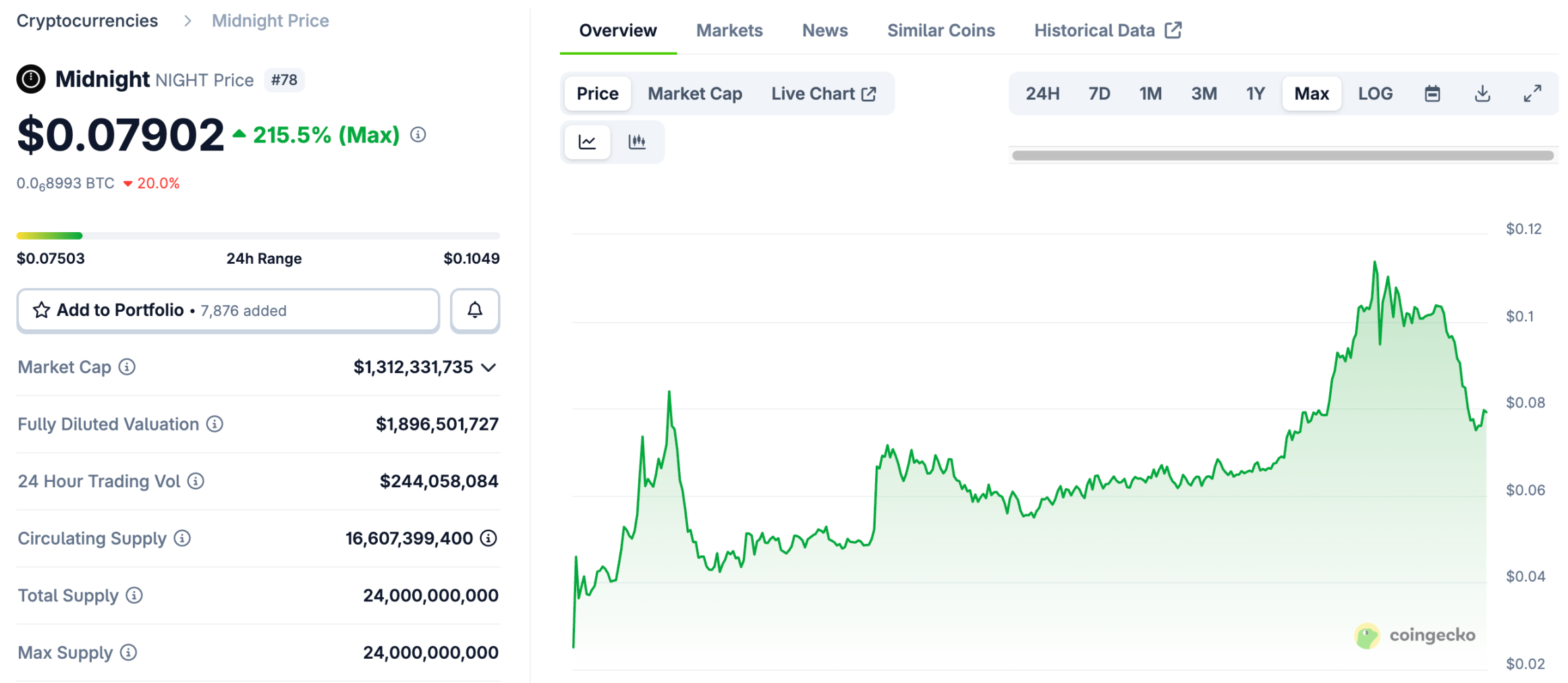
Such performance from a token listed on several major exchanges simultaneously is not entirely unexpected. However, the interesting part is that NIGHT is the token of Midnight, a privacy-focused sidechain of Cardano. The explosive power of a project bearing both the "Cardano" and "privacy" labels truly surprised most people.

What Makes Midnight "Valuable"?

Midnight is a sidechain developed by Input Output Global (IOG, the parent company of Cardano) with "programmable data protection" as its core selling point. It packages zero-knowledge proofs (ZKP) into a ready-to-use TypeScript API, allowing Web2 developers to implement "selective disclosure" on-chain without needing to learn cryptography. The entire network uses Cardano as its consensus layer and Halo2 as its ZK backend, employing a dual-token model (NIGHT+DUST). The goal is first to land the "data availability without visibility" that enterprises care about most, and then gradually expand to scenarios like DeFi, RWA, and on-chain compliant identity.

Overall, it doesn't seem particularly unique. It adopts ZKP privacy technology but doesn't natively protect privacy; instead, it makes privacy features optional to address practical needs.

IOG first publicly announced the plan to develop Midnight in November 2022, but the testnet wasn't launched until nearly two years later, in October 2024. This is indeed IOG's style—it took almost 5 years from announcing smart contracts for Cardano to actual implementation, which wasn't achieved until September 2021, long after the bull market had passed.

In May of this year, Midnight established a foundation, with Fahmi Syed, former CFO of Polkadot development team Parity, as chairman, signaling the first step towards TGE (Token Generation Event). Just two days after announcing the foundation's establishment, Cardano founder Charles Hoskinson revealed plans to airdrop tokens to 37 million addresses on 8 major blockchains, stating that the airdrop would target only retail users, with no VC participation in the project.

Perhaps what truly ignited market sentiment was Midnight's "massive airdrop." In addition to the airdrop, Midnight also distributed nearly 3 billion NIGHT tokens in collaboration with Binance, OKX, and Bybit. This large-scale approach, which contrasts sharply with the recent popular ICO models, garnered a positive market response.
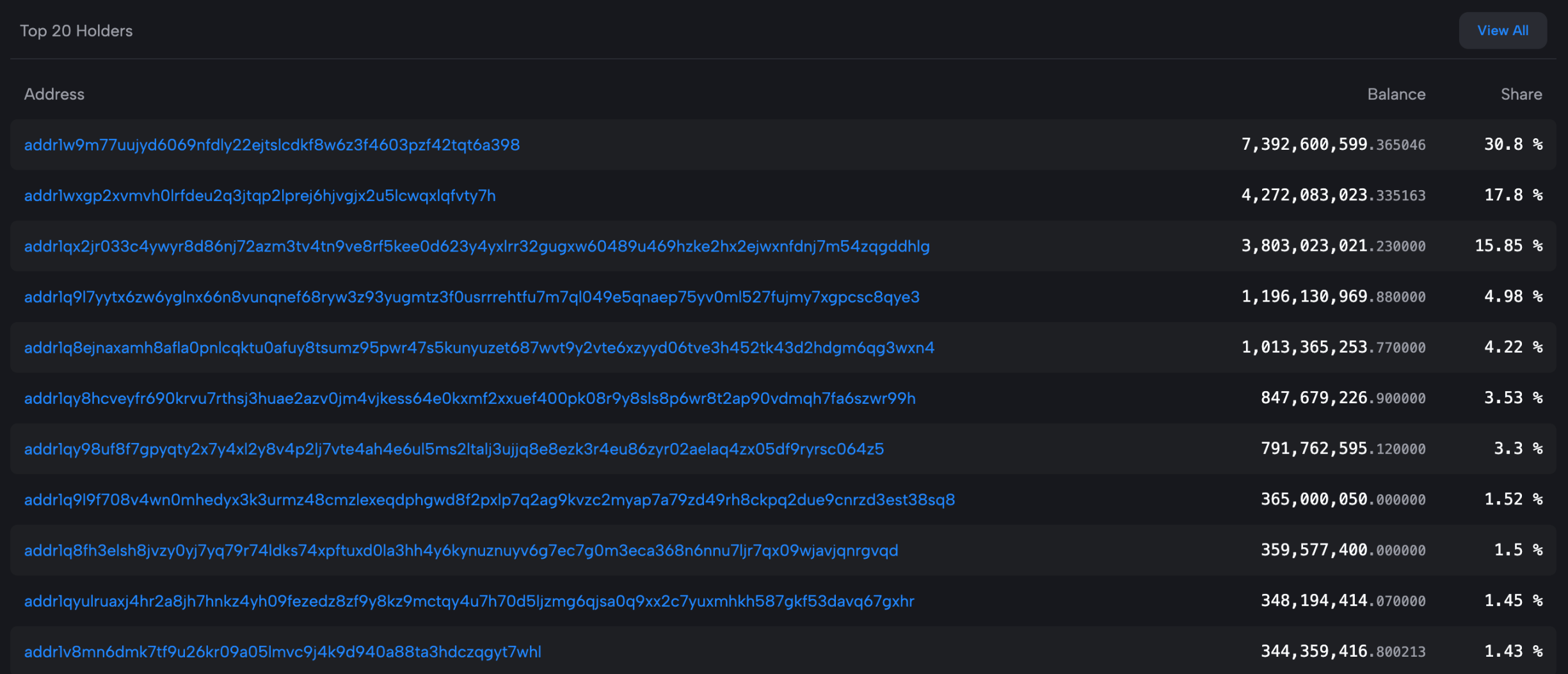
Looking at the block explorer, aside from the top three addresses which likely belong to IOG or the Midnight Foundation, the holdings of the remaining addresses are relatively decentralized. According to data provided on the official website, the author estimates that the airdrop itself, combined with exchange collaboration events, distributed nearly one-third of the total supply (24 billion tokens), which indeed qualifies as a massive effort.

Midnight's tokenomics feature not just NIGHT, but a "NIGHT+DUST" dual-token model. This rare design isn't based on some "whimsical idea" but rather aims to ensure regulatory compliance. NIGHT can be used for network governance, incentives, and generating the other token, DUST. NIGHT itself is not related to privacy and supports on-chain auditing.

DUST, generated by holding NIGHT, is used to pay for transaction fees, similar to Gas. Additionally, DUST will be used to pay for privacy fees—if one wants to add optional privacy features to on-chain transactions, they must pay DUST. DUST is automatically distributed to NIGHT holders' accounts with each block produced and "decays" over time to prevent malicious hoarding and network attacks.

Thus, Midnight's "equity" token, NIGHT, does not participate in paying on-chain transaction fees but exists solely as a governance token and a generator for the actual on-chain fuel, DUST. DUST itself, as a "renewable resource" generated by NIGHT and constantly decreasing over time, would be considered a resource rather than an asset from a regulatory perspective, potentially satisfying regulatory requirements in various jurisdictions.

Cardano to Heavily Invest in On-Chain Ecosystem Next Year

According to Cardano's roadmap, next year will be focused on comprehensively boosting on-chain activity.

First and foremost, Cardano will undergo a network upgrade to increase throughput to 1000-10,000 TPS through parallel block processing and a layered structure for vertical scaling, while maintaining security and decentralization. Following this will be the mainnet launch of the protagonist of this article, Midnight. Cardano believes Midnight's launch will bring more DeFi activity and TVL through its optional privacy features. Additionally, the Cardano Treasury will allocate funds to support the native issuance of major stablecoins like USDT and USDC on Cardano.

The last point, which the author finds most important, is Cardano's plan to focus on interoperability—not simple cross-chain functionality, but enabling users from other chains to interact directly with DApps on Cardano by paying gas fees on their source chain.

Last week, Cardano achieved atomic swaps between BTC and ADA through Fluid, not via cross-chain bridges, wrapped tokens, or centralized custody, but directly through underlying script-to-script transactions, which is somewhat facilitated by Cardano's own UTXO ledger model. Two days ago, interactions between Cardano stake pool operators and Solana's co-founder on X also confirmed this development direction.

Accompanying the strategic and product plans is capital investment. The Cardano Foundation plans to increase its marketing budget by 12% and "make an appearance" at events like TOKEN2049 and Consensus. Venture Hub will also invest 2 million ADA to support startups and ecosystem projects. Furthermore, the Cardano Foundation plans to inject tens of millions of ADA into on-chain DeFi to improve liquidity and attract institutional participation.

From this perspective, driving up the price of NIGHT might just be the appetizer Cardano is serving for a series of plans. Perhaps 2026 is really the year to keep an eye on this project, which launched its mainnet back in 2017 and has been almost forgotten by the mainstream Web3 market.


Twitter:https://twitter.com/BitpushNewsCN

Bitpush TG Discussion Group:https://t.me/BitPushCommunity

Bitpush TG Subscription: https://t.me/bitpush

Original link:https://www.bitpush.news/articles/7598128

Связанные с этим вопросы

QWhat is NIGHT and which blockchain is it from?

ANIGHT is the native token of Midnight, a privacy-focused sidechain developed by Input Output Global (IOG), the parent company of Cardano.

QWhat was the 24-hour trading volume of NIGHT that sparked significant attention?

ANIGHT achieved a 24-hour trading volume of nearly $9 billion, approaching $10 billion, which was a major point of discussion.

QWhat is the core technological feature of the Midnight blockchain?

AMidnight's core feature is 'programmable data protection,' offering TypeScript APIs for zero-knowledge proofs (ZKPs) to enable 'selective disclosure' without requiring developers to learn cryptography.

QHow does Midnight's dual-token model (NIGHT and DUST) work and why was it designed this way?

ANIGHT is used for governance and generating DUST, while DUST acts as gas for transaction fees and privacy features. This design helps comply with regulatory requirements by separating the governance token from the transactional resource.

QWhat are some of Cardano's key plans for its ecosystem in the coming year as mentioned in the article?

ACardano plans to upgrade network throughput to 1000-10,000 TPS, launch the Midnight mainnet, support native issuance of stablecoins like USDT and USDC, focus on interoperability allowing users to interact with DApps using their native chain's gas tokens, and invest in marketing and liquidity.

Похожее

How Many Tokens Away Is Yang Zhilin from the 'Moon Chasing the Light'?

The article explores the intense competition between two leading Chinese AI companies, DeepSeek and Kimi (Moon Dark Side), and the mounting pressure on Yang Zhilin, the founder of Kimi. While DeepSeek re-emerged after 15 months of silence with its powerful V4 model—boasting 1.6 trillion parameters and low-cost, long-context capabilities—Kimi has been focusing on long-context processing and multi-agent systems with its K2.6 model. Yang faces a threefold challenge: technological rivalry, commercialization pressure, and investor expectations. Despite Kimi’s high valuation (reaching $18 billion), its revenue heavily relies on a single product with low paid conversion rates, while DeepSeek’s strategic silence and open-source influence have strengthened its market position and valuation prospects, now targeting over $20 billion. Both companies reflect broader trends in China’s AI ecosystem: Kimi aims for global influence through open-source contributions and agent-based advancements, while DeepSeek prioritizes foundational innovation and hardware independence, notably shifting to Huawei’s chips. Their competition is seen as vital for China’s AI progress, with the gap between top Chinese and U.S. models narrowing to just 2.7% on the Elo rating scale. Ultimately, the article argues that this rivalry, though anxiety-inducing for leaders like Zhilin, is essential for driving innovation and solidifying China’s role in the global AI landscape.

marsbit3 ч. назад

How Many Tokens Away Is Yang Zhilin from the 'Moon Chasing the Light'?

marsbit3 ч. назад

TechFlow Intelligence Bureau: ChatGPT Helps Amateur Mathematician Crack 60-Year-Old Problem, CFTC Sues New York Regulator Over Coinbase and Gemini

An amateur mathematician, with the assistance of ChatGPT, has solved a combinatorial mathematics puzzle originally proposed by Hungarian mathematician Paul Erdős in the 1960s. This marks another milestone in AI-aided mathematical research, demonstrating the evolving capabilities of large language models in formal reasoning. In other AI developments, OpenAI introduced a new privacy filter tool for enterprise API usage, automatically screening sensitive data. Meanwhile, the Qwen3.6-27B model achieved 100 tokens per second on a single RTX 5090 GPU using quantization, significantly lowering the cost barrier for local AI deployment. In crypto and Web3, the U.S. CFTC sued New York’s financial regulator, challenging its oversight of Coinbase and Gemini—a first-of-its-kind federal-state regulatory clash. Following a vulnerability, KelpDAO and major DeFi protocols established a recovery fund. Tether froze $344 million in assets linked to Iran’s central bank upon U.S. Treasury request, highlighting the centralized control risks in stablecoins. Separately, Litecoin underwent a 3-hour chain reorganization to undo a privacy-layer exploit. In the U.S., former President Trump invoked the Defense Production Act to address power grid bottlenecks affecting AI data centers and dismissed the entire National Science Board, raising concerns over research independence. A retail trader gained 250% on a $600k Intel options bet amid AI-related speculation. Xiaomi announced its first performance electric vehicle, targeting rivals like Tesla. Meanwhile, iPhone users reported devices automatically reinstalling a hidden app daily, suspected to be MDM-related. A Chinese securities report noted that A-share institutional crowding has reached its second-longest streak since 2007, signaling high valuations and potential style rotation. The day’s developments reflect a dual narrative: AI is enabling unprecedented individual breakthroughs, while centralized power structures—whether governmental or corporate—are becoming more assertive, underscoring that decentralization is as much a political-economic challenge as a technical one.

marsbit4 ч. назад

TechFlow Intelligence Bureau: ChatGPT Helps Amateur Mathematician Crack 60-Year-Old Problem, CFTC Sues New York Regulator Over Coinbase and Gemini

marsbit4 ч. назад

Торговля

Спот
Фьючерсы

Популярные статьи

Как купить ADA

Добро пожаловать на HTX.com! Мы сделали приобретение Cardano (ADA) простым и удобным. Следуйте нашему пошаговому руководству и отправляйтесь в свое крипто-путешествие.Шаг 1: Создайте аккаунт на HTXИспользуйте свой адрес электронной почты или номер телефона, чтобы зарегистрироваться и бесплатно создать аккаунт на HTX. Пройдите удобную регистрацию и откройте для себя весь функционал.Создать аккаунтШаг 2: Перейдите в Купить криптовалюту и выберите свой способ оплатыКредитная/Дебетовая Карта: Используйте свою карту Visa или Mastercard для мгновенной покупки Cardano (ADA).Баланс: Используйте средства с баланса вашего аккаунта HTX для простой торговли.Третьи Лица: Мы добавили популярные способы оплаты, такие как Google Pay и Apple Pay, для повышения удобства.P2P: Торгуйте напрямую с другими пользователями на HTX.Внебиржевая Торговля (OTC): Мы предлагаем индивидуальные услуги и конкурентоспособные обменные курсы для трейдеров.Шаг 3: Хранение Cardano (ADA)После приобретения вами Cardano (ADA) храните их в своем аккаунте на HTX. В качестве альтернативы вы можете отправить их куда-либо с помощью перевода в блокчейне или использовать для торговли с другими криптовалютами.Шаг 4: Торговля Cardano (ADA)С легкостью торгуйте Cardano (ADA) на спотовом рынке HTX. Просто зайдите в свой аккаунт, выберите торговую пару, совершайте сделки и следите за ними в режиме реального времени. Мы предлагаем удобный интерфейс как для начинающих, так и для опытных трейдеров.

1.9k просмотров всегоОпубликовано 2024.03.29Обновлено 2025.07.02

Как купить ADA

SNEK: ведущий мемкоин на блокчейне Cardano, открывающий новую эпоху для экосистемы Cardano

SNEK - это дефляционный мемкоин, выпущенный на блокчейне Cardano. Он создаёт децентрализованную культурную и развлекательную ценность за счёт участия глобального сообщества.

2.0k просмотров всегоОпубликовано 2025.10.15Обновлено 2025.10.15

SNEK: ведущий мемкоин на блокчейне Cardano, открывающий новую эпоху для экосистемы Cardano

Неделя обучения по популярным токенам 8: запуск основной сети Ouroboros Leios для ADA ожидается в 2026 году

Основная сеть Ouroboros Leios для ADA, как ожидается, будет запущена в 2026 году, а хардфорк до версии протокола 11 запланирован на I квартал 2026 года.

1.9k просмотров всегоОпубликовано 2026.02.10Обновлено 2026.02.12

Неделя обучения по популярным токенам 8: запуск основной сети Ouroboros Leios для ADA ожидается в 2026 году

Обсуждения

Добро пожаловать в Сообщество HTX. Здесь вы сможете быть в курсе последних новостей о развитии платформы и получить доступ к профессиональной аналитической информации о рынке. Мнения пользователей о цене на ADA (ADA) представлены ниже.

活动图片