Hong Kong Freezes Stablecoin Rollout, Leaving HSBC, Standard Chartered Waiting

bitcoinistОпубликовано 2026-04-02Обновлено 2026-04-02

Введение

Hong Kong has postponed the issuance of its first batch of stablecoin licenses, delaying approvals for major applicants like HSBC and Standard Chartered. The delay, attributed to money laundering concerns, may lead to stricter KYC regulations. This setback affects 36 applicants and follows mainland China's earlier crackdown on stablecoins due to regulatory and illegal activity risks. Despite initial plans to issue a small number of licenses in March, the Hong Kong Monetary Authority (HKMA) has not yet granted any approvals. The article also notes similar regulatory delays in South Korea, while Japan and the U.S. have advanced their stablecoin frameworks. The stablecoin market cap remains strong at $316 billion, a new all-time high. Bitcoin is trading around $68,700, down 4% over the week.

Hong Kong has postponed its first batch of stablecoin licenses amid money laundering concerns that could warrant stricter KYC rules.

Hong Kong Has Delayed Its Initial Batch Of Stablecoin Licenses

As reported by Wu Blockchain, citing coverage from Caixin, Hong Kong has postponed the issuance of its first stablecoin approvals, meaning that applicants would be waiting for longer before they can receive a license.

Hong Kong first passed its stablecoin bill in August 2025, making it so that organizations looking to issue stablecoins in the Chinese city’s jurisdiction will need to acquire approval from the Hong Kong Monetary Authority (HKMA).

Following the rollout of the new rules, HKMA started receiving applications from big names like Standard Chartered in its Joint Venture (JV) and HSBC. The first batch of approvals was expected to go out by the end of March, but now April has begun, and no licenses have been handed out at all.

“Hong Kong is concerned that stablecoins may be used for money laundering and may therefore implement stricter KYC regulations,” noted Wu Blockchain. The delay has thrown a wrench in the plans of 36 applicants. Earlier, mainland Chinese regulators cracked down on the sector, stating that fiat-tied cryptocurrencies don’t qualify as legal tender, as they fail to meet regulatory requirements and pose a risk of being used for illegal activities.

Despite the mainland’s stance, however, Hong Kong still moved forward with its stablecoin plans, announcing in February that a “very small number” of issuer licenses would be handed out in March. With that plan not coming to fruition, it now remains to be seen when the HKMA will be able to advance the city’s stablecoin ambitions.

Elsewhere in Asia, South Korea has also seen its stablecoin plans stall, with the Bank of Korea (BoK) arguing for bank-majority stablecoins, while the Financial Services Commission (FCS) advocates for laxer rules.

Meanwhile, Japan took ahead of its neighbors with the launch of its first yen-backed coin last year. The nation could also see its first bank-backed stablecoin this year, with Shinsei Trust and Banking planning on a Q2 2026 launch.

Over in the United States, President Donald Trump signed into law the GENIUS Act last year, providing a formal framework for stablecoins. Overall, this part of the cryptocurrency sector has seen significant global regulatory momentum over the past year, so it’s not surprising to see that its market cap has held up relatively well despite the recent market downturn.

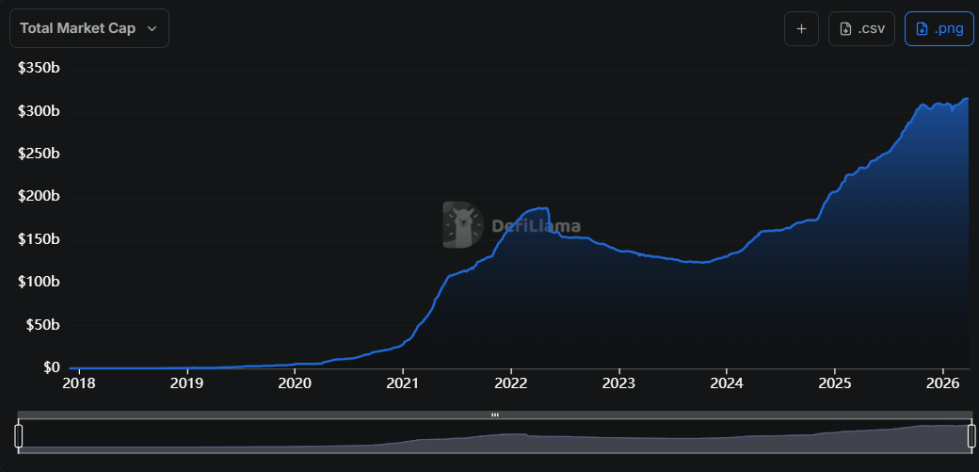
The trend in the stablecoin market cap over the last several years | Source: DefiLlama

As the chart from DefiLlama shows, the market cap of the fiat-tied tokens has mostly moved sideways in recent months, with its value currently sitting at $316 billion, a new all-time high (ATH).

Bitcoin Price

At the time of writing, Bitcoin is trading around $68,700, down over 4% in the last week.

Looks like the price of the coin has gone up a bit over the past day | Source: BTCUSDT on TradingView

Связанные с этим вопросы

QWhy has Hong Kong postponed the issuance of its first stablecoin licenses?

AHong Kong has postponed the issuance due to concerns that stablecoins may be used for money laundering, which could lead to the implementation of stricter Know Your Customer (KYC) regulations.

QWhich major financial institutions are among the applicants for stablecoin licenses in Hong Kong?

AMajor applicants include Standard Chartered, through its Joint Venture, and HSBC.

QWhat was the original timeline for issuing the first batch of stablecoin licenses, and what is the current status?

AThe first batch of approvals was expected to be issued by the end of March, but as of the beginning of April, no licenses have been handed out.

QHow does the regulatory stance on stablecoins in mainland China differ from that in Hong Kong?

AMainland Chinese regulators have cracked down on stablecoins, stating they do not qualify as legal tender and pose a risk for illegal activities. In contrast, Hong Kong has moved forward with its own regulatory framework to license stablecoin issuers.

QWhat is the current total market capitalization of stablecoins, according to the article?

AThe current market capitalization of stablecoins is $316 billion, which is a new all-time high (ATH).

Похожее

From Survival to Accelerated Growth: The Journey of Zcash's Three-Year Rise as Told by the Founder of ZODL

**From Survival to Accelerated Growth: Zcash Founder Details the 3-Year Rise** Three years ago, Zcash (ZEC) was a struggling pioneer in privacy technology, with a price near $30, low shielded supply (11%), and a community mired in governance disputes. Today, ZEC trades around $600, with over 31% of its supply (~$3B) in user-controlled shielded pools. This transformation resulted from breaking key constraints. First, **governance shackles were removed**. The old model guaranteed funding to two entities (ECC and ZF) regardless of performance, creating a monopoly. In 2024, ECC rejected further direct funding, forcing a change. The NU6 upgrade ended direct funding, allocating 8% to community grants and 12% to a protocol-controlled treasury for retroactive rewards, expiring in 2028 unless renewed by overwhelming consensus. The entities also relinquished their trademark-based veto power, freeing community governance. Second, the **product focus shifted** from pure cryptography to user growth. Previously, engineering excelled at privacy tech but failed to attract users. In early 2024, the team (later ZODL) pivoted to building products users wanted, like the Zodl wallet (default privacy, hardware support, cross-asset swaps). This drove shielded supply to grow over 400% in ZEC terms, with 86.5% of recent transactions being shielded, representing real user adoption. Third, the **narrative evolved** from the limiting "privacy coin" label to "unstoppable private money." This clarified Zcash's value proposition: a Bitcoin-like monetary policy with verifiable private payments via advanced cryptography. This structural narrative—protocol (Zcash), asset (ZEC), gateway (Zodl)—enabled broader exchange listings, institutional interest, and ETF filings. Finally, **organizational constraints were broken**. In early 2026, the ECC team left its non-profit structure after disputes over control, forming Zcash Open Development Lab (ZODL). ZODL raised $25M from top VCs (Paradigm, a16z, etc.), gaining the capital and agility of a startup to scale consumer products. Current metrics show strong momentum: social discussion volume for ZEC surged 15,245% in a year, with 81% positive sentiment. The focus is now on enhancing user experience (Zodl wallet), scalability (Tachyon project targeting Visa-level throughput with 25-second blocks), and post-quantum security (quantum-recoverable wallets coming soon). Zcash is positioned to become faster, more usable, scalable, and quantum-resistant.

marsbit7 мин. назад

From Survival to Accelerated Growth: The Journey of Zcash's Three-Year Rise as Told by the Founder of ZODL

marsbit7 мин. назад

Five Counterparty Risk Architectures: A Settlement-Layer Methodology for Classifying TradFi Models in Crypto Exchanges

**Summary:** This companion piece reframes the five TradFi-on-crypto exchange architectures, previously classified by "architectural fingerprint," through the lens of counterparty risk. The core question is: whose balance sheet bears the loss first in a stress scenario, and has it historically done so? Each of the five models corresponds to a distinct risk holder with its own documented failure modes. * **Model 1 (Stablecoin-Settled CEX Perpetuals):** Risk is held by the stablecoin issuer (e.g., reserve composition, bank connectivity) and the CEX's own book. History includes Tether's banking disconnections (2017) and reserve misrepresentations (CFTC 2021 Order). * **Model 2 (CFD Brokers):** Risk resides on the broker's balance sheet (B-book model). Regulatory differences (e.g., ESMA's mandatory negative balance protection vs. Mauritius FSC's lack thereof) define loss allocation rules, as seen in the 2015 SNB event (Alpari UK insolvency). * **Model 3 (Off-Chain Custody & Transfer Agent Chain):** Risk lies with the off-chain custodian/platform. User asset recovery depends on Terms of Use and corporate structure, exemplified by the Celsius bankruptcy ruling (2023) where Earn Account assets were deemed property of the estate. * **Model 4 (DEX Perpetual Protocols):** No single balance sheet bears risk. Loss absorption relies on a protocol's insurance fund and Auto-Deleveraging (ADL) mechanism, as demonstrated in the GMX V1 (2022) and dYdX v3 YFI (2023) incidents. * **Model 5 (Regulated CCP - DCM-DCO-FCM):** The most institutionalized model concentrates risk in the Central Counterparty (CCP). However, history shows CCPs can employ non-standard tools under extreme stress, such as mass trade cancellation (LME Nickel, 2022) or enabling negative price settlements (CME WTI, 2020). The report argues that regulatory choices and counterparty risk structures are co-extensive, not in an upstream-downstream relationship. It concludes with five separate observation checklists (not predictions) for monitoring the structural vulnerabilities of each risk model.

marsbit24 мин. назад

Five Counterparty Risk Architectures: A Settlement-Layer Methodology for Classifying TradFi Models in Crypto Exchanges

marsbit24 мин. назад

Торговля

Спот
Фьючерсы
活动图片