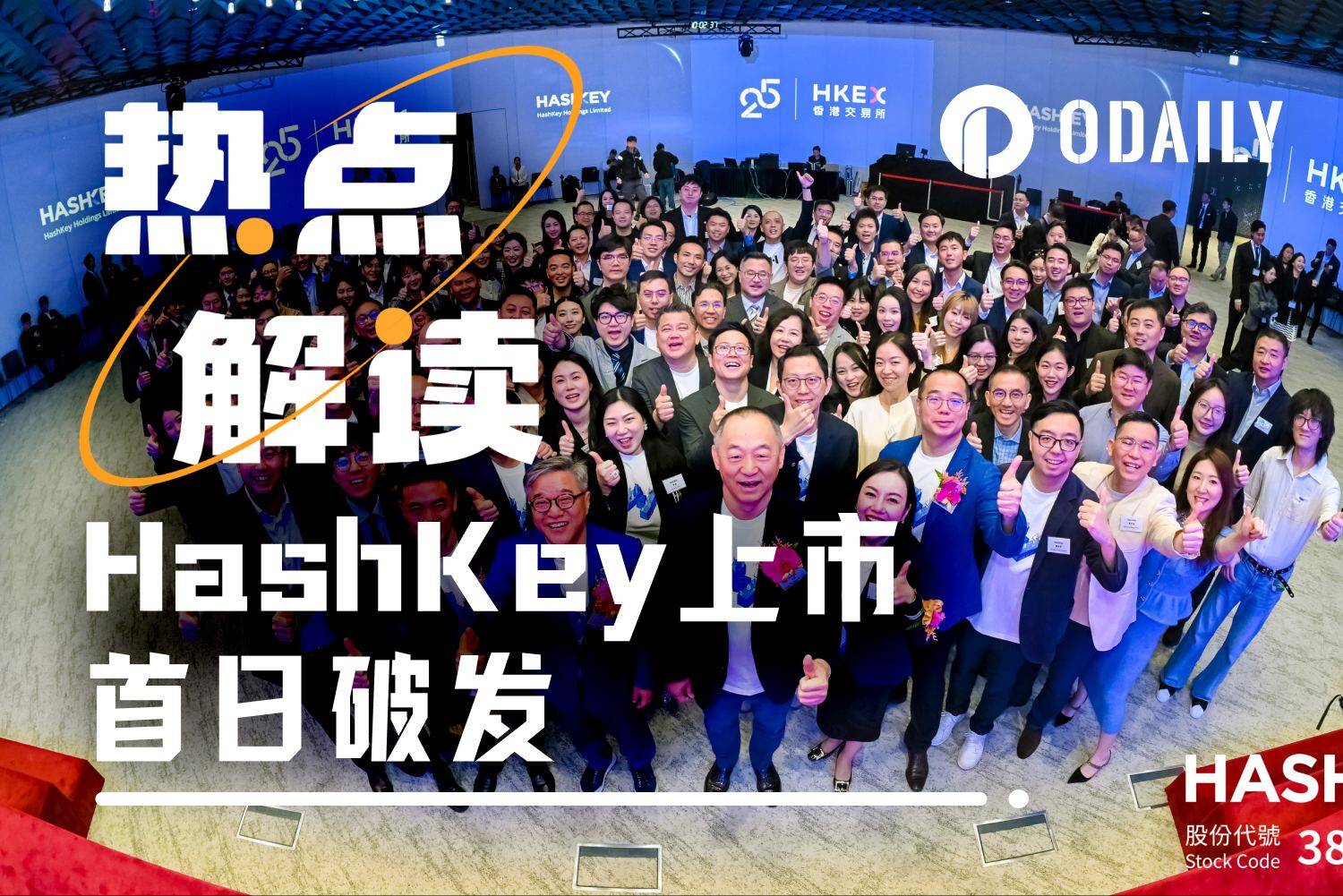
HashKey Falls Below IPO Price on First Day of Trading, 'The Eastern Coinbase' Not Yet Established

Odaily星球日报Опубликовано 2025-12-17Обновлено 2025-12-17

Введение

HashKey Holdings (stock code: 03887.HK), known as the first Hong Kong-listed cryptocurrency exchange, debuted on the Hong Kong Stock Exchange on December 17. Despite strong pre-IPO interest—with its public offering oversubscribed by nearly 394 times—the stock price fell below its initial offering price of HK$6.68 within the first hour of trading. It closed the day at HK$6.67 after hitting a low of HK$6.12. The market response contrasts sharply with earlier optimism from crypto industry participants, who had hailed HashKey as a milestone for Hong Kong’s Web3 sector and even dubbed it the "Eastern Coinbase." However, the article points out significant gaps between HashKey and Coinbase in terms of scale: HashKey has only 138,000 registered users and average daily trading volumes in the millions of dollars, far below Coinbase’s pre-IPO user base of 56 million and billions in daily trades. HashKey has reported four consecutive years of losses, which the company attributes to high investment in technology and compliance during its early development phase. The IPO raised approximately HK$1.67 billion, with 40% earmarked for technology upgrades and another 40% for market expansion. The listing is seen by some as a symbolic step toward broader acceptance of crypto in traditional finance, yet the author suggests HashKey’s successful listing may remain an isolated case in Hong Kong. This is largely due to the influential backing of its major shareholder, Lu Weiding—chairman of Wanxia...

Original | Odaily Planet Daily (@OdailyChina)

Author | Golem (@web3_golem)

On December 17th, HashKey Holdings (03887.HK) officially listed on the stock exchange. Regrettably, the "first Hong Kong stock of a crypto exchange" fell below its IPO price of HK$6.68 within the first hour of trading.

According to Hong Kong stock market data, HASHKEY HLDGS saw its share price rise to a high of HK$7.12 during the session before declining steadily to a low of HK$6.12. It closed at HK$6.67 on its first day, close to the issue price.

This stock performance starkly contrasts with the high investor enthusiasm shown during HashKey Holdings' offering period. On December 12th, HashKey Holdings concluded its offering, selling 240.6 million shares at HK$6.68 per share, raising HK$1.67 billion (approximately US$206 million) from this Hong Kong IPO. The Hong Kong public offering portion was oversubscribed by 393.71 times, and the international placement portion was also oversubscribed.

Public opinion has become divided. On one hand, some crypto practitioners praise HashKey for pushing the crypto industry into the mainstream, calling it a significant milestone for Hong Kong's Web3 development. On the other hand, Hong Kong stock investors who scrambled to subscribe to the new shares were met with an immediate setback.

Statistics show the break-even rate for Hong Kong stocks in 2025 is between 24% and 30%; the first crypto stock hasn't escaped this range.

"The Eastern Coinbase": Wishful Thinking by Crypto Enthusiasts?

In early December, when HashKey Holdings completed its listing hearing and published its prospectus, Odaily provided an in-depth analysis of the numerous challenges facing HashKey Holdings' businesses, such as four consecutive years of financial losses, underperforming exchange operations, lack of competitiveness in its on-chain ecosystem, excessive R&D and compliance expenditures, and the decreasing scarcity of compliance licenses. We explicitly advised investors to consider the investment cautiously. (Related reading: Four consecutive years of losses, sluggish HSK, HashKey IPOs against the trend, will the capital market buy it?)

However, judging by the subsequent fervor in the HashKey IPO subscription market, expectations for the "first Hong Kong crypto stock" remained high, with the market seemingly less concerned about HashKey's loss-making status (the prospectus stated that losses were due to the trading platform still being in an early development stage and a period of high investment).

It is important to note that HashKey still allocated 40% of the funds from this offering for technology and infrastructure iteration, another 40% for market expansion and ecosystem partnerships, and the remaining 20% for operations and risk management, working capital, and general corporate purposes, respectively.

This clearly states, "I'm not profitable now, but I have growth potential. Place your bets, let's gamble on the future together."

The stock market, while valuing financial statements and corporate cash flow, has many well-known companies that are not profitable but possess high growth potential, and investors are willing to invest—for example, Amazon was unprofitable for 3 years before its IPO, but that didn't prevent it from growing into an e-commerce giant later. A more relevant example is Coinbase, which, like HashKey, took the compliance route and was also unprofitable before its IPO, yet that didn't stop it from being pursued by capital after listing.

But those comparing HashKey to the Eastern Coinbase often avoid the crucial points, emphasizing regional compliance as the commonality between HashKey and Coinbase, and highlighting HashKey's compliance premium and high growth potential.

In my view, the biggest gap between HashKey and Coinbase lies in the fact that Coinbase's massive compliance expenditures brought substantial returns to its actual business, whereas HashKey, despite obtaining a Hong Kong compliance license, shows little improvement in its business data.

Before its IPO in 2021, Coinbase's self-reported disclosures showed 56 million registered users, while HashKey Exchange currently has only 138,000 registered users; before its IPO, Coinbase's average daily trading volume had reached the billion-dollar level, while HashKey Exchange's average daily trading volume remains at the million-dollar level. As for HashKey's on-chain services and asset management business, they are even less comparable, and these two business segments contribute very limitedly to HashKey's revenue.

There were already signs that secondary market investors weren't buying the "analogy to Coinbase." In yesterday's dark pool trading on Futu, HashKey Holdings' stock price had already fallen below the issue price.

However, in this lackluster macro environment, discussing the significance of HashKey's listing抛开 its stock performance恰好 hit the collective sweet spot for the crypto industry's desire to break into the mainstream.

Exception? Or the First Case?

Judging everything based on one day's performance is indeed short-sighted. Let's take a longer view. For the Chinese crypto community, another significant meaning of HashKey's listing in Hong Kong is that it symbolizes a further "loosening" and acceptance of the crypto industry by the Hong Kong capital market. HashKey's listing fired the first shot; perhaps more high-quality crypto projects will take root and sprout in Hong Kong in the future, even triggering a bull run. The strategic significance represented by HashKey for crypto far exceeds its own value.

From this perspective, who has the chance to be the next runner?

My judgment is that HashKey's listing might be an isolated case for crypto companies in Hong Kong, and this is due to one key figure.

Xiao Feng, this often publicly visible crypto celebrity is not the largest shareholder of HashKey. The real controller of HashKey is Lu Weiding, the chairman of Wanxiang Group, who stood beside him ringing the bell this morning.

Lu Weiding (third from left) and Xiao Feng (third from right)

Lu Weiding is the major controlling shareholder of HashKey, holding 43.2% of the shares and able to exercise voting rights for 22.9% held by an employee share platform, while Xiao Feng, as the founder of Hashkey, holds 16.3%; other investors collectively hold 17.6%. The shareholding structure shows Lu Weiding's absolute authority in HashKey.

Lu Weiding took over as chairman of Wanxiang Group after his father, Lu Guanqiu, passed away. Wanxiang Group was originally a large domestic实体 enterprise, starting from automotive parts manufacturing and later engaging in real estate, tourism, agricultural products, finance, energy, metal resources, and other industries.

After taking over as chairman, Lu Weiding vigorously developed Wanxiang Group's financial industry. The group owns numerous financial enterprises including Minsheng Life Insurance, Allinpay, Zhejiang Fund, Puxing Jueneng, Wanxiang Trust, Wanxiang Leasing, Tonghui Futures, etc., building a Wanxiang financial control empire.

Why is Lu Weiding crucial to HashKey's ability to list?

Because besides being the chairman of Wanxiang Group and the major controlling shareholder of HashKey, Lu Weiding's roles also include being a deputy to the 14th National People's Congress, vice chairman of the All-China Federation of Industry and Commerce, member of the Zhejiang Provincial Committee of the Chinese People's Political Consultative Conference, and meritorious entrepreneur of Zhejiang Province. These identities and the resources they represent provide HashKey with stronger support.

One must ask, under the current regulatory environment, how can other followers replicate this advantage? Will their path to listing be as smooth? Therefore, labeling HashKey as the "model for Hong Kong crypto" would create misjudgments for entrepreneurs and investors.

For a long time to come, HashKey will not only be the "first Hong Kong crypto stock" but more likely a lone runner who squeezed onto the track at a fleeting moment of right timing, geographical convenience, and human harmony.

Связанные с этим вопросы

QWhat was the performance of HashKey Holdings' stock on its first day of trading on the Hong Kong Stock Exchange?

AHashKey Holdings' stock price fell below its IPO price of HK$6.68 within the first hour of trading. It reached a high of HK$7.12 and a low of HK$6.12 before closing near the issue price at HK$6.67.

QHow does the market's pre-IPO enthusiasm for HashKey contrast with its first-day trading performance?

AThere was extremely high pre-IPO enthusiasm, with the Hong Kong public offering portion receiving 393.71 times oversubscription and the international placement also being oversubscribed. This high demand sharply contrasts with the stock's first-day price drop below the offering price.

QWhat are the key reasons the article suggests that comparing HashKey to an 'Eastern Coinbase' is not accurate?

AThe comparison is inaccurate due to a significant gap in user base and trading volume. Before its IPO, Coinbase had 56 million registered users and daily trading volumes in the billions of dollars, while HashKey has only 138,000 registered users and daily volumes in the millions of dollars.

QWho is the major controlling shareholder of HashKey Holdings, and why is this significant for its ability to list?

AThe major controlling shareholder is Lu Weiding, Chairman of Wanxiang Group, who holds 43.2% of the shares and controls 22.9% of the votes through an employee持股 platform. His status as a National People's Congress representative and his extensive political and business connections provided crucial support for HashKey's successful listing.

QAccording to the article, why might HashKey's listing be an isolated case rather than a precedent for other crypto firms in Hong Kong?

AHashKey's listing may be an isolated case because its success was heavily dependent on the unique political and business resources of its major shareholder, Lu Weiding. Other crypto firms are unlikely to be able to replicate this specific advantage, making it difficult for them to achieve a similar listing.

Похожее

The Essence of AI Layoffs: Why More AI Adoption Leads to More Corporate Anxiety?

The author, awaiting potential inclusion on an 8000-person layoff list, analyzes the true nature of recent "AI-driven" layoffs. They argue that while AI use, particularly tools like Claude for code generation, has skyrocketed and boosted developer output (e.g., 2-5x more code commits), this has not translated into proportional business growth or revenue. The core issue is a misalignment between increased "Input" (code) and tangible "Outcomes" (user value, revenue). AI acts as a costly B2B SaaS, inflating operational expenses without guaranteed returns. Two key problems emerge: 1) The friction that once filtered out bad ideas is gone, as AI allows cheap pursuit of even weak concepts. 2) Organizational "alignment tax"—the difficulty of coordinating across teams—becomes crippling when development velocity outpaces consensus-building. Thus, layoffs serve two immediate purposes: 1) To offset ballooning AI costs (Token consumption) and maintain cash flow, as rising input costs without outcome growth destroys unit economics. 2) To reduce organizational bloat and alignment friction by simply removing teams, thereby speeding up execution in the short term. Therefore, these layoffs are fundamentally caused by AI, even if AI doesn't directly replace roles. They represent a painful correction until companies learn to convert AI-driven productivity into real business outcomes and streamline organizational coordination to match the new pace of work. The cycle will continue until this learning curve is mastered.

marsbit6 мин. назад

The Essence of AI Layoffs: Why More AI Adoption Leads to More Corporate Anxiety?

marsbit6 мин. назад

Can the Solana Foundation and Google's Collaboration on Pay.sh Bridge the Payment Link Between Web2 and Web3 in the Agent Economy?

Solana Foundation, in collaboration with Google Cloud, has launched Pay.sh, a payment gateway designed to bridge the gap between AI agents and enterprise-grade service infrastructure. The initiative aims to solve a key bottleneck in the "agent economy": existing payment systems are ill-suited for autonomous AI agents. Traditional methods like credit cards require human verification, while newer on-chain protocols like x402 and MPP create a separate, Web3-native system that raises barriers for service providers. Pay.sh functions as a universal payment layer. It allows users to fund a Solana wallet via credit card or stablecoin, which then acts as an identity and payment proxy for AI agents. When an agent needs to access a paid API service (e.g., Google Cloud, Alibaba Cloud), Pay.sh handles the transaction seamlessly. It leverages the HTTP 402 status code ("Payment Required") to initiate payments, intelligently choosing between one-time transfers (x402-style) or session-based authorizations (MPC-style) based on the service's billing model. This spares agents from manual account registration and API key management. A key feature for service providers is low integration effort. They can adopt Pay.sh by providing a declarative configuration file, enabling features like tiered pricing, free tiers, and automatic revenue splitting to multiple addresses (e.g., for royalties, cloud costs). Providers can also list their APIs in a central Pay Skill Registry for agent discovery. The collaboration with Google Cloud provides crucial infrastructure for API proxying, traffic routing, and compliance logging, aiming to keep agent activities within regulated boundaries. By connecting Web2 services with Web3 payment rails, Pay.sh positions the Solana wallet as a foundational identity and payment tool for AI agents, potentially driving more transaction volume to the Solana ecosystem. However, the report notes challenges. The service registry currently lacks robust vetting, risking exposure to unauthorized or malicious third-party APIs. Pay.sh also inherits security and compatibility risks from its underlying payment protocols (x402, MPC). Furthermore, adoption may be hindered by varying regional data privacy and payment compliance regulations among API providers. Despite these hurdles, Pay.sh represents a significant step towards integrating Web2 and Web3 for autonomous agent commerce.

marsbit13 мин. назад

Can the Solana Foundation and Google's Collaboration on Pay.sh Bridge the Payment Link Between Web2 and Web3 in the Agent Economy?

marsbit13 мин. назад

Bitcoin's Bull-Bear Cycle Indicator Turns Positive for the First Time in 7 Months: End of Bear Market or False Breakout?

Bitcoin's "Bull-Bear Market Cycle Indicator" from CryptoQuant has turned positive for the first time since October 2025. This gauge, based on the P&L Index relative to its 365-day moving average, suggests a potential shift from a bear market phase. Concurrently, the Bull Score Index rose to a neutral reading of 50 in late April. The indicator's move into positive territory follows a roughly 35% price rebound from a low near $60,000 in February to above $81,000. The recovery over approximately three months was faster than the 12-month period observed during the 2022 bear market. However, analysts caution against premature optimism, citing a historical precedent from March 2022. Back then, the Bull Score Index briefly hit 50, but it proved to be a false signal as Bitcoin's price subsequently plunged further. Structural differences exist in the current cycle, including consistent inflows into spot Bitcoin ETFs and an increase in large holder addresses. Yet, some models, referencing the four-year halving cycle, suggest a potential deeper bottom near $50,000 might still be possible around late 2026. In summary, while on-chain data shows marked improvement and the worst panic may be over, market participants remain cautious. A convincing trend reversal confirmation likely requires Bitcoin to sustainably break above key resistance, such as the 200-day moving average near $82,000.

marsbit20 мин. назад

Bitcoin's Bull-Bear Cycle Indicator Turns Positive for the First Time in 7 Months: End of Bear Market or False Breakout?

marsbit20 мин. назад

How to Automate Any Workflow with Claude Skills (Complete Tutorial)

This is a comprehensive guide to mastering Claude Skills, a feature for creating permanent, reusable instruction sets that automate specific workflows. Unlike simple saved prompts, Skills function like trained employees, delivering consistent, high-quality outputs by defining the entire task process, standards, error handling, and output format. The guide is structured in four phases: **Phase 1: Installation (5 minutes).** Skills are folders containing a `SKILL.md` file. The user is instructed to find a relevant Skill online, install it, test it on a real task, and compare its performance to one-off prompts. **Phase 2: Building Your First Custom Skill.** Start by rigorously defining the Skill's purpose, trigger phrases, and providing a concrete example of perfect output. The `SKILL.md` file has two parts: a YAML frontmatter with a specific name/description/triggers, and a detailed, step-by-step workflow written in natural language with examples and quality standards. **Phase 3: Testing & Optimization for Production.** Test the Skill in three scenarios: 1) a standard, common task; 2) edge cases with missing or conflicting data; and 3) a pressure test with maximum complexity. Any failure indicates a needed instruction. Implement a weekly optimization cycle to continuously refine the Skill based on real usage. **Phase 4: Building a Complete Skill Library.** The goal is to create a team of Skills for all repetitive tasks. Examples are given for industries like real estate, marketing, finance, consulting, and e-commerce. The user should list their tasks, prioritize them, and build one new Skill per week, maintaining a master document to track their library. The conclusion emphasizes the compounding time savings: ten Skills saving 30 minutes each per week reclaims over 260 hours (6.5 work weeks) per year, fundamentally transforming one's work system.

marsbit44 мин. назад

How to Automate Any Workflow with Claude Skills (Complete Tutorial)

marsbit44 мин. назад

Торговля

Спот
Фьючерсы
活动图片