Has the Era of Project Buyback Bonuses Really Come to an End?

marsbitОпубликовано 2026-01-09Обновлено 2026-01-09

Введение

"Project Buybacks: The End of an Era?" In traditional finance, stock buybacks are often seen as a confidence booster. However, this strategy has largely failed to produce positive results in the Web3 space. Recently, Jupiter co-founder SIONG proposed halting $JUP's buyback program after the project spent over $70 million on repurchases with little positive impact on the token price. Similarly, Helium's founder Amir Haleem announced an end to their buyback, calling it "throwing money into a black hole." Data from 2025 shows a collective downturn for major projects that executed buybacks. Despite Hyperliquid spending $716 million and others like Pump.fun, LayerZero, Raydium, and Sky also making significant investments, most tokens continued to decline in value, raising questions about the efficacy of buybacks. The debate highlights a split in perspectives: some founders advocate reallocating funds towards user acquisition and product development to strengthen fundamentals. Others, like DeFi OG CM, argue that buybacks are inherently beneficial by reducing circulating supply, though they don't guarantee short-term price increases. Critics, including Helius CEO Mert Mumtaz, view buybacks as a pessimistic mechanism, signaling a lack of better growth opportunities. Former Aave executive Ajit Tripathi called the buyback narrative "the most value-destructive play after memecoins." Alternative strategies are emerging. Selini Capital's Jordi Alexander emphasizes the importance of ex...

Author: Chloe, ChainCatcher

In the world of traditional finance, stock buybacks are often seen as a "shot in the arm" for market confidence. When a company announces a share repurchase, it usually signifies that management believes the stock is undervalued or that the company has ample cash flow. However, applying a similar strategy to Web3 projects fails to yield positive results.

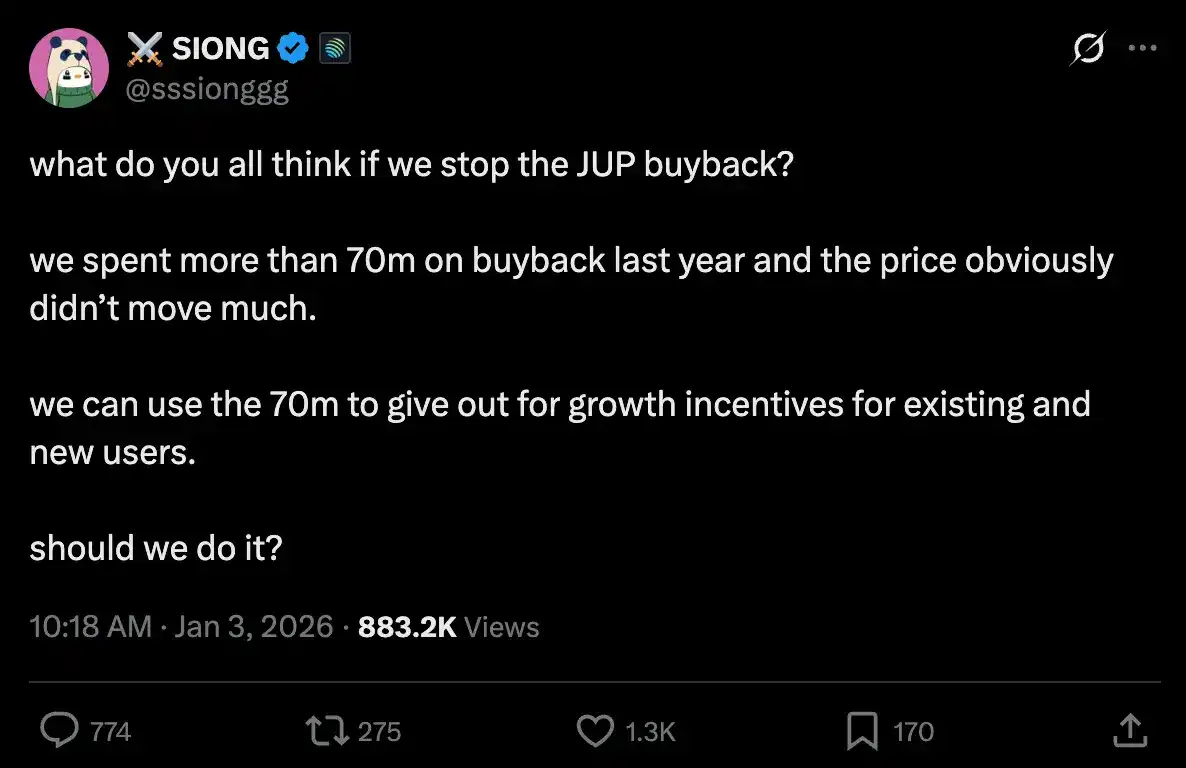
Recently, Jupiter co-founder SIONG initiated a discussion on X, proposing to halt the $JUP token buyback plan. He stated that Jupiter had invested over $70 million in token buybacks over the past year, but the token's performance has been lackluster. Meanwhile, Helium founder Amir Haleem directly announced the cessation of token buybacks, describing it as "throwing money into a black hole."

Why can tens of millions of dollars in real money not create even a ripple in the crypto market? Is the problem with the underlying design of the buyback strategy? Below is a summary of the performance data of project buybacks last year and market perspectives on project buybacks.
Data Performance: The Collective Waterloo of 2025's Buyback Projects

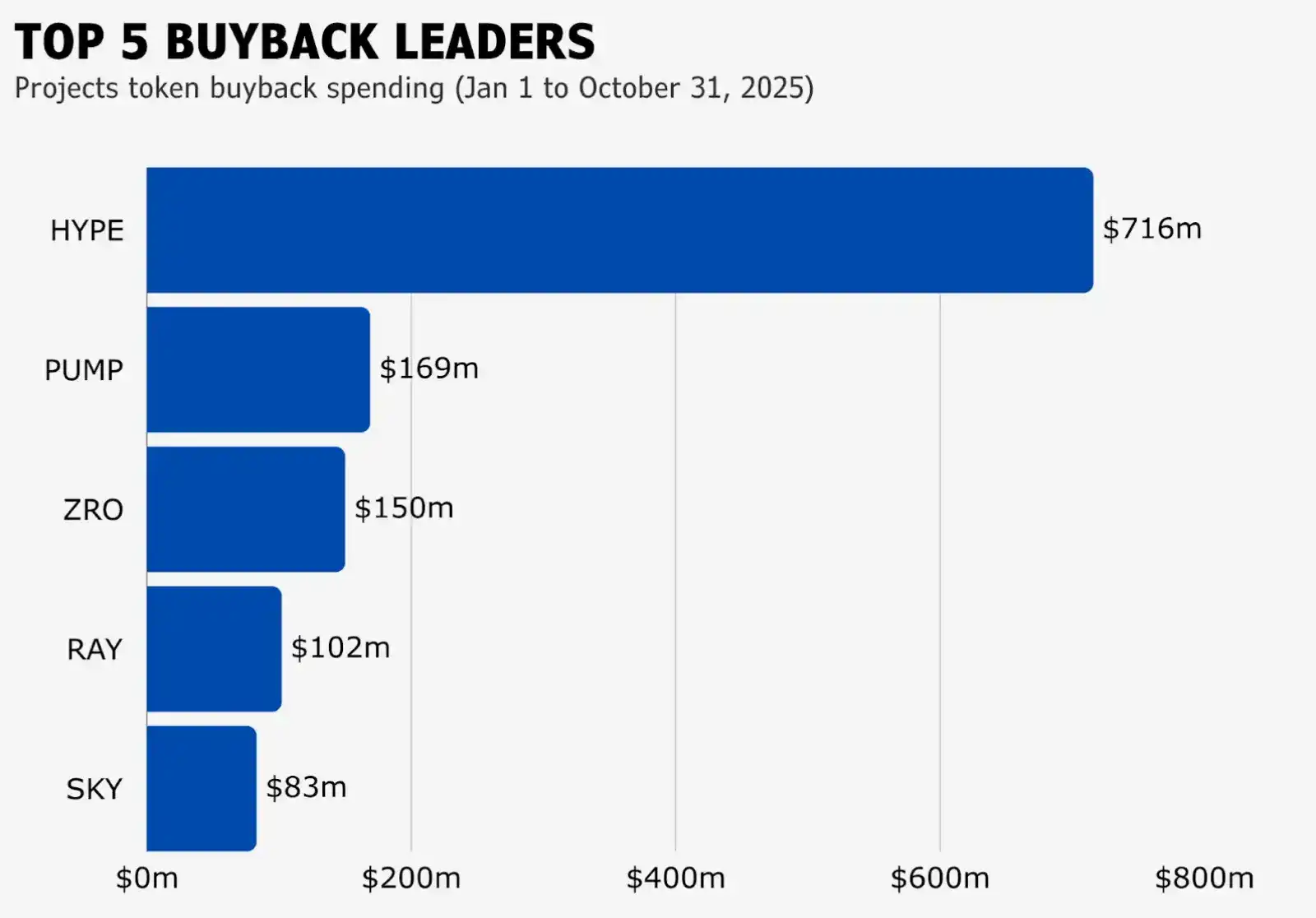
According to market research agency blockmates' tracking of buyback projects from January to October 2025, the top five projects were Hyperliquid, Pump.fun, LayerZero, Raydium, and Sky. Among them, Hyperliquid's buyback amount reached as high as $716 million, while Sky, at the bottom of the list, also invested $83 million.

However, the capital input did not yield proportional returns. Except for Hyperliquid's token price, which remained strong in the first three quarters (it has since fallen from $45.5 at the end of October to $25.94 at the time of writing), almost all other projects experienced continuous declines. This phenomenon has led the market to question: if buybacks cannot enhance token value, is this money essentially wasted?
Viewpoint Debate: The Trade-off Between Buybacks, Staking, and Growth Incentives

Regarding whether projects should stop buybacks, there are starkly different voices in the market:

The founders of Jupiter and Helium lean towards stopping token buybacks and instead using the funds to "acquire users," potentially through subsidizing transaction fees, rewarding new users, or enhancing product features to strengthen fundamentals. However, this shift still faces challenges: tokens will continue to unlock, and users might choose to sell due to a lack of long-term confidence, creating sustained selling pressure and risking a further significant drop in token price.

DeFi OG CM stated that the core meaning of buybacks lies in reducing the circulating supply and establishing a "regular deflation" model. Token price ultimately depends on market supply and demand and project fundamentals, not the buyback action itself. Buybacks are necessarily beneficial for token holders but are not equivalent to a short-term "guaranteed rise." Project teams should not easily halt execution due to low token prices or high buyback costs.

Helius CEO Mert Mumtaz expressed that buybacks are inherently a pessimistic mechanism, implicitly signaling that the project team cannot find a better use for the funds than short-term price boosting, attempting to initiate a growth cycle through price reflexivity rather than product growth. Buybacks are not the optimal strategy in a highly competitive market; the only effective edge case is opportunistic buybacks during market crashes (when equity is irrationally undervalued), combined with aggressive reinvestment during normal times. This is a judgment from a founder's perspective, not an investor's.

Ajit Tripathi, former Head of Institutional Business at Aave and FinTech Partner at ConsenSys, stated that the buyback narrative is the most value-destructive play after meme coins. This logic was initially a marketing tactic by Solana to boast its superiority over Ethereum, but it ended up harming all tokens, even those with revenue, forcing everyone to play pure financial games in the end.

Many other viewpoints have proposed alternative solutions. For example, Selini Capital founder Jordi Alexander observed that the failure of many projects lies not in the mechanism but in the "execution timing" of token buybacks. Some star projects of this cycle (e.g., HYPE, ENA, $JUP) executed large-scale buybacks during the market's most frenzied period when token valuations were most unreasonable. When the price-to-earnings ratio of tokens inflated due to excessive hype, project teams continued buybacks, essentially buying at the peak for sellers, which was a wrong decision. Therefore, Jordi suggests that project teams need more complex "financial engineering," and an ideal model should be dynamic buybacks based on the price-to-earnings ratio.

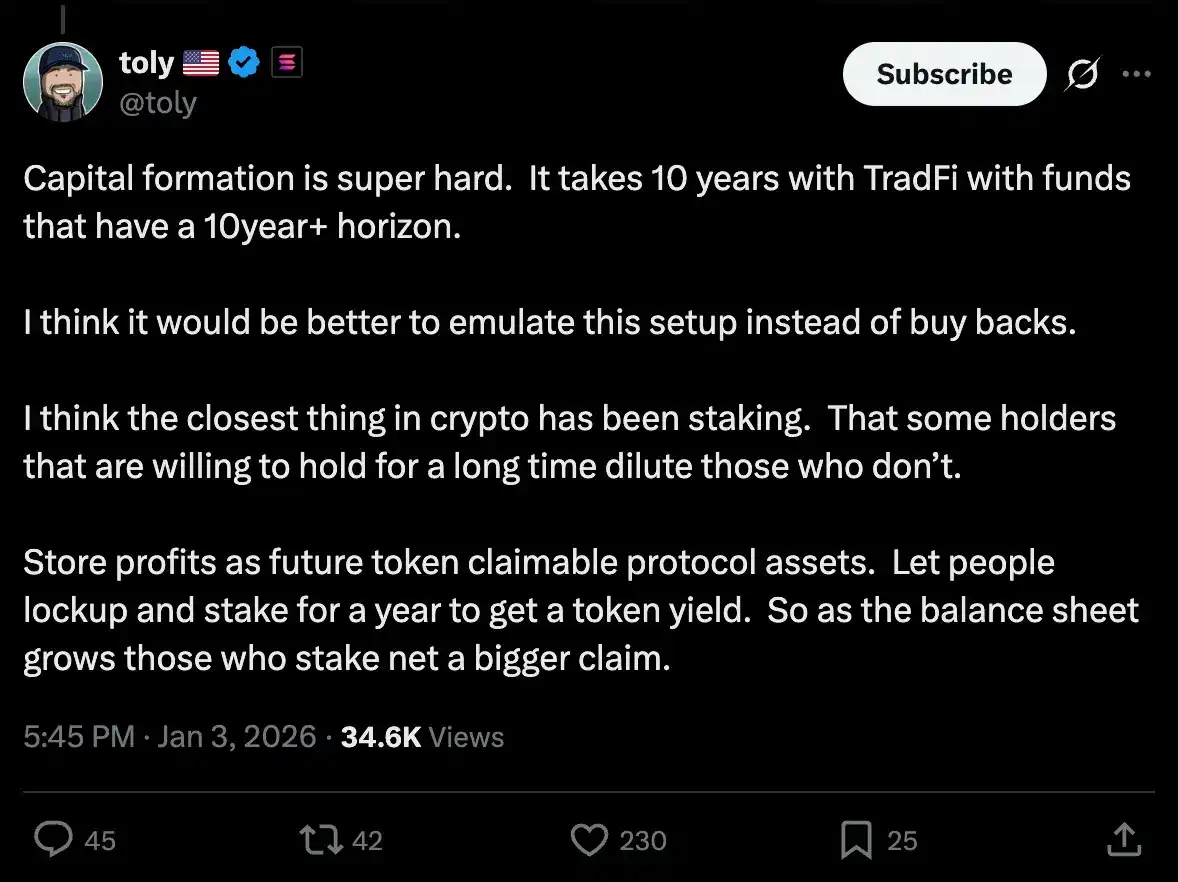
Solana founder Anatoly believes that projects should not pursue short-term price stimulation (buybacks) but should learn from traditional finance and establish a capital accumulation process spanning 10 years. He favors staking mechanisms more, allowing long-term lockers to obtain more shares, thereby diluting short-term speculators. He believes profits should be stored as "future token claims" rather than consumed in market fluctuations.
Represented by Selini Capital founder Jordi Alexander, some believe the buyback itself is not wrong, but the "amateur execution" is. Projects should hire professional financial advisors to adjust buyback strategies based on the token's price-to-earnings ratio and market cycles, rather than blindly repurchasing, leading to the dilemma of depleting the treasury at the bull market peak and having no funds to protect the price when entering a trough.

Evolution from "Blind Buybacks" to "Strategic Value Management"

Token buybacks are essentially a "deflation tool," not a guarantee of price increase. Amid various market fluctuations, buybacks more often play a role of "passive defense." They can reduce supply and establish a bottom support for the token price, but they cannot single-handedly reverse complex trends formed by macro conditions, unlocking pressure, or market sentiment.

The path to token value growth should evolve from单一的 buyback actions to strategic value management. First, projects need to establish execution strategies with better financial judgment, such as following the logic of "buying low valuation, reserving high valuation": firmly executing buybacks when the token price is far below intrinsic value to maximize capital return; and halting buybacks when market heat is excessive and valuation is unreasonable, instead depositing profits into the treasury as reserve funds or using them to fuel product growth.

Furthermore, buybacks can only address the "supply" issue but cannot create "demand." A project must give users a reason to hold tokens continuously. These reasons may come from the expectation of protocol revenue distribution, the power of ecosystem governance, or the irreplaceable competitiveness of the product itself. Without solid fundamental support, any form of buyback will ultimately become an exit channel for arbitrageurs.


Связанные с этим вопросы

QWhy are some Web3 project founders, like those from Jupiter and Helium, proposing to stop token buybacks?

AThey believe that spending millions on buybacks has not effectively supported the token price and view it as inefficient capital allocation, with one founder even comparing it to 'throwing money into a black hole'. They suggest reallocating these funds towards user acquisition and product growth instead.

QAccording to the data from blockmates, what was the performance of major buyback projects in 2025?

AThe data showed a collective downturn. Despite significant investments, with Hyperliquid leading at $716 million in buybacks, most projects experienced continuous price declines. Only Hyperliquid maintained a strong performance initially, but its price also fell significantly later, dropping from $45.5 to $25.94 by the time of writing.

QWhat is the core argument in favor of continuing token buybacks, as presented by DeFi OG CM?

ACM argues that the core value of a buyback is to reduce circulating supply and establish a 'regular deflation' model. While buybacks are beneficial for token holders by creating a supply shock, they do not guarantee short-term price increases. The ultimate token price depends on market supply-demand dynamics and project basics, not the buyback action itself.

QWhat alternative to buybacks does Solana founder Anatoly Yakovenko propose for long-term value creation?

AAnatoly Yakovenko advocates for a long-term capital accumulation process over 10 years, similar to traditional finance, rather than short-term price stimulation via buybacks. He favors a staking mechanism that rewards long-term holders with more tokens, thereby diluting short-term speculators, and suggests storing profits as 'future token claims' instead of spending them on market volatility.

QWhat key flaw in the execution of buyback strategies does Jordi Alexander, founder of Selini Capital, identify?

AJordi Alexander identifies the flaw as 'amateur execution', not the mechanism itself. He observes that many projects conducted large-scale buybacks at the peak of market frenzy when token valuations were most inflated, essentially buying at the top for sellers. He recommends a more sophisticated 'financial engineering' approach with a dynamic buyback model based on the token's price-to-earnings ratio and market cycles.

Похожее

Jensen Huang's Message to Graduates: AI Won't Replace You, But Those Who Excel at Using AI Will

NVIDIA CEO Jensen Huang, addressing 2026 graduates at Carnegie Mellon University, emphasized that AI will not replace people, but those who leverage AI effectively will have an advantage. He delivered this message during a commencement speech where he also received an honorary doctorate, his seventh. Huang reflected on his personal journey as an immigrant, starting from humble beginnings as a dishwasher to co-founding NVIDIA. He shared early struggles, including a near-bankruptcy moment saved by honesty with Sega, highlighting resilience and learning from failure. He positioned the current era as the dawn of the AI revolution, a shift as significant as past computing waves. Huang explained that AI is redefining computing from human-written software to machine learning, creating a new industry focused on manufacturing intelligence. While acknowledging fears about job displacement, he argued that AI amplifies human capabilities rather than replaces human purpose. Tasks may be automated, but the core meaning of professions remains. Huang urged graduates to embrace this transformative time with responsibility and optimism. He stated that AI should democratize technology, bridging gaps and enabling broader participation in creation and problem-solving. His final advice was to actively engage with the opportunity: "So run, don’t walk," and to put their hearts into their work.

marsbit3 мин. назад

Jensen Huang's Message to Graduates: AI Won't Replace You, But Those Who Excel at Using AI Will

marsbit3 мин. назад

Three Scenarios for BTC's Future Direction and a Duel Between Two Strong Forces | Special Invited Analysis

**Title: Three Scenarios for BTC's Future Trajectory and a Key Duel | Invited Analysis** The market remains at a critical juncture. Over the past week, Bitcoin (BTC) consolidated broadly between $79,500 and $80,600, validating previous technical analysis. The current focus is on whether this marks the start of a new uptrend or a pause within a larger correction. **BTC Multi-Cycle Analysis & Three Possible Scenarios** BTC's daily chart structure, following its peak at $126,200 in October 2025, presents three primary technical scenarios based on Elliott Wave theory: 1. **Bullish Scenario (End of Correction):** The corrective A-B-C wave from $126,200 ended at the $60,000 low in February 2026. The current price action is the start of a major Wave I uptrend. A subsequent Wave II pullback would not break below $60,000. 2. **Bearish Scenario 1 (Complex Correction):** The correction is unfolding as an A-B-C-D-E pattern. The current move from $60,000 is a D-wave rally. After its completion, a final E-wave decline could potentially breach the $60,000 level. 3. **Bearish Scenario 2 (Larger Correction):** The entire move down from $126,200 to $60,000 was a large A-wave. The current rally is a B-wave correction within a larger A-B-C structure, to be followed by a C-wave decline below $60,000. *Analysis suggests Scenario 2 is less probable due to time disproportions between waves. The battle is effectively between the Bullish Scenario (1) and Bearish Scenario (3).* **Key BTC Levels & Weekly Strategy** On the 4-hour chart, BTC trades above a crucial consolidation zone ("Central Pivot C"). * **Key Resistance:** $83,500-$84,500; $89,000-$90,500. * **Key Support:** $78,500-$79,500 (pivot upper bound); $73,500-$75,000; $69,500-$70,500. **Weekly Outlook:** The market direction hinges on BTC's ability to hold above or break below the $78,500-$79,500 support zone. * **Mid-term Strategy:** Neutral/Wait-and-see stance due to unclear direction. * **Short-term Tactics:** Two contingency plans using 30% max capital: * **Plan A (Bullish):** Look for long entries if price holds above $78,500-$79,500 with confirming signals. Initial stop-loss below $78,500. * **Plan B (Bearish):** Consider short positions if price breaks below $73,500-$75,000 with confirming signals. Initial stop-loss above $76,500. **HYPE Analysis & Strategy** HYPE's daily chart shows a seven-segment structure from its January low of $20.46, forming a "rising pivot" zone. * **Key Level to Watch:** $45.76 (previous high). A break above would confirm the bullish structure remains intact. * **Short-term Strategy:** Focus on pivot zone boundaries ($38.41 upper, $34.44 lower). * **Long:** Consider on support near $38.41 with bullish confirmation signals. * **Short:** Consider on a break below $34.44 with bearish confirmation signals. * Position size must be below 30% with strict stop-loss discipline. **Risk Management Reminder:** Always set an initial stop-loss upon entry. Move stop-loss to breakeven at +1% profit, then trail it upwards to lock in profits dynamically. All views are based on technical analysis for informational purposes only and do not constitute investment advice. The market is inherently risky.

Odaily星球日报12 мин. назад

Three Scenarios for BTC's Future Direction and a Duel Between Two Strong Forces | Special Invited Analysis

Odaily星球日报12 мин. назад

Sequoia Interview with Hassabis: Information is the Essence of the Universe, AI Will Open Up Entirely New Scientific Branches

Demis Hassabis, co-founder and CEO of Google DeepMind and Nobel laureate, discusses the path to AGI and its profound implications in a Sequoia Capital interview. He outlines his lifelong dedication to AI, tracing his journey from game development (e.g., *Theme Park*)—a perfect AI testing ground—to neuroscience and finally founding DeepMind in 2009. He emphasizes the critical lesson of being "5 years, not 50 years, ahead of time" for successful entrepreneurship. Hassabis reiterates DeepMind's two-step mission: first, solve intelligence by building AGI; second, use AGI to tackle other complex problems. He highlights the transformative potential of "AI for Science," particularly in biology where tools like AlphaFold have revolutionized protein folding. He envisions AI-powered simulations drastically shortening drug discovery from years to weeks and enabling personalized medicine. Furthermore, he predicts AI will spawn new scientific disciplines, such as an engineering science for understanding complex AI systems (mechanistic interpretability) and novel fields enabled by high-fidelity simulators for complex systems like economics. He posits a fundamental worldview where information, not just matter or energy, is the essence of the universe, making AI's information-processing core uniquely suited to understanding reality. He defends classical Turing machines as potentially sufficient for modeling complex phenomena, including quantum systems, as demonstrated by AlphaFold. On consciousness, Hassabis suggests first building AGI as a powerful tool, then using it to explore deep philosophical questions. He believes components like self-awareness and temporal continuity are necessary for consciousness but that defining it fully remains an open challenge. He predicts AGI could arrive around 2030 and, once achieved, would be used to probe the deepest questions of science and reality, much as envisioned in David Deutsch's *The Fabric of Reality*.

链捕手30 мин. назад

Sequoia Interview with Hassabis: Information is the Essence of the Universe, AI Will Open Up Entirely New Scientific Branches

链捕手30 мин. назад

Morgan Stanley 2026 Semiconductor Report: Buy Packaging, Buy Testing, Buy China Chips, Avoid Traditional Tracks

Morgan Stanley 2026 Semiconductor Report: Buy Packaging, Buy Testing, Buy Chinese Chips; Avoid Traditional Segments. The core theme is the shift in AI compute supply from NVIDIA dominance to a three-track system of GPU + ASIC + China-local chips. The key opportunity is capturing share in this expansion, while non-AI semiconductors face marginalization due to resource reallocation to AI. Key investment conclusions, in order of priority: 1. **Advanced Packaging (CoWoS/SoIC) - Highest Conviction**: TSMC is the primary beneficiary of explosive demand, driven by massive cloud capex. Its pricing power and AI revenue share are rising significantly. 2. **Test Equipment - Undervalued & High-Growth Certainty**: Chip complexity is causing test times to double generationally, structurally driving handler/socket/probe card demand. Companies like Hon Hai Precision (Foxconn), WinWay, and MPI offer compelling value. 3. **China AI Chips (GPU/ASIC) - Long-Term Irreversible Trend**: Export controls are accelerating domestic substitution. Companies like Cambricon, with firm customer orders and SMIC's 7nm capacity support, are positioned to benefit from lower TCO (30-60% vs NVIDIA) and growing local cloud demand. 4. **Avoid Non-AI Semiconductors (Consumer/Auto/Industrial)**: These segments face a weak, structurally hindered recovery due to AI's resource "crowding-out" effect on capacity and supply chains. 5. **Memory - Severe Internal Divergence**: Strongly favor HBM (Hynix primary beneficiary) and NOR Flash (Macronix). Be cautious on interpreting price rises in DDR4/NAND as true demand recovery. The report emphasizes a 2026-2027 time window, stating the AI capital expenditure cycle is far from over. Key macro variables include persistent export controls and AI's systemic "crowding-out" effect on traditional semiconductor supply chains.

marsbit1 ч. назад

Morgan Stanley 2026 Semiconductor Report: Buy Packaging, Buy Testing, Buy China Chips, Avoid Traditional Tracks

marsbit1 ч. назад

Circle:Sluggish Market? The Top Stablecoin Stock Continues to Expand

Circle, the issuer of the stablecoin USDC, reported its Q1 2026 earnings on May 11th, Eastern Time. Against a backdrop of weak crypto market sentiment, USDC's average circulation in Q1 was $752 billion, with a modest 2% sequential increase to $770 billion by quarter-end. New minting volumes declined due to the poor crypto market, but remained high, indicating demand expansion beyond crypto trading. USDC's market share remained stable at 28% of the total stablecoin market, while competition from Tether's USDT persists. A key highlight was "Other Revenue," which reached $42 million, more than doubling year-over-year, though sequential growth slowed to 13%. This revenue stream, including fees from services like Web3 software, the Cipher payment network (CPN), and the Arc blockchain, is critical for diversifying away from interest income. Circle's internally held USDC share increased to 18%, helping to improve gross margin by 130 basis points to 41.4% by reducing external sharing costs. However, profitability was pressured as total revenue growth slowed, primarily due to the significant weight of interest income, which is tied to USDC规模 and Treasury rates. Adjusted EBITDA was $133 million with a 19.2% margin. Management maintained its full-year 2026 guidance for adjusted operating expenses ($570-$585 million) and other revenue ($150-$170 million). The long-term target for USDC's CAGR remains 40%, though near-term volatility is expected. The article concludes that while Circle's current valuation of $28 billion appears reasonable after a recent recovery, further upside depends on the pace of stable币 adoption and potential positive sentiment from the advancement of regulatory clarity acts like CLARITY.

链捕手1 ч. назад

Circle:Sluggish Market? The Top Stablecoin Stock Continues to Expand

链捕手1 ч. назад

Торговля

Спот
Фьючерсы

Популярные статьи

Как купить ERA

Добро пожаловать на HTX.com! Мы сделали приобретение Caldera (ERA) простым и удобным. Следуйте нашему пошаговому руководству и отправляйтесь в свое крипто-путешествие.Шаг 1: Создайте аккаунт на HTXИспользуйте свой адрес электронной почты или номер телефона, чтобы зарегистрироваться и бесплатно создать аккаунт на HTX. Пройдите удобную регистрацию и откройте для себя весь функционал.Создать аккаунтШаг 2: Перейдите в Купить криптовалюту и выберите свой способ оплатыКредитная/Дебетовая Карта: Используйте свою карту Visa или Mastercard для мгновенной покупки Caldera (ERA).Баланс: Используйте средства с баланса вашего аккаунта HTX для простой торговли.Третьи Лица: Мы добавили популярные способы оплаты, такие как Google Pay и Apple Pay, для повышения удобства.P2P: Торгуйте напрямую с другими пользователями на HTX.Внебиржевая Торговля (OTC): Мы предлагаем индивидуальные услуги и конкурентоспособные обменные курсы для трейдеров.Шаг 3: Хранение Caldera (ERA)После приобретения вами Caldera (ERA) храните их в своем аккаунте на HTX. В качестве альтернативы вы можете отправить их куда-либо с помощью перевода в блокчейне или использовать для торговли с другими криптовалютами.Шаг 4: Торговля Caldera (ERA)С легкостью торгуйте Caldera (ERA) на спотовом рынке HTX. Просто зайдите в свой аккаунт, выберите торговую пару, совершайте сделки и следите за ними в режиме реального времени. Мы предлагаем удобный интерфейс как для начинающих, так и для опытных трейдеров.

620 просмотров всегоОпубликовано 2025.07.17Обновлено 2025.07.17

Как купить ERA

Обсуждения

Добро пожаловать в Сообщество HTX. Здесь вы сможете быть в курсе последних новостей о развитии платформы и получить доступ к профессиональной аналитической информации о рынке. Мнения пользователей о цене на ERA (ERA) представлены ниже.

活动图片