Hardcore Breakdown of Polymarket's Fee Formula: How Did the Extreme Rate of 90+% Pop Up?

Odaily星球日报Опубликовано 2026-04-01Обновлено 2026-04-01

Введение

Polymarket, a prediction market platform, recently faced backlash due to unexpectedly high transaction fees, with some users reporting fees as extreme as 94.8%. The issue stemmed from a temporary change in the fee calculation formula. The platform initially used an "old formula": fee = C × p × feeRate × (p × (1 - p))^exponent. However, a brief update to an "abnormal formula" removed a critical "× p" term, becoming: fee = C × feeRate × (p × (1 - p))^exponent. Since share prices (p) are always less than $1, this omission drastically increased fees, especially for very low-priced shares (near $0.001), as the fee was no longer scaled by the price. An exponent value of 0.5 in certain markets ("Weather" and "Economy") further exacerbated the curve, leading to the extreme rates. Polymarket quickly responded by implementing a "new formula": fee = C × feeRate × p × (1 - p), effectively setting the exponent to 1. This change significantly reduced fees, particularly for extreme price points, bringing maximum fees down to around 5%. The article advises users to avoid high fees by using limit orders (which are free and even offer a 20-25% maker rebate) or the platform's "Split" function to indirectly establish positions instead of market orders.

Original | Odaily Planet Daily (@OdailyChina)

Author | Azuma (@azuma_eth)

Polymarket suddenly found itself in a fee controversy.

Last night, multiple community users discovered that they were charged abnormally high fees when trading on Polymarket, resulting in significantly reduced actual shares received or profits compared to before.

An overseas user, Frosen(@frosen), even posted a screenshot showing that when trying to place an order for 100 shares at a price of 0.1 cent in an "Economy" market, the potential winning profit displayed on the Polymarket frontend was only $5.2 (normally it should be $100) — corresponding to an outrageous fee rate of 94.8%!
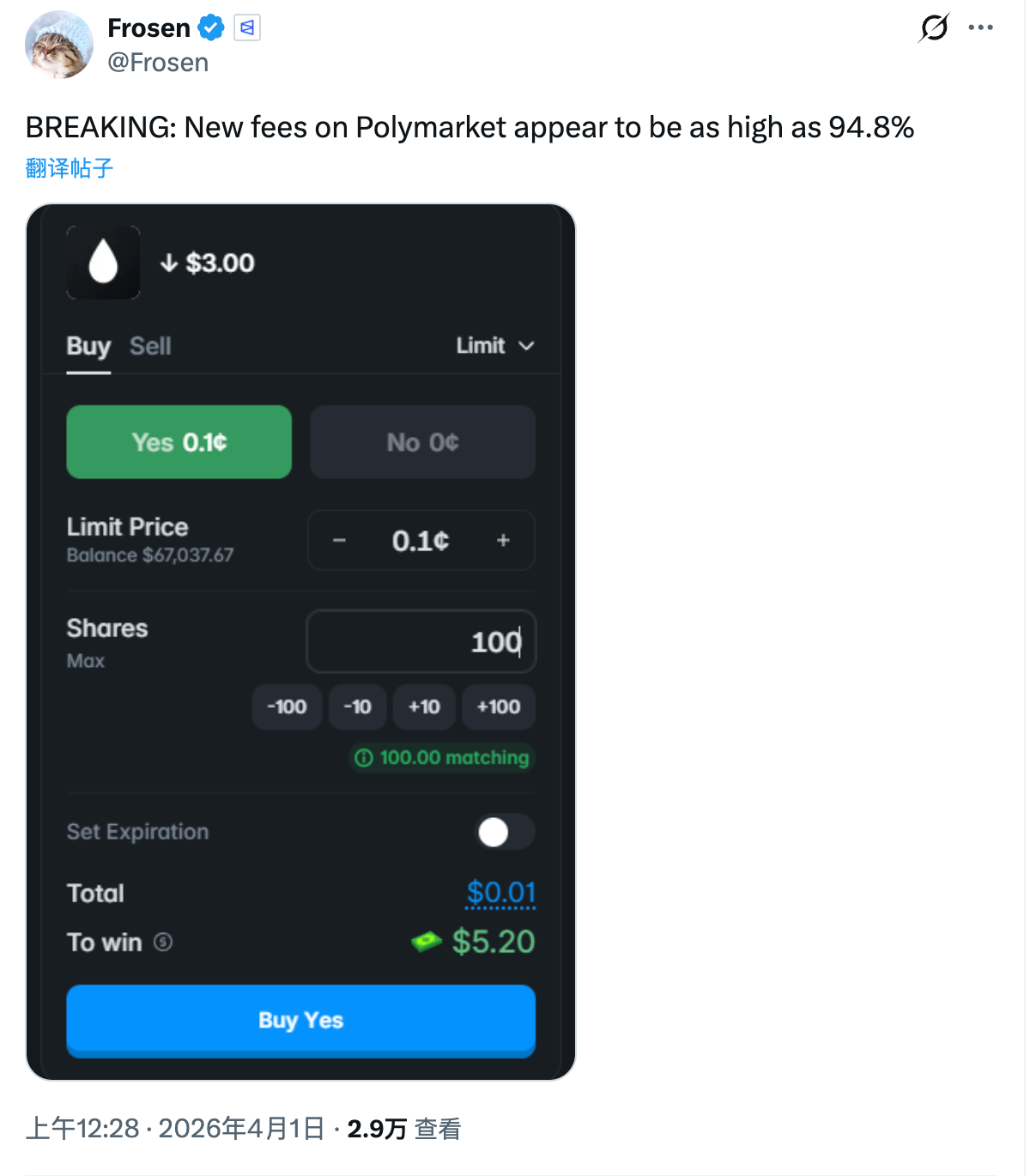
What's going on? Is Polymarket that desperate for money? According to official disclosures from Polymarket and community investigations, Odaily found that the direct cause of this unexpected situation is that Polymarket modified the platform's fee formula last night.

In short, Polymarket changed the formula versions three times last night:

  • First, the "Old Formula": fee = C × p × feeRate × (p × (1 - p))^exponent;
  • Then the first change, the formula that caused the unexpected situation (referred to as the "Anomalous Formula"): fee = C × feeRate × (p × (1 - p))^exponent;
  • After realizing the issue, Polymarket made a correction, resulting in the current version's "New Formula": fee = C × feeRate × p × (1 - p);
  • It's important to note that in all three formulas, C refers to the number of shares traded, p refers to the price of the shares traded, and feeRate and exponent are variables.
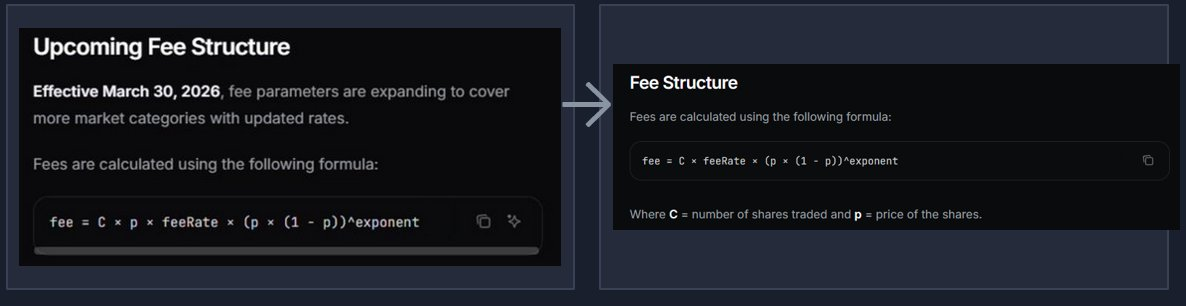
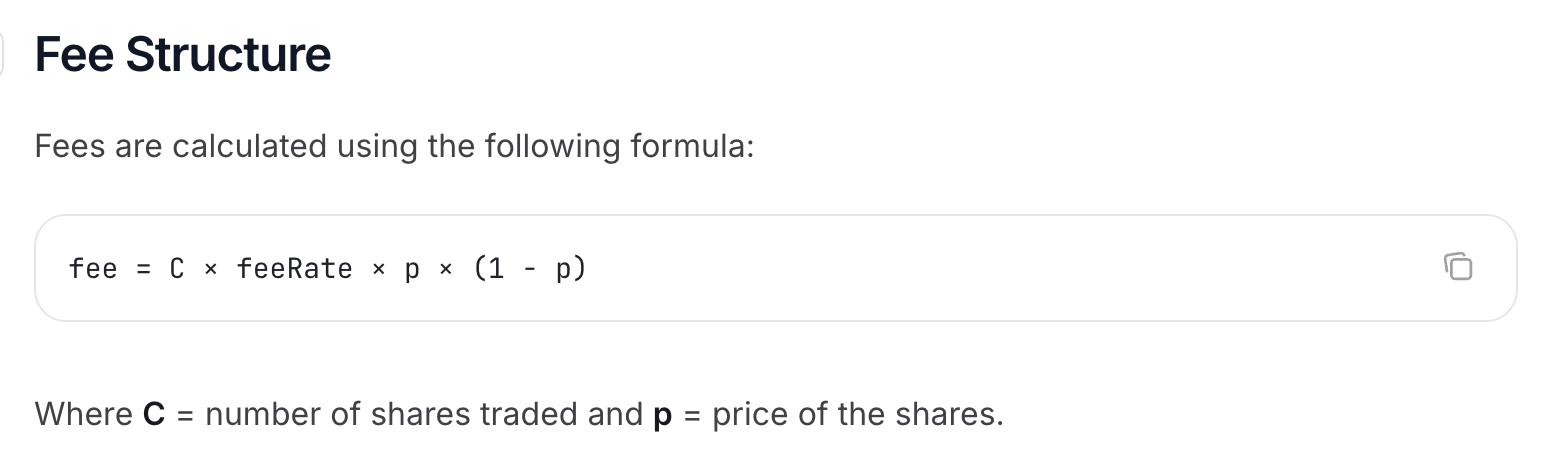
Deconstructing the Anomalous Formula: How Did the Outrageous 94.8% Fee Rate Happen?

You don't need to worry too much about the mathematical details. By comparing the "Old Formula" and the "Anomalous Formula," you can simply see that the latter only removed a " × p" (this is the multiplication symbol, not a lowercase X) compared to the former, meaning it ultimately multiplied by the share price one less time.

Since the price of all shares on Polymarket is always less than $1, this would inevitably cause the overall fee to increase. The lower the share price, the more pronounced the increase in the fee due to one less multiplication — when the share price is close to 0, it could lead to very absurd fee rates.

As for how outrageous this fee could become, it also depends on the variable ^exponent, which exists in both the old and anomalous formulas. ^exponent directly translates to "raised to the power of exponent"; this variable is mainly used to control the steepness of the fee curve.

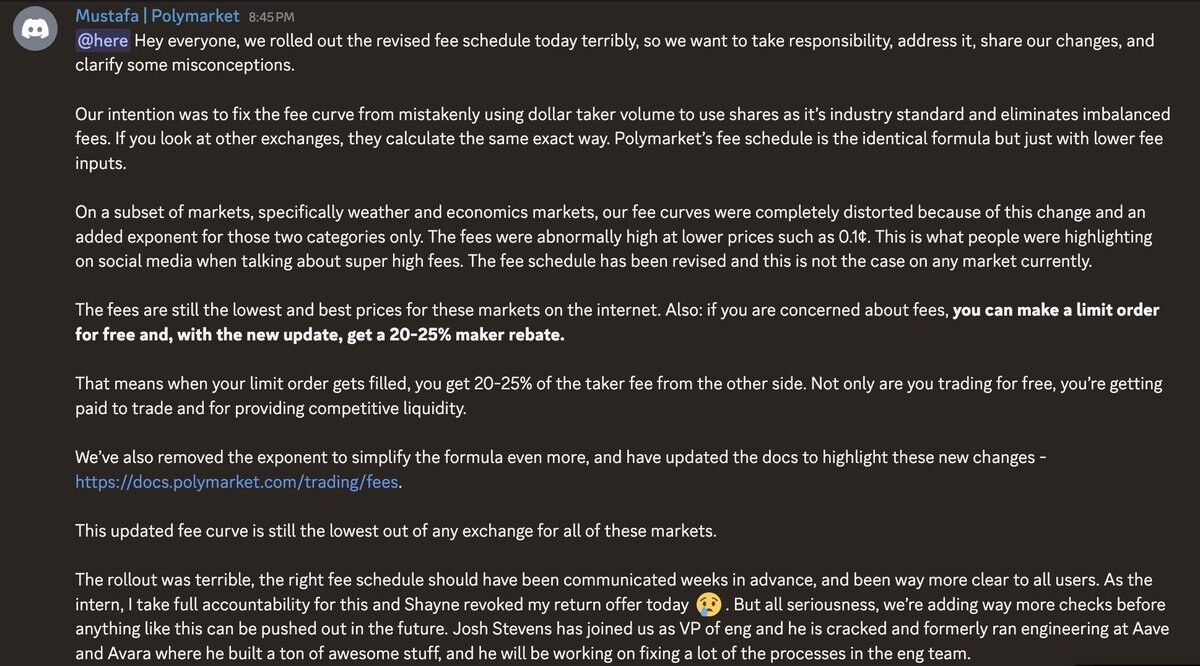
According to Mustafa, an official from Polymarket, the anomalous formula last night only introduced the exponent in the "Weather" and "Economy" market categories (other markets could ignore this variable by setting the parameter to 1). Furthermore, according to disclosures by overseas KOL Quant Chad(@Autonomous_Chad), the exponent parameter set for these two major markets at the time was 0.5.
Now, back to Frosen's case, plug the corresponding numbers into the anomalous formula: fee = C × feeRate × (p × (1 - p))^exponent. It is known that C equals 100, meaning Frosen wanted to order 100 shares; p equals 0.001, i.e., $0.001 (0.1 cent); exponent equals 0.5, meaning perform an exponentiation operation on (p × (1 - p)); the final fee rate is 94.8%.

Throwing this directly to AI allows us to inversely deduce that the feeRate level at the time was 0.03, and also reconstruct the detailed formula calculation Polymarket performed for this order.
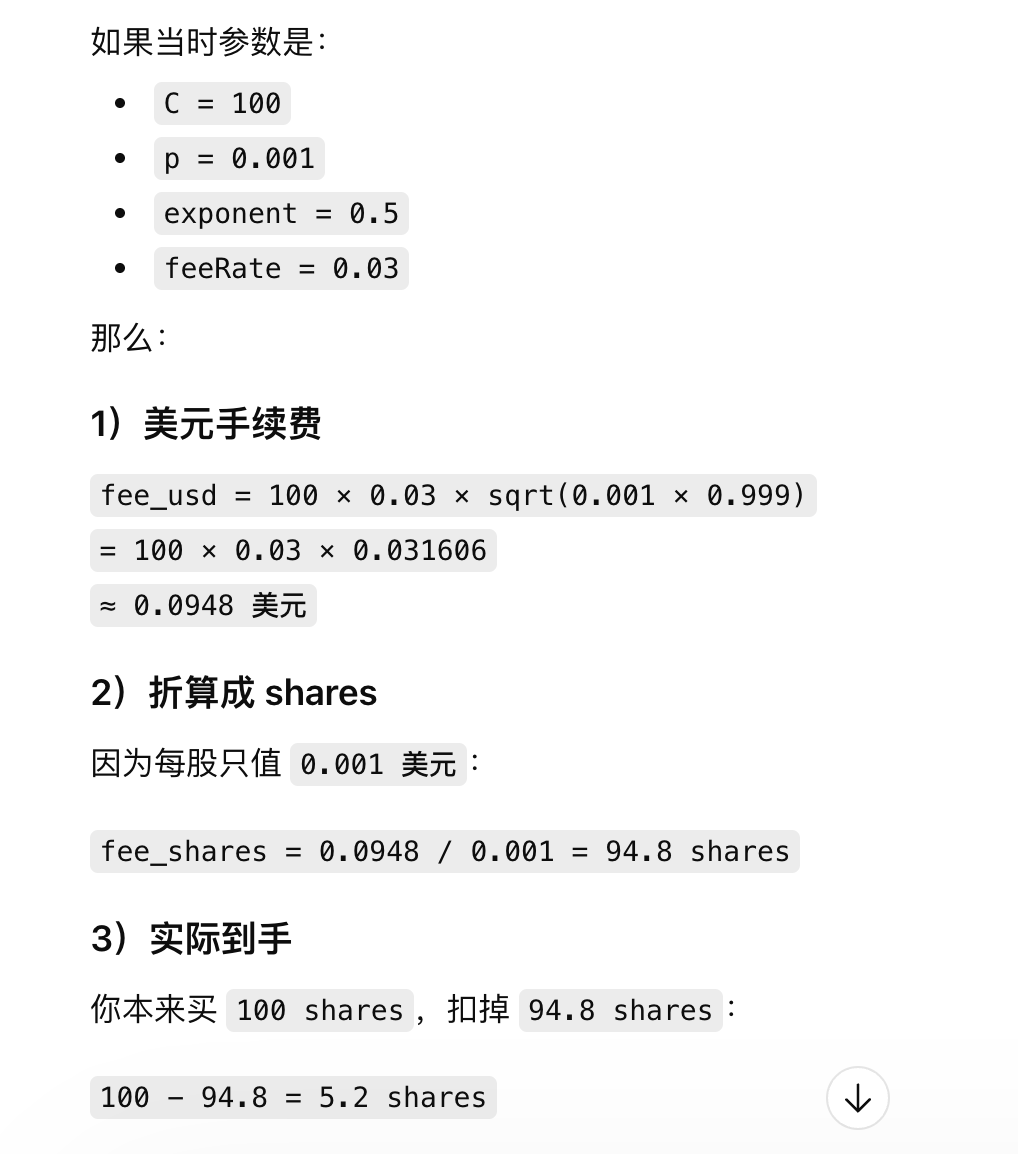
Simply put, based on the anomalous formula, Polymarket calculated that the fee for this order should be $0.0948. Since Polymarket deducts fees for buy orders by directly deducting the corresponding value in shares, and the share price at the time was only $0.001, it meant deducting 94.8 shares. Therefore, Frosen ultimately received only 5.2 shares, and even if the prediction was correct, the potential profit would only be $5.2.

Polymarket's Remedial Measures

Shortly after the abnormal fee issue emerged, Polymarket quickly responded by changing the formula to the current version: fee = C × feeRate × p × (1 - p). Compared to the anomalous formula, the new formula removed the "^exponent" — essentially, it increased the exponent parameter in the anomalous formula fee = C × feeRate × (p × (1 - p))^exponent from 0.5 to 1.

In the anomalous formula, the effect of ^exponent was to perform an exponentiation operation on the data set p × (1-p). In the actual operational context of Polymarket, the theoretical result range of p × (1 - p) is between "0.000999 - 0.25" — the closer p is to 0.5 (share price closer to $0.5), the closer this data set is to 0.25; the closer p is to 0 or 1 (share price closer to $0 or $1, with extremes at $0.001 and $0.999), the closer this data set is to 0.000999.

Within the range of "0.000999 - 0.25", regardless of the value taken, when the exponent parameter is increased from 0.5 to 1, it directly reduces the final fee result in the formula operation, i.e., lowers the overall fee.

More importantly, this reduction has a more pronounced inhibitory effect on the abnormally high fee rates near extreme low prices — when p × (1-p)=0.000999, the fee under the new formula is only about 3.16% of the fee under the anomalous formula, equivalent to a reduction of about 96.84%; whereas when p × (1-p)=0.25, the fee under the new formula is 50% of that under the anomalous formula.

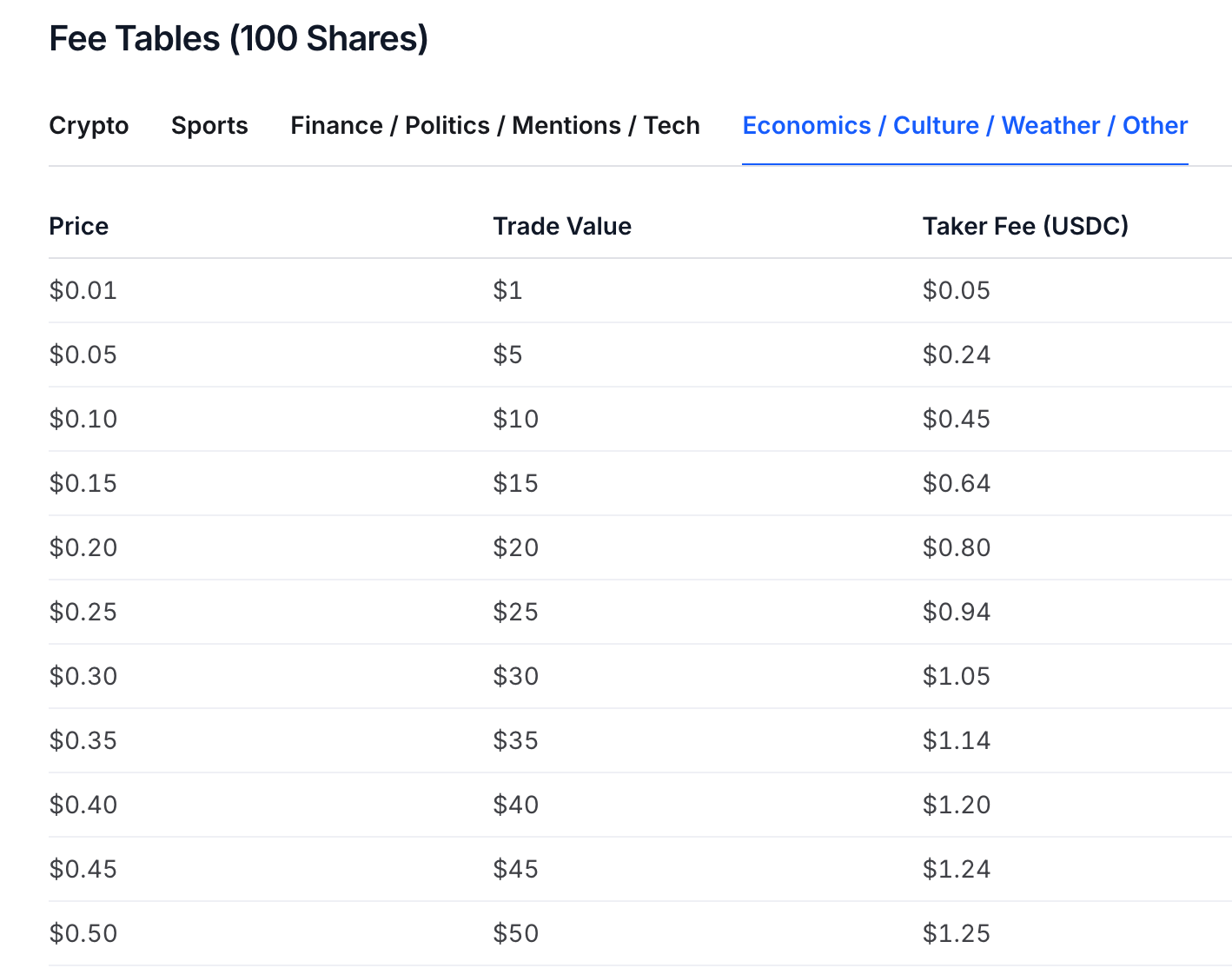
As shown in Polymarket's official documentation, after the new formula was implemented, the fee rate at extremes in the "Weather" and "Economy" market categories has now been reduced to 5%.
How Can Retail Users Avoid Fees?

I know most users can't be bothered to look at the formulas above but are still concerned about Polymarket's current fee issues.

Regarding this, Mustafa mentioned in the official Discord: "If you are worried about fees, you can place limit orders for free, and after this new update, you can also get a 20%-25% maker rebate — this means that when your limit order is filled, you will receive 20%-25% of the taker fee paid by the counterparty. So not only are you trading for free, but you can even get paid by trading and providing competitive liquidity."

So change your habits. Try to avoid taking orders directly. Switch to using limit orders more often. You can also try using Polymarket's Split function more to indirectly build a position by placing a reverse limit order to sell the other side of shares.


Связанные с этим вопросы

QWhat was the direct cause of the unusually high fees on Polymarket as described in the article?

AThe direct cause was a modification to Polymarket's fee formula. The platform changed to an 'abnormal formula' which removed a '× p' (multiplication by the price) from the previous formula, causing fees to increase significantly, especially for shares with prices near zero.

QWhat was the specific 'abnormal formula' that caused the issue, and how did it differ from the old one?

AThe 'abnormal formula' was: fee = C × feeRate × (p × (1 - p))^exponent. It differed from the old formula (fee = C × p × feeRate × (p × (1 - p))^exponent) by removing one multiplication by the share price (× p).

QHow did the 'exponent' parameter in the formula contribute to the extreme 94.8% fee rate in the user Frosen's case?

AThe exponent parameter, set to 0.5 for 'Weather' and 'Economics' markets, made the fee curve steeper. For a share price (p) of $0.001, the calculation (p × (1 - p))^0.5 resulted in a very high fee, which when deducted from the low-value shares, led to the effective 94.8% rate.

QWhat is the new, corrected fee formula that Polymarket implemented after the incident?

AThe new formula is: fee = C × feeRate × p × (1 - p). This is equivalent to setting the exponent parameter to 1 in the previous abnormal formula structure, which significantly reduces fees, especially for shares with extreme prices.

QWhat advice does the article give to users who want to avoid paying high fees on Polymarket?

AThe article advises users to place free limit orders instead of market orders. Additionally, users can utilize Polymarket's Split function to indirectly build a position by placing a limit order to sell the other side of the trade. Limit orders also qualify for a 20%-25% maker rebate on the taker's fee.

Похожее

Why Do You Always Lose Money on Polymarket? Because You're Betting on News, While the Pros Read the Rules

Why do you always lose money on Polymarket? Because you bet on news, while the pros study the rules. This article explains how top traders ("che tou") profit by meticulously analyzing market rules, not just predicting events. Polymarket, a prediction market platform, often sees disputes over event outcomes due to ambiguous rule wording. For instance, a market asking "Who will be the leader of Venezuela by the end of 2026?" was misinterpreted by many who bet on Delcy Rodríguez, assuming she held power. However, the rules specified "officially holds" as the formally appointed, sworn-in individual. Since Nicolás Maduro was still recognized as president officially, he won the market—even being in prison. To resolve such disputes, Polymarket uses a decentralized arbitration system via UMA protocol. The process involves: 1. Proposal: Anyone can propose a market outcome by staking 750 USDC, earning 5 USDC if unchallenged. 2. Dispute: A 2-hour window allows challenges with a 750 USDC stake; successful challengers earn 250 USDC. 3. Discussion: A 48-hour period on UMA Discord for evidence and debate. 4. Voting: UMA token holders vote in two 24-hour phases (blind then public). Outcomes require >65% consensus and 5M tokens voted; otherwise, four re-votes occur before Polymarket intervention. 5. Settlement: Results are final and automatic. Unlike traditional courts, Polymarket’s system lacks separation between arbitrators and stakeholders—voters often hold market positions, creating conflicts of interest. This leads to herd mentality in discussions and non-transparent outcomes without explanatory rulings, preventing precedent formation. Thus, success on Polymarket hinges on deep rule interpretation, not just event prediction, exploiting gaps between reality and contractual wording.

marsbit1 ч. назад

Why Do You Always Lose Money on Polymarket? Because You're Betting on News, While the Pros Read the Rules

marsbit1 ч. назад

DeepSeek Funding: Liang Wenfeng's 'Realist' Pivot

DeepSeek, a leading Chinese AI company, has initiated its first external funding round, aiming to raise at least $300 million at a valuation of no less than $10 billion. This move marks a significant shift from its founder Liang Wenfeng’s previous idealistic stance of rejecting external capital to maintain independence. Despite strong financial backing from its parent company, quantitative trading firm幻方量化 (Huanfang Quant), which provided an estimated $700 million in revenue in 2025 alone, DeepSeek faces mounting challenges. Key issues include a 15-month gap in major model updates, delays in its flagship V4 release, and the loss of several core researchers to competitors offering significantly higher compensation. The company is also undergoing a strategic pivot by migrating its infrastructure from NVIDIA’s CUDA to Huawei’s Ascend platform, a move aligned with China’s push for technological self-reliance amid U.S. export controls. However, DeepSeek lags behind rivals like智谱AI and MiniMax—both now publicly listed—in areas such as product ecosystem, multimodal capabilities, and commercialization. The funding round, though relatively small in scale, is seen as a way to establish a market-validated valuation anchor, making employee stock options more competitive and facilitating talent retention. It also signals DeepSeek’s transition from a pure research-oriented organization to a commercially-driven player in the global AI ecosystem.

marsbit1 ч. назад

DeepSeek Funding: Liang Wenfeng's 'Realist' Pivot

marsbit1 ч. назад

Торговля

Спот
Фьючерсы
活动图片