Goldman Sachs Predicts 11% Return: How Far Can the Optimistic Cycle of Global Stock Markets Go?

比推Опубликовано 2026-01-14Обновлено 2026-01-14

Введение

Goldman Sachs Research forecasts an 11% total return (including dividends, in USD terms) for global equities over the next 12 months, anticipating a continued but more moderate bull market into 2026. While valuations are at historical highs following last year's strong performance, the rally is expected to be driven by corporate earnings growth and sustained economic expansion rather than further multiple expansion. A key theme is the importance of diversification. Investors benefited in 2025 from geographic diversification, a trend expected to continue and broaden to include factors (growth vs. value) and sectors. The analysis suggests the market is in an "optimism" phase of the cycle, which typically carries upside risk to valuations. The report highlights that while AI enthusiasm remains high, it does not constitute a bubble. The tech sector's dominance is supported by superior earnings growth, and the valuation gap between the largest tech stocks and the rest of the market is far smaller than during previous bubbles. Investors are advised to seek alpha opportunities through stock selection as correlations decrease and to consider non-tech companies that may benefit from AI-driven capital expenditure.

Author: Goldman Sachs

Compiled by: Shenchao TechFlow

Original title: Goldman Sachs Predicts: Global Stock Markets Expected to Achieve 11% Return in the Next 12 Months


  • Following last year's strong growth, Goldman Sachs Research predicts that global stock markets are expected to continue climbing in 2026, with an anticipated return of 11% over the next 12 months (including dividends, in USD terms).

  • Although last year's stock market rally has left valuations at historically high levels, corporate earnings and economic growth globally are expected to continue supporting the markets.

  • Last year, investors benefited significantly from cross-regional diversification, a trend that is likely to continue. Additionally, diversification across investment styles and sectors is expected to further enhance returns.

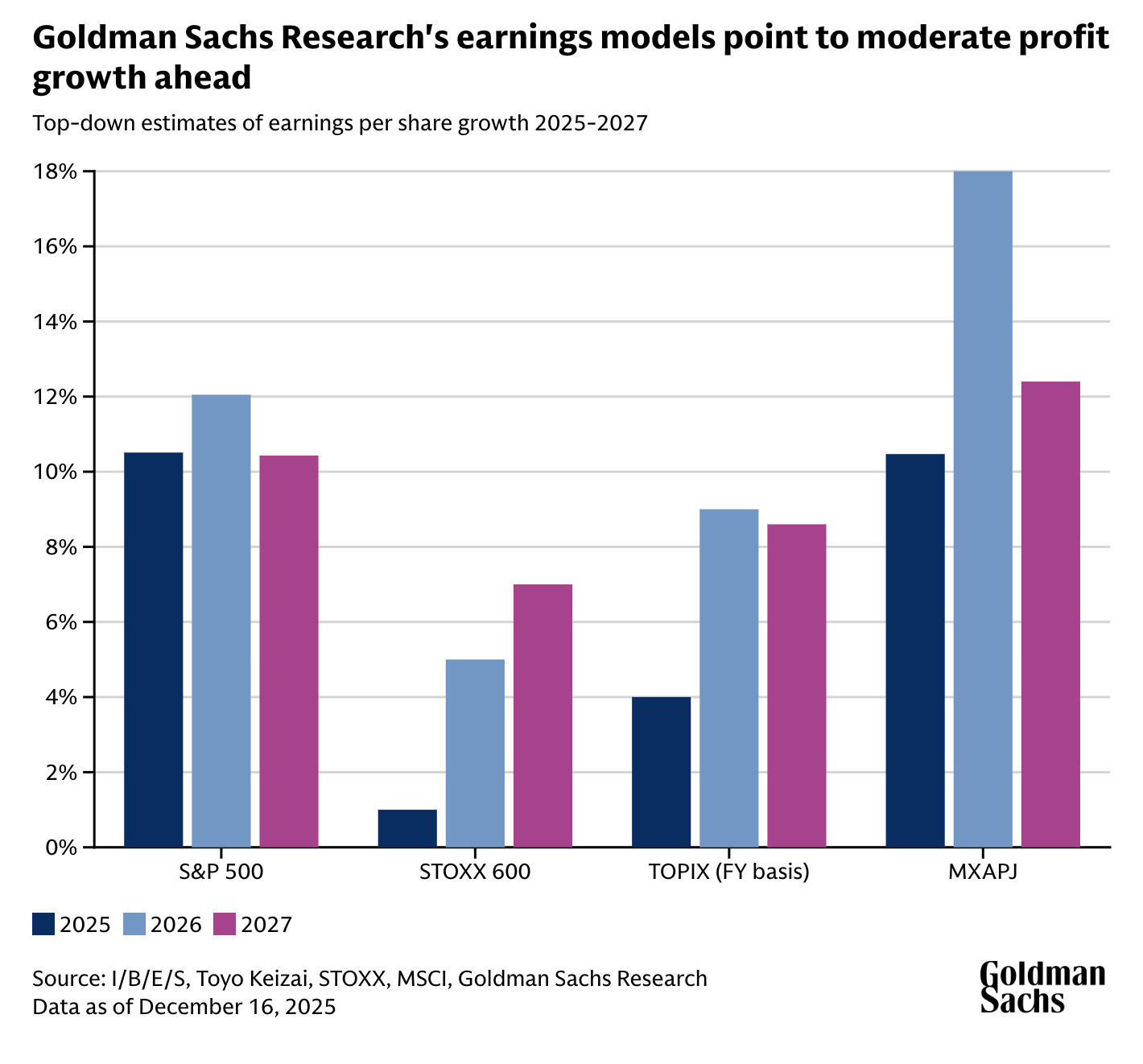
According to Goldman Sachs Research, the global bull market is likely to continue this year, driven by growth in corporate earnings and sustained economic expansion. However, the gains in the stock market are expected to be lower than the significant rally seen in 2025. In 2026, the global economy is expected to maintain expansion across regions, and the US Federal Reserve is anticipated to continue with moderate easing policies.

"In the current macroeconomic context, even with high valuations, a significant stock market correction or bear market without an economic recession would be unusual," wrote Peter Oppenheimer, Chief Global Equity Strategist at Goldman Sachs Research, in his report titled "Global Equity Strategy 2026 Outlook: Tech Tonic—a Broadening Bull Market."
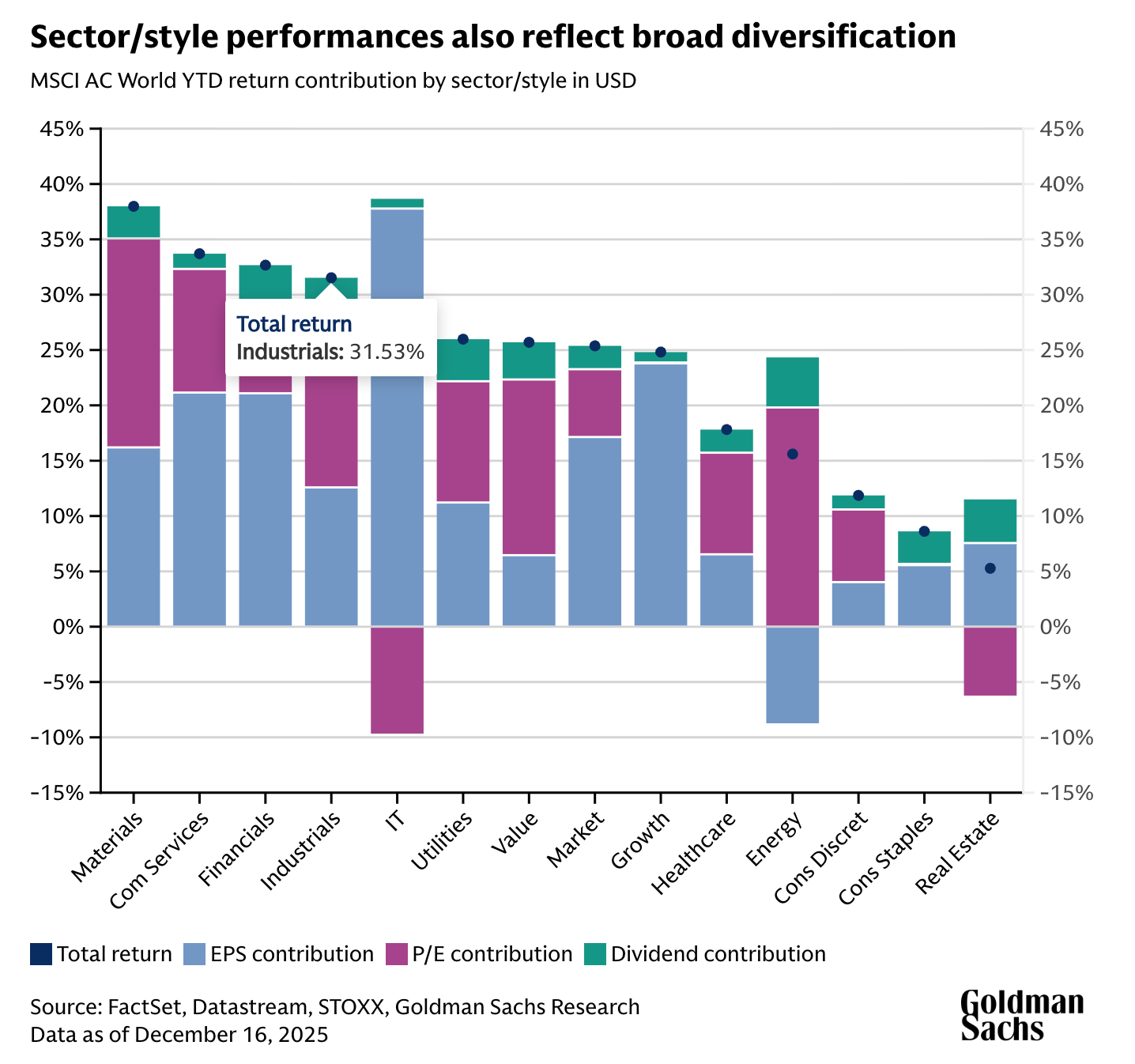
Diversification was a core theme emphasized by Goldman Sachs Research last year. In 2025, for the first time in many years, investors who diversified across regions were rewarded. Goldman Sachs analysts expect this trend to continue in 2026 and expand to include diversification across investment factors such as growth and value, as well as across various sectors. (Investment factors refer to asset characteristics such as size, value, or momentum that typically influence risk and return.)

What Is the Outlook for Global Stock Markets in 2026?

Despite the strong performance of stock markets in 2025, outperforming commodities and bonds, the rally was not smooth. At the beginning of the year, stocks underperformed, with the S&P 500 experiencing a nearly 20% correction from mid-February to April before rebounding.

Peter Oppenheimer, Chief Global Equity Strategist at Goldman Sachs Research, noted that the strong rally in global stock markets has left valuations at historically high levels across all regions, including the US, Japan, Europe, and emerging markets.
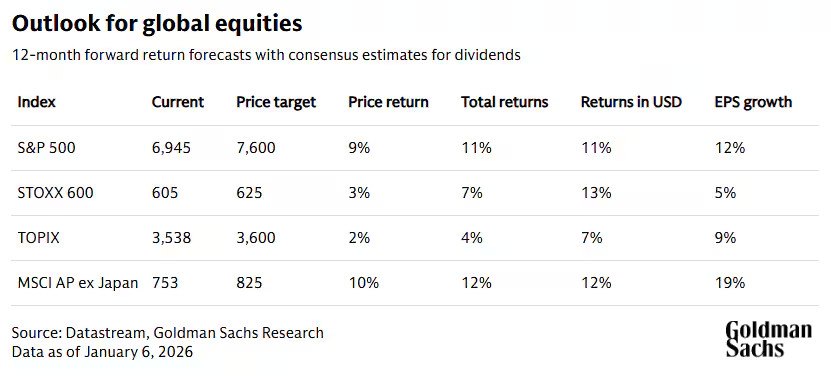
"Therefore, we believe that returns in 2026 are more likely to be driven by fundamental earnings growth rather than further valuation expansion," Oppenheimer said. According to Goldman Sachs analysts' forecasts as of January 6, 2026, global stock prices (weighted by regional market capitalization) are expected to rise by 9% over the next 12 months, achieving an 11% return in USD terms (including dividends). He added, "Most of the return will come from earnings-driven growth."

Additionally, according to another Goldman Sachs forecast, commodity indices are also expected to rise this year, with gains in precious metals once again offsetting declines in energy prices, a trend similar to 2025.

Oppenheimer's team also studied the typical evolution of market cycles: the despair phase during bear markets when stocks fall; the brief hope phase during market rebounds; the longer growth phase where returns are driven by earnings growth; and finally, the optimistic phase where investor confidence strengthens and even becomes complacent.

Their analysis suggests that stocks are currently in the optimistic phase of a cycle that began with the bear market during the COVID-19 pandemic in 2020. "This late-cycle optimistic phase is often accompanied by rising valuations, indicating that there may be some upside risk to our core forecast," Oppenheimer's team wrote.

Should Investors Diversify Their Stock Portfolios in 2026?

In 2025, geographical diversification provided significant benefits to investors, which is uncommon. US stock markets underperformed other major markets for the first time in nearly 15 years. Due to the depreciation of the US dollar, the returns from European, Chinese, and Asian stock markets were almost double the total return of the S&P 500.

Returns in US stock markets were primarily driven by earnings growth, especially from large technology companies. However, outside the US, the balance between earnings improvement and valuation expansion was more even. Last year, the growth-adjusted valuation gap between US and global markets narrowed.

"Even though absolute valuations in the US remain high, we expect these growth-adjusted valuation ratios to continue converging in 2026," Oppenheimer's team wrote.

Oppenheimer noted that diversification is still expected to provide better risk-adjusted returns in 2026. He advises investors to explore broad geographical investment opportunities, including increased focus on emerging markets. At the same time, investors should balance between growth and value stocks and pay attention to different sectors. Additionally, they can look for opportunities where correlations between stocks decrease, providing room for stock picking.
"As stock correlations decline and may remain low, we are also paying more attention to enhancing alpha," wrote Peter Oppenheimer, Chief Global Equity Strategist at Goldman Sachs Research. Alpha measures an asset's performance relative to a broader market index.

Oppenheimer added that non-technology sectors may perform strongly this year, and investors could profit from stocks benefiting from technology companies' capital expenditures. Furthermore, as new capabilities of artificial intelligence (AI) are gradually realized, market attention may increasingly focus on companies outside the technology sector that benefit from AI development.

Are AI Stocks in a Bubble?

Overall, market focus on artificial intelligence "remains intense," Goldman Sachs analysts noted. However, this does not mean there is a bubble in the AI sector. "The dominance of the technology sector in the market was not triggered by the rise of AI," Oppenheimer wrote. "This trend began after the financial crisis and has been supported by its exceptional earnings growth."

Despite the surge in stock prices of large technology companies, current valuation levels have not reached the extremes seen in previous bubble periods. For example, comparing the valuation gap between the five largest companies by market capitalization in the S&P 500 and the other 495 stocks shows that this gap is much smaller than in previous cycles, such as the peak of the tech bubble in 2000.


Twitter: https://twitter.com/BitpushNewsCN

BitPush TG Discussion Group: https://t.me/BitPushCommunity

BitPush TG Subscription: https://t.me/bitpush

Original link: https://www.bitpush.news/articles/7602780

Связанные с этим вопросы

QWhat is Goldman Sachs' predicted 12-month return for global equities, and what factors are expected to drive this return?

AGoldman Sachs predicts an 11% return for global equities over the next 12 months (including dividends, in USD terms). This return is expected to be primarily driven by fundamental earnings growth rather than further valuation expansion, supported by corporate profit growth and continued economic expansion across regions.

QAccording to the report, what stage of the market cycle are global equities currently in, and what characterizes this phase?

AGlobal equities are currently in the 'optimism' phase of the market cycle, which began with the bear market during the COVID-19 pandemic in 2020. This phase is characterized by rising valuations and increased investor confidence, sometimes bordering on complacency.

QHow did geographic diversification benefit investors in 2025, and is this trend expected to continue in 2026?

AIn 2025, geographic diversification provided significant benefits as U.S. equities underperformed other major markets for the first time in nearly 15 years. European, Chinese, and Asian markets delivered nearly double the total return of the S&P 500. This trend is expected to continue in 2026, with further convergence in growth-adjusted valuations and better risk-adjusted returns from diversification.

QDoes Goldman Sachs report suggest that AI stocks are in a bubble, and what evidence supports this view?

ANo, the report does not suggest that AI stocks are in a bubble. While market enthusiasm for AI remains high, the dominance of the tech sector is not solely triggered by AI but began after the financial crisis and is supported by superior earnings growth. The valuation gap between the top five companies in the S&P 500 and the rest is far smaller than during previous bubbles, such as the 2000 tech bubble peak.

QWhat investment strategies does Peter Oppenheimer recommend for 2026 to enhance returns and manage risk?

APeter Oppenheimer recommends diversifying across geographies, including increased exposure to emerging markets, balancing growth and value investment styles, and diversifying across sectors. He also suggests focusing on stock picking opportunities as correlations between stocks decrease, and looking for non-tech sectors that may perform well, including companies benefiting from tech capital expenditure and AI adoption.

Похожее

Will the Fed Still Cut Interest Rates? Tonight's Data Is Crucial

The core debate surrounding the Federal Reserve's potential interest rate cuts is intensifying amid geopolitical conflict and rebounding inflation. The key question is whether high energy prices will cause persistent inflation or weaken consumer demand enough to force the Fed to cut rates. Citigroup presents a bullish case for cuts, arguing that oil supply disruptions from the Strait of Hormuz are temporary and will not lead to lasting inflationary pressure. They point to receding bond yields and oil prices as evidence the market is pricing in a short-lived shock. Citi's data also shows tightening financial conditions, a stabilizing labor market, and healthy tax returns, supporting their view that the path to lower rates remains open. Conversely, Deutsche Bank offers a starkly contrasting, more hawkish outlook. They argue the Fed's current policy is already neutral and expect rates to remain unchanged indefinitely. Their view is based on stalled disinflation progress and a shift toward more hawkish rhetoric from key Fed officials like Waller, who cited risks from prolonged Middle East conflict and tariffs. Other officials, including Williams and Hammack, signaled rates would likely stay on hold for a "considerable time." The market pricing has shifted dramatically, now forecasting zero cuts in 2026. The imminent release of the March retail sales "control group" data is highlighted as a critical test. This metric, which excludes gas station sales, will reveal if high gasoline prices are eroding consumer spending in other areas. A weak reading could support the case for imminent rate cuts, while a strong one would bolster the argument for the Fed to hold steady. This data is pivotal for determining the near-term policy path.

marsbit9 мин. назад

Will the Fed Still Cut Interest Rates? Tonight's Data Is Crucial

marsbit9 мин. назад

The Second Half of Macro Influencer Fu Peng's Career

Fu Peng, a prominent Chinese macroeconomist and former chief economist of Northeast Securities, has joined Hong Kong-based digital asset management firm Bitfire Group (formerly New Huo Group) as its chief economist. This move, announced in April 2026, triggered an 11% surge in Bitfire's stock price. Fu, known for his accessible macroeconomic commentary and large social media following, will focus on integrating digital assets into global asset allocation frameworks, particularly combining FICC (fixed income, currencies, and commodities) with cryptocurrencies for institutional clients. His career includes roles at Lehman Brothers and Solomon International, with significant influence gained through public communication. However, in late 2024, Fu faced temporary social media bans after a controversial private speech at HSBC on China's economic challenges, though he denied regulatory sanctions. He later left Northeast Securities citing health reasons. Bitfire, a licensed virtual asset manager serving high-net-worth clients, seeks to build trust and attract traditional capital through Fu’s expertise and credibility. The partnership represents a strategic shift for both: Fu enters the crypto sector after a traditional finance peak, while Bitfire aims to leverage his macro framework for institutional adoption. Outcomes remain uncertain regarding capital inflows and compatibility within corporate structure.

marsbit1 ч. назад

The Second Half of Macro Influencer Fu Peng's Career

marsbit1 ч. назад

Торговля

Спот
Фьючерсы
活动图片