From Robinhood to Polymarket: Is the Era of Integrating All Assets on a Single Platform Coming?

marsbitОпубликовано 2026-04-24Обновлено 2026-04-24

Введение

From Robinhood to Polymarket: The Era of All-in-One Asset Platforms Is Coming Asset classes are rapidly converging. Platforms that once specialized in single categories—such as stocks, cryptocurrencies, or prediction markets—are now moving toward offering all three. Robinhood pioneered this model, starting with equities, adding crypto in 2018, and prediction markets in 2025. This strategy has proven resilient: when crypto revenues fell, other segments like options and stocks filled the gap. Now, prediction market leaders Polymarket and Kalshi are moving in the same direction, both announcing perpetual futures trading on April 21, 2026, pending regulatory approval. These futures will cover assets like Bitcoin, gold, and stocks such as Nvidia. This trend mirrors the consolidation seen in consumer tech, like smartphones replacing dedicated cameras and MP3 players. Younger users, accustomed to interacting with multiple asset types from an early age, will increasingly demand unified platforms. A key competitive advantage in prediction markets is collateral utilization—idle assets locked during betting periods. Polymarket’s move into perpetuals may be a strategy to generate yield from that capital, similar to earlier DeFi integrations like PolyAave. As the regulatory landscape evolves, traditional finance is also likely to incorporate crypto and prediction markets, further accelerating this convergence.

Written by: Tiger Research

Compiled by: AididiaoJP, Foresight News

Key Points

Different asset classes are accelerating their integration: Stocks, cryptocurrencies, and prediction markets were once independent. Today, the trend of integrating all assets on a single platform is accelerating. Robinhood has proven this model with data; Polymarket and Kalshi are moving in the same direction.

In prediction markets, collateral utilization will become a core competitive advantage: In prediction markets, collateral is locked until the outcome is determined. Polymarket's launch of perpetual futures trading is likely an effort to generate returns from idle assets.

Traditional finance is also moving toward the same integration: The new generation of users has grown up accustomed to interacting with multiple asset classes simultaneously. As generations shift, the demand for integrated platforms will only grow, and large financial institutions will gradually incorporate crypto spot trading and prediction markets as the environment opens up to regulation.

On April 21, 2026, the two leading prediction market platforms, @Polymarket and @Kalshi, announced the launch of perpetual futures trading on the same day. The trading targets are expected to include cryptocurrencies like Bitcoin, commodities like gold, and stocks like Nvidia. Both platforms stated that they will officially launch after receiving regulatory approval.

Why Now

This can be understood through the "Robinhood model." The trend of integrating previously independent asset classes into a single platform has long been underway; the announcements from Polymarket and Kalshi are merely a continuation of this trend.

Robinhood started as a stock trading app, added cryptocurrency trading in 2018, and incorporated prediction markets in 2025, pioneering the model of consolidating fragmented trading markets under one platform.
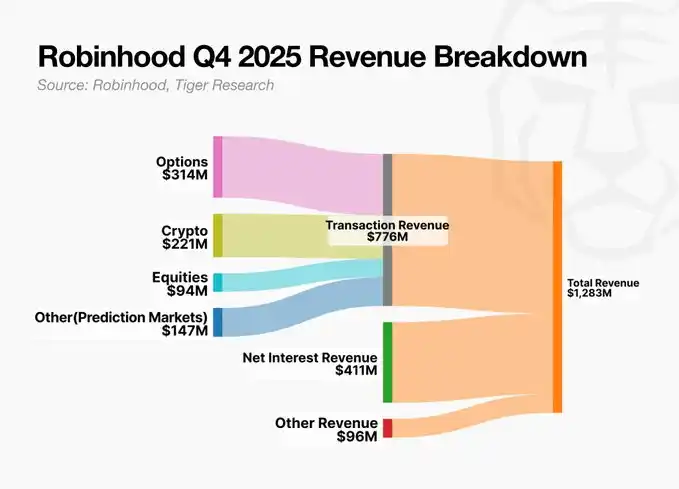
This model has been validated by data. After expanding its crypto business, crypto trading revenue became Robinhood's largest single revenue source in Q4 2024. Although crypto revenue fell 38% year-over-year in Q4 2025, total revenue remained stable, with options, stocks, and prediction markets filling the gap. A structure of resilience through diversification has taken shape.

Polymarket and Kalshi are starting from the opposite direction but heading toward the same endpoint. They originated in prediction markets and are now adding futures trading. The starting points differ, but the destination is the same. As the Robinhood model proves successful, traditional finance is likely exploring the same path.

A Simple Analogy

Smartphones integrated cameras, MP3 players, and navigation into a single device; the era of carrying separate devices for each function is over. The same transformation is happening in finance.

Brokerage accounts, crypto exchanges, and prediction markets are merging into a single platform. Robinhood started as a stock app and gradually added cryptocurrencies and prediction markets; Polymarket started with prediction markets and is now adding crypto perpetual contracts. The starting points differ, but the direction is the same.

The Generalization of the Robinhood Model

As generations shift, this trend will accelerate further. The new generation of users has grown up simultaneously exposed to stocks, cryptocurrencies, and prediction markets. Just as smartphone users would not accept separate devices for a camera, MP3 player, and map, this generation finds the idea of using separate apps for each asset class unfamiliar from the start. The demand for an integrated platform that handles all assets within a familiar interface will grow naturally with each generation.

This is the generalization of the Robinhood model.

Polymarket and Kalshi have a particular advantage in this model. Because collateral in prediction markets is locked until the outcome is determined, how to utilize these idle assets will become a key competitive differentiator.

On December 3, 2025, a developer proposed the concept of PolyAave: depositing Polymarket's outcome tokens into an Aave liquidity pool to earn interest. This was an early attempt to convert prediction market collateral into DeFi yields. Polymarket's launch of perpetual futures is likely an extension of this logic. The strategy of not letting locked capital sit idle is sound.

Polymarket and Kalshi are moving first, but traditional finance faces the same pressure. As the regulatory environment gradually opens up, large financial institutions will directly support crypto spot trading and gradually incorporate new asset classes, including prediction markets.


Связанные с этим вопросы

QWhat is the main trend discussed in the article regarding asset trading platforms?

AThe main trend is the convergence of different asset classes—such as stocks, cryptocurrencies, and prediction markets—into single, integrated platforms, as exemplified by Robinhood, Polymarket, and Kalshi.

QHow did Robinhood validate the integrated platform model according to the article?

ARobinhood validated the model by expanding from stocks to cryptocurrencies in 2018 and prediction markets in 2025, with crypto trading becoming its largest revenue source in Q4 2024. Despite a crypto revenue drop in Q4 2025, total revenue remained stable due to diversification into options, stocks, and prediction markets.

QWhy are Polymarket and Kalshi adding perpetual futures trading?

AThey are adding perpetual futures trading to utilize idle collateral locked in prediction markets, turning it into yield and enhancing their competitive advantage by not letting capital remain idle.

QWhat generational shift is driving the demand for integrated financial platforms?

AYounger generations, who have grown up simultaneously exposed to stocks, cryptocurrencies, and prediction markets, naturally prefer a single platform for all assets, similar to how smartphones integrate multiple devices into one.

QHow might traditional financial institutions respond to this trend?

AAs regulatory environments open up, large financial institutions are likely to gradually adopt crypto spot trading and incorporate new asset classes like prediction markets, following the same convergence path.

Похожее

Agents Take Over Traffic Distribution Power: What Are Tencent, ByteDance, and Alibaba Competing For?

In the race to dominate the AI era's entry point, China's tech giants—Tencent, ByteDance, and Alibaba—are aggressively deploying AI Agents to control the future of traffic distribution. Alibaba is pursuing a dual-track "closed loop + openness" strategy. Its Qianwen app is evolving into a super-Agent integrated across its ecosystem (Taobao, Alipay, etc.) to handle complex tasks like travel planning. Concurrently, it is opening its platform to external brands (Luckin Coffee, KFC) and has launched a B2B Agent platform, "Wukong," targeting enterprise automation. Its other flagship, Quark, aims to be an "AI super search box" for information and tasks. ByteDance is executing an omnipresent "sprawl strategy." Its Doubao app boasts over 300 million monthly active users and is evolving into a default AI entry point for daily life, with plans for paid versions and e-commerce integration. Its core weapon is the Kouzi platform, a visual "AI assembly factory" for developers to build custom Agents. ByteDance is also pushing hardware integration, collaborating on AI phones and developing smart glasses to embed Doubao everywhere. Tencent is playing its long-held "ultimate card" by quietly embedding an AI Agent directly into WeChat. This Agent, accessible via a swipe, can understand user commands and automatically execute tasks by calling upon WeChat's millions of mini-programs (e.g., finding and ordering coffee). This leverages WeChat's unparalleled 1.4-billion-user ecosystem to position the app as an AI-powered "service operating system," a move that could dramatically reshape the competitive landscape. The core battleground is shifting from competing for "user screen time" to competing to be the "default execution layer" for user intent. The business model is evolving from an "attention economy" to an "intent economy," where the Agent that can most efficiently fulfill a user's need gains control over service access and token flow. This represents a fundamental change in how users connect with digital services, making the fight for the Agent入口 (entry point) a pivotal moment for redefining industry leadership in the AI age.

marsbit44 мин. назад

Agents Take Over Traffic Distribution Power: What Are Tencent, ByteDance, and Alibaba Competing For?

marsbit44 мин. назад

From Banning Doubao to Embracing Honor: Why Did WeChat Suddenly 'Change Its Face'?

The article explores the sudden shift in WeChat's strategy towards AI assistants from mobile phone manufacturers, transitioning from strict opposition to active collaboration. For over a year, WeChat fiercely resisted attempts by phone AI assistants (like ByteDance's Doubao in late 2025) to control its features via GUI automation ("simulated clicking"), citing security and data control concerns. This stance created a significant barrier for system-level AI integration. Now, Tencent has initiated A2A (Agent-to-Agent) partnerships with major phone brands like Honor, Xiaomi, OPPO, and vivo. This model allows a phone's system AI (e.g., Honor's YOYO) to parse a user's voice command and send a structured request directly to WeChat's own internal AI agent via secure APIs. WeChat then executes the action (e.g., sending a message) and returns the result. The article attributes Tencent's "change of face" to strategic pressure. While leading in social app usage, Tencent trails rivals like ByteDance and Alibaba in standalone AI app popularity. WeChat, with its vast mini-program ecosystem, is Tencent's key asset for an AI comeback. The upcoming WeChat AI agent aims to handle tasks like booking and payments within the app. However, phone system assistants remain the primary AI entry point for most users. The A2A collaboration allows Tencent to extend WeChat's AI reach to this crucial system layer while maintaining control over its core functions and data. For phone manufacturers, embracing A2A is a pragmatic move. The GUI route proved unviable due to WeChat's blocks. A2A offers a compliant path to integrate a vital service, enhancing their AI assistants' usefulness. It allows them to focus on developing their own AI ecosystems for other services while cooperating on WeChat access. The collaboration is framed as a mutual, strategic necessity: Tencent gains a distribution channel, and manufacturers gain a key functionality. The partnership relies on a "dual authorization" mechanism for security, requiring both user and app consent for each action. While questions about long-term data privacy practices remain, experts note A2A is more secure and compliant than GUI automation. Ultimately, this cooperation is seen as a tentative, calculated truce. Tencent's long-term goal is to make WeChat an AI-powered "service OS." Phone manufacturers aim to make their system AI the central user interface. Their paths may converge or clash in the future, but for now, the A2A deal represents the opening chapter in the battle for the AI-era user入口, driven by necessity and strategic calculus on both sides.

marsbit2 ч. назад

From Banning Doubao to Embracing Honor: Why Did WeChat Suddenly 'Change Its Face'?

marsbit2 ч. назад

Торговля

Спот
Фьючерсы

Популярные статьи

Как купить ERA

Добро пожаловать на HTX.com! Мы сделали приобретение Caldera (ERA) простым и удобным. Следуйте нашему пошаговому руководству и отправляйтесь в свое крипто-путешествие.Шаг 1: Создайте аккаунт на HTXИспользуйте свой адрес электронной почты или номер телефона, чтобы зарегистрироваться и бесплатно создать аккаунт на HTX. Пройдите удобную регистрацию и откройте для себя весь функционал.Создать аккаунтШаг 2: Перейдите в Купить криптовалюту и выберите свой способ оплатыКредитная/Дебетовая Карта: Используйте свою карту Visa или Mastercard для мгновенной покупки Caldera (ERA).Баланс: Используйте средства с баланса вашего аккаунта HTX для простой торговли.Третьи Лица: Мы добавили популярные способы оплаты, такие как Google Pay и Apple Pay, для повышения удобства.P2P: Торгуйте напрямую с другими пользователями на HTX.Внебиржевая Торговля (OTC): Мы предлагаем индивидуальные услуги и конкурентоспособные обменные курсы для трейдеров.Шаг 3: Хранение Caldera (ERA)После приобретения вами Caldera (ERA) храните их в своем аккаунте на HTX. В качестве альтернативы вы можете отправить их куда-либо с помощью перевода в блокчейне или использовать для торговли с другими криптовалютами.Шаг 4: Торговля Caldera (ERA)С легкостью торгуйте Caldera (ERA) на спотовом рынке HTX. Просто зайдите в свой аккаунт, выберите торговую пару, совершайте сделки и следите за ними в режиме реального времени. Мы предлагаем удобный интерфейс как для начинающих, так и для опытных трейдеров.

728 просмотров всегоОпубликовано 2025.07.17Обновлено 2026.06.02

Как купить ERA

Обсуждения

Добро пожаловать в Сообщество HTX. Здесь вы сможете быть в курсе последних новостей о развитии платформы и получить доступ к профессиональной аналитической информации о рынке. Мнения пользователей о цене на ERA (ERA) представлены ниже.

活动图片