Fortune Exclusive: a16z Crypto Fund AUM Plummets 40%, Multicoin Halved, Top Crypto VCs Shrink Collectively

marsbitОпубликовано 2026-04-17Обновлено 2026-04-17

Введение

According to exclusive SEC filings obtained by Fortune, leading crypto venture capital firms, including a16z crypto, Multicoin Capital, Pantera Capital, and Paradigm, experienced significant declines in their assets under management (AUM) in 2025. a16z crypto's AUM dropped nearly 40% to $9.5 billion, partly due to strategic distributions to LPs at market highs, with its first fund achieving a 5.4x DPI. Multicoin’s AUM was halved to approximately $2.7 billion, impacted by market volatility and crypto price corrections. Pantera also saw AUM shrink, though this was partly attributed to successful exits, including five portfolio company IPOs. In contrast, Haun Ventures grew its AUM by over 30% to nearly $2.5 billion, driven by a successful exit in the stablecoin sector and new fundraising. Despite the downturn, several firms are raising new funds, with a16z targeting up to $2 billion and Paradigm seeking up to $1.5 billion, indicating continued long-term confidence in the crypto market's cyclical nature.

Author: Ben Weiss

Compiled by: Deep Tide TechFlow

Deep Tide Guide: Fortune reporters obtained previously undisclosed financial disclosure documents of crypto VCs from the SEC. The data shows that the assets under management (AUM) of leading institutions such as Paradigm, Pantera, a16z crypto, and Multicoin have shrunk across the board in 2025. However, the shrinkage is not all bad news—a16z crypto returned money to LPs at the market peak, with the first fund's DPI reaching 5.4x. The only one that grew against the trend was Haun Ventures, which hit the stablecoin track by betting on BVNK's acquisition by Mastercard.

Top crypto VC players failed to escape the market crash of 2025.

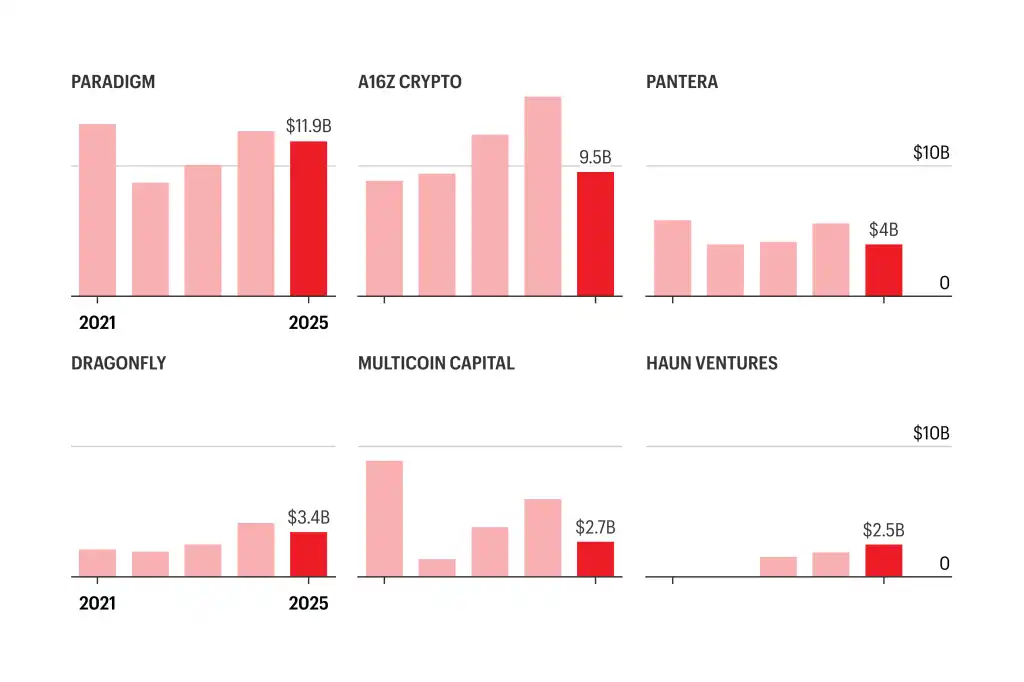
Fortune reporter Ben Weiss obtained a batch of previously undisclosed investment advisor financial disclosure documents from the U.S. Securities and Exchange Commission (SEC). The data is straightforward: the AUM of top institutions like Paradigm and Pantera Capital collectively shrunk in 2025.

Caption: Changes in AUM of top crypto VCs from 2021 to 2025

Chart by: Ben Weiss / Fortune

But before listing the numbers, there's a premise to clarify: AUM is not a good indicator of VC success or failure. It does not reflect new rounds of financing, LP exit distributions, or capital calls. Crypto asset prices themselves are highly volatile—a tweet from a moody man can send prices on a roller coaster (Elon Musk, Donald Trump, Changpeng Zhao, take your pick). Veteran crypto VCs have experienced asset surges during the 2021 NFT frenzy and subsequent portfolio plunges during the "crypto winter."

Original author Ben Weiss also emphasized: Truly top investors ultimately return money to LPs. Short-term AUM changes do not equal performance quality.

With that premise clear, let's look at the specific data.

a16z crypto: AUM shrunk nearly 40%, but money returned to LPs

The combined AUM of a16z crypto's four crypto funds plummeted nearly 40% from 2024, dropping to $9.5 billion. During the same period, the parent company Andreessen Horowitz's assets under management swelled to over $100 billion.

Part of the reason for the shrinkage is that the institution began distributing returns from the first three funds back to LPs. According to informed sources, a16z crypto intentionally chose to make distributions at the 2025 crypto market peak.

How effective was it? According to Newcomer data, a16z's first crypto fund achieved a net DPI (Distributed to Paid-In capital ratio) of 5.4x. Compared to other VC funds raised in the same period in 2018 on the Carta platform, this return rate is quite impressive.

In other words, the AUM shrinkage for a16z crypto is more a result of "making money and returning it to LPs" rather than "plummeting holdings."

Multicoin: AUM halved to $2.7 billion

Multicoin Capital's fate is deeply tied to the crypto market. During the 2021 crypto frenzy, its AUM nearly tripled in a year, approaching $9 billion. After FTX collapsed, it plummeted directly, then gradually rebounded over the next two years.

But the 2025 downturn hit it again. From 2024 to 2025, Multicoin's AUM shrunk by more than half, falling to approximately $2.7 billion. Since BTC began its dive in October 2025, crypto assets have retreated across the board, and Multicoin's structure—which operates both hedge funds and VC funds—was hit hardest.

Additional context: Multicoin co-founder Kyle Samani left the company in February this year, turning to invest in other areas of technology.

Pantera: Five portfolio companies IPO, capital returned to LPs

Pantera Capital's AUM also shrunk, but similar to a16z, part of the reason is active distributions to LPs.

According to informed sources, Pantera had five portfolio companies go public in 2025, including Circle and BitGo. These exits brought significant cash returns.

Haun Ventures: The only one growing against the trend, AUM up over 30%

Amid the widespread shrinkage, Haun Ventures is the only exception.

The institution, founded by former a16z crypto partner Katie Haun, saw its AUM increase by over 30% year-on-year, approaching $2.5 billion. This is partly due to betting on the right track—its investment in stablecoin company BVNK was acquired by Mastercard for up to $1.8 billion. Additionally, Haun Ventures itself raised a new $1 billion fund in 2025.

New fundraising rounds have begun

Although AUM has shrunk, top institutions have not stopped:

Paradigm is raising a new fund of up to $1.5 billion. a16z crypto is raising up to $2 billion. Dragonfly just closed its $650 million fourth fund. Post-publication correction by Fortune: A Dragonfly spokesperson actually responded, confirming the data is "accurate" and stating, "We are actively deploying capital."

Spokespersons for Paradigm, Pantera, a16z crypto, Multicoin, and Haun Ventures all declined to comment.

The cyclical fate of crypto VCs

The original article ends here, but a few background points are worth adding.

Crypto VCs are fundamentally different from traditional tech VCs. Traditional VCs invest in equity, exiting through IPOs or M&A. Many crypto startups have their own tokens, and VCs' holdings are directly exposed to token price fluctuations.

Multicoin is the most extreme case: According to a previous Fortune report, its assets increased by 20,287% from 2017 to 2021, then retreated 90% in 2022. This magnitude is unimaginable in the traditional VC field.

According to Pantera Capital's outlook report earlier this year, the total crypto market cap excluding BTC (also excluding ETH and stablecoins) fell about 44% from the end of 2024 highs. But according to historical patterns, bear markets are also windows for bottom-fishing. The intensive fundraising efforts by several leading institutions at this moment are betting on the next cycle.

According to a previous Fortune exclusive report, a16z crypto's fifth fund is planned to complete fundraising in the first half of 2026, led by Chris Dixon, and will continue to fully bet on the blockchain direction. Paradigm's new fund, according to The Wall Street Journal, will expand into AI and robotics technology. The strategic divergence is clear: a16z continues all-in on crypto, while Paradigm chooses cross-sector hedging.

Связанные с этим вопросы

QAccording to the article, which major crypto VC firm saw its AUM decrease by nearly 40% in 2025?

Aa16z crypto saw its AUM decrease by nearly 40% in 2025.

QWhat was the primary reason for the AUM decline at a16z crypto, as explained in the article?

AThe primary reason for the AUM at a16z crypto was that the firm chose to distribute returns from its first three funds back to its LPs during the 2025 crypto market peak.

QWhich crypto VC was the only one mentioned to experience AUM growth in 2025, and what was a key reason for this growth?

AHaun Ventures was the only crypto VC to experience AUM growth, increasing by over 30%. A key reason was its successful investment in the stablecoin company BVNK, which was acquired by Mastercard for up to $1.8 billion.

QWhat significant event involving five of its portfolio companies contributed to Pantera Capital's AUM decrease?

APantera Capital's AUM decrease was partly due to it distributing capital back to its LPs following the successful IPOs of five of its portfolio companies, including Circle and BitGo.

QHow does the article describe the fundamental difference between crypto VC and traditional tech VC regarding their investments?

AThe article states that traditional VCs invest in equity and exit via IPOs or acquisitions, while many crypto startups have their own tokens, meaning a crypto VC's holdings are directly exposed to the volatility of token prices.

Похожее

Has the 'Digital Gold' Narrative for BTC Failed?

**Title: Has the "Digital Gold" Narrative for Bitcoin Failed?** The article argues that Bitcoin's "digital gold" narrative remains valid despite a recent sharp price decline (from a peak near $126k in Oct 2025 to briefly under $61k in Feb 2026). It presents a long-term investment framework based on three core points: **1. Viewing Bitcoin as an Asset:** Bitcoin is presented as a superior potential store of value compared to gold. Key arguments are its absolute scarcity (21 million cap), superior portability, and transparent auditability via its public ledger. While acknowledging its current use in early, volatile stages (~3-4% global adoption), the author draws parallels to the early, disruptive phases of the internet and e-commerce. **2. Understanding the Recent Downturn:** The current ~50% correction is framed as a predictable, consensus-driven cycle following its post-halving peak (the 2024 halving preceded the Oct 2025 high). A crucial factor is a historic "changing of hands": the influx of new institutional buyers via ETFs allowed early, low-cost holders (miners, OG believers) to take profits. The author notes that while severe, Bitcoin's historical drawdowns (e.g., 93% in 2011, 77% in 2021-22) have been progressively smaller, suggesting maturing holder structure and decreasing volatility over time. **3. The Long-Term Perspective:** The long-term thesis hinges on Bitcoin capturing a portion of gold's market value. With Bitcoin's market cap at ~$1.4 trillion (at $70k) versus gold's ~$20 trillion, significant upside potential exists if the "digital gold" narrative is partially realized. However, the author strongly cautions that short-term risks remain, the bottom is unpredictable, and high volatility is inherent. The real risk is not Bitcoin failing but poor personal position management (over-leverage, wrong capital) and a lack of deep understanding, which can force investors out during severe downturns. The conclusion uses Amazon's 95% crash post-2000 dot-com bubble and subsequent 42x recovery as an analogy. The ultimate question is not if Bitcoin's price will rise, but if an investor's strategy and conviction can withstand the volatility to see the long-term play out. The recent divergence (gold up, Bitcoin down) is posed not as a narrative failure, but as potential evidence of this ongoing, painful transition from a speculative asset to a mainstream allocation.

marsbit27 мин. назад

Has the 'Digital Gold' Narrative for BTC Failed?

marsbit27 мин. назад

Has BTC's 'Digital Gold' Narrative Failed?

The article discusses Bitcoin's "digital gold" narrative, its recent price drop, and long-term outlook through the perspective of "Jason". It argues the narrative is not a failure but that Bitcoin represents a superior, new asset class due to its fixed supply (21 million), portability, and auditability. The piece compares its current ~3-4% global adoption rate to early internet/e-commerce, suggesting significant growth potential. Regarding the 2025-2026 price decline (from ~$126k to briefly under $61k), the author views it as a predictable, consensus-driven sell-off within Bitcoin's ~4-year cycle post-halving, exacerbated by a major "handover" from early, low-cost holders to new institutional buyers via ETFs. A key observation is that historical peak-to-trough drawdowns have lessened over time (e.g., 93% in 2011 to ~50% in 2026), indicating maturing volatility as holder structure changes. For the long term, the author uses a simple framework: Bitcoin's total market cap (~$1.4T at $70k) is only about 7% of gold's (~$20T). Even capturing 30-50% of gold's value would imply substantial upside. However, the article strongly cautions against viewing this as investment advice, emphasizing extreme volatility and the critical importance of risk management, position sizing, and deep fundamental understanding to survive severe drawdowns. It concludes by drawing a parallel to Amazon's 95% crash in 2000 and subsequent 42x recovery, stressing that the key is surviving market cycles to realize long-term potential.

链捕手37 мин. назад

Has BTC's 'Digital Gold' Narrative Failed?

链捕手37 мин. назад

From Code to Cognition: A Ten-Thousand-Word Guide to the Evolution of the Robot Brain

"From Code to Cognition: The Evolution of Robot Brains" The journey of robotic intelligence has shifted dramatically from manually coded systems to AI-driven brains. For decades, robots relied on layered software stacks—perception, state estimation, planning, control—each handcrafted. While predictable, they lacked adaptability. The 2010s saw deep learning revolutionize perception (e.g., object detection) and control (via reinforcement learning), but learned skills remained narrow. The arrival of Large Language Models (LLMs) marked a turning point. LLMs acted as high-level planners, interpreting natural language instructions and generating sequences of actions for traditional robotic systems to execute. However, true integration came with Visual-Language-Action (VLA) models, which fused vision, language, and motion prediction into a single network. Pioneered by models like RT-2 and open-source projects like OpenVLA, VLAs enable robots to reason and act directly from visual input and commands. The most advanced humanoid robots now employ a "dual-brain" architecture: a slow-thinking, large VLA (System 2) for reasoning and planning, and a fast-reacting, small network (System 1) for high-frequency motion control, sometimes with an even lower-level System 0 for balance. This split balances cognition with the physics of real-time movement. Computation is split between onboard hardware (e.g., NVIDIA Jetson) for safety-critical control loops and cloud/edge servers for non-critical tasks like learning and interfaces. A crucial driver is the open-source ecosystem—models like GR00T and OpenVLA allow startups to build upon pre-trained brains and fine-tune them with their own data, accelerating development. Despite progress, current systems struggle with recovery from errors, sample inefficiency, and long-horizon tasks. This has spurred the rise of **World Models**—neural networks that predict the consequences of actions. By simulating possible futures before acting (like NVIDIA Cosmos or Meta V-JEPA), robots can plan, recover, and generalize better. This represents the next frontier: shifting intelligence from learned reactions to an internal model of physics and cause-and-effect. The field is rapidly evolving. While not yet at its "ChatGPT moment," the convergence of cheaper hardware, scalable simulation, and world models points toward robots that are increasingly capable, adaptive, and useful. The question is shifting from "what can robots do?" to "what *should* they do?"

marsbit1 ч. назад

From Code to Cognition: A Ten-Thousand-Word Guide to the Evolution of the Robot Brain

marsbit1 ч. назад

AI Bubble Is Bursting

The AI Bubble is Bursting: A Necessary Purge on the Path to Ubiquitous Intelligence Market volatility has reignited debates about an AI bubble, with figures like Ray Dalio pointing to high valuations. However, this parallels the dot-com bubble, which, despite its crash, laid the physical infrastructure for today's internet era. The current AI investment frenzy, with tech giants planning trillions in infrastructure spending far outstripping current AI application revenues, appears similarly imbalanced. This 'bubble' is seen as an inevitable phase for a disruptive technology, paying the "innovation tax." Critically, AI inference costs have plummeted over 99.7% since 2023, making intelligence nearly free at the margin. This hasn't reduced spending but has instead unlocked massive new demand, as seen in enterprise AI cloud expenditure tripling. This follows the Jevons Paradox: efficiency gains lead to greater total consumption. The market is now entering a cleansing phase, weeding out speculative ventures lacking real moats. The deeper shift is a move from capital expenditure (CapEx) on hardware to value creation in operational expenditure (OpEx) through AI applications that solve real industry problems. While infrastructure valuations are high, rapid earnings growth from widespread AI adoption across sectors—from manufacturing and finance to law and healthcare—may digest these valuations over time. Ultimately, this creative destruction will leave behind robust infrastructure and optimized models, cheaply powering an AI-augmented future for all industries, much as the internet became indispensable after its own bubble burst. The core productive potential remains undiminished.

链捕手1 ч. назад

AI Bubble Is Bursting

链捕手1 ч. назад

Торговля

Спот
Фьючерсы
活动图片