Following the Clues: Guess What Projects a16z with $15 Billion Will Invest In?

marsbitОпубликовано 2026-01-12Обновлено 2026-01-12

Введение

a16z Raises $15 Billion, Signaling Major Crypto Investments Ahead Venture capital giant Andreessen Horowitz (a16z) has raised $15 billion in new funding, its largest round to date. The firm emphasized that winning the next century of technological competition hinges on advancements in AI and crypto. The capital will be allocated across six funds, with significant implications for the crypto sector: * **App Fund ($1.7B):** Targets consumer applications, including Web3, fintech, and AI apps. * **Infrastructure Fund ($1.7B):** Focuses on foundational tech, including blockchain protocols (L1s, L2s), developer tools, and AI infrastructure. * **Growth Fund ($6.75B):** Will back mature, late-stage companies, such as established crypto exchanges and unicorns (e.g., Coinbase). A review of a16z's 2025 investments revealed heavy bets on prediction markets (Kalshi), wallet services, privacy blockchains, stablecoins, and AI-crypto intersections. Looking to 2026, a16z's published "big ideas" highlight key areas of excitement, suggesting these will be prime investment targets. These include: * Enhanced privacy as a core crypto feature. * The expansion of smarter prediction markets. * "Crypto-native" stablecoins and real-world asset (RWA) tokenization. * Improved on/off-ramps for stablecoins. * The convergence of AI and crypto, specifically around agentic systems ("know your agent"). * The concept of the internet evolving into a bank. In summary, a16z's massive new war...

Original | Odaily Planet Daily (@OdailyChina)

Author | Azuma (@azuma_eth)

On January 9, amidst a highly active cryptocurrency market, the venture capital giant Andreessen Horowitz (a16z) announced the completion of a new $15 billion fundraising round. This is the largest fundraising effort in the firm's history, accounting for over 18% of the total venture capital raised in the United States in 2025.

In the relatively brief official announcement, a16z mentioned cryptocurrency twice. The most critical statement, "Our mission is to ensure that the United States wins the technological competition of the next 100 years, which begins with winning the key architectures of the future—artificial intelligence and cryptocurrency technology," indicates that a16z, now well-funded, will continue to actively invest in the cryptocurrency market.

Breakdown of Six Major Directions

According to a16z's plan, this batch of funds will be allocated across six major directions: the American Dynamism fund will receive $1.176 billion, the App fund $1.7 billion, the Bio + Health fund $700 million, the Infrastructure fund $1.7 billion, the Growth fund $6.75 billion, and the Other Venture Strategies fund $3 billion.

Although a16z did not explicitly designate a dedicated cryptocurrency fund in this fundraising, these six directions actually have significant overlap with cryptocurrency.

First is the American Dynamism fund. This is a direction with a clear "political" focus that a16z has been promoting in recent years. Its core goal is to use venture capital to rebuild America's "hard power" and national competitiveness. The fund will primarily invest in aerospace, defense, public safety, education, housing, supply chain, industry, and manufacturing—objectively speaking, this fund has little crossover with cryptocurrency.

Next is the App fund. This is one of a16z's most traditional and VC-centric funds. Its core goal is to focus on application-layer products that can be directly used by consumers. The fund will mainly invest in consumer internet products, AI applications, creator tools, social products, content services, gaming, fintech, and Web3 applications—this is also the direction where a16z's cryptocurrency narrative is most easily realized.

Then comes the Bio + Health fund. This is a long-term bet for a16z beyond "pure technology." Its core goal is to use software, data, and engineering thinking to transform the life sciences and healthcare systems. The fund's main investment areas include biotechnology, drug development platforms, gene editing, synthetic biology, medical data and AI diagnostics, and healthcare infrastructure software—this part has little direct overlap with cryptocurrency, but DeSci could be a potential intersection point.

The Infrastructure fund focuses on infrastructure. Its core goal is to provide an irreplaceable technological foundation for the next generation of applications and platforms. The fund's main investment areas are cloud computing and distributed systems, AI infrastructure, data platforms, developer tools, network protocols, and blockchain underlying protocols (L1, L2, other tools)—this is another core battleground for a16z in the cryptocurrency space, alongside the App fund.

The Growth fund primarily invests in Series C and later stages, as well as Pre-IPO stages. Its core goal is not to find new opportunities but to amplify returns by supporting proven winners. The fund mainly invests in mature tech companies, AI platforms, fintech unicorns, and mature Web3 infrastructure or applications—a16z's official website shows that Coinbase, Kalshi, and others are explicitly categorized here.

The Other Venture Strategies fund is relatively special. It does not have a single theme but is more like a flexible "tactical capital pool," often used for special structure transactions, cross-fund collaborative investments, emerging field experimentation, secondary market opportunities, regional or thematic experimental funds, etc.—this fund has little direct crossover with cryptocurrency, but it cannot be ruled out that temporary associations may occur at special junctures, such as responsive moves during certain policy windows.

Looking at the six intended directions for this $15 billion, the App fund, Infrastructure fund, and Growth fund will be the main channels for a16z to inject capital into the cryptocurrency primary market. Among them, the App fund and Infrastructure fund will focus more on native application-layer and protocol-layer projects in the cryptocurrency market, respectively; while the Growth fund will focus more on platform-type services such as exchanges and prediction markets, and its investments will tend to favor leading players in sectors that have already shown advantages.

a16z's Investment Review for 2025

According to incomplete statistics from Odaily Planet Daily, a16z made a total of 31 investments in the broader cryptocurrency field over the past year, with two investments each in prediction market Kalshi, AI security company Doppel, and privacy blockchain Seismic—especially Kalshi. a16z first co-led a $300 million Series D funding round for the company in October with Sequoia, at a valuation of $5 billion; it invested again in November, participating in the company's $1 billion Series E funding round at a valuation of $11 billion—this was a16z's biggest bet in the cryptocurrency field last year.
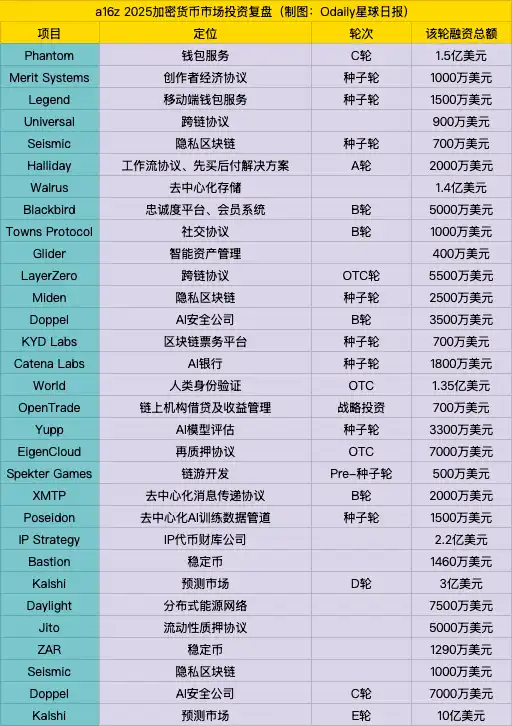
As can be seen from the statistics in the chart above, aside from the heavy bet on prediction markets, wallet services, privacy blockchains, stablecoins, and the intersection of AI and cryptocurrency were the focus of a16z's布局 in 2025. These sub-sectors can be categorized into the blockchain underlying protocols and tools covered by the Infrastructure fund, and the fintech and AI applications covered by the App fund.

a16z's Predictions for 2026

On New Year's Day 2026, a16z Crypto officially published a New Year's outlook article. In the article, a16z mentioned 17 potential developments they are excited about for 2026, which may contain clues to the firm's focus areas for future investments.
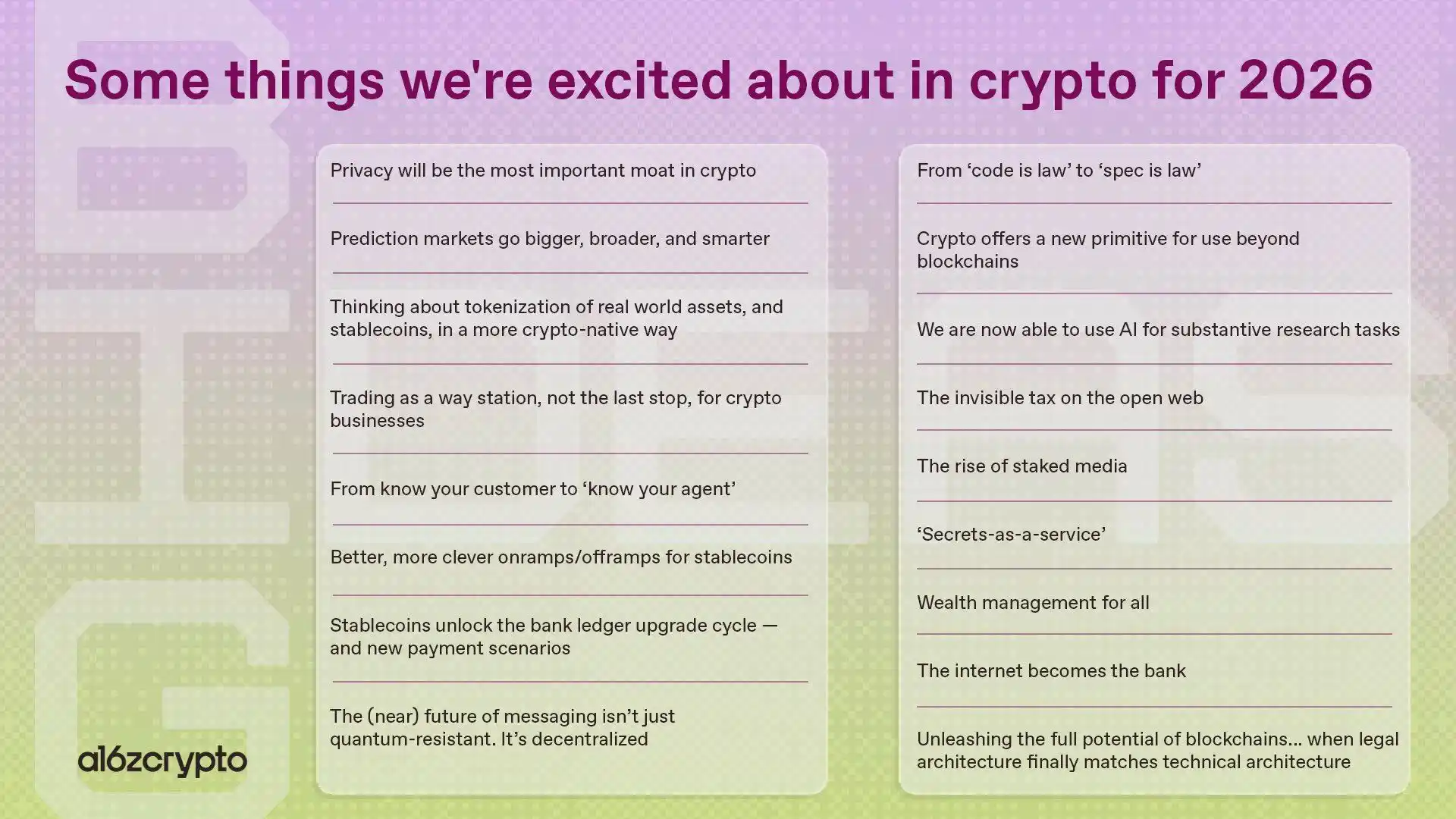
These 17 potential developments are:

  • Privacy will become the most important moat in crypto;
  • Prediction markets will become larger, broader, and smarter;
  • Thinking more "crypto-natively" about real-world asset tokenization and stablecoins;
  • Trading is just a waystation for crypto businesses, not the final destination;
  • From "Know Your Customer" (KYC) to "Know Your Agent";
  • Better, smarter on-ramps and off-ramps for stablecoins;
  • Stablecoins will kick off a bank ledger upgrade cycle and spawn new payment scenarios;
  • The future of instant messaging is not just quantum-resistant, but also decentralized;
  • From "code is law" to "norms are law";
  • Crypto is providing a new kind of foundational primitive whose uses go beyond blockchains themselves;
  • We can now use AI to perform substantive research tasks;
  • The "invisible tax" of the open internet;
  • The rise of Staked Media;
  • "Secrets-as-a-Service";
  • Wealth management for everyone;
  • The internet is becoming the bank;
  • When the legal framework finally matches the technical framework, the full potential of blockchains will be unleashed.

Among these 17 potential developments, some explicitly mention specific business models, including the sectors a16z has already heavily invested in, such as privacy, prediction markets, stablecoins, and AI. a16z also directly provided optimization paths for related models, such as the need for smarter on-ramp and off-ramp solutions for stablecoins.

At the same time, another part of the potential developments belongs to imaginings of future states, such as the internet eventually becoming the bank. However, how these imaginings will be realized is not clearly answered by a16z—this question needs to be left to entrepreneurs who can bring innovative solutions, and they are precisely the targets that a16z's $15 billion is most eager to find.


Связанные с этим вопросы

QWhat are the six main directions a16z plans to allocate its new $15 billion funding, and which ones are most relevant to cryptocurrency?

AThe six directions are: American Dynamism ($1.176B), App ($1.7B), Bio + Health ($0.7B), Infrastructure ($1.7B), Growth ($6.75B), and Other Venture Strategies ($3B). The App, Infrastructure, and Growth funds are most relevant to cryptocurrency, focusing on Web3 applications, blockchain protocols, and mature crypto companies respectively.

QWhich cryptocurrency-related sectors did a16z focus on in 2025, and can you name a key company they invested in?

AIn 2025, a16z focused on wallet services, privacy blockchains, stablecoins, and AI-crypto intersections. A key investment was Kalshi, a prediction market platform, where a16z participated in both a $300M Series D (at $5B valuation) and a $1B Series E (at $11B valuation).

QAccording to a16z's 2026 outlook, what are some specific areas they are excited about for cryptocurrency development?

Aa16z's 2026 outlook highlights 17 areas, including privacy as a key moat, expansion of prediction markets, improved stablecoin on/off ramps, 'crypto-native' RWA tokenization, AI agent verification, decentralized communication, and the evolution from 'code is law' to 'norms as law'.

QHow does a16z's Infrastructure fund specifically support the cryptocurrency ecosystem?

AThe Infrastructure fund ($1.7B) supports cryptocurrency by investing in blockchain底层协议 (L1s, L2s), distributed systems, network protocols, and developer tools that form the foundational technology for next-generation applications and platforms in crypto.

QWhat is the overarching mission statement a16z emphasized in their funding announcement regarding future technology competition?

Aa16z's mission is 'to ensure that America wins the next 100 years of technological competition, starting with winning the key architectures of the future—artificial intelligence and crypto technologies.'

Похожее

The Essence of AI Layoffs: Why More AI Adoption Leads to More Corporate Anxiety?

The author, awaiting potential inclusion on an 8000-person layoff list, analyzes the true nature of recent "AI-driven" layoffs. They argue that while AI use, particularly tools like Claude for code generation, has skyrocketed and boosted developer output (e.g., 2-5x more code commits), this has not translated into proportional business growth or revenue. The core issue is a misalignment between increased "Input" (code) and tangible "Outcomes" (user value, revenue). AI acts as a costly B2B SaaS, inflating operational expenses without guaranteed returns. Two key problems emerge: 1) The friction that once filtered out bad ideas is gone, as AI allows cheap pursuit of even weak concepts. 2) Organizational "alignment tax"—the difficulty of coordinating across teams—becomes crippling when development velocity outpaces consensus-building. Thus, layoffs serve two immediate purposes: 1) To offset ballooning AI costs (Token consumption) and maintain cash flow, as rising input costs without outcome growth destroys unit economics. 2) To reduce organizational bloat and alignment friction by simply removing teams, thereby speeding up execution in the short term. Therefore, these layoffs are fundamentally caused by AI, even if AI doesn't directly replace roles. They represent a painful correction until companies learn to convert AI-driven productivity into real business outcomes and streamline organizational coordination to match the new pace of work. The cycle will continue until this learning curve is mastered.

marsbit32 мин. назад

The Essence of AI Layoffs: Why More AI Adoption Leads to More Corporate Anxiety?

marsbit32 мин. назад

Can the Solana Foundation and Google's Collaboration on Pay.sh Bridge the Payment Link Between Web2 and Web3 in the Agent Economy?

Solana Foundation, in collaboration with Google Cloud, has launched Pay.sh, a payment gateway designed to bridge the gap between AI agents and enterprise-grade service infrastructure. The initiative aims to solve a key bottleneck in the "agent economy": existing payment systems are ill-suited for autonomous AI agents. Traditional methods like credit cards require human verification, while newer on-chain protocols like x402 and MPP create a separate, Web3-native system that raises barriers for service providers. Pay.sh functions as a universal payment layer. It allows users to fund a Solana wallet via credit card or stablecoin, which then acts as an identity and payment proxy for AI agents. When an agent needs to access a paid API service (e.g., Google Cloud, Alibaba Cloud), Pay.sh handles the transaction seamlessly. It leverages the HTTP 402 status code ("Payment Required") to initiate payments, intelligently choosing between one-time transfers (x402-style) or session-based authorizations (MPC-style) based on the service's billing model. This spares agents from manual account registration and API key management. A key feature for service providers is low integration effort. They can adopt Pay.sh by providing a declarative configuration file, enabling features like tiered pricing, free tiers, and automatic revenue splitting to multiple addresses (e.g., for royalties, cloud costs). Providers can also list their APIs in a central Pay Skill Registry for agent discovery. The collaboration with Google Cloud provides crucial infrastructure for API proxying, traffic routing, and compliance logging, aiming to keep agent activities within regulated boundaries. By connecting Web2 services with Web3 payment rails, Pay.sh positions the Solana wallet as a foundational identity and payment tool for AI agents, potentially driving more transaction volume to the Solana ecosystem. However, the report notes challenges. The service registry currently lacks robust vetting, risking exposure to unauthorized or malicious third-party APIs. Pay.sh also inherits security and compatibility risks from its underlying payment protocols (x402, MPC). Furthermore, adoption may be hindered by varying regional data privacy and payment compliance regulations among API providers. Despite these hurdles, Pay.sh represents a significant step towards integrating Web2 and Web3 for autonomous agent commerce.

marsbit39 мин. назад

Can the Solana Foundation and Google's Collaboration on Pay.sh Bridge the Payment Link Between Web2 and Web3 in the Agent Economy?

marsbit39 мин. назад

Bitcoin's Bull-Bear Cycle Indicator Turns Positive for the First Time in 7 Months: End of Bear Market or False Breakout?

Bitcoin's "Bull-Bear Market Cycle Indicator" from CryptoQuant has turned positive for the first time since October 2025. This gauge, based on the P&L Index relative to its 365-day moving average, suggests a potential shift from a bear market phase. Concurrently, the Bull Score Index rose to a neutral reading of 50 in late April. The indicator's move into positive territory follows a roughly 35% price rebound from a low near $60,000 in February to above $81,000. The recovery over approximately three months was faster than the 12-month period observed during the 2022 bear market. However, analysts caution against premature optimism, citing a historical precedent from March 2022. Back then, the Bull Score Index briefly hit 50, but it proved to be a false signal as Bitcoin's price subsequently plunged further. Structural differences exist in the current cycle, including consistent inflows into spot Bitcoin ETFs and an increase in large holder addresses. Yet, some models, referencing the four-year halving cycle, suggest a potential deeper bottom near $50,000 might still be possible around late 2026. In summary, while on-chain data shows marked improvement and the worst panic may be over, market participants remain cautious. A convincing trend reversal confirmation likely requires Bitcoin to sustainably break above key resistance, such as the 200-day moving average near $82,000.

marsbit46 мин. назад

Bitcoin's Bull-Bear Cycle Indicator Turns Positive for the First Time in 7 Months: End of Bear Market or False Breakout?

marsbit46 мин. назад

How to Automate Any Workflow with Claude Skills (Complete Tutorial)

This is a comprehensive guide to mastering Claude Skills, a feature for creating permanent, reusable instruction sets that automate specific workflows. Unlike simple saved prompts, Skills function like trained employees, delivering consistent, high-quality outputs by defining the entire task process, standards, error handling, and output format. The guide is structured in four phases: **Phase 1: Installation (5 minutes).** Skills are folders containing a `SKILL.md` file. The user is instructed to find a relevant Skill online, install it, test it on a real task, and compare its performance to one-off prompts. **Phase 2: Building Your First Custom Skill.** Start by rigorously defining the Skill's purpose, trigger phrases, and providing a concrete example of perfect output. The `SKILL.md` file has two parts: a YAML frontmatter with a specific name/description/triggers, and a detailed, step-by-step workflow written in natural language with examples and quality standards. **Phase 3: Testing & Optimization for Production.** Test the Skill in three scenarios: 1) a standard, common task; 2) edge cases with missing or conflicting data; and 3) a pressure test with maximum complexity. Any failure indicates a needed instruction. Implement a weekly optimization cycle to continuously refine the Skill based on real usage. **Phase 4: Building a Complete Skill Library.** The goal is to create a team of Skills for all repetitive tasks. Examples are given for industries like real estate, marketing, finance, consulting, and e-commerce. The user should list their tasks, prioritize them, and build one new Skill per week, maintaining a master document to track their library. The conclusion emphasizes the compounding time savings: ten Skills saving 30 minutes each per week reclaims over 260 hours (6.5 work weeks) per year, fundamentally transforming one's work system.

marsbit1 ч. назад

How to Automate Any Workflow with Claude Skills (Complete Tutorial)

marsbit1 ч. назад

Торговля

Спот
Фьючерсы
活动图片