Fitch Ratings flags risk for US banks with high crypto exposure

cointelegraphОпубликовано 2025-12-09Обновлено 2025-12-09

Введение

Fitch Ratings warns that US banks with significant cryptocurrency exposure may face negative reassessments of their business models and risk profiles. While crypto integration can offer benefits like improved efficiency and new revenue streams, it also introduces reputational, liquidity, operational, and compliance risks. The agency notes that banks must adequately manage challenges such as crypto volatility, pseudonymity of owners, and security of digital assets. A downgrade from Fitch could lead to lower investor confidence and higher borrowing costs for these banks. The report also highlights systemic risks from the growing stablecoin market, which could impact the broader system and even the Treasury market if adoption expands sufficiently. Major banks like JPMorgan and Bank of America are mentioned as being involved in the sector.

International credit rating agency Fitch Ratings has warned that it may reassess US banks with “significant” cryptocurrency exposure negatively.

In a report posted on Sunday, Fitch Ratings argued that while crypto integrations can boost fees, yields and efficiency, they also pose “reputational, liquidity, operational and compliance” risks for banks.

“Stablecoin issuance, deposit tokenization and blockchain technology use give banks opportunities to improve customer service. They also let banks leverage blockchain speed and efficiency in areas such as payments and smart contracts,” Fitch said, adding:

“However, we may negatively re-assess the business models or risk profiles of U.S. banks with concentrated digital asset exposures.”

Fitch stated that while regulatory advancements in the US are paving the way for a safer cryptocurrency industry, banks still face several challenges when dealing with cryptocurrencies.

“However, banks would need to adequately address challenges around the volatility of cryptocurrency values, the pseudonymity of digital asset owners, and the protection of digital assets from loss or theft to adequately realize the earnings and franchise benefits,” said Fitch.

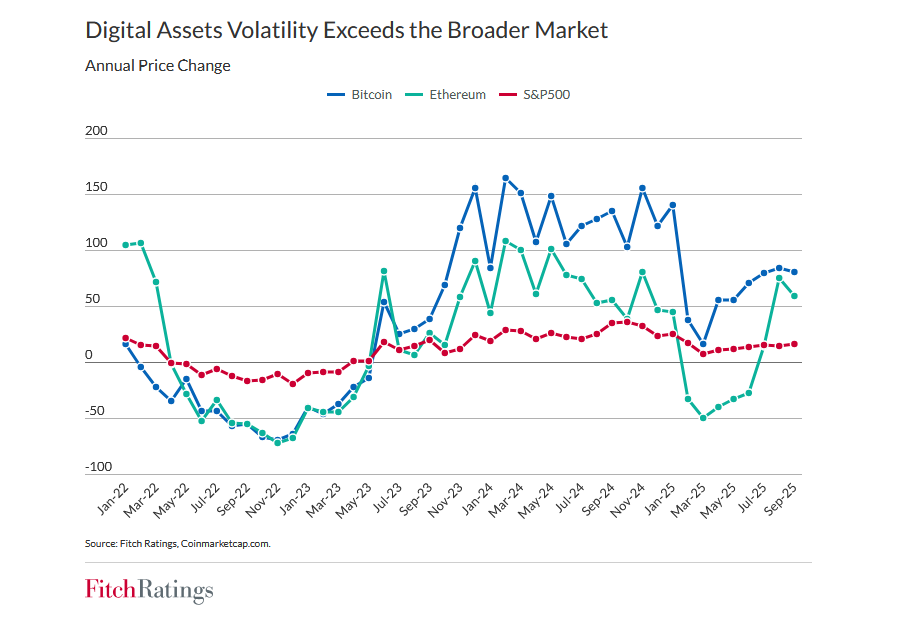
Bitcoin and Ether volatility vs S&P 500. Source: Fitch Ratings

Fitch Ratings is one of the “Big Three” credit rating agencies in the US alongside Moody’s and S&P Global Ratings.

The ratings from these firms — which can be controversial — carry significant weight in the financial world and impact how businesses are perceived or invested in from an economic viability perspective.

As such, Fitch’s downgrading the ratings of a bank with significant crypto exposure could result in lower investor confidence, higher borrowing costs and challenges to growth.

The report highlighted that several major banks, including JPMorgan Chase, Bank of America, Citigroup, and Wells Fargo, are involved in the crypto sector.

Fitch highlights systemic stablecoin risks

Fitch argued that another risk could come from the explosive growth of the stablecoin market, especially if it becomes large enough to influence other areas and institutions.

“Financial system risks could also increase if adoption of stablecoins expands, particularly if it reaches a level sufficient to influence the Treasury market.”

Related: Crypto, TradFi sentiment improves: Will Bitcoin traders clear shorts above $93K?

Moody’s also recently highlighted potential systemic risks of stablecoins in a report from late September, arguing that widespread adoption of stablecoins in the US could ultimately threaten the legitimacy of US dollar.

“High penetration of USD-linked stablecoins in particular can weaken monetary transmission, especially where pricing and settlement increasingly occur outside the domestic currency,” Moody’s said.

“This creates cryptoization pressures analogous to unofficial dollarization, but with greater opacity and less regulatory visibility,” it added.

Magazine: When privacy and AML laws conflict: Crypto projects’ impossible choice

Похожее

Polymarket's "2028 Presidential Election" Volume King Is... LeBron James???

An article from Odaily Planet Daily, authored by Azuma, discusses a peculiar phenomenon observed on the prediction market platform Polymarket regarding the "2028 US Presidential Election" event. Despite having a real-time probability of less than 1%, unlikely candidates such as NBA star LeBron James (with $48.41 million in trading volume), celebrity Kim Kardashian ($33.84 million), and even ineligible figures like Elon Musk ($23.14 million) and New York City Mayor Zohran Mamdani ($18.39 million) account for approximately 70% of the total trading volume. In contrast, high-probability candidates like Vice President JD Vance ($10.58 million), California Governor Gavin Newsom ($15.71 million), and Secretary of State Marco Rubio ($9.32 million) have significantly lower trading activity. The article explains that this counterintuitive trend is not driven by irrational speculation but by rational strategies. Polymarket offers a 4% annualized holding reward for certain markets, including the 2028 election, to maintain long-term pricing accuracy. This yield exceeds the current 5-year US Treasury rate (3.98%), attracting large investors ("whales") to hold "NO" shares on low-probability candidates for risk-free returns. Additionally, some users utilize a platform feature that allows converting a set of "NO" shares into corresponding "YES" shares for better liquidity or pricing efficiency, rather than directly buying "YES" shares for their preferred candidates. Thus, the seemingly absurd trading activity is strategically motivated.

marsbit31 мин. назад

Polymarket's "2028 Presidential Election" Volume King Is... LeBron James???

marsbit31 мин. назад

Dialogue with ViaBTC CEO Yang Haipo: Is the Essence of Blockchain a Libertarian Experiment?

"ViaBTC CEO Yang Haipo: Blockchain as a Hardcore Libertarian Experiment" In a deep-dive interview, ViaBTC CEO Yang Haipo reframes the essence of blockchain, arguing it is not merely a new technology or infrastructure but a hardcore libertarian experiment. This experiment, born from the 2008 financial crisis and decades of cypherpunk ideology, tests a fundamental question: to what extent can freedom and self-organization exist without centralized trust? The discussion highlights the experiment's verified outcomes. On one hand, it has proven its core value of censorship resistance, providing critical financial lifelines for entities like WikiLeaks and individuals in hyperinflationary or sanctioned countries via tools like stablecoins. However, Yang points out a key paradox: the most successful product, USDT, is itself a centralized compromise, showing users prioritize a less-controlled pipeline over pure decentralization. On the other hand, the experiment has exposed the severe costs of this freedom—a "dark forest" without safeguards. Events like the collapses of LUNA, Celsius, and FTX, resulting in massive wealth destruction and prison sentences for founders, underscore the system's fragility and the inherent risks of an unregulated environment. Yang observes that despite decentralized protocols, human nature inevitably recreates centralized power structures, speculative frenzies, and narrative-driven cycles (from ICOs to Meme coins), where emotion and belonging often trump technological substance. Looking forward, he believes blockchain's future is significant but niche. Its real value lies in serving specific, real-world needs for financial sovereignty and bypassing traditional controls, not as a universal infrastructure replacing all centralized systems. For the average participant, Yang's crucial advice is to cultivate independent judgment. True freedom is not holding a crypto wallet, but possessing a mind resilient to groupthink and narrative hype in a high-risk, often irrational market.

marsbit45 мин. назад

Dialogue with ViaBTC CEO Yang Haipo: Is the Essence of Blockchain a Libertarian Experiment?

marsbit45 мин. назад

Торговля

Спот
Фьючерсы
活动图片