Fed warns of ‘long, painful history’ – Why stablecoin oversight is urgent

ambcryptoОпубликовано 2026-04-01Обновлено 2026-04-01

Введение

Federal Reserve Governor Michael Barr has called for strict stablecoin oversight, citing risks to financial stability and a surge in illicit use. Chainalysis data shows stablecoins now account for 84% of illegal crypto activity, up from 15% in 2020, often facilitating terrorism financing and sanctions evasion. Barr warned that unregulated private money historically caused bank runs, emphasizing the need for tight reserve asset controls, supervision, and liquidity requirements. While illicit activity remains below 1% of all crypto transactions, regulators are advancing the GENIUS Act, aiming for finalized rules by mid-2026. Meanwhile, non-USD stablecoins are growing rapidly, and Asian markets—which drive over 60% of global stablecoin activity—may restrict USD-based options, potentially reshaping the $315 billion market.

Michael Barr, a member of the Federal Reserve Board of Governors, has called for caution and strict stablecoin oversight.

During a recent discussion on stablecoin law, the GENIUS Act, Barr singled out major uses of the products, including crypto trading, cheaper remittances, and savings overseas.

However, he raised concerns about stablecoins’ facilitation of terrorist financing and risk to financial stability.

Well, Chainalysis data estimates that stablecoins now account for 84% of illicit crypto activity. This is a massive spike from only 15% in 2020. Hackers are now embracing stablecoins and P2P transactions to evade sanctions.

To curb this, Barr recommended,

Both regulatory and technological solutions will need to be deployed to limit these risks.

Despite the surge, the overall illicit activity only accounts for less than 1% of total crypto transactions.

On financial stability risk, Barr cited the ‘long and painful history’ of competing private money (bank notes) in the 1800s that led to bank runs and financial panics because they traded below par.

The cause? Low-quality reserve assets and weak safeguards. Barr added,

Tight control over reserve assets, coupled with supervision, capital and liquidity requirements, and other measures, could enhance the stability of stablecoins and make them more viable payment instruments.

This is part of the rulemaking process as regulators race to meet the July 2026 deadline for implementing the GENIUS Act. So far, the OCC and NCUA have issued proposed rules for the same. The Fed and other regulators are expected to follow suit and finalize guidelines by early Q3.

Stablecoins: USD-based vs. others

For issuers, the GENIUS Act offers clear rules. But for the U.S. government, it’s an increasingly important demand line for Treasury Bills to finance its debt.

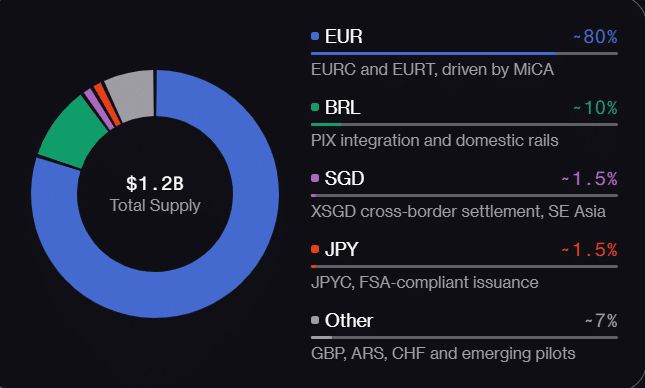
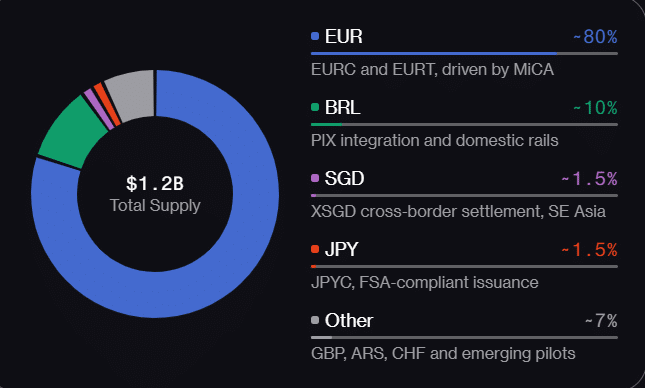
Source: Dune

Although USD-based versions (USDT, USDC) dominate the current $315 billion stablecoin market, non-USD alternatives have seen record growth. Since 2023, non-USD stablecoins have surged from $350 million to $1.2 billion. That’s a 3x expansion outpacing USD stablecoin growth, mostly dominated by Euro-based alternatives.

Beyond currency-based measures, Asia accounts for over 60% of global stablecoin activity, driven primarily by the Singapore–Japan–Hong Kong–China corridor. Interestingly, these jurisdictions are pushing for stablecoin rules that could restrict USD-based options. It’s unclear how these shifts will impact current stablecoin market dynamics in the upcoming months.


Final Summary

  • Fed’s Barr called for strong stablecoin oversight to avoid repeating the ‘painful’ bank runs of the 1800s due to private money.
  • The stablecoin market could be headed for major shifts as key global adoption jurisdictions mull restricting USD-based alternatives.

Связанные с этим вопросы

QWhat are the main concerns raised by Michael Barr regarding stablecoins?

AMichael Barr raised concerns about stablecoins facilitating terrorist financing and posing risks to financial stability, citing their use in illicit activities and the historical precedent of private money causing bank runs and financial panics in the 1800s.

QWhat percentage of illicit crypto activity do stablecoins account for according to Chainalysis data?

AAccording to Chainalysis data, stablecoins now account for 84% of illicit crypto activity, a significant increase from 15% in 2020.

QWhat solutions did Michael Barr recommend to address the risks associated with stablecoins?

AMichael Barr recommended deploying both regulatory and technological solutions, including tight control over reserve assets, supervision, capital and liquidity requirements, and other measures to enhance the stability of stablecoins.

QHow has the non-USD stablecoin market grown since 2023?

ASince 2023, non-USD stablecoins have surged from $350 million to $1.2 billion, a 3x expansion that outpaced the growth of USD stablecoins, with Euro-based alternatives dominating this segment.

QWhich regions are driving global stablecoin activity, and what regulatory shifts are they considering?

AAsia accounts for over 60% of global stablecoin activity, primarily driven by the Singapore–Japan–Hong Kong–China corridor. These jurisdictions are considering stablecoin rules that could restrict USD-based options.

Похожее

Huawei Cloud Rejects Token Price War, Zhou Yuefeng Seeks a New Winning Formula for AI Cloud

At the 2026 Huawei Cloud INSPIRE Creator Conference, CEO Zhou Yuefeng outlined Huawei Cloud's distinct strategy in the competitive AI cloud market. Instead of engaging in price wars based on token volume or Maas revenue—a common focus for rivals like Alibaba Cloud and ByteDance's Volcano Engine—Huawei Cloud is shifting the competition towards real-world productivity gains. Zhou highlighted three core differentiators: a fully domestic computing stack (Ascend, Kunpeng), a focus on government and enterprise clients rather than consumer internet, and a deep commitment to open-source ecosystems. To this end, Huawei Cloud launched a suite of new products under the "Agentic Infra" paradigm, including the AICS Lingqu computing cluster, AMS memory storage, and the ModelArts Next platform. These aim to solve enterprise challenges in deploying AI agents, such as latency, memory, scheduling, and security. The strategy further involves creating specialized industry zones ("AI Dream Factories") for sectors like healthcare and embodied intelligence. For example, a smart medical zone developed with Shanghai Ruijin Hospital aims to democratize expert-level diagnostic capabilities. In essence, Huawei Cloud is positioning itself not as a commodity token provider, but as the foundational infrastructure for industrial AI, leveraging its domestic supply chain and hybrid cloud solutions to serve sectors where productivity, not just scale, is the ultimate measure of value.

marsbit12 мин. назад

Huawei Cloud Rejects Token Price War, Zhou Yuefeng Seeks a New Winning Formula for AI Cloud

marsbit12 мин. назад

70% of the Public Opposes AI, Americans Hope the U.S. Loses the AI War

70% of Americans believe AI development is moving too fast, with growing public resistance evolving from online criticism to real-world protests and violence. This widespread anti-AI sentiment stems from fears of job losses, rising utility costs, environmental damage, threats to democracy, and financial instability. Key incidents illustrate the backlash: Google's former CEO Eric Schmidt was loudly booed at a graduation for promoting AI; AI company ads are vandalized; protests and even violent attacks target AI firms and data centers. Polls show deep public pessimism and strong local opposition to data center construction, often surpassing resistance to nuclear power plants. The core grievances are economic and practical: AI is seen as automating jobs, concentrating wealth, and increasing household electricity and water bills due to massive data center resource demands. Environmentalists also oppose AI's high energy use and carbon emissions. This opposition has turned AI into a major political issue in the US. While the Trump administration prioritizes AI innovation for global competition, bipartisan pushback is growing. Democrats and factions within the MAGA movement are forming temporary alliances to support stricter regulations and local bans on new data centers, pressuring the administration to choose between its tech industry backers and its voter base. The situation highlights a profound national divide over AI's future.

marsbit45 мин. назад

70% of the Public Opposes AI, Americans Hope the U.S. Loses the AI War

marsbit45 мин. назад

Agents Take Over Traffic Distribution Power: What Are Tencent, ByteDance, and Alibaba Competing For?

In the race to dominate the AI era's entry point, China's tech giants—Tencent, ByteDance, and Alibaba—are aggressively deploying AI Agents to control the future of traffic distribution. Alibaba is pursuing a dual-track "closed loop + openness" strategy. Its Qianwen app is evolving into a super-Agent integrated across its ecosystem (Taobao, Alipay, etc.) to handle complex tasks like travel planning. Concurrently, it is opening its platform to external brands (Luckin Coffee, KFC) and has launched a B2B Agent platform, "Wukong," targeting enterprise automation. Its other flagship, Quark, aims to be an "AI super search box" for information and tasks. ByteDance is executing an omnipresent "sprawl strategy." Its Doubao app boasts over 300 million monthly active users and is evolving into a default AI entry point for daily life, with plans for paid versions and e-commerce integration. Its core weapon is the Kouzi platform, a visual "AI assembly factory" for developers to build custom Agents. ByteDance is also pushing hardware integration, collaborating on AI phones and developing smart glasses to embed Doubao everywhere. Tencent is playing its long-held "ultimate card" by quietly embedding an AI Agent directly into WeChat. This Agent, accessible via a swipe, can understand user commands and automatically execute tasks by calling upon WeChat's millions of mini-programs (e.g., finding and ordering coffee). This leverages WeChat's unparalleled 1.4-billion-user ecosystem to position the app as an AI-powered "service operating system," a move that could dramatically reshape the competitive landscape. The core battleground is shifting from competing for "user screen time" to competing to be the "default execution layer" for user intent. The business model is evolving from an "attention economy" to an "intent economy," where the Agent that can most efficiently fulfill a user's need gains control over service access and token flow. This represents a fundamental change in how users connect with digital services, making the fight for the Agent入口 (entry point) a pivotal moment for redefining industry leadership in the AI age.

marsbit2 ч. назад

Agents Take Over Traffic Distribution Power: What Are Tencent, ByteDance, and Alibaba Competing For?

marsbit2 ч. назад

Торговля

Спот
Фьючерсы
活动图片