Ex-Ripple Director Shares 4 Crypto And Blockchain Predictions For 2026

bitcoinistОпубликовано 2025-12-24Обновлено 2025-12-24

Введение

Former Ripple director and current Evernorth CEO Asheesh Birla predicts that by 2026, institutional adoption will move beyond speculation and become embedded in everyday financial infrastructure. His four key forecasts include: 1) Corporate treasuries will become programmable through DeFi and AI, reducing manual processes and middlemen. 2) Local stablecoins will proliferate and challenge the traditional $9.6 trillion FX market via on-chain exchanges. 3) Stablecoins will achieve mainstream use in corporate and bank settlements for real-time liquidity analytics and faster transactions, potentially growing from $300 billion to $100 trillion in market cap. 4) NFTs will rebrand as digital access tokens for membership, combining ticketing, loyalty, and collectibles. Birla emphasizes a shift toward practical, institutional use cases for blockchain and crypto.

Asheesh Birla, a former Ripple board member who now runs Evernorth, an XRP-focused digital asset treasury, is out with a tidy set of 2026 predictions that basically boil down to one thing: institutions finally stop circling and start using this stuff in production.

In a short video shared to social media, Birla frames next year as the moment crypto infrastructure slips into the background and starts doing the boring work it always promised to do.

“My theme this year is really around how institutions, financial and corporate institutions, are going to start adopting blockchain technology at scale,” he said. “It’s going to be part of everyday financial infrastructure in 2026. It’s going to quietly power how money moves.”

4 Crypto Predictions For 2026 By Ex-Ripple Exec Birla

Prediction No. 1 is corporate treasury operations getting “programmable,” in his words, as DeFi tooling collides with AI-driven automation. The pitch is straightforward: back offices are still messy, manual, and full of middlemen. If you can turn parts of treasury management into code — and then let AI help run the workflows — you compress cost, time, and operational friction.

“It’s just a more efficient way to manage their operations, which today are manual and have a lot of middlemen,” the ex-Ripple director said. “Using DeFi and AI, I think you’re going to see a lot of those efficiency gains start to come to fruition and you’re going to see fewer middlemen and a better experience for moving money and managing your global operations in 2026.”

His second call is a twist on the stablecoin trade: not just more dollar coins, but “local stablecoins” proliferating across regions, then meeting on-chain in FX venues.

“You’re going to see these challenge the 9.6 trillion dollar FX market,” he said, arguing that on-chain DEX liquidity becomes the base layer for a new kind of spot FX market that competes with legacy rails.

Prediction No. 3 is stablecoins going fully mainstream inside corporate and bank plumbing — less as a crypto product, more as settlement tech. Birla claims the upside is obvious to finance teams: “real-time analytics into your liquidity positions around the world,” faster movement, cleaner reconciliation.

He also throws out the big-number trajectory that’s become common in these forecasts, saying stablecoins could grow “from 300 billion to 100 trillion dollars in market cap” based on “industry projections.”

And then there’s the NFT comeback, which he’s careful to describe as a rebrand and a reframing, not a rerun of 2021. Forget JPEG roulette, he says. Think access.

“They’re going to be about membership access,” the ex-Ripple director said in his prediction no. 4. “So it’s going to allow you to combine ticketing, loyalty, and digital collectibles into one digital access token.”

The subtext here matters: Birla’s now building Evernorth around XRP exposure and institutional participation, with the firm positioning itself as a purpose-built XRP treasury.

So his “bigger story” is also a bit of a sales thesis, crypto moving beyond speculation by embedding into how money moves, how treasuries run, and how brands manage customer relationships.

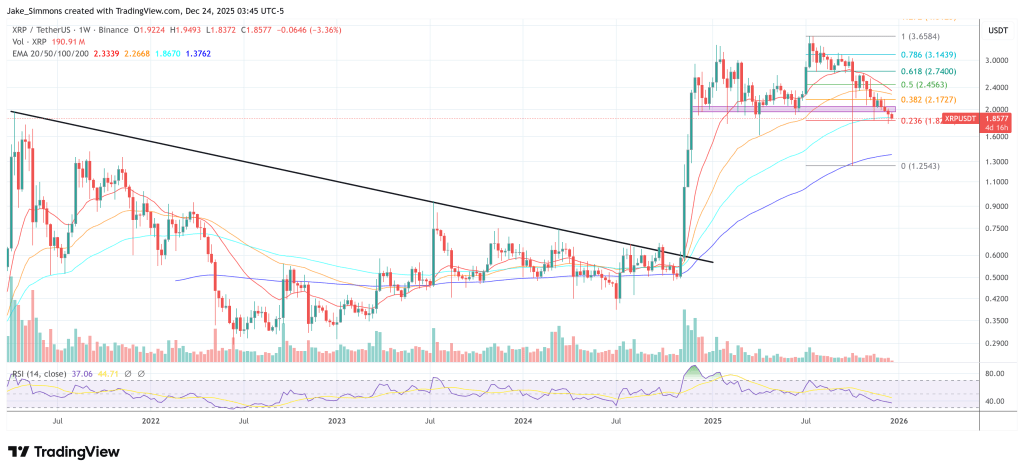
At press time, XRP traded at $1.8577.

XRP falls below key support, 1-week chart | Source: XRPUSDT on TradingView.com

Связанные с этим вопросы

QWhat is the main theme of Asheesh Birla's 2026 predictions for blockchain and crypto?

AThe main theme is how financial and corporate institutions will start adopting blockchain technology at scale, making it part of everyday financial infrastructure that quietly powers how money moves.

QAccording to Birla, what will be the primary use case for NFTs in 2026, moving beyond the 2021 speculation?

ANFTs will be rebranded and reframed to focus on membership access, combining ticketing, loyalty programs, and digital collectibles into one digital access token.

QHow does Birla predict stablecoins will evolve in the crypto market by 2026?

ABirla predicts stablecoins will go fully mainstream as settlement technology within corporate and bank systems, potentially growing from a $300 billion to a $100 trillion market cap, and will include the proliferation of 'local stablecoins' that challenge the traditional FX market.

QWhat specific efficiency gains does Birla foresee from combining DeFi tooling with AI-driven automation in corporate treasury operations?

AHe foresees that turning parts of treasury management into code and using AI to run workflows will compress cost, time, and operational friction by reducing manual processes and middlemen, leading to a more efficient way to manage global operations and move money.

QWhat role does Birla's company, Evernorth, play in the context of these predictions?

AEvernorth is a digital asset treasury focused on XRP, positioning itself to facilitate institutional participation and exposure to XRP as crypto moves beyond speculation and embeds into money movement, treasury management, and customer relationship management.

Похожее

Fu Peng's First Public Speech in 2026: What Exactly Are Crypto Assets? Why Did I Join the Crypto Asset Industry?

Fu Peng, a renowned macroeconomist and now Chief Economist at New火 Group, delivered his first public speech of 2026 at the Hong Kong Web3 Festival. He explained his perspective on crypto assets and why he joined the industry, framing it within the context of macroeconomic trends and financial evolution. Fu emphasized that crypto assets are transitioning from an early, belief-driven phase to a mature, institutionally integrated asset class. He drew parallels to the 1970s-80s, when technological advances (like computing) revolutionized traditional finance, leading to the rise of FICC (Fixed Income, Currencies, and Commodities). Similarly, current advancements in AI, data, and blockchain are reshaping finance, with crypto assets becoming part of a new "FICC + C" (C for Crypto) framework. He noted that institutional capital, including traditional hedge funds, avoided early crypto due to its speculative nature but are now engaging as regulatory clarity emerges (e.g., stablecoin laws, CFTC classifying crypto as a commodity). Fu predicted that 2025-2026 marks a turning point where crypto becomes a standardized, financially viable asset for diversified portfolios, akin to commodities or derivatives in traditional finance. Fu defined Bitcoin not as "digital gold" in a simplistic sense but as a value-preserving, financially tradable asset. He highlighted that crypto's future lies in regulated, institutional adoption, moving away from retail-dominated trading. His entry into crypto signals this maturation, where traditional finance integrates crypto into mainstream asset management.

marsbit33 мин. назад

Fu Peng's First Public Speech in 2026: What Exactly Are Crypto Assets? Why Did I Join the Crypto Asset Industry?

marsbit33 мин. назад

Justin Sun Sues Trump Family: What $75 Million Bought Was Only a Blacklist

Justin Sun, founder of Tron, has filed a lawsuit in federal court against World Liberty Financial (WLF), alleging he was made the "primary target of a fraudulent scheme" after investing $75 million. Sun claims the investment secured him an advisor title and WLFI tokens, which were later frozen by WLF, causing "hundreds of millions in losses." The dispute began in late 2024 when Sun's investment helped revive WLF's struggling token sale, which ultimately raised $550 million. Shortly after, the SEC dropped its lawsuit against Sun following Donald Trump's inauguration. However, relations soured when Sun refused WLF's demands for additional funding. In August 2025, WLF added a "blacklist" function to its smart contract, allowing it to unilaterally freeze tokens. Sun's holdings, worth approximately $107 million, were frozen, and he was threatened with token destruction. The lawsuit highlights WLF's structure, which directs 75% of token sale profits to the Trump family, who had earned $1 billion by December 2025. WLF's CEO is Zach Witkoff, son of U.S. Middle East envoy Steve Witkoff. The project faces scrutiny for opaque operations, including a controversial loan arrangement on the Dolomite platform, co-founded by a WLF advisor. Despite Sun's history with the SEC, the case underscores centralization risks within DeFi, as WLF controls governance and holds powers to freeze assets arbitrarily. Sun's tokens remain frozen as legal proceedings begin.

marsbit40 мин. назад

Justin Sun Sues Trump Family: What $75 Million Bought Was Only a Blacklist

marsbit40 мин. назад

$500 to Buy OpenAI Stock: Silicon Valley's Most Respectable Liquidity Invitation

Silicon Valley's largest venture capital platform, AngelList, has launched a new fund called USVC, allowing U.S. retail investors to buy into high-profile AI companies like OpenAI, Anthropic, and xAI with a minimum investment of $500—no accredited investor status required. Promoted by AngelList co-founder Naval Ravikant, the fund is framed as an opportunity for ordinary people to access high-growth private tech investments traditionally reserved for VCs. However, critics argue it functions more like an exit vehicle for early insiders. USVC acquires shares not through primary rounds but largely via secondary transactions—purchasing stakes from early investors, VC funds, and employees looking to cash out at peak valuations. With companies like xAI heavily weighted in the portfolio, the fund effectively channels retail money into providing liquidity for insiders who entered at much lower valuations. The fund’s structure raises concerns: shares are illiquid, with no secondary market, and buybacks are limited and discretionary. The actual annual fee reaches 3.61%, far above the advertised 1% management fee. This model parallels the "low float, high fully diluted valuation" strategy seen in crypto, where early investors profit by selling to latecomers at inflated prices. The timing—alongside similar moves by platforms like Robinhood—suggests that Silicon Valley’s sudden interest in retail inclusion may be less about democratizing access and more about securing exits for insiders.

marsbit1 ч. назад

$500 to Buy OpenAI Stock: Silicon Valley's Most Respectable Liquidity Invitation

marsbit1 ч. назад

Торговля

Спот
Фьючерсы
活动图片