Ethereum’s network scales up, but ‘failed transactions’ point to deeper issues

ambcryptoОпубликовано 2026-04-05Обновлено 2026-04-05

Введение

Ethereum is experiencing a significant increase in failed transactions, with rates exceeding 35% on March 22nd, despite declining network usage. This indicates deeper execution issues beyond network congestion, as failures rise even without heavy load. The problem stems from user inputs, smart contract design, and network conditions, reducing efficiency, increasing costs, and weakening user trust. While active addresses remain high (488,000) and contract interactions steady (649,691), engagement is weakening due to execution friction. Retail users reduce activity, while institutions demand reliability. Most transactions now move to Layer-2 networks, lowering costs but adding complexity. This creates a gap where adoption grows but fails to compound, risking user migration to simpler ecosystems. Ethereum scales in capability but struggles with usability, requiring a balance between innovation and reliable execution for long-term growth.

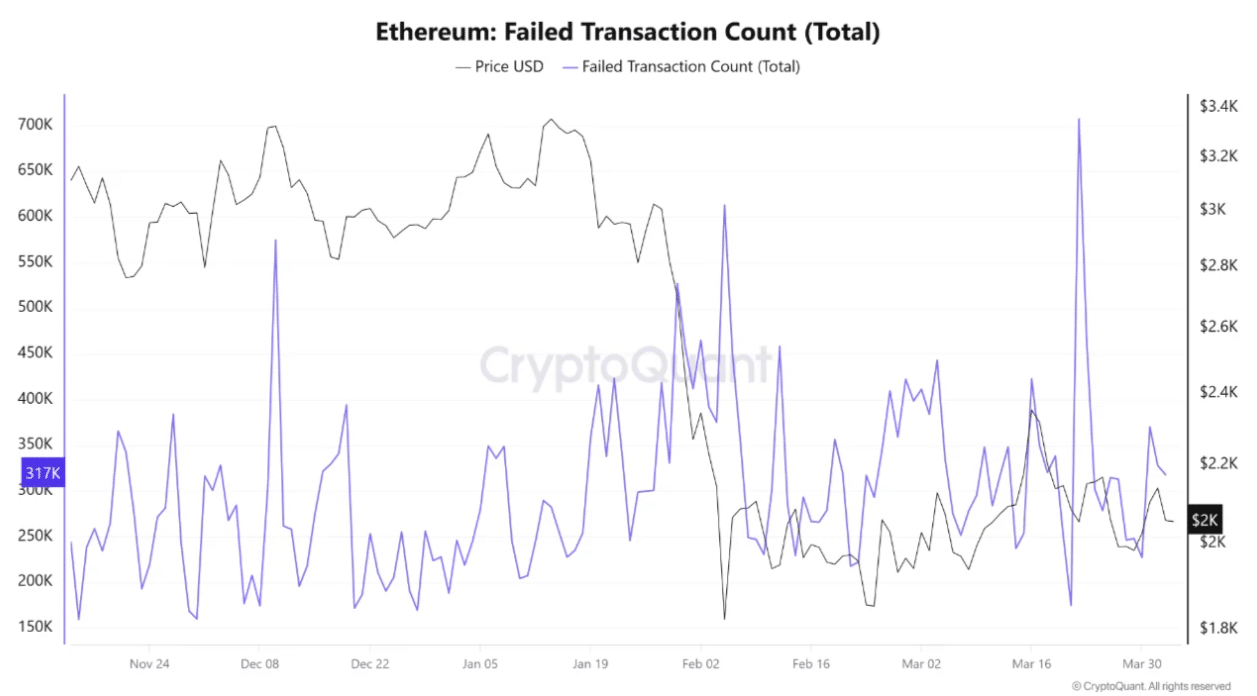
Ethereum [ETH] shows a growing disconnect between activity and execution, as more transactions fail even while usage declines. On the 22nd of March, failed transactions reached over 700,000, pushing failure rates above 35%.

This shift matters because it removes congestion as the main cause, which means something deeper is affecting execution. Earlier spikes in December and February already pointed to this trend, showing failures rise even without heavy network load.

Source: CryptoQuant

This happens because transactions depend on user inputs, smart contract design, and network conditions. When any layer introduces friction, failures increase, especially as complexity grows across applications.

The impact builds over time, as repeated failures reduce efficiency and increase costs for users. This weakens trust in execution, which may slow adoption and limit network usage despite lower activity levels.

Ethereum demand grows, but execution friction limits engagement

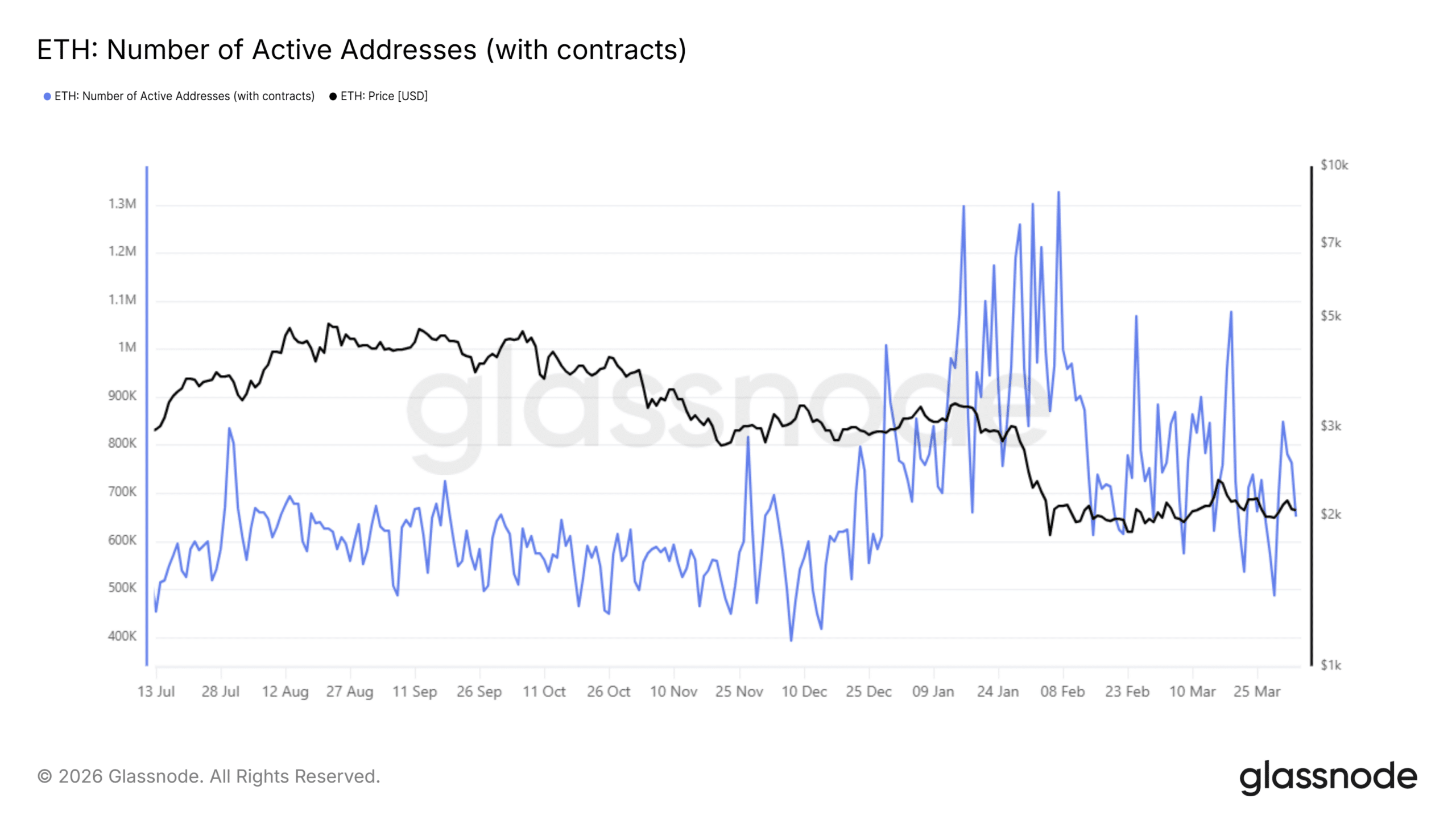
This pressure now shows up in how users behave, where growth in participation no longer translates into deeper network usage. Active addresses sat at 488,000, confirming demand still enters the network.

At the same time, active addresses with contracts held near 649,691, showing steady interaction, yet the pullback from peaks suggests weakening engagement and slowing demand momentum.

Source: Glassnode

This happens as execution friction, especially failed transactions and gas inefficiencies, disrupts user experience. Retail users reduce interaction, while institutions continue but demand reliability.

As a result, network growth expands in size but not intensity, which weakens transactional momentum. This creates a gap where adoption builds but fails to compound, increasing the risk of user flow shifting to simpler ecosystems.

Ethereum scales, but usability lags

This shift in user behavior highlights a changing balance, where Ethereum grows stronger in scale but faces new limits in usability.

Most activity now moves to Layer-2 networks, which handle most of the transactions, while costs drop sharply, removing earlier bottlenecks.

At the same time, this complexity supports more advanced use cases, which attracts institutional participation and deeper liquidity. Yet retail users often struggle with execution reliability, which slows frequent usage.

This creates a mixed outcome, where Ethereum grows in capability but risks losing simplicity. Adoption can continue, but long-term growth now depends on balancing innovation with easier execution.


Final Summary

  • Ethereum faces rising execution failures despite growing activity, as usability issues weaken engagement and limit the strength of demand growth.
  • Ethereum scales through Layer-2 adoption and lower costs, yet increasing complexity risks slowing adoption unless execution becomes more reliable.

Связанные с этим вопросы

QWhat was the peak number of failed Ethereum transactions mentioned in the article and on what date did it occur?

AOver 700,000 failed transactions occurred on the 22nd of March.

QAccording to the article, what are the three main factors that transactions depend on, which can lead to failures?

ATransactions depend on user inputs, smart contract design, and network conditions.

QWhat does the article suggest is the consequence of repeated transaction failures for users?

ARepeated failures reduce efficiency, increase costs for users, and weaken trust in execution, which may slow adoption.

QThe article states that most activity has moved to Layer-2 networks. What is one major benefit and one major risk associated with this shift?

AA major benefit is that Layer-2 networks handle most transactions with sharply lower costs, removing bottlenecks. A major risk is that the increasing complexity can make execution less reliable for retail users, potentially slowing frequent usage.

QWhat two metrics are provided to show that demand is still entering the Ethereum network, even as engagement weakens?

AActive addresses, which sat at 488,000, and active addresses with contracts, which held near 649,691.

Похожее

Can a Hair Dryer Earn $34,000? Deciphering the Reflexivity Paradox in Prediction Markets

An individual manipulated a weather sensor at Paris Charles de Gaulle Airport with a portable heat source, causing a Polymarket weather market to settle at 22°C and earning $34,000. This incident highlights a fundamental issue in prediction markets: when a market aims to reflect reality, it also incentivizes participants to influence that reality. Prediction markets operate on two layers: platform rules (what outcome counts as a win) and data sources (what actually happened). While most focus on rules, the real vulnerability lies in the data source. If reality is recorded through a specific source, influencing that source directly affects market settlement. The article categorizes markets by their vulnerability: 1. **Single-point physical data sources** (e.g., weather stations): Easily manipulated through physical interference. 2. **Insider information markets** (e.g., MrBeast video details): Insiders like team members use non-public information to trade. Kalshi fined a剪辑师 $20,000 for insider trading. 3. **Actor-manipulated markets** (e.g., Andrew Tate’s tweet counts): The subject of the market can control the outcome. Evidence suggests Tate’sociated accounts coordinated to profit. 4. **Individual-action markets** (e.g., WNBA disruptions): A single person can execute an event to profit from their pre-placed bets. Kalshi and Polymarket handle these issues differently. Kalshi enforces strict KYC, publicly penalizes insider trading, and reports to regulators. Polymarket, with its anonymous wallet-based system, has historically been more permissive, arguing that insider information improves market accuracy. However, it cooperated with authorities in the "Van Dyke case," where a user traded on classified government information. The core paradox is reflexivity: prediction markets are designed to discover truth, but their financial incentives can distort reality. The more valuable a prediction becomes, the more likely participants are to influence the event itself. The market ceases to be a mirror of reality and instead shapes it.

marsbit9 мин. назад

Can a Hair Dryer Earn $34,000? Deciphering the Reflexivity Paradox in Prediction Markets

marsbit9 мин. назад

First Day Review of "Musk's WeChat" XChat: Even Worse Than Expected

Elon Musk's much-anticipated "WeChat-like" app, XChat, has officially launched after multiple delays. The initial review reveals a product that falls short of expectations, offering an experience largely similar to X Platform's (formerly Twitter) direct messages, despite being marketed as an encrypted communication tool. Key observations from the first-day test include: 1. The app's promoted "end-to-end encryption" and its claimed relation to Bitcoin's architecture were criticized by experts as a superficial attempt to capitalize on crypto buzz, with no real technical connection. 2. Musk's vision of an ad-free "secure communication system" is technically met, but only because the app is currently extremely basic, featuring only a single chat interface. 3. A promised anti-screenshot feature appears inconsistent; it works in X Platform group chats but fails within the XChat app itself, where screenshots still capture avatars. 4. The app supports 45 languages and has a 16+ age rating, indicating a broader tolerance for content compared to WeChat's 13+ rating. 5. A puzzling login process requires users to verify the email associated with their X account. 6. The touted encryption" feels minimal in practice, with its presence only indicated by a simple "Encrypted - Yes" label on messages. 7. Disappearing message timers for groups can be set from 5 minutes to 4 weeks, with the timer starting upon being read by a user. 8. Group invite links are shared with X Platform groups. 9. Group size limits are planned to be increased, aiming for 1000 members, a move that has drawn user criticism. 10. The app offers 8 different colored icons, and its chat bubbles are notably similar to WeChat's. Message deletion options mimic Telegram's. Crucially, many pre-announced features like importing X contacts, integrating Grok AI, X Money payments, and Cashtags are not yet available. The initial release is seen as a bare-bones and underwhelming first step.

Odaily星球日报1 ч. назад

First Day Review of "Musk's WeChat" XChat: Even Worse Than Expected

Odaily星球日报1 ч. назад

Торговля

Спот
Фьючерсы

Популярные статьи

Как купить S

Добро пожаловать на HTX.com! Мы сделали приобретение Sonic (S) простым и удобным. Следуйте нашему пошаговому руководству и отправляйтесь в свое крипто-путешествие.Шаг 1: Создайте аккаунт на HTXИспользуйте свой адрес электронной почты или номер телефона, чтобы зарегистрироваться и бесплатно создать аккаунт на HTX. Пройдите удобную регистрацию и откройте для себя весь функционал.Создать аккаунтШаг 2: Перейдите в Купить криптовалюту и выберите свой способ оплатыКредитная/Дебетовая Карта: Используйте свою карту Visa или Mastercard для мгновенной покупки Sonic (S).Баланс: Используйте средства с баланса вашего аккаунта HTX для простой торговли.Третьи Лица: Мы добавили популярные способы оплаты, такие как Google Pay и Apple Pay, для повышения удобства.P2P: Торгуйте напрямую с другими пользователями на HTX.Внебиржевая Торговля (OTC): Мы предлагаем индивидуальные услуги и конкурентоспособные обменные курсы для трейдеров.Шаг 3: Хранение Sonic (S)После приобретения вами Sonic (S) храните их в своем аккаунте на HTX. В качестве альтернативы вы можете отправить их куда-либо с помощью перевода в блокчейне или использовать для торговли с другими криптовалютами.Шаг 4: Торговля Sonic (S)С легкостью торгуйте Sonic (S) на спотовом рынке HTX. Просто зайдите в свой аккаунт, выберите торговую пару, совершайте сделки и следите за ними в режиме реального времени. Мы предлагаем удобный интерфейс как для начинающих, так и для опытных трейдеров.

1.2k просмотров всегоОпубликовано 2025.01.15Обновлено 2025.03.21

Как купить S

Sonic: Обновления под руководством Андре Кронье – новая звезда Layer-1 на фоне спада рынка

Он решает проблемы масштабируемости, совместимости между блокчейнами и стимулов для разработчиков с помощью технологических инноваций.

2.2k просмотров всегоОпубликовано 2025.04.09Обновлено 2025.04.09

Sonic: Обновления под руководством Андре Кронье – новая звезда Layer-1 на фоне спада рынка

HTX Learn: Пройдите обучение по "Sonic" и разделите 1000 USDT

HTX Learn — ваш проводник в мир перспективных проектов, и мы запускаем специальное мероприятие "Учитесь и Зарабатывайте", посвящённое этим проектам. Наше новое направление .

1.8k просмотров всегоОпубликовано 2025.04.10Обновлено 2025.04.10

HTX Learn: Пройдите обучение по "Sonic" и разделите 1000 USDT

Обсуждения

Добро пожаловать в Сообщество HTX. Здесь вы сможете быть в курсе последних новостей о развитии платформы и получить доступ к профессиональной аналитической информации о рынке. Мнения пользователей о цене на S (S) представлены ниже.

活动图片