Ethereum’s 2020 Throwback: How A 3.46M ETH Supply Floor Creates A Liquidity Void

bitcoinistОпубликовано 2026-03-04Обновлено 2026-03-04

Введение

Ethereum is experiencing renewed volatility amid geopolitical tensions, but underlying on-chain dynamics reveal a significant shift. Binance's Ethereum reserves have dropped to approximately 3.46 million ETH, the lowest level since 2020, indicating a structural reduction in exchange-held supply. This decline suggests investors are moving ETH to long-term storage or staking, reducing immediately tradable supply and potentially decreasing sell-side pressure. Despite this, Ethereum's price remains weak, trading near $2,027 below key moving averages. The 4-hour chart shows a bearish structure with resistance near $2,100 and support around $1,900. A break above $2,100 could signal momentum shift, while losing $1,900 may lead to further declines. The tightening supply amid weak price action creates a potential imbalance that could drive upward pressure if demand increases.

Trusted Editorial content, reviewed by leading industry experts and seasoned editors. Ad Disclosure

Ethereum is navigating renewed volatility as escalating tensions in the Middle East reshape the macro landscape and weigh on digital assets. Price action has become increasingly reactive to external risk signals, with liquidity thinning during periods of heightened geopolitical uncertainty. While short-term swings dominate headlines, underlying on-chain dynamics suggest a more structural shift may be unfolding beneath the surface.

According to a recent CryptoQuant analysis, Ethereum reserves on Binance have declined to approximately 3.46 million ETH — the lowest level recorded since 2020. This contraction in exchange-held supply is not a marginal fluctuation but a multi-year structural low. Such a development carries meaningful implications for investor positioning and the evolving balance between available supply and latent demand.

Historically, declining exchange reserves indicate that investors are withdrawing assets to cold storage or long-term custody solutions. This behavior is typically associated with holding preference rather than imminent distribution. When fewer coins remain readily accessible on centralized platforms, the pool of immediately tradable supply contracts is reduced. In theory, this reduces the probability of abrupt sell-side shocks driven by excess exchange liquidity.

Ethereum Exchange Reserves Hit Six-Year Lows as Supply Tightens

The longer-term trajectory of Ethereum reserves on Binance reinforces the structural nature of this shift. From prior cycle peaks above 5 million ETH, exchange balances have trended steadily lower, interrupted only by brief countertrend rebounds that failed to establish higher highs. The pattern of successive lower highs signals persistent net outflows rather than episodic movements. At approximately 3.46 million ETH, reserves now sit at their lowest level in nearly six years, underscoring the magnitude of the contraction.
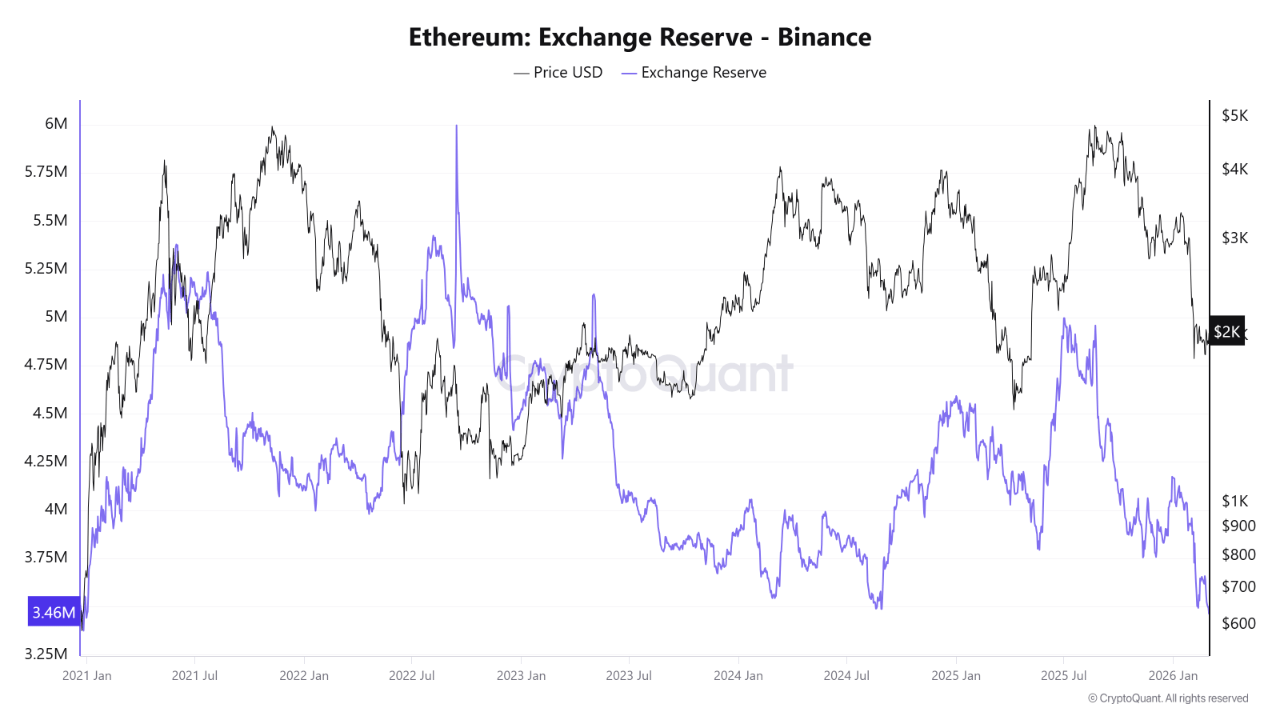
Ethereum Exchange Reserve | Source: CryptoQuant

This evolution aligns with broader behavioral changes across the Ethereum ecosystem. The rise of self-custody solutions and the expansion of staking participation have structurally reduced the float available on centralized venues. Coins removed from exchanges are less likely to be deployed for immediate trading, particularly when allocated to long-term custody or yield-generating mechanisms.

The timing is notable. With ETH trading near $2,027, the market occupies a technically sensitive zone. A continued decline in reserves at this level may indicate growing conviction among holders unwilling to sell into volatility. Should incremental demand emerge while exchange supply continues to tighten, the resulting imbalance could generate upward pressure.

Ethereum Struggles Below $2,000 as Bearish Structure Remains Intact

On the 4-hour timeframe, Ethereum remains structurally weak despite attempts to stabilize near the $1,950–$2,000 zone. Price continues to trade below the 50, 100, and 200-period moving averages, all of which are sloping downward — a clear alignment that confirms short-term bearish control.
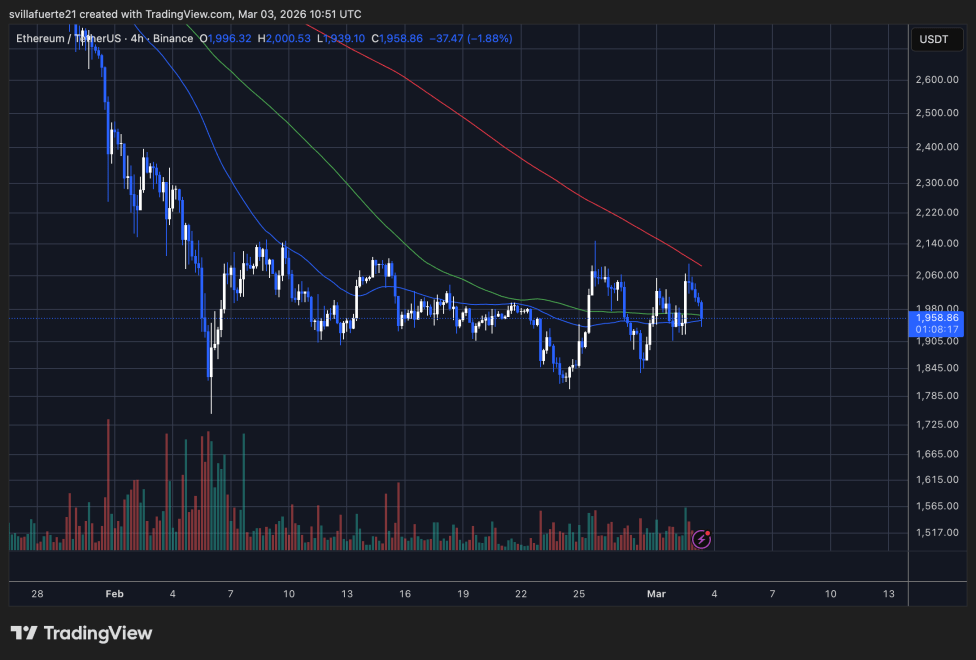
Ethereum consolidates in a range | Source: ETHUSDT chart on TradingView

The early-February selloff established a lower high structure, and subsequent rebounds have failed to reclaim the 200-period moving average (red), currently positioned well above price near the $2,100 region. This level now acts as a decisive dynamic resistance ceiling. Meanwhile, the 100-period moving average (green) has repeatedly capped intraday recoveries, reinforcing the broader downtrend.

Support has developed around $1,900, where buyers previously stepped in following a sharp liquidation wick. However, each bounce has produced progressively weaker follow-through, suggesting demand remains reactive rather than proactive.

Volume expanded during the breakdown phases but has since tapered, indicating temporary equilibrium rather than accumulation. The compression between $1,900 and $2,000 reflects indecision under a bearish structure.

For momentum to shift meaningfully, ETH would need a sustained break above $2,050–$2,100 to challenge the descending moving averages. A loss of $1,900, however, would likely reopen downside toward the $1,800 liquidity pocket.

Featured image from ChatGPT, chart from TradingView.com 

Editorial Process for bitcoinist is centered on delivering thoroughly researched, accurate, and unbiased content. We uphold strict sourcing standards, and each page undergoes diligent review by our team of top technology experts and seasoned editors. This process ensures the integrity, relevance, and value of our content for our readers.

Sebastian Villafuerte

Follow

Sebastian's journey into the world of crypto began four years ago, driven by a fascination with the potential of blockchain technology to revolutionize financial systems. His initial exploration focused on understanding the intricacies of various crypto projects, particularly those focused on building innovative financial solutions. Through countless hours of research and learning, Sebastian developed a deep understanding of the underlying technologies, market dynamics, and potential applications of cryptocurrencies. As his knowledge grew, Sebastian felt compelled to share his insights with others. He began actively contributing to online discussions on platforms like X and LinkedIn, focusing on fintech and crypto-related content. His goal was to expose valuable trends and insights to a wider audience, fostering a deeper understanding of the rapidly evolving crypto landscape. Sebastian's contributions quickly gained recognition, and he became a trusted voice in the online crypto community. To further enhance his expertise, Sebastian pursued a UC Berkeley Fintech: Frameworks, Applications, and Strategies certification. This rigorous program equipped him with valuable skills and knowledge regarding Financial Technology, bridging the gap between traditional finance (TradFi) and decentralized finance (DeFi). The certification deepened his understanding of the broader financial landscape and its intersection with blockchain technology. Sebastian's passion for finance and writing is evident in his work. He enjoys delving into financial research, analyzing market trends, and exploring the latest developments in the crypto space. In his spare time, Sebastian can often be found immersed in charts, studying 10-K forms, or engaging in thought-provoking discussions about the future of finance. Sebastian's journey as a crypto analyst and investor has been marked by a relentless pursuit of knowledge and a dedication to sharing his insights. His ability to navigate the complex world of crypto, combined with his passion for financial research and communication, makes him a valuable asset to the industry. As the crypto landscape continues to evolve, Sebastian remains at the forefront, providing valuable insights and contributing to the growth of this revolutionary technology.

Full Profile

Related Posts

Ethereum Exodus Continues: Supply On Crypto Exchanges Dries Up To Years-Long Low

Ethereum Reaching End Game? Founder Vitalik Buterin Shares New Development

Ethereum Is Bullish In March: Here’s How It Has Performed In Previous Years

Ethereum Accumulation Addresses See Continued Capital Inflows While Market Volatility Persists

Ethereum Roadmap Could Advance Faster With AI, Vitalik Buterin Says

The 2.4 Million Ethereum Anchor: How Binance’s Illiquid Supply Is Absorbing ETH’s February Volatility

Похожее

Google and Amazon Simultaneously Invest Heavily in a Competitor: The Most Absurd Business Logic of the AI Era Is Becoming Reality

In a span of four days, Amazon announced an additional $25 billion investment, and Google pledged up to $40 billion—both direct competitors pouring over $65 billion into the same AI startup, Anthropic. Rather than a typical venture capital move, this signals the latest escalation in the cloud wars. The core of the deal is not equity but compute pre-orders: Anthropic must spend the majority of these funds on AWS and Google Cloud services and chips, effectively locking in massive future compute consumption. This reflects a shift in cloud market dynamics—enterprises now choose cloud providers based on which hosts the best AI models, not just price or stability. With OpenAI deeply tied to Microsoft, Anthropic’s Claude has become the only viable strategic asset for Google and Amazon to remain competitive. Anthropic’s annualized revenue has surged to $30 billion, and it is expanding into verticals like biotech, positioning itself as a cross-industry AI infrastructure layer. However, this funding comes with constraints: Anthropic’s independence is challenged as it balances two rival investors, its safety-first narrative faces pressure from regulatory scrutiny, and its path to IPO introduces new financial pressures. Globally, this accelerates a "tri-polar" closed-loop structure in AI infrastructure, with Microsoft-OpenAI, Google-Anthropic, and Amazon-Anthropic forming exclusive model-cloud alliances. In contrast, China’s landscape differs—investments like Alibaba and Tencent backing open-source model firm DeepSeek reflect a more decoupled approach, though closed-source models from major cloud providers still dominate. The $65 billion bet is ultimately about securing a seat at the table in an AI-defined future—where missing the model layer means losing the cloud war.

marsbit5 ч. назад

Google and Amazon Simultaneously Invest Heavily in a Competitor: The Most Absurd Business Logic of the AI Era Is Becoming Reality

marsbit5 ч. назад

Computing Power Constrained, Why Did DeepSeek-V4 Open Source?

DeepSeek-V4 has been released as a preview open-source model, featuring 1 million tokens of context length as a baseline capability—previously a premium feature locked behind enterprise paywalls by major overseas AI firms. The official announcement, however, openly acknowledges computational constraints, particularly limited service throughput for the high-end DeepSeek-V4-Pro version due to restricted high-end computing power. Rather than competing on pure scale, DeepSeek adopts a pragmatic approach that balances algorithmic innovation with hardware realities in China’s AI ecosystem. The V4-Pro model uses a highly sparse architecture with 1.6T total parameters but only activates 49B during inference. It performs strongly in agentic coding, knowledge-intensive tasks, and STEM reasoning, competing closely with top-tier closed models like Gemini Pro 3.1 and Claude Opus 4.6 in certain scenarios. A key strategic product is the Flash edition, with 284B total parameters but only 13B activated—making it cost-effective and accessible for mid- and low-tier hardware, including domestic AI chips from Huawei (Ascend), Cambricon, and Hygon. This design supports broader adoption across developers and SMEs while stimulating China's domestic semiconductor ecosystem. Despite facing talent outflow and intense competition in user traffic—with rivals like Doubao and Qianwen leading in monthly active users—DeepSeek has maintained technical momentum. The release also comes amid reports of a new funding round targeting a valuation exceeding $10 billion, potentially setting a new record in China’s LLM sector. Ultimately, DeepSeek-V4 represents a shift toward open yet realistic infrastructure development in the constrained compute landscape of Chinese AI, emphasizing engineering efficiency and domestic hardware compatibility over pure model scale.

marsbit5 ч. назад

Computing Power Constrained, Why Did DeepSeek-V4 Open Source?

marsbit5 ч. назад

Торговля

Спот
Фьючерсы

Популярные статьи

Как купить S

Добро пожаловать на HTX.com! Мы сделали приобретение Sonic (S) простым и удобным. Следуйте нашему пошаговому руководству и отправляйтесь в свое крипто-путешествие.Шаг 1: Создайте аккаунт на HTXИспользуйте свой адрес электронной почты или номер телефона, чтобы зарегистрироваться и бесплатно создать аккаунт на HTX. Пройдите удобную регистрацию и откройте для себя весь функционал.Создать аккаунтШаг 2: Перейдите в Купить криптовалюту и выберите свой способ оплатыКредитная/Дебетовая Карта: Используйте свою карту Visa или Mastercard для мгновенной покупки Sonic (S).Баланс: Используйте средства с баланса вашего аккаунта HTX для простой торговли.Третьи Лица: Мы добавили популярные способы оплаты, такие как Google Pay и Apple Pay, для повышения удобства.P2P: Торгуйте напрямую с другими пользователями на HTX.Внебиржевая Торговля (OTC): Мы предлагаем индивидуальные услуги и конкурентоспособные обменные курсы для трейдеров.Шаг 3: Хранение Sonic (S)После приобретения вами Sonic (S) храните их в своем аккаунте на HTX. В качестве альтернативы вы можете отправить их куда-либо с помощью перевода в блокчейне или использовать для торговли с другими криптовалютами.Шаг 4: Торговля Sonic (S)С легкостью торгуйте Sonic (S) на спотовом рынке HTX. Просто зайдите в свой аккаунт, выберите торговую пару, совершайте сделки и следите за ними в режиме реального времени. Мы предлагаем удобный интерфейс как для начинающих, так и для опытных трейдеров.

1.2k просмотров всегоОпубликовано 2025.01.15Обновлено 2025.03.21

Как купить S

Sonic: Обновления под руководством Андре Кронье – новая звезда Layer-1 на фоне спада рынка

Он решает проблемы масштабируемости, совместимости между блокчейнами и стимулов для разработчиков с помощью технологических инноваций.

2.2k просмотров всегоОпубликовано 2025.04.09Обновлено 2025.04.09

Sonic: Обновления под руководством Андре Кронье – новая звезда Layer-1 на фоне спада рынка

HTX Learn: Пройдите обучение по "Sonic" и разделите 1000 USDT

HTX Learn — ваш проводник в мир перспективных проектов, и мы запускаем специальное мероприятие "Учитесь и Зарабатывайте", посвящённое этим проектам. Наше новое направление .

1.8k просмотров всегоОпубликовано 2025.04.10Обновлено 2025.04.10

HTX Learn: Пройдите обучение по "Sonic" и разделите 1000 USDT

Обсуждения

Добро пожаловать в Сообщество HTX. Здесь вы сможете быть в курсе последних новостей о развитии платформы и получить доступ к профессиональной аналитической информации о рынке. Мнения пользователей о цене на S (S) представлены ниже.

活动图片