Ethereum Spot ETFs Stack In Silence – Here’s How Much Have Been Accumulated So Far

bitcoinistОпубликовано 2025-12-11Обновлено 2025-12-11

Введение

Ethereum Spot ETFs are demonstrating strong and steady accumulation despite recent price fluctuations, with on-chain holdings reaching a record 10.48 million ETH. This quiet but consistent institutional buildup suggests smart money is positioning for long-term gains ahead of potential retail attention. While ETH's derivatives market shows cooling funding rates, this indicates an uncrowded leverage environment that could support a sustained upward move. Major firms like Bitmine continue acquiring ETH at scale, with one report noting over 138,000 ETH purchased in a week. The data points to growing institutional demand and a bullish outlook for Ethereum's price trajectory.

Despite recent fluctuations in the price of Ethereum, accumulation seems to be holding strong, which is observed in the Spot Ethereum Exchange-Traded Funds (ETFs). With more ETH leaving exchanges and ETFs stacking ETH, the leading altcoin could be poised for a crucial shift in market dynamics, which may be good for its price trajectory.

Smart Money Moves Quietly Via Ethereum Spot ETFs

The broader cryptocurrency market is shifting towards a bullish state once again, and the Ethereum institutional story is subtly transitioning into a new chapter. While price action remains relatively subdued, on-chain and fund flow data show a strong undercurrent as Spot Ethereum ETFs are steadily stacking.

According to Everstake.eth, the head of the Ethereum segment at Everstake, the ETH spot ETFs have been quietly increasing, reaching unprecedented levels. This silent accumulation raises the possibility that major companies are positioning themselves well ahead of the competition, creating long-term exposure while retail attention is still dispersed.

Data shared by the expert reveals that spot Ethereum ETF on-chain holdings have now reached approximately 10.48 million ETH. Everstake added that this is one of the strongest, most consistent accumulation trends ever recorded since the launch of the funds about a year ago.
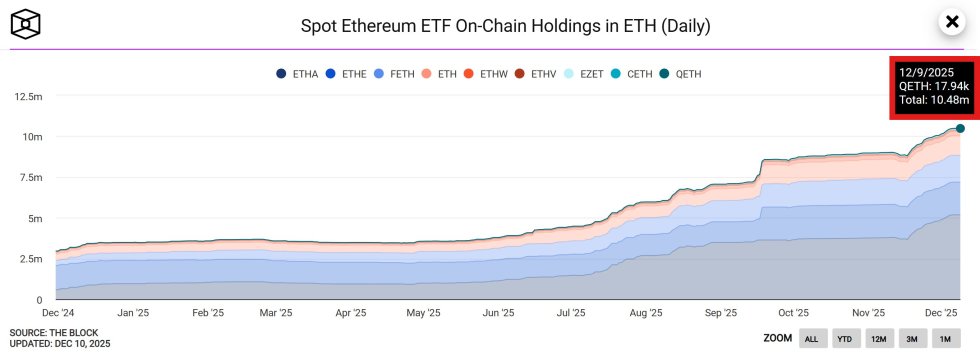
ETH spot ETFs at a historical level | Source: Chart from Everstake.eth on X

Given the substantial growth of the funds, the expert has declared that “the future is bullish, and the future is Ethereum.” As ETF holdings rise to previously unheard-of levels, the question now is not whether smart money is going in, but rather what they anticipate.

The steady growth is not observed among other metrics, like the Funding Rates. Currently, the derivatives market for ETH is starting to cool, and funding rates are clearly reflecting this change. However, this is not entirely a bad thing for the altcoin and its price trajectory.

As reported by Sina Estavi, the Chief Executive Officer (CEO) of Bridge Capital, a declining ETH funding rate is not merely a sign of a cool market. Rather, it is the structure that typically appears on the chart prior to a sustained move.

When funding resets in the absence of aggressive shorting, it usually implies that leverage is not overcrowded, the rally is not overheated, and spot-driven demand can carry the price further. Should ETH register even a modest growth in demand, the market may have room to extend this bullish leg.

Institutional Demand For ETH Is Returning

Ethereum’s recent sideways price movements do not seem to have swayed institutions from acquiring the altcoin. Big firms such as Bitmine Immersion, a leading treasury company run by industry leader Tom Lee, are still scooping up ETH at a substantial rate and scale.

The report from Arkham shows that as of Tuesday, Bitmine has purchased over 138,452 ETH valued at approximately $431.97 million since last week. Following the purchase, the company’s crypto holdings now boost about $12.05 billion in ETH. Despite this massive holding of ETH, the firm still has $1 billion left to accumulate more of the altcoin.


ETH trading at $3,186 on the 1D chart | Source: ETHUSDT on Tradingview.com

Похожее

How Does x402 V2 Enable Autonomous Payments for AI Agents?

The x402 protocol, initially developed by Coinbase, leverages the HTTP 402 status code to embed payment logic directly into web requests. The newly released V2 upgrade introduces significant improvements to address limitations in cross-chain support, scalability, identity authentication, and repeated payments experienced in V1. Key enhancements include: - **Wallet Identity and Reusable Sessions**: Supports wallet-based authentication (e.g., Sign-In-With-X via CAIP-122), allowing reusable sessions after initial payment. This reduces latency and costs for high-frequency use cases like AI agent tasks and LLM inference. - **Unified Payment Interface**: Enables multi-chain payments (e.g., Base, Solana) and compatibility with traditional systems (ACH, SEPA, credit cards) via Facilitators. Dynamic payTo routing allows context-aware pricing and complex market structures. - **Modular Architecture**: A plugin-driven SDK simplifies integration, supporting easy expansion to new chains and payment methods without core changes. Multi-Facilitator support automates optimal payment path selection based on preferences. - **Automatic Discovery**: Services can expose metadata for automatic synchronization, ensuring real-time pricing and availability updates without manual intervention. For end-users, V2 enables seamless, subscription-like access with reduced friction. Developers benefit from flexible, low-maintenance payment integration and dynamic pricing models. AI agents gain autonomy to make economic decisions, such as purchasing API calls or compute resources independently using allocated budgets. x402 V2 evolves from a pay-per-use tool into a versatile economic layer, though challenges like ecosystem adoption, modular risks, and regulatory uncertainty remain.

比推14 мин. назад

How Does x402 V2 Enable Autonomous Payments for AI Agents?

比推14 мин. назад

Bitcoin (BTC) Price Trend and Investor Sentiment Suggest a Bullish December

Bitcoin (BTC) is showing signs of a potential bullish December, challenging a decade-old bearish seasonal pattern where November losses typically extend into year-end declines. Key factors supporting this shift include reduced leverage, with open interest dropping from $94 billion to $60 billion, and Bitcoin’s price reclaiming its monthly volume-weighted average price (rVWAP), indicating controlled distribution. Liquidity dynamics have also shifted, with deep liquidity clusters moving upward, and around $3 billion in short positions set to liquidate near $96,000. Market structure diverges from historical cycles due to spot ETF inflows, introducing constant structural demand and accelerating price discovery. Analysts note that Bitcoin’s four-year cycle, while not obsolete, is no longer time-aligned, resembling extended accumulation phases like mid-2016 or late-2019. Macro liquidity (M2) growth has plateaued, creating a late-cycle environment where risk assets rally despite underlying economic softening. Supporting indicators, such as CNY/USD and ETH/BTC correlations, along with improving PMI data and gold’s relative strength, suggest continued risk-on momentum rather than cycle fatigue. While buy-sell ratios show urgency, analysts caution this may reflect positioning squeeze rather than sustainable accumulation. Overall, December’s performance may depend more on structural forces—ETF flows, liquidity rotation, and shifting macro correlations—than traditional halving-driven周期 patterns.

cointelegraph_中文30 мин. назад

Bitcoin (BTC) Price Trend and Investor Sentiment Suggest a Bullish December

cointelegraph_中文30 мин. назад

Торговля

Спот
Фьючерсы
活动图片