ETH Breaks Below $1,900! Behind the 22% Plunge, Vitalik's 'Five-Year Austerity' Strategy

marsbitОпубликовано 2026-02-24Обновлено 2026-02-24

Введение

Ethereum (ETH) has experienced a sharp decline, falling below $1,900 and dropping over 22% from recent highs. This downturn is driven by a combination of liquidity outflows and shifting market expectations. Key factors include significant net redemptions from U.S. spot Ethereum ETFs, large-scale selling by whale addresses (1.43 million ETH sold in two weeks), and substantial personal sales by co-founder Vitalik Buterin. In response, the Ethereum Foundation has announced a five-year "moderate austerity" strategy to ensure long-term financial sustainability and continued development of core technology. Buterin is personally funding certain public goods projects to reduce the Foundation’s financial burden. Despite price pressure, Ethereum’s network performance has improved, with TPS reaching a record high due to the Fusaka upgrade. However, centralization risks in block building remain. The upcoming Glamsterdam upgrade aims to address this with ePBS (enshrined Proposer-Builder Separation) to reduce dominance by a few large players and reshape MEV economics. Additionally, regulatory pressure is mounting with the EU’s MiCA regulation set to take effect in July 2026, increasing compliance costs and affecting DeFi and liquidity providers. Ethereum is currently in a phase of short-term volatility and structural adjustment, balancing capital outflows against long-term technical and governance improvements.

Author: Max.s

The current cryptocurrency market is undergoing a severe structural adjustment. According to the latest trading data (as shown on the chart, ETH/USDT has fallen to around $1,847.84, with a clear recent unilateral downward trend), Ethereum (ETH) is experiencing a deep correction driven by both capital flows and market expectations.
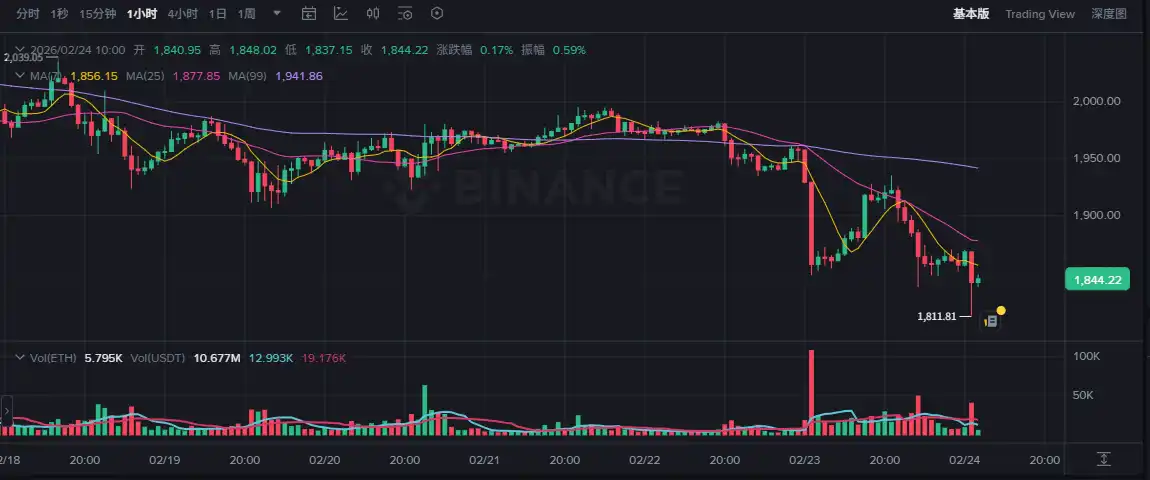
Looking back at the price movement in February 2026, ETH plummeted from above $2,360 to the $1,825 range in a short period, a drop of over 22.7%. Behind the surface of the price decline lies a comprehensive restructuring of the Ethereum network in terms of technical upgrades, organizational structure, and regulatory environment. For institutional investors and financial professionals, looking beyond short-term price fluctuations and understanding the transformation of Ethereum's underlying asset logic is the core issue at hand.

The most immediate pressure facing Ethereum currently comes from the continuous withdrawal of liquidity. This capital outflow is not a single event but a resonance of multiple sources of capital.

Net Redemptions in Spot ETFs: Risk aversion among institutional investors has significantly increased. For example, on January 29, 2026, U.S. spot Ethereum ETFs recorded a single-day net outflow of $155.7 million. Among them, Fidelity's FETH saw a net outflow of $59.2 million, BlackRock's ETHA had a net outflow of $54.9 million, and Grayscale's two funds also recorded outflows in the tens of millions of dollars. This indicates that traditional Wall Street capital is systematically reducing its exposure to Ethereum.

Concentrated Selling by Early Holders: On-chain data shows that whale accounts sold approximately 1.43 million ETH within just two weeks.

Founder's Sell-Off: This month, Ethereum co-founder Vitalik Buterin sold over 8,800 ETH, cashing out approximately $18.45 million. In traditional financial markets, intensive selling by core management is often seen as a major bearish signal, further exacerbating market panic.
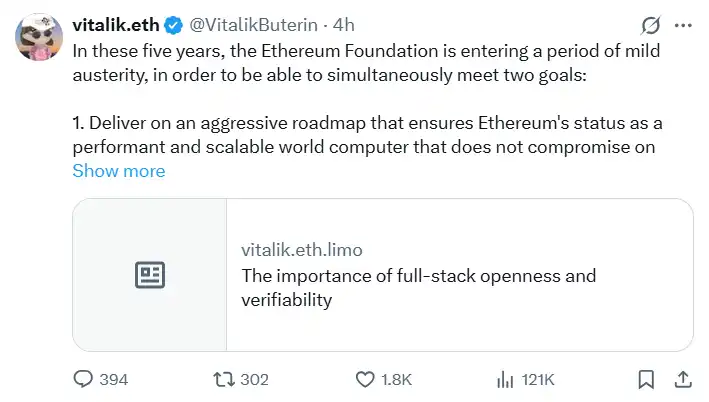
Facing the market's winter, the Ethereum Foundation (EF) has made a defensive shift in its financial strategy. Vitalik Buterin announced that the foundation will enter a five-year period of "moderate austerity."

From a corporate finance perspective, this is a classic cash flow management strategy. Its core objectives are twofold: first, to ensure the foundation can continue to fund the development of Ethereum's core underlying technology in the future, avoiding threats to its independence due to excessive resource consumption; second, to ensure that Ethereum's ambitious roadmap as a high-performance "world computer" is delivered on schedule.

To support this strategy, Vitalik himself proactively severed the funding dependence of some "special projects" on the foundation. He chose to extract 16,384 ETH and use decentralized staking yields to self-fund research and development for public goods such as open-source software, hardware, and privacy protection projects. This approach of internalizing peripheral R&D expenses and focusing on core business marks a move toward maturity and restraint in Ethereum's capital operations.

While the price is under pressure, Ethereum's technical fundamentals have shown remarkable resilience, even exhibiting a rare phenomenon of "price-volume divergence." Recently, the Ethereum network's TPS (transactions per second) reached a historic high of 75,862, far exceeding the previous peak of 58,786.
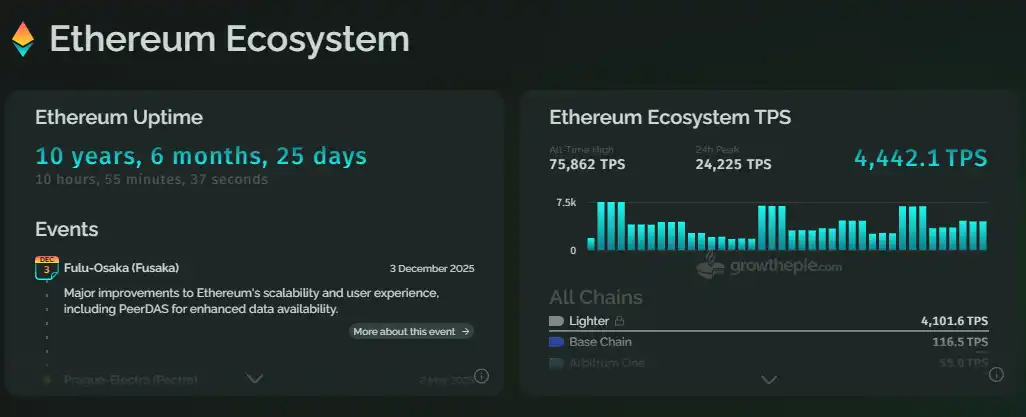
This is largely due to the Fusaka upgrade deployed last December. This upgrade introduced the PeerDAS mechanism, significantly expanding the data throughput of Layer 2 networks. However, with the explosion in data capacity, new systemic risks are emerging. Vitalik pointed out that because current block builders still need to download complete data, the network faces serious centralization risks.

To address this hidden danger, Ethereum plans to launch the Glamsterdam upgrade in 2026, which is essentially a bottom-up reform targeting internal oligopolies within the network.

ePBS Mechanism Reshapes Profit Distribution: The core of this upgrade is ePBS (in-protocol proposer-builder separation). It forcibly incorporates the block-building process into the protocol's底层, standardizing the bidding process and weakening the absolute dominance of the current few external builders over the market.

Preventing Rent-Seeking by Giants: For financial professionals, this means Ethereum is proactively intervening in its internal MEV (Maximal Extractable Value) market structure, breaking down the technical barriers of leading capital, and reconstructing the underlying logic of staking yields.

In addition to the internal structural pains, the Ethereum ecosystem also faces the impending regulatory hammer. The EU's MiCA (Markets in Crypto-Assets) regulation, set to take full effect on July 1, 2026, requires all crypto businesses operating within the EU to meet strict compliance standards.

The implementation of this regulation will directly impact the vast number of DeFi protocols, liquidity providers, and related derivative markets on the Ethereum chain that lack the backing of traditional corporate entities. The sharp rise in compliance costs and the early withdrawal of some non-compliant funds are the deep-seated macro reasons behind the recent sustained bleeding in the spot market.

Ethereum is in a period of divergence: on one side, there is the ruthless selling by short-term capital and the pre-pricing of strict regulations; on the other, there is the robust expansion of technical infrastructure and a self-driven revolution against internal monopolies. This is a typical "deleveraging" process, trading short-term pain for long-term systemic stability.


Связанные с этим вопросы

QWhat is the main reason for the recent sharp decline in Ethereum's price, according to the article?

AThe main reason is a dual pressure from capital outflows and shifting expectations, including massive net redemptions from spot ETFs, concentrated selling by early large holders, and sell-offs by founders, all contributing to a 22.7% drop.

QWhat strategic shift did Vitalik Buterin announce for the Ethereum Foundation in response to market conditions?

AVitalik Buterin announced that the Ethereum Foundation will enter a five-year 'mild austerity' phase to ensure sustainable funding for core technology development and maintain independence while focusing on Ethereum's ambitious roadmap.

QHow did the recent Fusaka upgrade impact Ethereum's network performance?

AThe Fusaka upgrade, deployed last December, introduced the PeerDAS mechanism, which significantly increased data throughput for Layer 2 networks, pushing Ethereum's TPS to a new high of 75,862.

QWhat is the purpose of the upcoming Glamsterdam upgrade for Ethereum?

AThe Glamsterdam upgrade aims to address centralization risks by implementing ePBS (in-protocol proposer-builder separation) to reform the block building process, reduce dominance by a few external builders, and restructure the MEV market to prevent oligopoly.

QWhat regulatory challenge is the Ethereum ecosystem facing in 2026, as mentioned in the article?

AThe Ethereum ecosystem is facing the EU's MiCA (Markets in Crypto-Assets) regulation, set to take full effect on July 1, 2026, which imposes strict compliance standards on crypto firms operating in the EU, potentially impacting DeFi protocols and liquidity providers.

Похожее

За $100 000 в месяц: Truth Social продает доступ к постам Трампа инвестиционным фирмам

Корпорация Trump Media and Technology Group (TMTG) запустила платный сервис Truth API, предоставляющий институциональным инвесторам и фирмам, занимающимся высокочастотной торговлей, мгновенный доступ к постам самых влиятельных аккаунтов в Truth Social, включая аккаунт экс-президента Дональда Трампа. Стоимость подписки, по данным источников, может достигать $100 000 в месяц. Компания позиционирует это как стратегию по извлечению прибыли из собственных активов. Инициатива вызвала критику со стороны ряда сенаторов-демократов и республиканцев, которые обвинили TMTG в продаже привилегированного доступа к постам президента и потребовали проверки со стороны SEC. В ответ компания заявила о скоординированной кампании по нанесению вреда её бизнесу. Анализ отмечает, что подобный сервис создает архитектуру риска, аналогичную случаям, когда торговые алгоритмы в прошлом вызывали обвал рынков, реагируя на фейковые сообщения в соцсетях. Отсутствие встроенного механизма верификации постов в реальном времени делает платформу потенциальной целью для манипуляций.

cryptonews.ru32 мин. назад

За $100 000 в месяц: Truth Social продает доступ к постам Трампа инвестиционным фирмам

cryptonews.ru32 мин. назад

Дивиденды по привилегированным акциям STRC остаются на уровне 12% несмотря на цену ниже номинала

Хотя привилегированные акции STRC компании Strategy завершили июль значительно ниже номинальной стоимости в $100, инвесторам сообщили, что дивиденд за август останется на уровне 12% и не будет увеличен. Акции закрылись 2 августа на уровне $89.46. Генеральный директор Фонг Ле подтвердил, что корпоративная цель — достичь торговли акциями в диапазоне $99-$100, но не уточнил сроки. В июле компания сообщила о чистом убытке в $8.22 млрд за второй квартал, в основном из-за нереализованных потерь на хранении биткоина. Для обеспечения выплат по привилегированным акциям Strategy создала денежный резерв в $3.75 млрд, которого хватит более чем на два года. Компания также выкупила часть своих привилегированных акций со скидкой и намерена продолжать покупки, пока они торгуются ниже номинала.

cointelegraph1 ч. назад

Дивиденды по привилегированным акциям STRC остаются на уровне 12% несмотря на цену ниже номинала

cointelegraph1 ч. назад

Вывод биткоинов продолжается: 8 лет хранения в холодном кошельке Coldcard закончились нулем

Аппаратный кошелек Coldcard оказался уязвимым, что привело к масштабному выводу средств. По данным Galaxy Research на 2 августа 2026 года, похищено уже более 1367 BTC (около $88.6 млн) с 4585 адресов. Проблема связана не с прошивкой, а с seed-фразами, сгенерированными на уязвимых устройствах в определенный период (Mk2/Mk3 с прошивкой 4.0.1–4.1.9; Mk4/Mk5 до версии 5.6.0; Q до версии 1.5.0Q). Причина — ошибка в интеграции библиотеки libNgU, из-за которой устройство перестало использовать аппаратный генератор случайных чисел, перейдя на предсказуемый программный. Обновление прошивки не меняет существующую seed-фразу, поэтому владельцам необходимо сгенерировать новую на исправленной версии и перевести активы. Статья приводит трагичный пример 39-летнего инвестора, который за 8 лет накопил 2 BTC тяжелым трудом, храня их в Coldcard как защиту от гиперинфляции в своей стране, но потерял все за минуты из-за этой уязвимости. Этот случай показывает, что даже стратегия холодного хранения не является абсолютно надежной, особенно когда уязвимость кроется в самом генераторе случайных чисел внутри изолированного устройства.

cryptonews.ru2 ч. назад

Вывод биткоинов продолжается: 8 лет хранения в холодном кошельке Coldcard закончились нулем

cryptonews.ru2 ч. назад

Торговля

Спот
活动图片




