ETFs See Net Inflows for Two Consecutive Weeks, On-Chain Gold Surpasses $6.1 Billion, Crypto Outperforms US Stocks This Week

marsbitОпубликовано 2026-03-15Обновлено 2026-03-15

Введение

Cryptocurrency markets outperformed traditional equities this week, with assets like HYPE (+18.8%), Ethereum (+5.2%), and Bitcoin (+4.7%) posting gains. Crypto ETFs recorded net inflows for the second consecutive week, totaling $609.9 million, signaling renewed institutional interest amid macroeconomic uncertainty. HIP-3 open interest reached a record $1.3 billion, largely driven by oil futures, which now account for 31% of total open interest—a significant shift indicating growing demand for real-world asset exposure on-chain. Tokenized gold supply also surged, surpassing 1.2 million ounces (worth ~$6.1 billion), reflecting increased demand for blockchain-based hard assets. Other notable developments include Mastercard’s expanded crypto partnership program, Coinbase’s potential collaboration with Bybit, and Kraken’s progress toward direct Fed payment access. These trends suggest a broader shift of capital into crypto and tokenized real-world assets as macro conditions favor alternative stores of value.

Author: Artemis Analytics

Compiled by: Deep Tide TechFlow

Deep Tide Insight: This weekly report illustrates one thing with data—the crypto market is shifting from defense to offense. ETFs recording net inflows for two consecutive weeks, on-chain gold tripling in scale, and HIP-3 open interest hitting a record high—the simultaneous strength of these three trends reflects macro uncertainties driving capital to reprice hard assets.

Market Overview: Weekly Review

Welcome back to Artemis' "Digital Finance Fundamentals" weekly report!

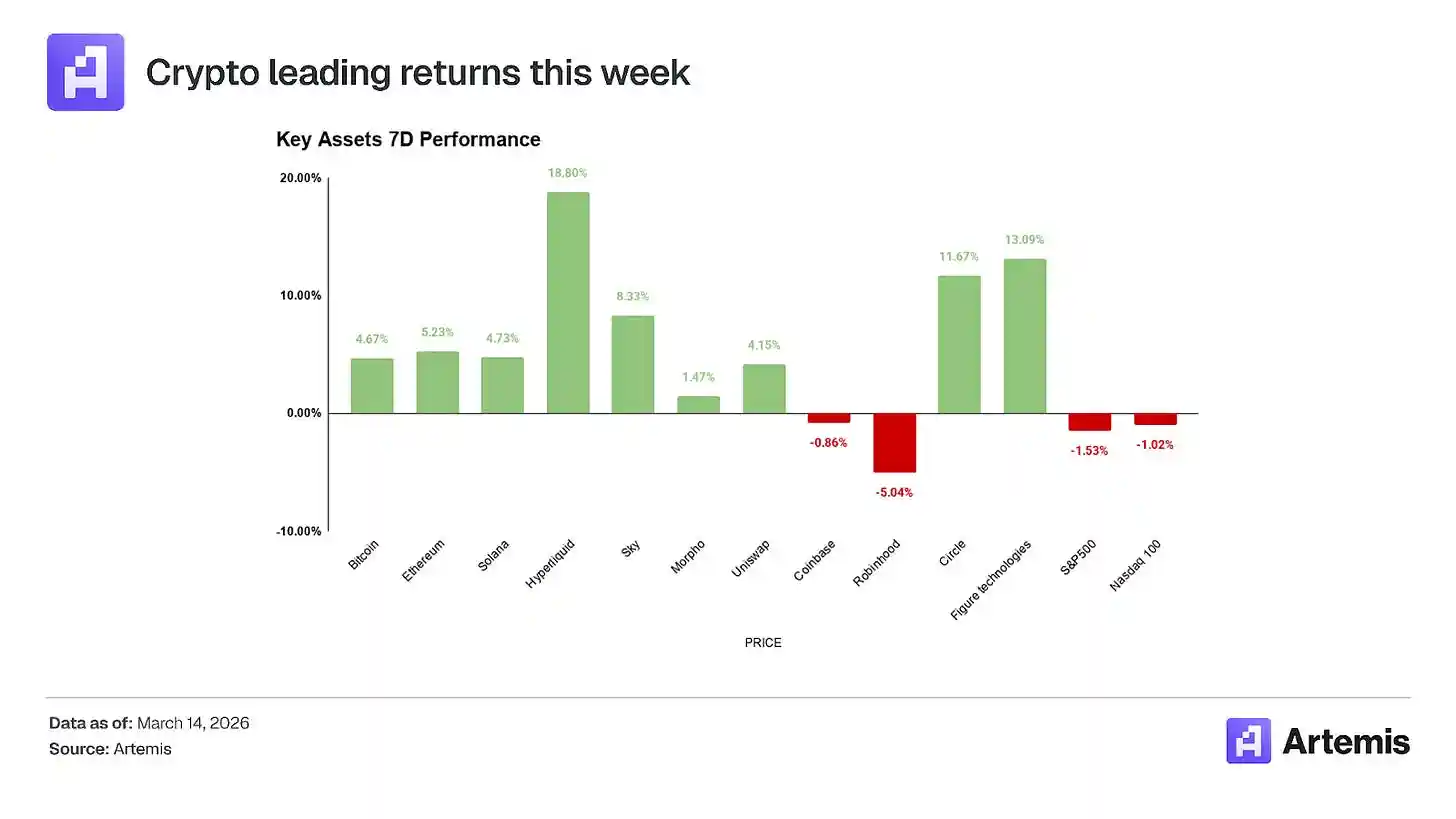
This week, crypto asset returns significantly outperformed. HYPE was the standout performer, surging +18.8% over the past 7 days; Figure Technologies (+13.1%) and Circle (+11.7%) also posted substantial gains. Among mainstream assets, Ethereum (+5.2%), Solana (+4.7%), and Bitcoin (+4.7%) all advanced, with Uniswap (+4.2%) and SKY (+8.3%) further boosting the overall rally in digital assets.

Notably, crypto clearly outperformed traditional stocks this week. Although digital assets and crypto-related stocks were mostly in the green, Coinbase (-0.9%) and Robinhood (-5.0%) underperformed the broader market, showing more divergence at the equity level. Among traditional benchmarks, the S&P 500 fell -1.5% weekly, and the Nasdaq 100 declined -1.0%. Overall, risk appetite clearly flowed back into crypto assets, with tokens and some crypto-linked instruments significantly outperforming the market.
Highlights of the Week

HIP-3 open interest and trading volume hit record highs, driven by oil futures

Crypto ETFs see net inflows for two consecutive weeks

On-chain tokenized gold supply exceeds 1.2 million ounces

1. HIP-3 Open Interest and Volume Hit Record Highs, Oil Futures Become Key Driver
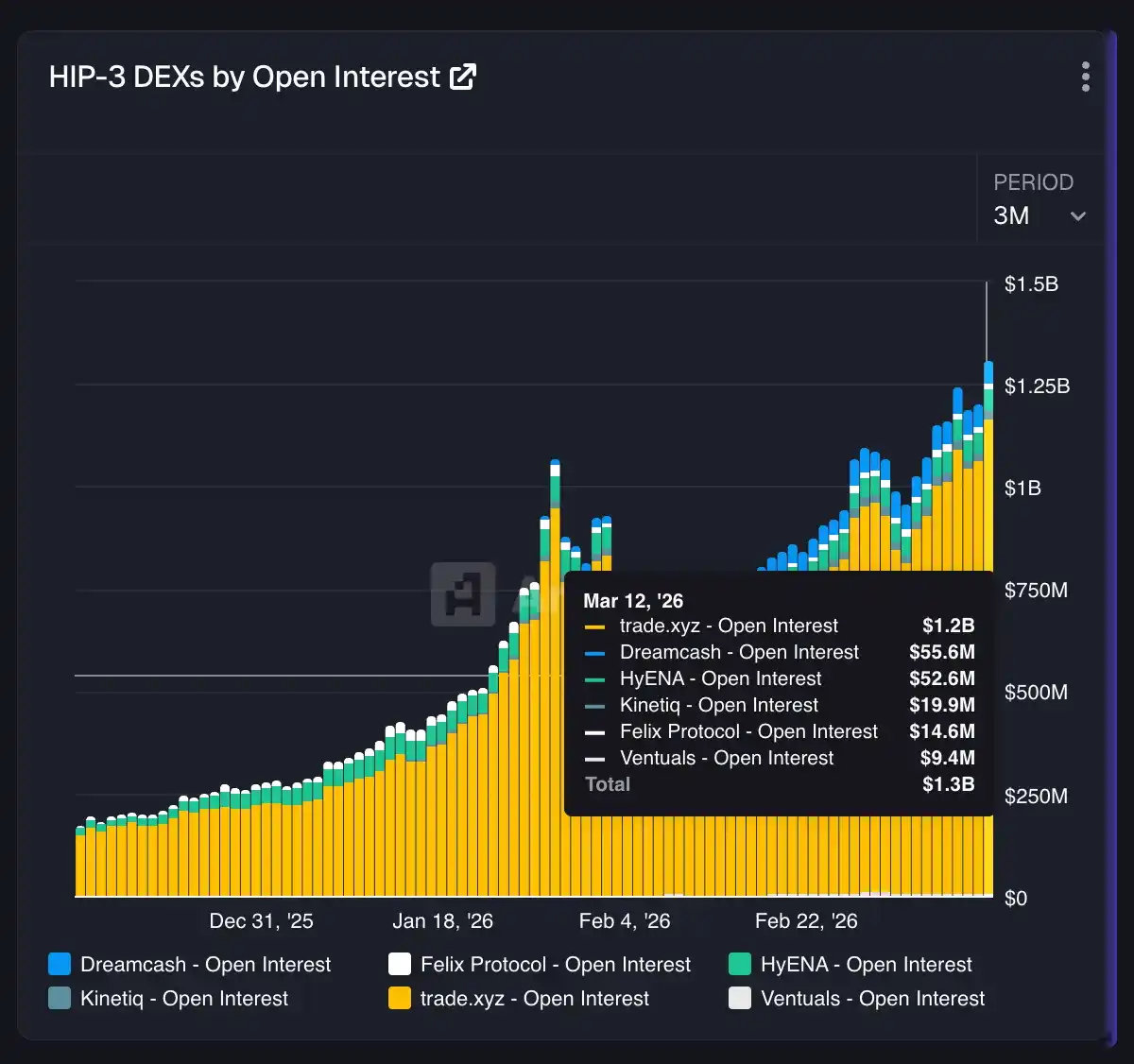
HIP-3 market open interest (OI) reached another record high this week: on March 12, total OI hit approximately $1.3 billion. The platform trade.xyz contributed about $1.2 billion of this, with smaller platforms like Dreamcash and HyENA providing additional depth.
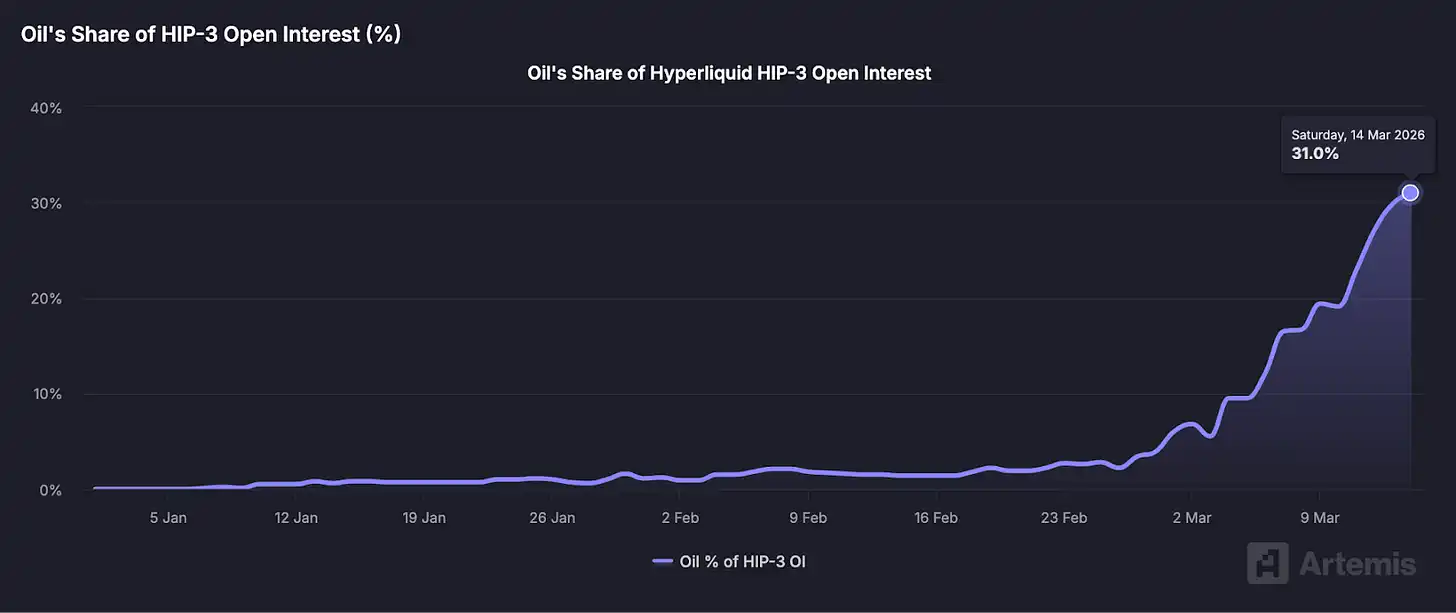
More important than the absolute numbers is the shift in drivers. Oil's share of HIP-3 total open interest rose to 31% by March 14—up from nearly negligible levels for most of January and February. In less than two weeks, oil went from a marginal role to one of the most in-demand sources in the entire ecosystem.

This shift signals that HIP-3 is evolving beyond crypto-native long-tail experiments into a truly permissionless venue for macro expression. When offshore traders seek quick exposure to oil, indices, and event-driven volatility, capital is accelerating its flow on-chain. If this trend continues, HIP-3 could become the clearest case of on-chain markets beginning to capture global commodity flows.

2. Crypto ETFs See Net Inflows for Two Consecutive Weeks

Crypto ETF flows remained positive for the second consecutive week, further indicating a resurgence in institutional demand. For the week ending March 8, net inflows totaled $609.9 million, led by Bitcoin ETFs (+$568.5 million), with healthy inflows also seen in Ethereum (+$23.5 million) and Solana (+$22.0 million). Ripple-related products saw minor outflows (-$4.1 million), but overall flows remained positive.
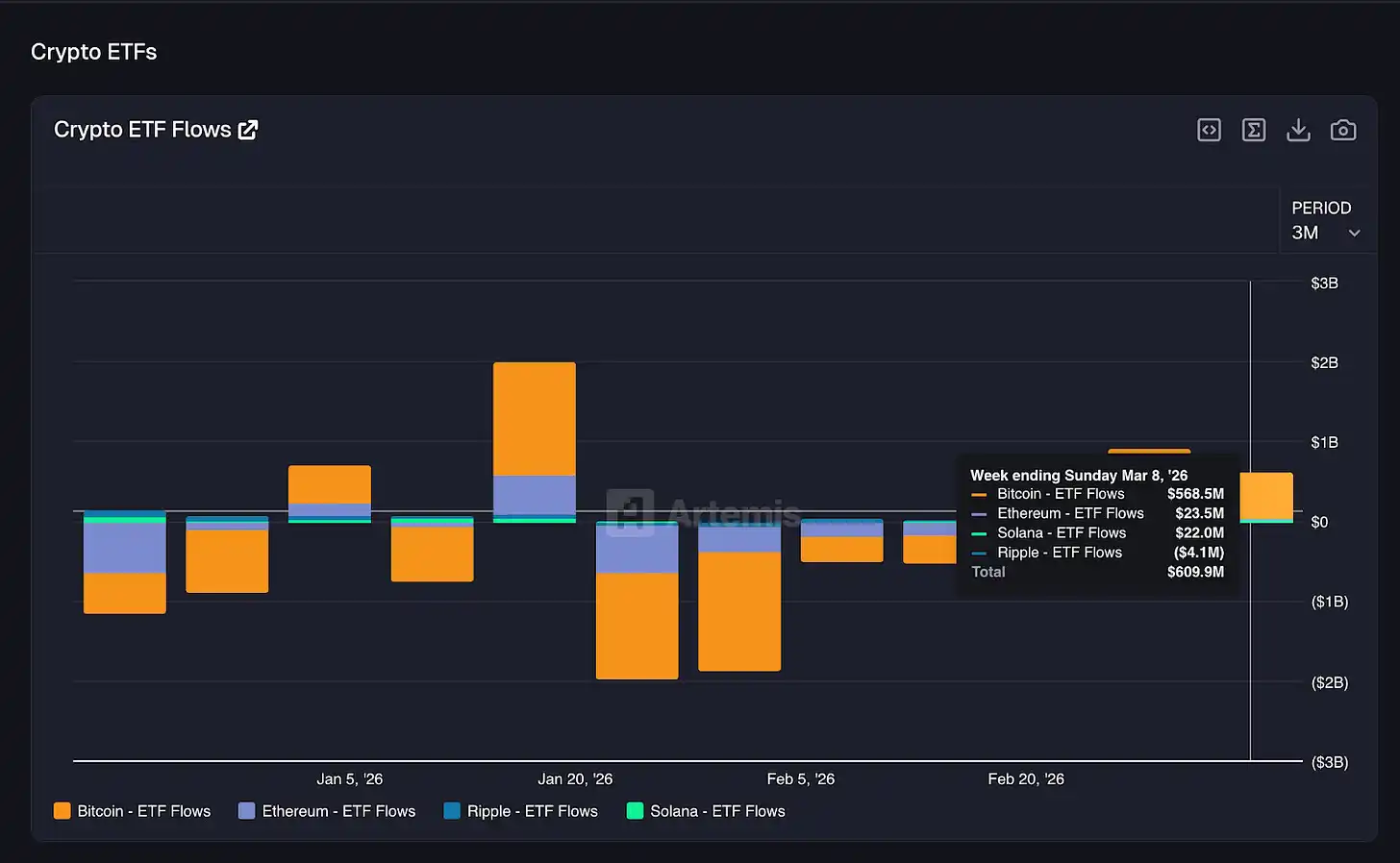
The more critical takeaway: this no longer appears to be a one-week rebound. After weeks of pressure, two consecutive weeks of positive data suggest asset allocators are gradually rebuilding crypto exposure.

The macro logic supporting these sustained flows is directly related to the Iran conflict.
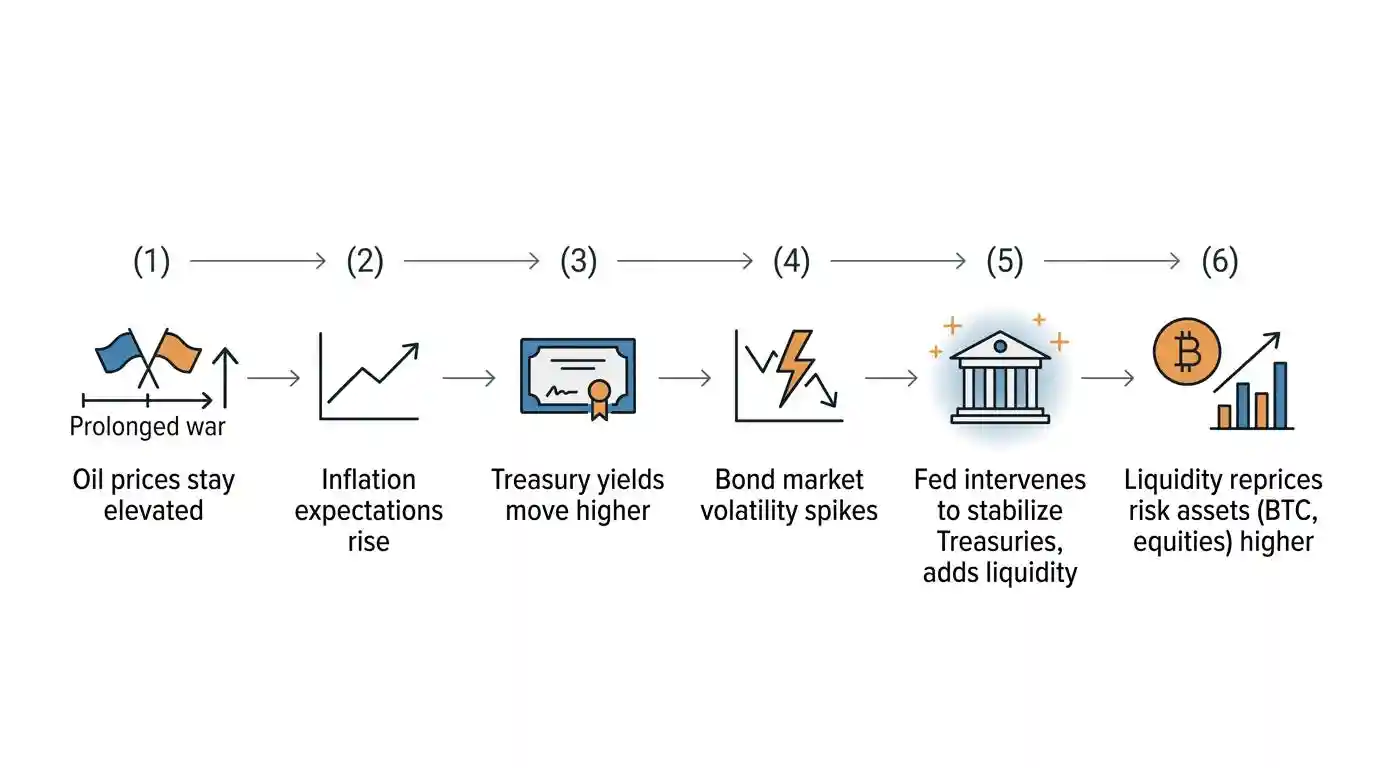
(Hayes' "iOS Warfare" is currently the most detailed exposition of this logic.)

The macro backdrop may continue to provide support. Geopolitical tensions, rising oil prices, and the market's reassessment of Fed rate cut expectations are pushing investors to more seriously consider hard assets and alternative stores of value. If macro uncertainties persist, ETF demand could remain robust as allocators rebuild crypto positions.

3. On-Chain Tokenized Gold Supply Exceeds 1.2 Million Ounces

Tokenized gold supply continued to breakneck growth this week, with on-chain holdings reaching approximately 1.2 million ounces, equivalent to about $6.1 billion. Compared to less than $2 billion just under a year ago, the rapid growth highlights investors' accelerating demand for blockchain-based hard asset exposure.
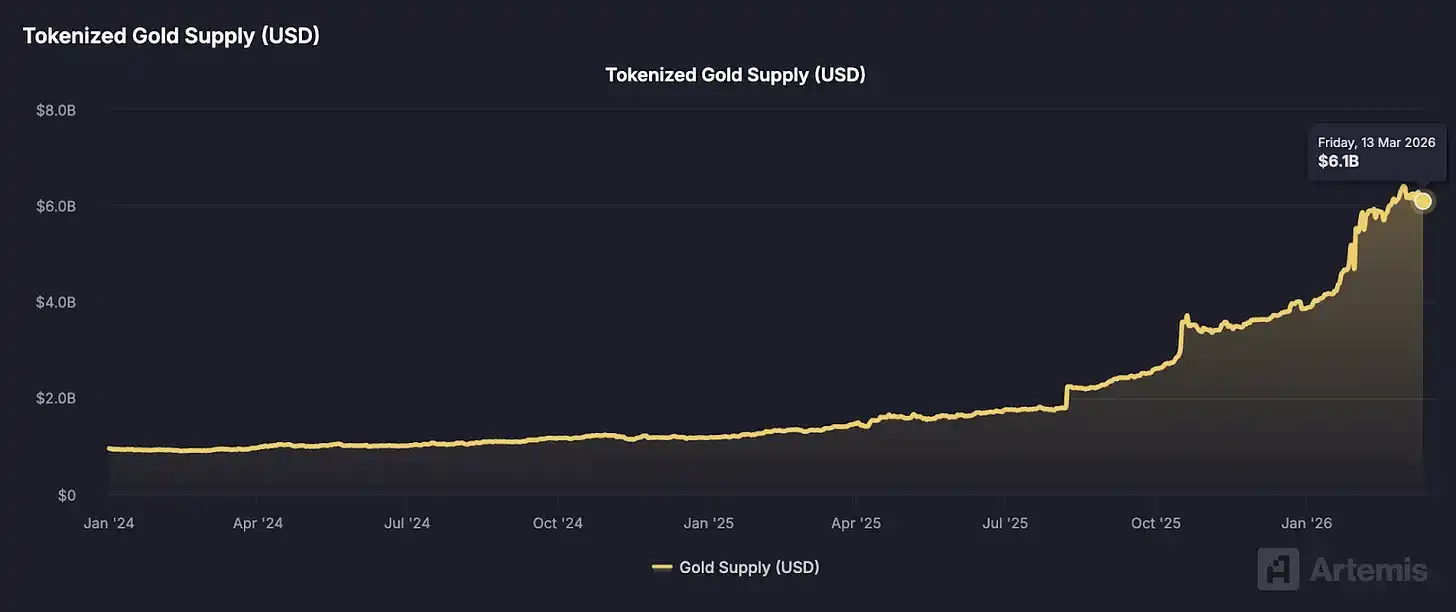
Amid increasing macro uncertainty dominating markets, tokenized gold is benefiting from two trends: gold's traditional role as a safe-haven asset, and growing acceptance of its on-chain wrapped form as a circulation channel.

The bigger conclusion: tokenization is no longer just a payments or stablecoin story; it is meaningfully extending to store-of-value assets, with gold emerging as one of the clearest real-world beneficiaries.

Chart of the Week

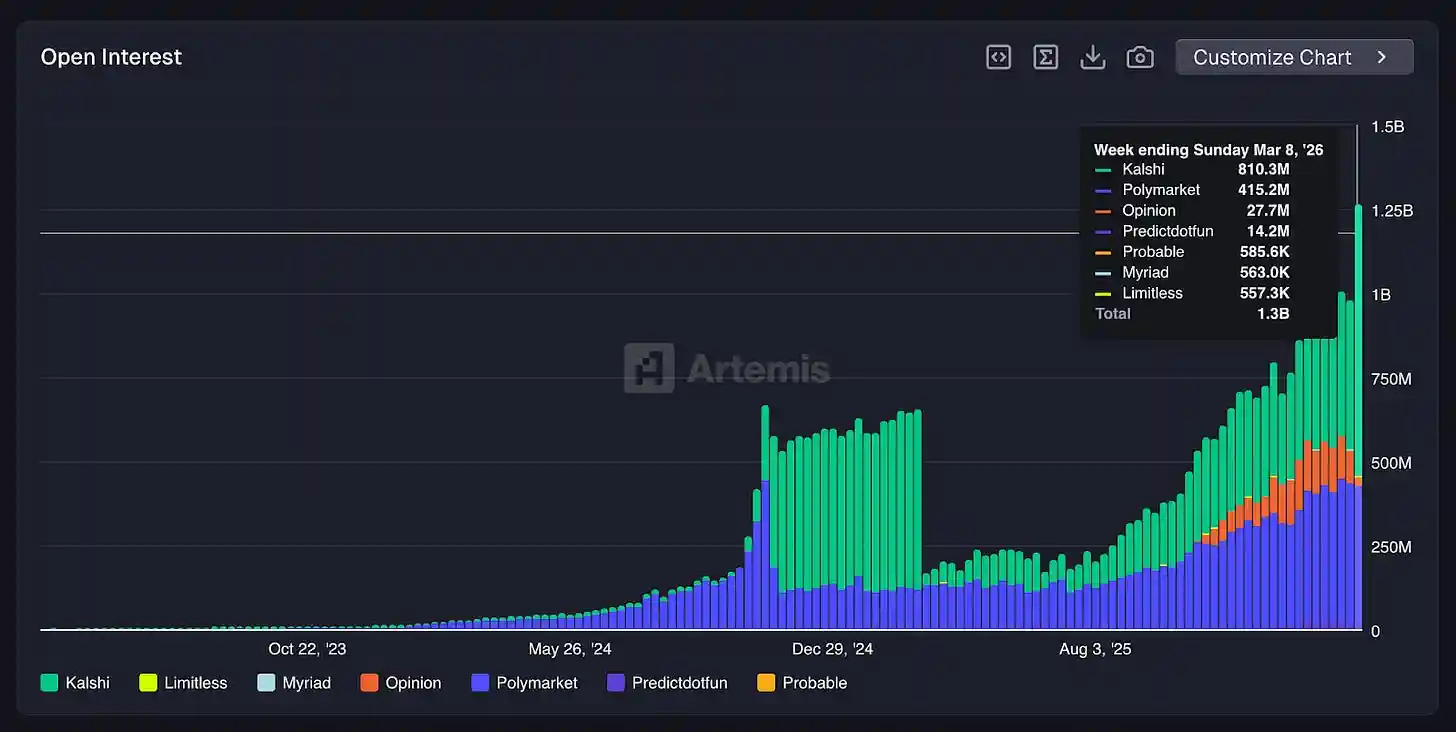
Prediction markets continued growing this week, with total open interest reaching approximately $1.3 billion, led by Kalshi and Polymarket. Traders are increasingly using event markets to express real-time views on political, macro, and geopolitical volatility. This landscape is worth watching—it indicates demand has expanded beyond pure crypto price speculation into broader real-world information and probability pricing markets.
Other Noteworthy News

Mastercard launches large-scale crypto partnership program. On March 11, Mastercard announced a new crypto collaboration program involving over 85 institutions, including Binance, Circle, Ripple, PayPal, Gemini, and Paxos. The initiative aims to leverage stablecoins and digital assets to support cross-border payments, B2B transfers, and global settlement on networks like Solana, Polygon, Avalanche, and Aptos. This marks another step in the integration of blockchain payment infrastructure with the mainstream financial system.

Coinbase in talks with Bybit for potential investment partnership. Reports on March 14 indicated Coinbase is negotiating a possible investment or strategic partnership with Bybit. A deal would bring Bybit closer to the compliant US market, while Coinbase would gain access to one of the largest offshore exchanges globally. From a macro perspective, such talks confirm a trend: as market structure matures, major global exchanges are increasingly aligning with regulated counterparts.

BitGo selected by SoFi to provide infrastructure and institutional distribution support for SoFiUSD. This partnership makes BitGo the core provider for issuance, custody, and distribution of SoFi's bank-issued stablecoin, with institutional clients able to access SoFiUSD directly via BitGo's platform. This again shows regulated banks moving from stablecoin experimentation to actual deployment, backed by crypto-native infrastructure providers.

Kraken's banking unit moves closer to US direct payment access. Kraken Financial's pursuit of a Federal Reserve master account continues to draw attention as one of the most significant infrastructure developments in the space. Direct access to Fedwire and related payment channels would reduce friction for institutional fiat transfers, representing another case of crypto companies integrating into core financial plumbing rather than building alternatives.


Связанные с этим вопросы

QWhat were the main drivers behind the record high in HIP-3 open interest, and why is this significant?

AThe record high in HIP-3 open interest was primarily driven by a surge in oil futures, which grew from a negligible share to 31% of the total in under two weeks. This is significant because it signals that HIP-3 is evolving from a crypto-native experiment into a permissionless venue for macro-economic expression, potentially capturing global commodity flows on-chain.

QWhat does the data show about cryptocurrency ETF flows for the week ending March 8th?

ACryptocurrency ETF flows were positive for the second consecutive week, with a net inflow of $609.9 million. Bitcoin ETFs led with an inflow of $568.5 million, followed by Ethereum ($23.5 million) and Solana ($22 million), indicating a rebuilding of institutional crypto exposure.

QHow much has the supply of on-chain tokenized gold grown, and what does this trend indicate?

AThe supply of on-chain tokenized gold has grown to approximately 1.2 million ounces, valued at around $6.1 billion, a significant increase from less than $2 billion a year ago. This rapid growth indicates rising investor demand for blockchain-based hard asset exposure and greater acceptance of tokenized forms of traditional safe-haven assets.

QAccording to the report, how did the performance of crypto assets compare to traditional stocks this week?

ACrypto assets significantly outperformed traditional stocks this week. Major cryptocurrencies like HYPE (+18.8%), Ethereum (+5.2%), Solana (+4.7%), and Bitcoin (+4.7%) posted gains, while traditional benchmarks like the S&P 500 (-1.5%) and Nasdaq 100 (-1.0%) declined, showing a clear shift in risk appetite towards crypto assets.

QWhat major partnership did Mastercard announce, and what is its goal?

AMastercard announced a new Crypto Partner Program involving over 85 institutions, such as Binance, Circle, and PayPal. The program aims to leverage stablecoins and digital assets on networks like Solana and Polygon to support cross-border payments, B2B transfers, and global settlement, marking a step towards integrating blockchain payment infrastructure with the mainstream financial system.

Похожее

Google and Amazon Simultaneously Invest Heavily in a Competitor: The Most Absurd Business Logic of the AI Era Is Becoming Reality

In a span of four days, Amazon announced an additional $25 billion investment, and Google pledged up to $40 billion—both direct competitors pouring over $65 billion into the same AI startup, Anthropic. Rather than a typical venture capital move, this signals the latest escalation in the cloud wars. The core of the deal is not equity but compute pre-orders: Anthropic must spend the majority of these funds on AWS and Google Cloud services and chips, effectively locking in massive future compute consumption. This reflects a shift in cloud market dynamics—enterprises now choose cloud providers based on which hosts the best AI models, not just price or stability. With OpenAI deeply tied to Microsoft, Anthropic’s Claude has become the only viable strategic asset for Google and Amazon to remain competitive. Anthropic’s annualized revenue has surged to $30 billion, and it is expanding into verticals like biotech, positioning itself as a cross-industry AI infrastructure layer. However, this funding comes with constraints: Anthropic’s independence is challenged as it balances two rival investors, its safety-first narrative faces pressure from regulatory scrutiny, and its path to IPO introduces new financial pressures. Globally, this accelerates a "tri-polar" closed-loop structure in AI infrastructure, with Microsoft-OpenAI, Google-Anthropic, and Amazon-Anthropic forming exclusive model-cloud alliances. In contrast, China’s landscape differs—investments like Alibaba and Tencent backing open-source model firm DeepSeek reflect a more decoupled approach, though closed-source models from major cloud providers still dominate. The $65 billion bet is ultimately about securing a seat at the table in an AI-defined future—where missing the model layer means losing the cloud war.

marsbit3 ч. назад

Google and Amazon Simultaneously Invest Heavily in a Competitor: The Most Absurd Business Logic of the AI Era Is Becoming Reality

marsbit3 ч. назад

Computing Power Constrained, Why Did DeepSeek-V4 Open Source?

DeepSeek-V4 has been released as a preview open-source model, featuring 1 million tokens of context length as a baseline capability—previously a premium feature locked behind enterprise paywalls by major overseas AI firms. The official announcement, however, openly acknowledges computational constraints, particularly limited service throughput for the high-end DeepSeek-V4-Pro version due to restricted high-end computing power. Rather than competing on pure scale, DeepSeek adopts a pragmatic approach that balances algorithmic innovation with hardware realities in China’s AI ecosystem. The V4-Pro model uses a highly sparse architecture with 1.6T total parameters but only activates 49B during inference. It performs strongly in agentic coding, knowledge-intensive tasks, and STEM reasoning, competing closely with top-tier closed models like Gemini Pro 3.1 and Claude Opus 4.6 in certain scenarios. A key strategic product is the Flash edition, with 284B total parameters but only 13B activated—making it cost-effective and accessible for mid- and low-tier hardware, including domestic AI chips from Huawei (Ascend), Cambricon, and Hygon. This design supports broader adoption across developers and SMEs while stimulating China's domestic semiconductor ecosystem. Despite facing talent outflow and intense competition in user traffic—with rivals like Doubao and Qianwen leading in monthly active users—DeepSeek has maintained technical momentum. The release also comes amid reports of a new funding round targeting a valuation exceeding $10 billion, potentially setting a new record in China’s LLM sector. Ultimately, DeepSeek-V4 represents a shift toward open yet realistic infrastructure development in the constrained compute landscape of Chinese AI, emphasizing engineering efficiency and domestic hardware compatibility over pure model scale.

marsbit3 ч. назад

Computing Power Constrained, Why Did DeepSeek-V4 Open Source?

marsbit3 ч. назад

Торговля

Спот
Фьючерсы
活动图片