Dogecoin ETFs lose their bite as Bitcoin, Ethereum big dogs lead the pack

cointelegraphОпубликовано 2025-12-09Обновлено 2025-12-09

Введение

US spot Dogecoin ETFs are experiencing a significant decline in trading activity, with total value traded (TVT) dropping to a record low of $142,000, far below the peak of over $3 million seen in late November. This cooling demand contrasts sharply with Dogecoin's strong performance in the broader crypto market, where it maintains over $1.1 billion in daily spot trading volume and a $22.6 billion market cap. The discrepancy suggests investors prefer accessing DOGE directly through exchanges rather than via ETFs. Meanwhile, Bitcoin and Ethereum ETFs continue to dominate the market, with TVTs of $3.1 billion and $1.3 billion respectively, underscoring their dominance in the regulated crypto ETF space. Other altcoin ETFs, including those for Solana and XRP, trail significantly behind in trading volume.

US spot Dogecoin exchange-traded funds (ETFs) are showing early signs of cooling demand, as total value traded (TVT) has fallen to its lowest level since launch.

SoSoValue data shows that on Monday, Dogecoin ETFs’ TVT fell to just $142,000, the lowest since launch. This marks a sharp retreat from late November, when the funds saw days where value traded topped $3.23 million.

Total value traded refers to the total dollar amount of ETF shares bought and sold over a given period. It serves as a gauge of market activity and practical liquidity, indicating the amount of money that has moved through the funds.
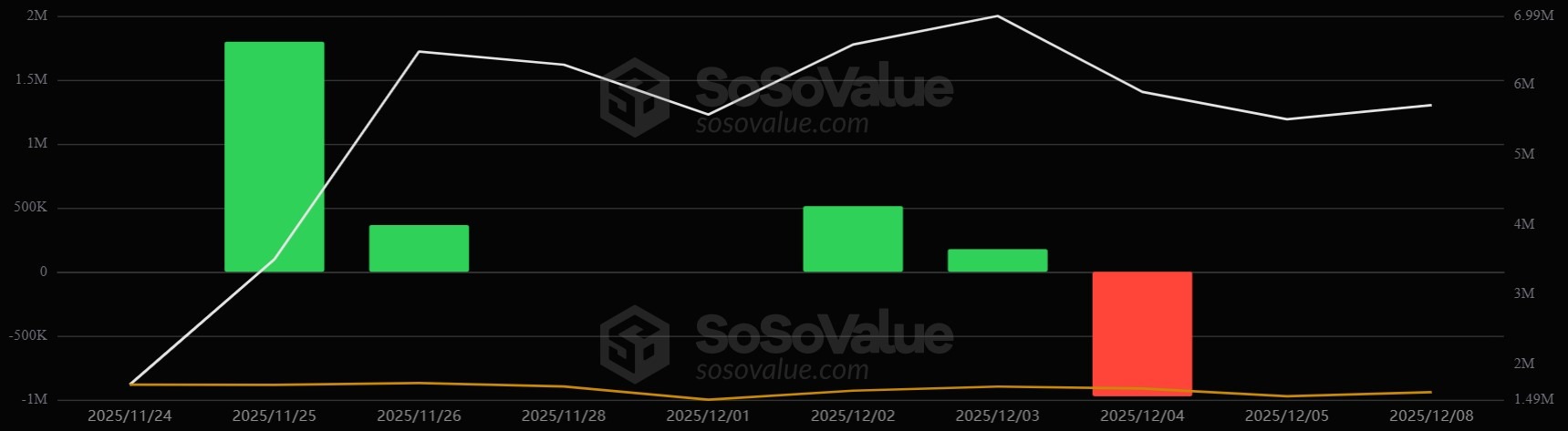
Daily spot ETF net inflows and total net assets. Source: SoSoValue

The contrast is stark when compared to Dogecoin (DOGE) activity in the broader crypto market. CoinGecko data shows that in the last 24 hours, DOGE recorded over $1.1 billion in spot trading volume and has a market capitalization of $22.6 billion.

This shows that the underlying asset remains highly liquid, but not through its ETF wrappers. This discrepancy suggests that traders are accessing DOGE directly through exchanges rather than traditional market vehicles.

Grayscale’s Dogecoin ETF made its debut in November but fell well short of initial volume expectations. ETF analyst Eric Balchunas predicted at the time that the ETFs would get at least $12 million in volume. However, the ETF only saw $1.4 million on its first day.

Related: BlackRock files with SEC for listing of staked Ether ETF

Bitcoin and Ether dominate ETF trading as alt-ETFs trail behind

On Dec. 8, ETF trading activity remained concentrated on Bitcoin (BTC) and Ether (ETH)-based products. According to SoSoValue, Bitcoin ETFs posted $3.1 billion in TVT, while Ether ETFs recorded $1.3 billion.

Solana (SOL) ETFs saw $22 million in value traded, while XRP products recorded $21 million in value traded. Further down the curve, the recently-launched Chainlink ETFs recorded a $3.1 million TVT on the same day, while Canary’s Litecoin (LTC) ETF had about $526,000.

The data suggests that ETF capital still overwhelmingly flows toward the two largest digital assets, continuing their lead as the core liquidity centers of regulated crypto exchange-traded products.

In terms of inflows, XRP (XRP) remains strong. On Monday, XRP ETFs’ inflow streak remains unbroken since its launch. Meanwhile, Solana ETFs, which first had their inflow streak broken in November, are on a three-day inflow streak after seeing $32 million in outflows on Dec. 3.

Magazine: Bitcoin whale Metaplanet ‘underwater’ but eyeing more BTC: Asia Express


Похожее

Institutions Are Taking Over the Crypto Market: Is This the End of Decentralization, or the Prelude to a New Cycle?

The cryptocurrency market is undergoing a structural shift in 2025, with institutional investors now accounting for approximately 95% of capital inflows, while retail participation has declined to 5–6%. According to Aishwary Gupta of Polygon Labs, this transition is driven by maturing infrastructure rather than market sentiment. Major asset managers like BlackRock, Apollo, and Hamilton Lane are allocating portions of their portfolios to digital assets via ETFs and on-chain tokenized products, leveraging public blockchains that meet traditional finance compliance standards. Key drivers include yield generation through tokenized treasuries and institutional staking, followed by efficiency gains from faster settlements, shared liquidity, and programmable assets. While retail investors retreated due to losses from meme coin cycles, Gupta believes they will return as more regulated and transparent products emerge. He argues that institutional involvement does not undermine decentralization; instead, it enhances legitimacy and fosters a hybrid financial ecosystem where DeFi, NFTs, and traditional assets coexist on public chains. Although increased compliance may limit some experimentation, it promotes more sustainable innovation. Looking ahead, institutional liquidity is expected to reduce market volatility and accelerate the growth of real-world asset tokenization and cross-chain interoperability infrastructure. This evolution signals crypto’s transition from a speculative asset to a core component of the global financial system.

比推12 мин. назад

Institutions Are Taking Over the Crypto Market: Is This the End of Decentralization, or the Prelude to a New Cycle?

比推12 мин. назад

World's Richest Man, 'Silicon Valley Iron Man' Musk, to Take SpaceX Public in 2026!

Elon Musk, the world's richest person and CEO of SpaceX, plans to take the company public in 2026 with a target valuation of approximately $1.5 trillion. The IPO is expected to raise "significantly more than $30 billion," potentially making it the largest in history, surpassing Saudi Aramco's 2019 offering. A key driver of this ambitious valuation is a new narrative: **space-based AI computing**. Musk introduced the concept of "space AI compute" at a recent investor conference, arguing that within five years, running AI training and inference in space could become the lowest-cost solution. The core advantages include near-uninterrupted solar power and the vacuum of space acting as an ultimate heat sink. Additionally, with its reusable Starship rockets, SpaceX aims to drastically reduce launch costs to as low as $200–300 per kilogram. This vision, however, faces significant technical hurdles. Challenges include managing extreme heat radiation in direct sunlight, protecting hardware from cosmic radiation, and the economic risks associated with potential launch failures. Competitors are also entering the arena, including Jeff Bezos’ Blue Origin, which is developing its own orbital data centers, and Sam Altman’s OpenAI, which is reportedly considering acquiring a rocket company. Despite the challenges, Wall Street has responded positively. Firms like Ark Invest are now valuing SpaceX as a high-growth AI infrastructure company rather than a traditional aerospace firm, projecting that its space-based compute business could generate $80–120 billion in high-margin revenue by 2030. The success of this new "space dream" hinges on the continued development of Starship, overcoming technical barriers, and navigating future regulatory landscapes.

marsbit26 мин. назад

World's Richest Man, 'Silicon Valley Iron Man' Musk, to Take SpaceX Public in 2026!

marsbit26 мин. назад

Торговля

Спот
Фьючерсы
活动图片