Author: Shouyi, Biteye Content Team
This is the toughest year for the crypto community: Bitcoin keeps falling, contracts are constantly liquidated, no one is sending red envelopes in group chats, and everyone has shifted from "buying the dip" to "playing dead."
This decline is not just a technical correction but a simultaneous eruption of multiple pressures: global regulation tightening, escalating geopolitical conflicts, industry leaders retreating, and retail investor confidence collapsing. These four forces are converging, staging a "Siege of Bright Summit" battle in the crypto world.
However, upon closer examination of these ten bearish factors, many of the "bad things" are actually necessary steps for the industry's maturation. Below, Biteye breaks them down one by one. After reading, you'll know how to respond.
I. Regulatory Iron Curtain: Stablecoins, Taxation, and Platform Regulation
1. Stablecoin Interest Earnings to Be Cut Off
https://x.com/CryptosR_Us/status/2021523353769480336
Amid the legislative stalemate over the U.S. "Clarity for Payment Stablecoins Act," the American Bankers Association (ABA) and major Systemically Important Banks (SIBs) have lobbied regulators to prohibit stablecoin issuers and intermediary platforms from paying interest to users. Violators face daily fines of up to $500,000.
Short-term impact: Stablecoins' attractiveness will undoubtedly decline, and with the weakening dollar, some TVL will flow elsewhere;
Long-term impact: A complete ban is unrealistic; a compromise with limited rewards is more probable. Policies are expected to be finalized in Q2, and the market will gradually digest this expectation over the next 3-6 months.
2. Global Tax Dragnet Arrives
https://x.com/Foresight_News/status/2010935974742937622
The Crypto Asset Reporting Framework (CARF), led by the Organisation for Economic Co-operation and Development (OECD), has taken effect in 48 jurisdictions (including the EU's 27 countries, the UK, Japan, and South Korea). It requires exchanges to automatically exchange cross-border transaction data of users, with the U.S. simultaneously implementing Form 1099-DA.
Short-term impact: Compliance costs will rise significantly, triggering panic selling among retail investors;
Long-term impact: Tax transparency is a prerequisite for traditional institutional entry. Trillions in institutional funds may only flow in after full implementation in 2026; this is just the painful transition period.
3. Even X Platform Starts Restricting Ad Qualifications
https://x.com/nikitabier/status/2025337476391608540
X platform has updated its advertising policy for prediction markets, mandating mandatory disclosures for all promotional content, effectively significantly raising customer acquisition costs for projects.
Short-term impact: Shitcoin hype is completely dead; marketing on X is basically unworkable;
Long-term impact: Good money drives out bad, helping rebuild industry credibility. However, frankly, there aren't many serious projects still advertising on X; this rule is more symbolic, and its impact depends on enforcement.
II. Geopolitical Strangulation: War, Tariffs, and Summit Diplomacy
4. Middle East Conflict, Capital Fleeing to Safety
https://x.com/StateDept/status/2026518216600858881
Trump's maximum pressure on Iran, threatening "small strikes first, then big ones," has driven risk-averse sentiment, pushing the U.S. Dollar Index (DXY) to 97.7, raising the 10-year Treasury yield, and Brent crude breaking $65/barrel. The Global Economic Policy Uncertainty Index hit a record high since FRED database records began, with capital flooding into traditional safe-haven assets.
Short-term impact: Crypto market liquidity was instantly drained, most evident in the disappearance of USDT premiums, which even turned into discounts;
Long-term impact: Geopolitical shocks often come and go quickly. Historically, suppressed buying often rebounds violently within 1-2 months. Selling now to switch to dollars likely means selling at the bottom.
5. Trump's 15% Tariff Hammer Falls
https://x.com/baldwin_daniel_/status/2025246781592773073
After the Supreme Court rejected related relief requests, the Trump administration, under Section 122 of the Trade Act of 1974, raised the global baseline tariff from 10% to 15% on February 24 for 150 days. This policy transmits through the chain of "tariffs → inflation expectations → stronger dollar," and crypto, as a high-beta risk asset, is hit first.
Short-term impact: Negative shocks typically peak at policy onset. If major countries later break the ice in talks, the pressure will quickly turn positive;
Long-term impact: Trump habitually uses maximum pressure before negotiations; the TACO (Tariff-Agreement Cycle) is a classic pattern and won't last the full 150 days.
6. Market Awaits U.S.-China "Summit Diplomacy"
https://x.com/AJEnglish/status/2025111127110418517
The Trump administration announced plans to visit China from March 31 to April 2, but may implement "pre-negotiation maximum pressure" through tariff escalations and tech bans beforehand—a typical game theory strategy. The market must continue trading under policy suspense until late March.
Short-term impact: This bearish factor artificially amplifies volatility, keeping the market under a cloud of policy uncertainty;
Long-term impact: If talks yield substantial progress, global risk assets will see a liquidity release window. Expectations are that this bearish news will be digested after the late March meeting results. Until then, "uncertainty" persists, and market volatility may increase.
III. Internal Bleeding: Liquidations, Selling, and Retreat
7. Jihan Wu Liquidates BTC, Fully Shifts to AI
https://x.com/CupidMonday/status/2025956106833449279
Bitdeer (NASDAQ: BTDR), controlled by Jihan Wu, recently liquidated about 1,132 BTC (approx. $72 million at the time) and announced a full transition to AI Data Center (AIDC) business. The company's IR statement emphasized this as a "non-permanent zero position," essentially balance sheet management to cope with miner upgrade pressures (4nm/3nm chips) and capital expenditure needs for AI computing infrastructure.
Short-term impact: Panic over "miner selling" is amplified. If even a mining tycoon is selling, why should retail hold?
Long-term impact: AI-crypto computing fusion is an industry upgrade trend, not a systemic crisis. Expect funds to flow back into crypto after AIDC construction.
8. Vitalik Continues Selling ETH, Lower and Lower
https://x.com/DeFiTracer/status/2018698179277963356
Ethereum co-founder Vitalik Buterin recently continued selling ETH via a multisig address, offloading 1,869 coins in two days, totaling over 7,000 ETH (approx. $15.5 million) sold. Official confirmation stated funds are for Ethereum Foundation R&D and long-term investments in biotech. Relative to his ~$430 million holdings, the sell-off is less than 0.36%.
Short-term impact: In the weak market, Vitalik's actions precisely hit ETH bulls' confidence, creating a vicious cycle of "selling more as price drops, price drops as more is sold." Many on X question if Vitalik has lost faith in ETH, and this sentiment spread is dangerous;
Long-term impact: Normal operation for founders to cash out and feed the ecosystem, just at an unfortunate time.
9. Influencers Collective Call to Exit, Smart Money Leaves
https://x.com/dotyyds1234/status/2026097439850303512
High-impact trader KOLs like "Honba Dragon King" publicly announced reducing on-exchange positions by 30%-50% and released bearish言论. In a illiquid market, such voices amplify via social media, causing emotional contagion. Now, people in groups are posting empty position screenshots, showing signs of follow-on panic selling.
Short-term impact: Bearish言论 from on-chain leaders and traders significantly affect the market;
Long-term impact: When market-recognized "smart money" collectively exits loudly, it often forms an excellent contrarian bottom indicator. Of course, whether this time is an exception is uncertain. Some KOLs may delete posts and turn bullish later; use @xhunt_ai plugin to check deletion history.
IV. Emotional Nuclear Bomb: "Bitcoin Is Dead," Depegging, and Trust Crisis
10. FUD Erupts, "Bitcoin Is Dead" Trends
https://x.com/XHuntCN/status/2025963293920342134
Google Trends shows "Bitcoin is dead" searches peaked since the 2022 FTX collapse; USD1 stablecoin briefly depegged to 0.98 USDT due to FUD; on-chain detective ZachXBT预告 will expose insider trading evidence of "the most profitable company in crypto" on February 26.
Short-term impact: In this environment, trust mechanisms are severely damaged, triggering indiscriminate selling;
Long-term impact: "BTC is dead" search peaks are often the strongest signal of market bottoms—as in 2018 and 2022. Expect ZachXBT's exposure to cause short-term flight to safety but long-term industry cleansing and renewal.
V. Technical Data: It's Bad, but Maybe Nearing the Bottom
A look at the data shows it's indeed bad. Three core indicators (BTC oversold Index, ahr999 buying index, Extreme Fear Index) are near historical extremes. Indicators suggest the market's oversold level is approaching historical limits but hasn't broken the longest record;震荡寻底 may continue for 1-2 months.
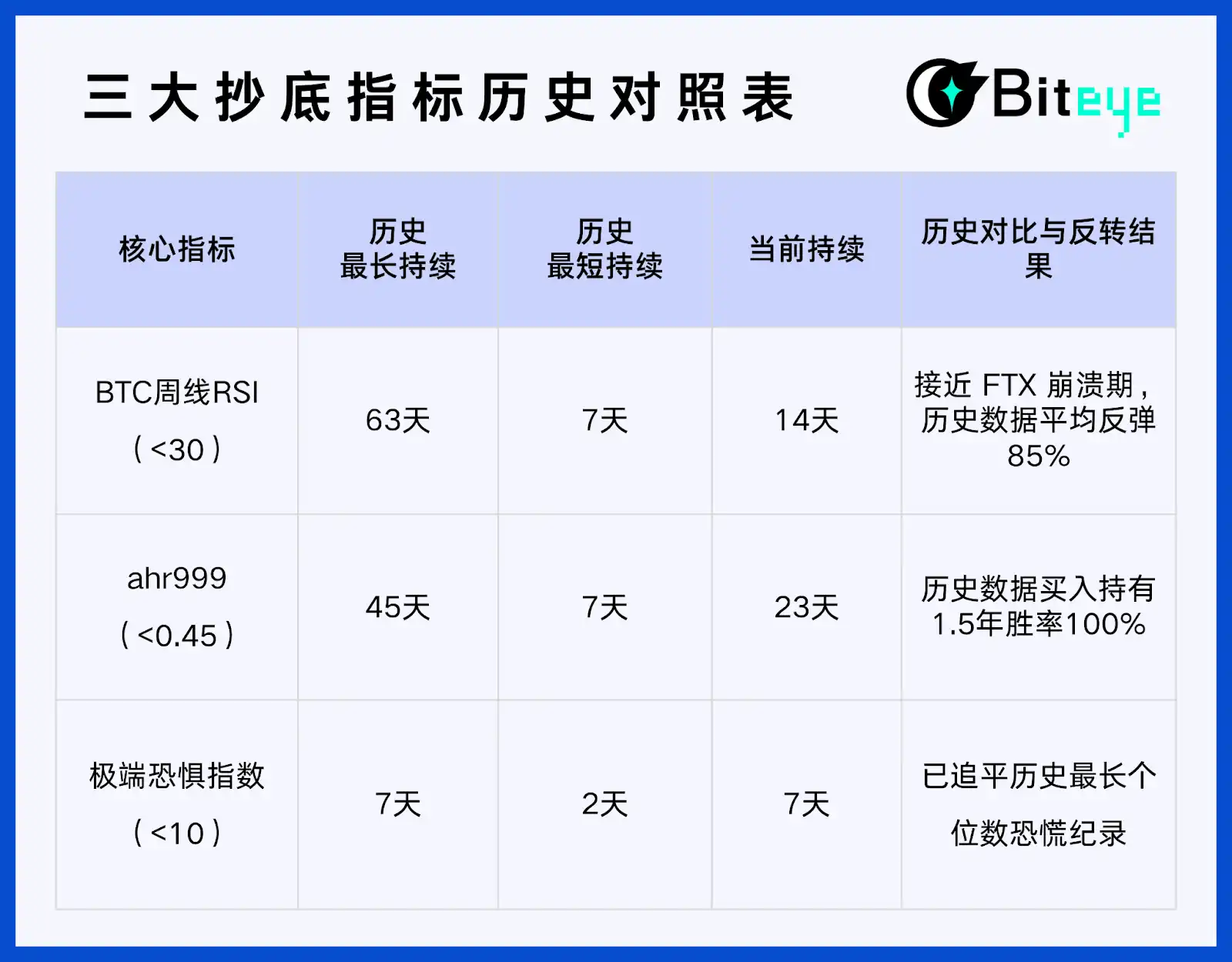
Optimistically, historical data shows "despair often breeds new life." After exiting such extreme indicators, BTC's 90-day return averaged over +50%. Combined with Trump's late March China visit schedule, the fastest reversal window may open in March.
Pessimistically, if Trump's visit fails in late March or ZachXBT drops a bombshell (e.g., Tether reserve fraud confirmed), all these "bottom signals" may fail. Users are advised to坚决 remove leverage short-term and closely monitor ZachXBT's爆料 and Trump's visit progress.
Market Advice: Survival Over Profits
Reviewing the recent ten bearish factors, 60% come from regulation and geopolitics, 40% from internal selling pressure and emotional collapse. It seems all bearish, but upon closer calculation, about 70% of bearish factors turn bullish medium-to-long term—regulatory iron curtains build合规 moats for traditional funds, and low sentiment is often the darkest before dawn.
"Buy the dip" and "short" on Twitter are more about emotion. When the real bottom hits, groups should be dead silent, not still arguing "is this the bottom?"
The "Siege of Bright Summit" is not crypto's end—more important than profit is staying at the table.