Crypto Watchlist: 5 Things To Monitor This Week

bitcoinistОпубликовано 2026-03-02Обновлено 2026-03-02

Введение

Crypto markets face a mix of geopolitical and product catalysts this week. Bitcoin remains the key macro watch, rebounding after an initial dip from U.S.-Iran tensions, with traders assess whether the conflict will escalate or fade. Oil price movements are being monitored for inflation and rate implications. On the product side, Starknet is launching strkBTC, a privacy-optional wrapped Bitcoin. Polygon’s March 4 upgrade will recycle gas fees to subsidize machine-to-machine payments. Avalanche begins its Retro9000 incentive round on March 2, shifting focus to rewarding most-used projects. The week concludes with the U.S. jobs report on March 6, which could reset interest rate expectations. Overall, macro factors like geopolitical risk and economic data may drive sharp market swings. The total crypto market cap stood at $2.25 trillion.

Crypto heads into the week of March 2 with five clear catalysts on deck: a worsening US-Iran conflict under President Donald Trump, a privacy-focused Bitcoin wrapper from Starknet, Polygon’s March 4 agentic-payments gas upgrade, Avalanche’s new incentive round, and Friday’s US jobs report.

Crypto Watchlist For This Week

Bitcoin is still the biggest macro watch this week, but the setup has already changed. The initial war shock over the weekend pushed BTC down toward $63,000, yet that move did not hold. The token rebounded as high as $68,196 on Sunday and was back around $65,807 by European Monday morning, while broader reporting showed traders were already reassessing whether the conflict would become a lasting macro shock or a violent but temporary headline event.

Oil followed a similar pattern: Brent briefly surged to $82.37 before giving back part of the move and easing back into the upper-$70s, which matters because crypto traders are now watching inflation risk and rate expectations more than the initial geopolitical headline itself.

What matters now is not simply that Washington and Tehran are in open conflict, but that the political signals are mixed. Trump has said he is willing to talk to Iran’s “new leadership,” while the White House has also made clear that military operations are continuing.

At the same time, AP’s live coverage says Iranian leaders are publicly rejecting negotiations. For markets, that creates a more nuanced watch item than a straight risk-off story: if diplomacy starts to look credible and oil keeps fading from its highs, Bitcoin’s rebound may hold; if the war widens and energy markets tighten again, crypto is likely to trade under macro pressure first and narrative second.

On the product side, Starknet is preparing to roll out strkBTC, a wrapped Bitcoin asset issued on Starknet and redeemable for native BTC, with optional shielding for balances and transfers. The design matters because Starknet is not pitching privacy as mandatory. In its own words, “Privacy is available when needed. Transparency remains available when required for compliance.”

Polygon’s catalyst lands on March 4, when the Lisovo/LisovoPro hardfork is scheduled around block 83,756,500, with implementation of PIP-82 included in the release. The proposal would recycle up to $1 million in gas base fees spent on agentic-commerce transactions, a direct subsidy aimed at machine-to-machine payments. Polygon’s own proposal says the chain has attracted 20.3% of x402 transactions and 10.4% of total volume since the start of the year.

Avalanche’s watch item is the Retro9000 C-Chain Round, which starts on March 2 and draws from the Foundation’s $40 million Retro9000 funding pool. The key shift is methodological. Avalanche says the program is moving from rewarding who built to rewarding what gets used, with projects ranked by AVAX burned through smart-contract activity and the top 40 becoming eligible for rewards.

The cleanest scheduled macro event arrives on Friday, March 6, when the Bureau of Labor Statistics releases the February US employment report at 8:30 a.m. ET. Reuters expects payroll growth of 60,000 after January’s 130,000 gain, making the release an important test of whether the prior month was a false signal or the start of a firmer labor backdrop. For crypto, that report matters because it can quickly reset rate-cut expectations just as markets are trying to price geopolitical stress.

This leaves crypto focused mainly on macro. If Middle East risk keeps oil, the dollar and broader risk sentiment in motion, Bitcoin and the wider altcoin market could remain exposed to sharp headline-driven swings. But if US-Iran tensions cool, Friday’s jobs report may become the next major trigger, with markets likely to judge it through one question above all: whether it strengthens or weakens the case for Fed easing.

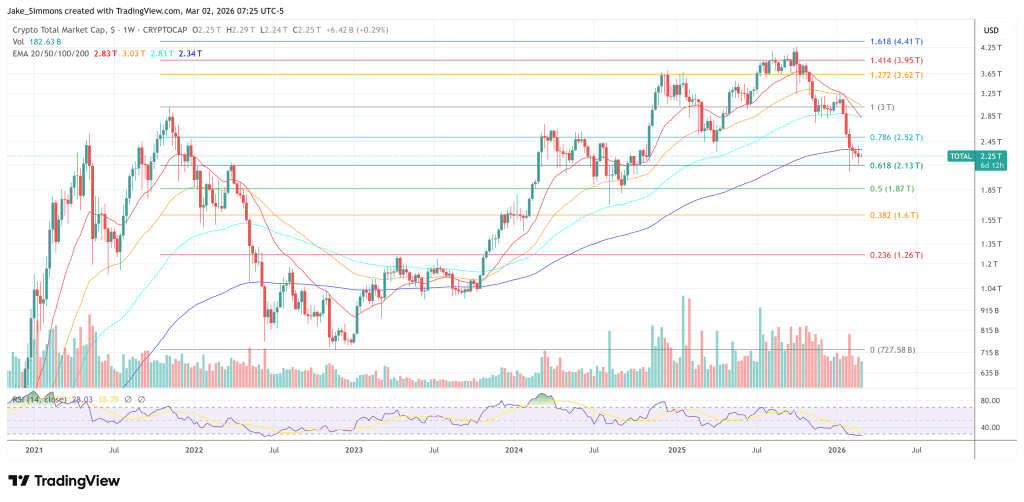
At press time, the total crypto market cap stood at $2.25 trillion.

Total crypto market cap remains above the 0.618 Fib, 1-week chart | Source: TOTAL on TradingView.com

Связанные с этим вопросы

QWhat are the five key catalysts for the crypto market this week as mentioned in the article?

AThe five catalysts are: a worsening US-Iran conflict, the launch of Starknet's strkBTC, Polygon's gas upgrade on March 4, Avalanche's new incentive round, and the US jobs report on Friday.

QHow did Bitcoin initially react to the US-Iran conflict over the weekend, and what was its price by European Monday morning?

AThe initial war shock pushed Bitcoin down toward $63,000, but it rebounded to as high as $68,196 on Sunday and was trading around $65,807 by European Monday morning.

QWhat is the key feature of Starknet's new strkBTC product?

AstrkBTC is a wrapped Bitcoin asset issued on Starknet that is redeemable for native BTC, with optional privacy shielding for balances and transfers, meaning privacy is available when needed but transparency remains for compliance.

QWhat is the purpose of Polygon's March 4 upgrade, and what specific feature does it implement?

AThe purpose of the upgrade is to implement agentic-payments through the Lisovo hardfork, which includes PIP-82. This proposal recycles up to $1 million in gas base fees spent on agentic-commerce transactions to directly subsidize machine-to-machine payments.

QHow does the Avalanche Retro9000 C-Chain Round differ from previous incentive programs?

AThe key methodological shift is that it moves from rewarding 'who built' to rewarding 'what gets used.' Projects are ranked by the amount of AVAX burned through smart-contract activity, with the top 40 becoming eligible for rewards from the $40 million funding pool.

Похожее

The Value Distribution of Stablecoins

**Summary: The Value Distribution of Stablecoins** The article argues that stablecoins are evolving from mere trading tools into broader channels for dollar access. It divides the stablecoin ecosystem into four layers to analyze how value is distributed: 1. **Issuance Layer:** Mints stablecoins, holds reserve assets, and captures the spread between reserve yield and user costs (e.g., Tether, Circle). This layer currently earns the largest profit margin. 2. **Infrastructure Layer:** Connects stablecoins to the traditional financial system, handling fiat on/off-ramps, banking integration, compliance (KYC/AML), and asset management (e.g., Bridge, BVNK). This is the "unglamorous" but critical work, building the essential bridges between crypto and real-world finance. 3. **Acquiring/Distribution Layer:** Integrates stablecoins into merchant systems, manages payment flows, and provides enterprise financial software (e.g., Stripe, Coinbase). They act as the access point for businesses. 4. **Application Layer:** The end-users and businesses that ultimately use stablecoins for payments, settlements, or as a store of value. They benefit from convenience but have little pricing power. The core thesis is that while the issuance layer currently dominates profits, the often-overlooked **infrastructure layer holds significant long-term potential**. The real challenge and barrier to mass adoption is not the on-chain transfer of stablecoins (which is simple), but the complex "last mile" integration into existing business workflows, banking systems, and regulatory frameworks across different countries. Companies in this layer are currently in a "land grab" phase, investing heavily to build networks, secure bank partnerships, and establish compliance pathways. While their position is currently pressured by the profitable issuers above and distribution platforms below, the article suggests that if stablecoins become a default financial rail for businesses, the infrastructure providers who have done the hard work of integration will ultimately gain strong pricing power and become entrenched, essential players.

marsbit28 мин. назад

The Value Distribution of Stablecoins

marsbit28 мин. назад

The Value Distribution of Stablecoins

The Value Distribution of Stablecoins The article argues that stablecoins are evolving from a mere trading tool into a broad "dollar channel." It analyzes the industry's value chain through four layers: 1. **Issuance Layer (e.g., Tether, Circle):** The top layer that mints stablecoins, holds reserve assets, and captures the thickest interest rate spread. 2. **Infrastructure Layer (e.g., Bridge, BVNK):** Connects stablecoins to the traditional financial system, handling critical but complex "dirty work" like fiat on/off-ramps, banking integration, compliance (KYC/AML), and cross-border settlement. 3. **Acquiring/Distribution Layer (e.g., Stripe, Coinbase):** Embeds stablecoins into merchant systems, manages payment flows, and integrates with enterprise software. 4. **Application Layer:** End-users and businesses that ultimately use stablecoins for payments, settlement, or storing value. The author posits that while the issuance layer currently captures the most profit, the most overlooked and potentially critical layer is infrastructure. The core challenge for stablecoin adoption isn't the on-chain transfer (which is simple), but bridging the gap between blockchain and the real-world financial system. This involves solving practical problems for businesses: fiat conversion, reconciliation, tax handling, and user onboarding. Infrastructure companies are currently in a difficult "land-grab" phase—building networks, securing banking relationships, and achieving compliance country-by-country. They face pressure from both the profitable issuance layer above and distribution platforms below. However, the author suggests this layer is building a crucial moat. Once stablecoins become a default business rail, the infrastructure players who have done the hard work of integration may gain significant, durable value and pricing power.

链捕手32 мин. назад

The Value Distribution of Stablecoins

链捕手32 мин. назад

How to Do Research Well: Deliberately Practice the Real Skills That Matter

No one truly teaches you how to do research. You're often given a desk, a pre-selected problem, and vague instructions to "create something new." Consequently, many people reverse-engineer the job based on visible outputs—papers, posts, announcements—learning only how to *appear* like a researcher rather than how to *become* one. True research capability is built from stacking small, trainable skills, nearly all of which can be developed through deliberate practice. **Pick Your Own Problem:** Most researchers absorb problems from advisors or trends, lacking the underlying reasoning. Choosing a problem you genuinely care about, as John Schulman advises, leads to original work. Develop "taste" like a muscle: predict experiment outcomes, guess paper results from methods, and track which findings remain important over time. **Upgrade Your Inputs:** Relying on shared reading lists (arXiv hot lists, filtered group chats) leads to unoriginal conclusions. Undervalued old literature often holds crucial insights (e.g., MoE, LSTM, backpropagation). Richard Sutton's "The Bitter Lesson" or Claude Shannon's 1952 talk on creative thinking are more predictive than lengthy modern surveys. Breadth matters as much as depth: draw from neuroscience, mechanism design, hardware knowledge, and honest statistics. Read papers directly, especially appendices and limitations sections. **Write Everything Down:** As Paul Graham noted, writing exposes flaws in seemingly mature ideas. Writing is the cheapest defense against self-deception. Following Feynman's principle, Darwin programmatically wrote down facts contradicting his theory to combat memory bias. Maintain a detailed log of hypotheses, setups, predictions, results, and updated understandings. Reviewing past logs fosters essential humility.

marsbit2 ч. назад

How to Do Research Well: Deliberately Practice the Real Skills That Matter

marsbit2 ч. назад

Торговля

Спот
Фьючерсы
活动图片