Crypto VCs Pivot to AI: A 'Coming of Age' Ceremony Beginning with a Collapse of Belief

比推Опубликовано 2026-02-05Обновлено 2026-02-05

Введение

In a personal reflection, the author expresses sadness over Kyle Samani, a partner at crypto VC firm Multicoin Capital, publicly announcing his departure from the crypto industry to focus on AI, longevity tech, and robotics. Kyle was known for his thesis-driven, opinionated, and often controversial investment style—publicly criticizing Ethereum’s scaling roadmap, backing Solana early, and supporting DePIN projects like Helium. Despite mistakes (EOS, FTX exposure), he was transparent about losses and decisions. His exit feels symbolic: an honest, sharp voice leaving crypto. Before deleting the tweet, Kyle stated that crypto is primarily an asset ledger with limited use beyond finance, marking a shift from evangelist to realist—a “loss of faith” rather than just market loss. The author contrasts crypto’s current state—filled with memecoins, gambling, and technical debates—with AI’s rapid, tangible progress. Yet, they choose to stay, seeing crypto as a permissionless, open field for upward mobility and financial infrastructure innovation (e.g., stablecoins, DeFi, RWA), while remaining open to future possibilities.

Author: Dora B Dream, Deep Tide TechFlow

Original Title: Kyle Left the Crypto Industry, and I'm a Bit Sad


*This article expresses personal opinions.

On the morning of February 5th, a day that began with a market crash, I was scrolling through Twitter as usual when a departure announcement from Kyle Samani, a partner at the well-known crypto VC firm Multicoin, suddenly appeared in my feed. My finger paused on the screen for a few seconds. My heart sank. Why him?

I know Kyle, or more accurately, I know *of* him.

Back in 2020, during my junior year of college, I read Multicoin's "pitch" paper for the first time. It was eye-opening. The concept of being "Thesis-Driven" was imprinted in my mind.

I realized VCs could write like this—not using vague, PPT-style phrases like "we see long-term value in the XX sector," but thinking like traders, directly providing clear bullish and bearish logic, avoiding ambiguity, and presenting sharp, distinct viewpoints.

Kyle's persona on Twitter has always been distinct: aggressive, mean, offending countless people.

He dared to publicly criticize Ethereum's scaling roadmap when everyone was bullish on it. He dared to place firm bets on Solana when others dismissed it. He dared to promptly, transparently disclose losses and复盘 decision-making after the FTX collapse, where Multicoin suffered significant losses.

Many in the Western crypto circle dislike him, finding him *too arrogant*. But I've always felt the industry needs people like him.

Now he's gone. Pivoting to AI, longevity technology, robotics. I suddenly felt a pang of sadness: If even Kyle doesn't want to play anymore, what's wrong with this industry?

When Kyle Left

What makes me sad isn't just another VC pivoting to AI—who isn't talking about AI these days?

What makes me sad is that it's specifically Multicoin's Kyle, someone I viewed as very resolute.

What is the investment logic of most Crypto VCs? Spray and pray, bet on sectors, say nice things but never make a definitive judgment, or just follow others' leads.

Open the investment reports of those famous firms; it's always "we believe in a decentralized future," "we are optimistic about innovation in the XX field," but you never see a firm statement like "we think Project A will outperform Project B."

This isn't prudence; it's worldliness. No matter who wins, they can always say, "See, we were positioned early."

Kyle, or rather Multicoin, wasn't like that. He dared to make "life-or-death judgments."

He publicly declared Ethereum's sharding roadmap a dead end as early as 2017. He once bet on EOS and failed. In 2018, he placed his bets on Solana. In 2020, he strongly supported Helium, believing DePIN was the only viable non-financial use case for Crypto.

Yes, he missed many opportunities and made big mistakes—EOS and FTX are bloody lessons. But he never hid them, disclosing losses transparently and owning up to every error he should.

He wasn't the smartest VC, nor the gentlest evangelist, but he was one of the most "real" ones. His departure symbolizes a certain kind of "honesty and sharpness" fading from this industry.

That Instantly Deleted Tweet

What struck me even more was the tweet he sent just before leaving, though he deleted it instantly.

He said: "Crypto is not fundamentally as interesting as many crypto enthusiasts want it to be. I used to believe in the Web3 vision, I used to believe in dApps. I no longer do. Blockchains are primarily asset ledgers. They can reshape finance, but their potential in other areas is limited."
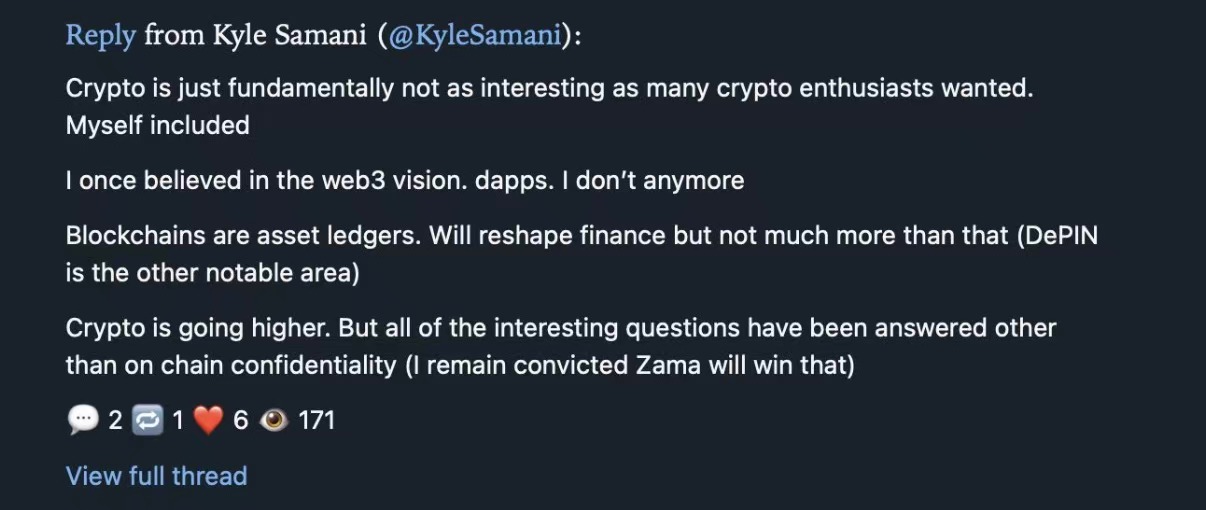
Why delete it instantly? Because saying it out loud makes you a "heretic."

Why couldn't he resist posting it? It's the conclusion reached by someone trapped between faith and reality, after spending 8 years and investing hundreds of millions of dollars.

I understand this feeling all too well because it mirrors my own journey this past year.

What did we believe in when we entered in 2021? That decentralized social would颠覆 Twitter. That on-chain identity (DID) would let users control their data. That GameFi would let players truly "own their assets." Back then, everyone on Twitter timelines was discussing "how Web3 will change the world." Every new project felt like a gateway to the future.

What is the reality in 2025? Friend.tech died. Lens Protocol has no users. ENS has become a tool for speculation; no one actually uses DID beyond wallet addresses. The collapses of Axie and StepN proved "X to Earn" is just a Ponzi scheme in disguise.

But Kyle didn't否定 everything. He still sees value in stablecoins, DeFi, RWA (these financial applications), and projects like Helium (DePIN). He's still betting on technologies like Zama's fully homomorphic encryption.

The question is: Do these things still require "faith"? Or just rational calculation?

Some see Kyle's departure as a betrayal. In my eyes, it's a process of "disenchantment"—transitioning from a Crypto Evangelist to a Crypto Realist. This transformation might be the necessary coming-of-age ceremony the entire industry must undergo.

Last Time We Lost Money, This Time We're Losing Confidence

When FTX imploded in 2022, the entire industry hit rock bottom. Luna went to zero, Three Arrows Capital破产, the market was halved and halved again. But back then, everyone still held onto a belief: The market crashed, but we weren't wrong. If we persevere, the bull market will prove us right.

Back then, we still believed in Ethereum's "endgame narrative"—from PoW to PoS, from a single chain to modularity—thinking it was the necessary path to the "world computer."

We still believed in Solana's "performance revolution," thinking that high-performance chains would surely win if they could just survive the bear market.

We still believed in Web3's "paradigm shift," believing the next chapter of the internet必然 was decentralization.

What about now, in 2025?

Objectively, the data is much better than the last trough. BTC briefly surpassed $100,000, ETFs were approved, and Crypto's ties with Wall Street grew stronger.

But the subjective feeling is completely opposite. Prices are higher, but confidence is lower.

The "culprit," or perhaps the "revealing mirror," is AI.

When ChatGPT launched in 2023, everyone was discussing "how AI will change the world." What was Crypto discussing at the same time? "Should L2 sequencers be decentralized?" One was talking about a productivity revolution; the other was arguing over technical details.

The subsequent two years saw AI progress at a dizzying pace: Gemini, Claude, ChatGPT—a three-way battle, with new developments daily. Lately, everyone is obsessed with OpenClaw.

And Crypto? There are more and more L2s and chains, but no one can clearly explain "why we need 100 L2s." Even Vitalik has reflected on past roadmap mistakes. NFT, GameFi, SocialFi have all had their moments, but they were all flashes in the pan.

By now, the biggest innovation of this cycle has turned out to be Meme Coins and "reinventing gambling."

I often ask myself late at night: AI is redefining productivity with technology. Crypto is redistributing wealth with financial games. The former creates; the latter transfers. What are we actually building?

Kyle's departure is, at its core, a "value choice."

He chose to chase AI, longevity tech, robotics—fields that are truly "expanding human frontiers." Crypto, at least for now,更像 is a high-stakes casino.

But I'm Not Ready to Leave Yet

After saying all this, you might think I'm about to announce my exit too.

But no, I still want to "gamble" one more time.

Kyle can leave because he is already financially free and can pursue grander dreams. But for young people like me, Crypto still represents: a relatively fair channel for "upward mobility," a "permissionless" testing ground that doesn't require diplomas, background, or connections—just cognition and courage. It's an emerging industry not yet completely monopolized by the elite class.

More importantly, perhaps the grand Web3 narrative has failed, but that doesn't mean Crypto is worthless.

The revolution in financial infrastructure has already happened. The daily settlement volume of stablecoins has surpassed Visa. DeFi allows people worldwide to use financial services and RWA 24/7.

Most crucially: I haven't figured out my own answer yet.

Kyle spent 8 years concluding "Crypto is just an asset ledger."

But I'm still just a rookie; what right do I have to make that judgment now?

Maybe in a few years, I'll leave like he did. But for now, I want to stay at the table to see if this industry still holds some unseen possibilities.

Years from now, Crypto might no longer be the "disrupt-everything" revolution but rather the value settlement layer for the AI era.

When that time comes, I'll order a coffee and chat about the scenery I saw along the way.


Twitter:https://twitter.com/BitpushNewsCN

Bitpush TG Discussion Group:https://t.me/BitPushCommunity

Bitpush TG Subscription: https://t.me/bitpush

Original article link:https://www.bitpush.news/articles/7609106

Связанные с этим вопросы

QWhy did Kyle Samani's departure from the crypto industry resonate so deeply with the author?

ABecause Kyle represented a rare combination of honesty, sharpness, and a willingness to make bold, public judgments in an industry often filled with vague, non-committal statements. His departure felt like the loss of a 'real' and aggressive voice that the author believed the industry needed.

QWhat was the core belief that Kyle Samani expressed in his since-deleted tweet?

AHe expressed that cryptocurrency is not as revolutionary as many enthusiasts hope. He no longer believes in the Web3 vision or dApps, concluding that blockchain is primarily a ledger for assets with significant potential mainly in finance, but limited potential in other fields.

QHow does the author contrast the current state of the AI and Crypto industries?

AThe author contrasts them by stating that AI is focused on a 'productivity revolution,' creating new things and pushing the boundaries of human capability with rapid, tangible progress. In contrast, much of Crypto's recent innovation has been in 'Meme Coin and reinventing gambling,' which is more about wealth transfer than creation, leading to a crisis of confidence despite higher prices.

QDespite the author's sense of disillusionment, what reasons do they give for staying in the crypto industry?

AThe author cites that crypto still offers a relatively fair path for social mobility ('class leap'), a permissionless testing ground that doesn't require traditional credentials, and that the financial infrastructure revolution (e.g., stablecoins, DeFi) is already real. They feel it's too early in their own journey to make a final judgment and want to see if there are still unseen possibilities.

QWhat does the author mean by calling Kyle's departure a '祛魅' (disenchantment) and the industry's 'adult ceremony'?

AIt means that Kyle's shift from a 'Crypto Evangelist' to a 'Crypto Realist' represents a loss of naive faith and a transition to a more mature, sober, and pragmatic understanding of the technology's actual capabilities and limitations, which the author believes is a necessary growing-up phase for the entire industry.

Похожее

Фуцзянь, Цзиньцзян: супер-единорог в сфере памяти тихо делает своё дело

В провинции Фуцзянь в городе Цзиньцзян, известном производством спортивной обуви, находится перспективная компания в области производства чипов памяти — Fujian Jinhua Integrated Circuit Co. (Jinhua). Основанная в 2016 году как часть национального плана по развитию полупроводниковой промышленности, компания столкнулась с серьёзными вызовами. В 2018 году она была внесена в санкционный список Министерства торговли США по обвинению в промышленном шпионаже в пользу американской компании Micron, что привело к остановке производственной линии. После пяти лет судебных разбирательств в феврале 2024 года федеральный суд в Сан-Франциско полностью оправдал Jinhua, сняв все обвинения. Несмотря на правовую победу, компания всё ещё остаётся в санкционном списке, а годы задержек серьёзно замедлили её развитие. Под руководством своего ключевого инженера Чэнь Чжэнкуня, известного как «мастер эффективности», компания сумела адаптировать производство, увеличив долю отечественного оборудования. В отличие от ChangXin Memory Technologies (CXMT) и Yangtze Memory Technologies (YMTC), которые продвинулись дальше в производстве DRAM и NAND-памяти соответственно, Jinhua сосредоточена на специализированной (нишевой) DRAM-памяти для потребительской электроники. Её текущая производственная мощность составляет около 40 000 пластин в месяц. Хотя её доход в 2023 году оценивался примерно в 2 млрд юаней, что значительно меньше, чем у конкурентов, компания остаётся важным игроком. История Jinhua тесно связана с амбициозной промышленной трансформацией города Цзиньцзян. Местные власти оказали компании полную поддержку, включая финансовые гарантии и создание кластера, что демонстрирует стратегическую важность проекта для региона. Несмотря на то, что Jinhua упустила первые годы бума на рынке памяти, её устойчивость в условиях санкций показывает потенциал для восстановления в новом цикле роста, движимом развитием искусственного интеллекта.

marsbit34 мин. назад

Фуцзянь, Цзиньцзян: супер-единорог в сфере памяти тихо делает своё дело

marsbit34 мин. назад

Почему биткойн-фермы внезапно стали новым входом для вычислительных мощностей ИИ на фоне дефицита электроэнергии в 38 ГВт?

Заголовок: Почему майнинговые фермы для биткоина внезапно стали новым входом для вычислительных мощностей ИИ на фоне дефицита электроэнергии в 38 ГВт? Краткое содержание: Когда конкуренция между центрами обработки данных ИИ сместилась с вопроса «кто купит больше GPU» к «кто раньше получит электроэнергию», некоторые майнинговые фермы для биткоина, ранее считавшиеся волатильными активами, начали трансформироваться в центры обработки данных для облачных провайдеров, используя свои готовые возможности подключения к сети, землю и трансформаторные подстанции. По расчетам Morgan Stanley, в период 2026-2028 годов в США может возникнуть дефицит электроэнергии для ЦОДов около 38 ГВт, и модернизация старых майнинговых ферм может обеспечить от 10 до 19 ГВт. Такие компании, как TeraWulf и Hut 8, переориентируются с добычи криптовалют на предоставление инфраструктуры («Powered Shell Provider»), предлагая клиентам из сферы ИИ критически важный ресурс — возможность быстрее конкурентов развернуть значительные вычислительные мощности. Ключевой ценностью становится не вычислительная мощность для майнинга, а дефицитный доступ к электросетям, получение которого «с нуля» в некоторых регионах США теперь может занять 5-7 лет.

华尔街日报36 мин. назад

Почему биткойн-фермы внезапно стали новым входом для вычислительных мощностей ИИ на фоне дефицита электроэнергии в 38 ГВт?

华尔街日报36 мин. назад

Майкл Сэйлор: «Мы никогда не говорили, что никогда не будем продавать биткоины»

Председатель стратегической комиссии Майкл Сэйлор прокомментировал сообщения о новом разрешении компании Strategy на продажу биткоинов. Он заявил, что данное разрешение не является новым — оно было объявлено ещё 29 июня в рамках системы управления капиталом компании. Соглашение позволяет продавать BTC на сумму до 5 миллиардов долларов для определённых целей, но не обязывает компанию к продаже. Сэйлор подчеркнул, что Strategy никогда официально не брала на себя обязательство никогда не продавать свои биткоины, хотя и рассчитывает оставаться чистым покупателем BTC в долгосрочной перспективе. Он назвал текущие новости «старыми», переподанными как новые, и подтвердил, что программа монетизации биткоинов компании не предполагает обязательной продажи её активов.

cryptonews.ru1 ч. назад

Майкл Сэйлор: «Мы никогда не говорили, что никогда не будем продавать биткоины»

cryptonews.ru1 ч. назад

«Летняя пила» продолжается: пробой $67 000 станет началом роста биткоина

Цена биткоина продолжает консолидироваться в диапазоне $58 000–$67 000 с начала июня. 1 августа актив снизился до $62 217. Аналитики расходятся в краткосрочных прогнозах: некоторые, как Crypto Candy, ожидают тестирования уровня $60 000 или ниже, пока цена находится под $66 000. Другие, как Jelle, видят в боковом движении «летнюю пилу» и придерживаются стратегии усреднения. Ключевым для определения дальнейшего направления считается уровень $67 000. По мнению Daan Crypto Trades, его пробой необходим для выхода из затянувшейся паузы. Roman полагает, что уверенный пробой с объемом может быстро запустить рост к $70 000–$80 000 и выше. С долгосрочной точки зрения, макроаналитик Герт ван Лаген рассматривает текущую фазу как накопление в рамках масштабной формации «чаша с ручкой». Он отмечает, что долгосрочные держатели не спешат продавать актив, о чем говорит показатель NUPL. Таким образом, рынок находится в решающей фазе, где пробой либо поддержки $60 000, либо сопротивления $67 000 задаст тренд на ближайшее будущее.

cryptonews.ru2 ч. назад

«Летняя пила» продолжается: пробой $67 000 станет началом роста биткоина

cryptonews.ru2 ч. назад

На неделе с 3 по 9 августа стоит обратить внимание: Закон CLARITY, возможно, будет поставлен на голосование в Сенате; SpaceX и Circle опубликуют финансовые отчеты

**Важные события на следующей неделе (3–9 августа 2026 г.)** **Ключевые даты:** * **3 августа:** Публикация отчетов American Bitcoin за Q2. Полное закрытие сервисов DeFi-трекера Zapper и кошелька Ctrl Wallet. LayerZero прекратит поддержку ретрансляторов v1. Upbit прекратит торговлю токенами AQT и AERGO. * **4 августа:** Публикация финансовых отчетов SpaceX и Hut 8 за второй квартал 2026 года. * **5 августа:** Circle опубликует отчет за Q2. Начинается предварительное ценовое консультирование для IPO компании Unitree Tech (Ушу Цзишу) в Китае. * **6 августа:** Первая крупная разблокировка акций SpaceX — до 12% от общего капитала. * **7 августа:** Выход важных данных по рынку труда США (отчет о занятости за июль). Предельный срок для Сената США — получить 60 голосов в поддержку **Закона CLARITY** (билль о регулировании криптовалют и этике). Ожидается выпуск Grok 4.6 от xAI. * **8 августа:** Начало принудительной подачи сигналов в сети Bitcoin согласно предложению BIP-110. * **На неделе (дата уточняется):** Ожидается голосование полного состава Сената США по **Закону CLARITY**. Выход нового релиза XRP Ledger (v3.3.0) с новыми функциями, такими как конфиденциальные данные и пакетные транзакции. **Основные темы недели:** корпоративная отчетность (SpaceX, Circle), регулирование (CLARITY Act), рыночные события (разблокировка акций SpaceX, отчет по занятости в США) и обновления в технологиях блокчейна.

marsbit2 ч. назад

На неделе с 3 по 9 августа стоит обратить внимание: Закон CLARITY, возможно, будет поставлен на голосование в Сенате; SpaceX и Circle опубликуют финансовые отчеты

marsbit2 ч. назад

Торговля

Спот
活动图片





