Crypto today: Safe-yield vaults hit $6B as traders chase gold and silver

ambcryptoОпубликовано 2026-01-28Обновлено 2026-01-28

Введение

Today's crypto market highlights a significant shift toward "safe-yield" on-chain vaults, which have surged to over $6 billion in assets. These vaults use smart contracts to provide transparent, non-custodial yield strategies, attracting investors seeking stable returns amid crypto's underperformance compared to traditional assets like gold and silver. Revolut expanded its digital banking services globally by launching in Mexico with a full banking license, aiming to target underbanked markets with high-yield savings and multi-currency services. Meanwhile, crypto market performance lags: Bitcoin and Ethereum are down year-over-year, while gold and silver have seen massive gains. Retail investor attention, as shown by Google Trends and social data, is rotating toward precious metals and away from crypto, driven by recent volatility and underperformance. Capital is chasing faster-moving assets, which currently are not cryptocurrencies.

What happened in crypto today? From bold predictions to crypto’s growing gap with traditional markets, there’s a lot for investors to take in.

Here’s the rundown!

Is crypto moving towards safe yield?
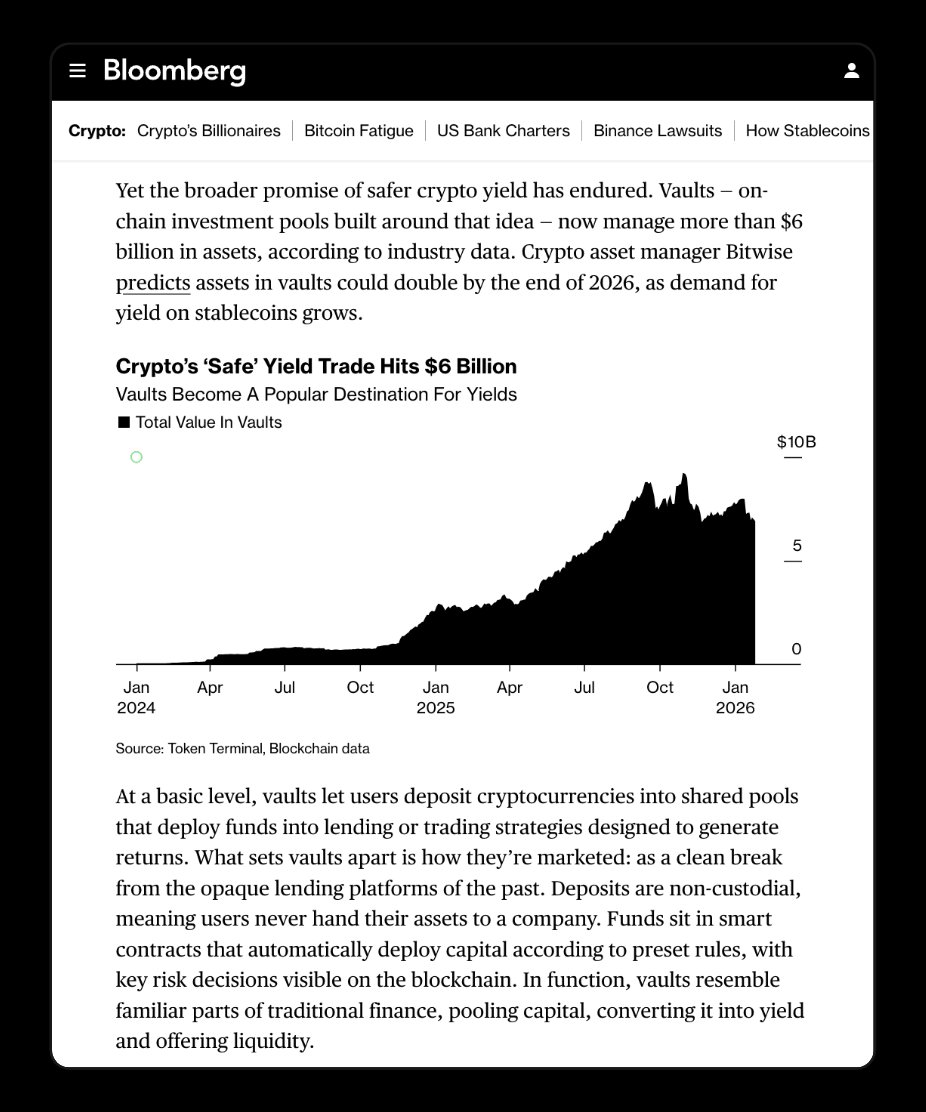
The market can certainly look a bit better right now, but there’s something arguably more important that you should keep an eye on. On-chain “vaults,” designed to offer steadier, more transparent yields, are becoming one of the sector’s fastest-growing products.

Source: X

According to industry data, assets locked in crypto vaults have crossed $6 billion. Bitwise now expects that figure to double by the end of 2026, with rising demand for yield on stablecoins.

In a market where prices have lagged behind traditional assets, investors seem highly focused on earning predictable returns.

Vaults work by pooling user funds into smart contracts that deploy capital across lending or trading strategies, all on-chain and non-custodial.

Revolut’s banking model goes global

Revolut has taken a major step beyond Europe, officially launching full banking operations in Mexico. This is its first bank established outside the region. Fintech is pushing aggressively into high-growth, underbanked markets where digital banking still has limited competition.

To enter Mexico, Revolut obtained a full banking license through direct application, becoming the country’s first independent digital bank to do so. The unit has been capitalized with over $100 million, more than double the regulatory minimum.

The license enables Revolut to offer high‑yield savings accounts, foreign exchange services, holdings in over 30 currencies, and international money transfers.

Mexico is probably a testing ground for Revolut’s wider ambitions. The company is pursuing a full banking license in Peru and plans to roll out a payments platform in India. With more than 70 million customers worldwide, Revolut aims to reach 100 million daily active users across 100 countries.

Is crypto falling out of favor?

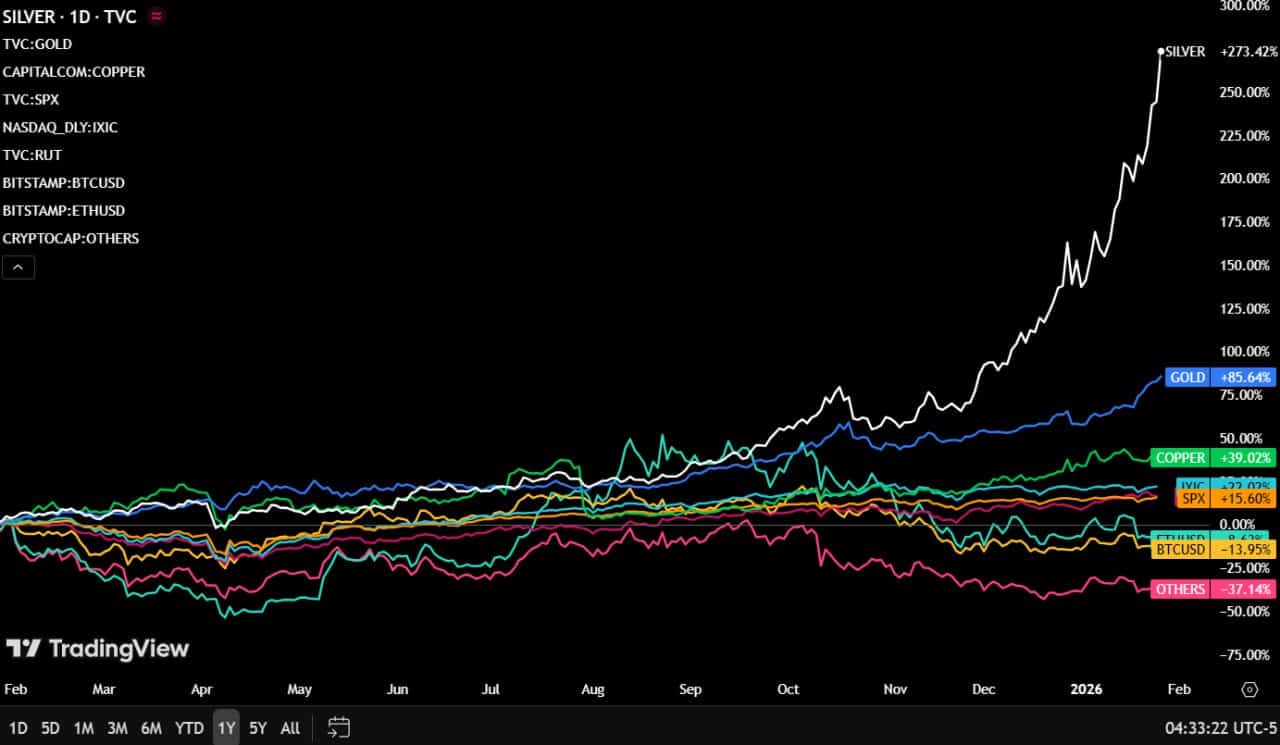
Over the past 12 months, nearly every major asset class has delivered positive returns, except crypto. Silver is up a staggering 267%, gold has gained 84%, copper is up 38%, and even equities like the Nasdaq and S&P 500 are solidly higher.

Source: X

In contrast, Bitcoin [BTC] is down 14%, Ethereum [ETH] is off 8%, the total crypto market cap has fallen 14%, with altcoins down nearly 50%.

Source: Google Trends

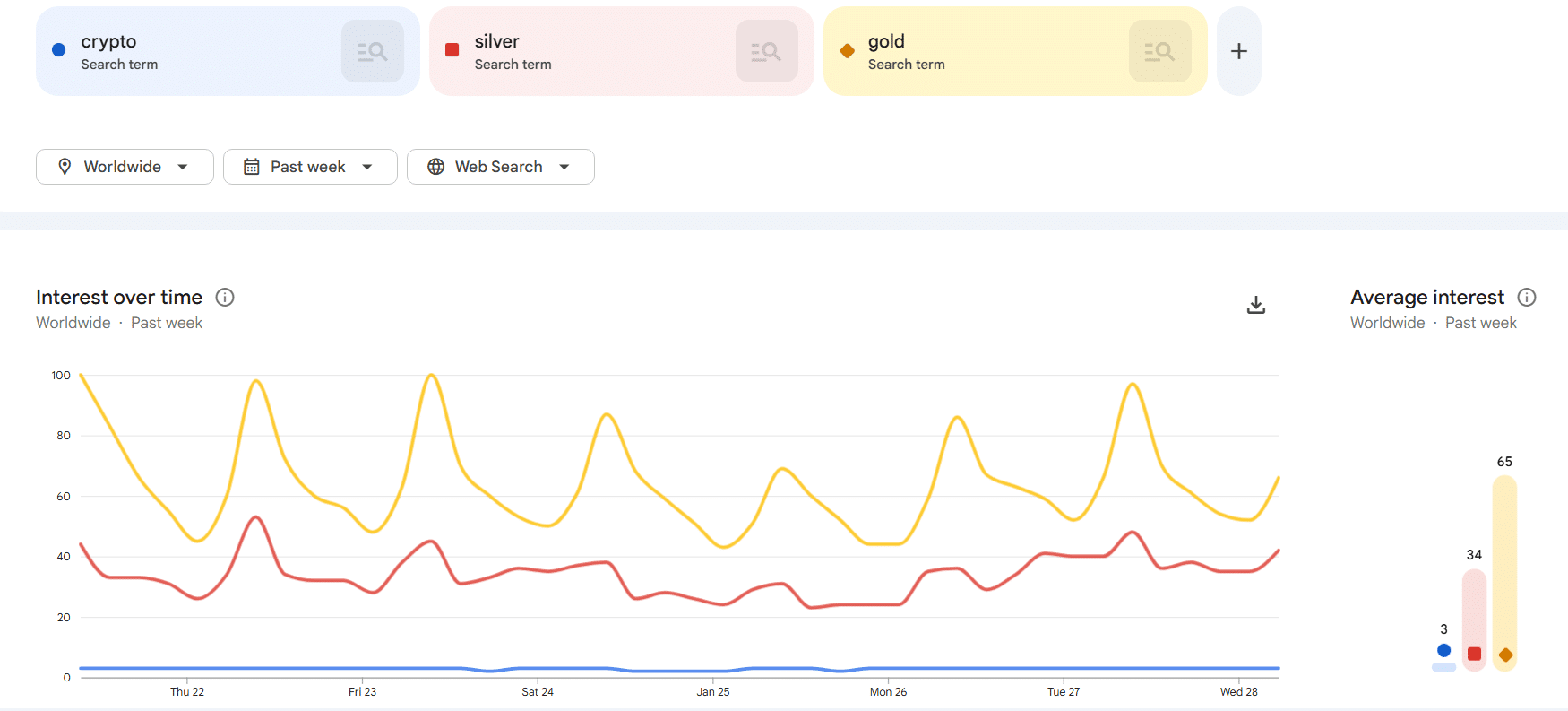
So, where is attention shifting? Google Trends data from the past week shows strong global interest in gold and silver, while searches for crypto remain largely flat.

Source: Santiment

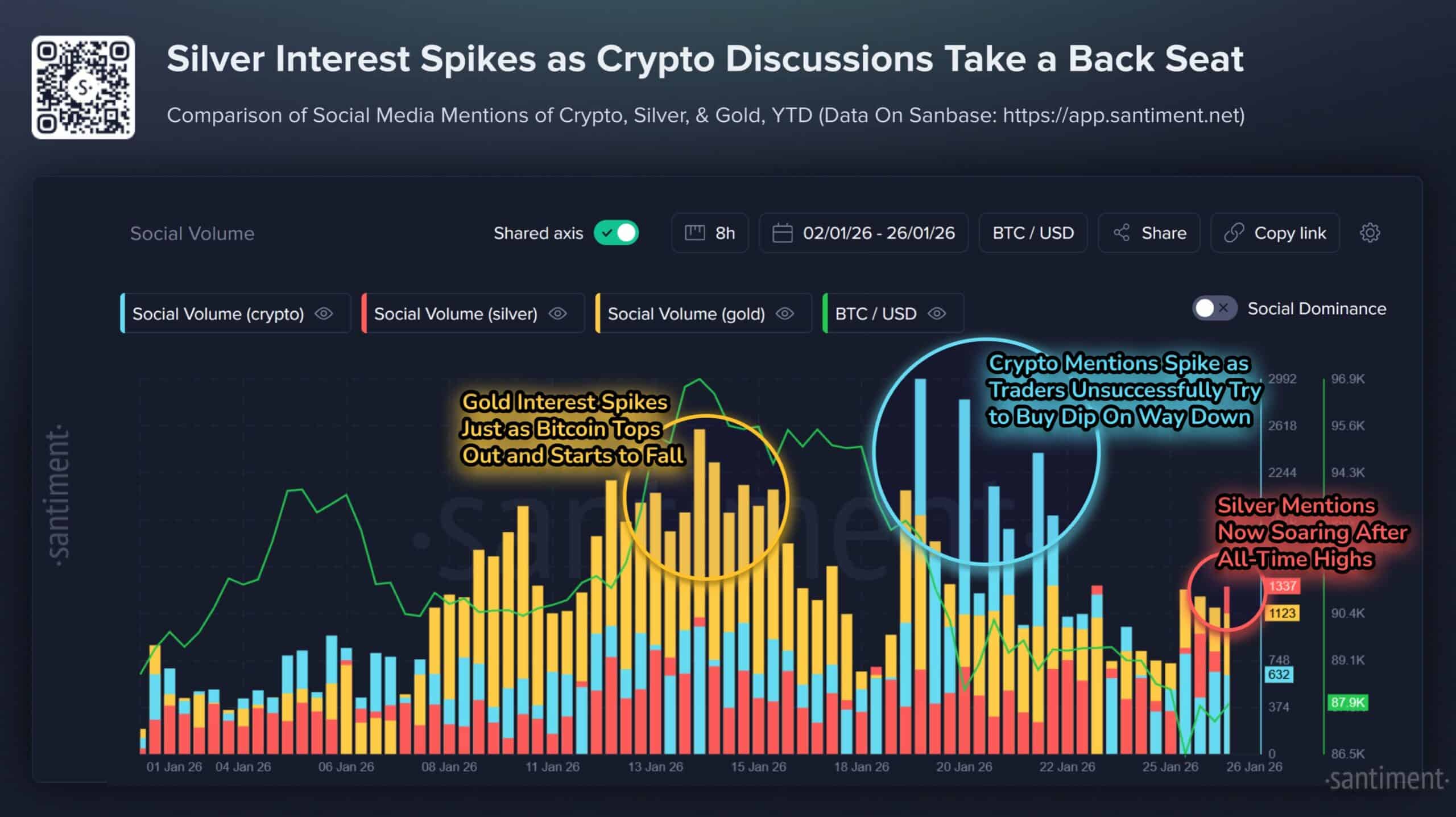
Santiment’s social data backs this up. January began quietly as traders returned from holidays. Then gold stole the spotlight with sky high numbers, followed by a spike in Bitcoin interest when prices dipped.

That coincided with another crypto sell-off. Most recently, silver took center stage, surging past $117 before reversing to nearly $102 within hours as retail FOMO peaked.

Retail is chasing whatever is moving fastest. Right now, that’s not crypto.


Final Thoughts

  • As crypto prices lag, capital is moving to safer on-chain yield, with vault assets already above $6 billion.
  • Retail attention is rotating out of crypto and also into gold and silver.
Next: Zcash jumps 10% – But is ZEC’s rally built on speculation?
Share
  • Share
  • Tweet

Связанные с этим вопросы

QWhat is the current total value of assets locked in crypto vaults and what is the projected growth by the end of 2026?

AAssets locked in crypto vaults have crossed $6 billion, and Bitwise expects that figure to double by the end of 2026.

QWhat major step did Revolut take in its global expansion and in which country?

ARevolut officially launched full banking operations in Mexico, marking its first bank established outside Europe.

QHow have gold and silver performed compared to major cryptocurrencies like Bitcoin and Ethereum over the past 12 months?

ASilver is up 267%, gold has gained 84%, while Bitcoin is down 14% and Ethereum is off 8% over the past 12 months.

QAccording to Google Trends data, where is global search interest shifting in contrast to crypto?

AGoogle Trends data shows strong global interest in gold and silver, while searches for crypto remain largely flat.

QWhat is the primary function of on-chain crypto vaults and how do they operate?

ACrypto vaults work by pooling user funds into smart contracts that deploy capital across lending or trading strategies, all on-chain and non-custodial, to offer steadier, more transparent yields.

Похожее

U.S. Government Bans Foreign Nationals from Using Fable 5, Anthropic Issues Rebuttal

U.S. Government Bans Foreign Access to Fable 5, Anthropic Issues Rebuttal On June 12th, the U.S. government ordered AI company Anthropic to immediately suspend all foreign access—including foreign nationals within the U.S. and Anthropic's own foreign employees—to its newly released Fable 5 and Mythos 5 AI models, citing national security concerns. This forced Anthropic to temporarily disable access to both models for all users globally, as it cannot technically differentiate user nationality at scale. The models, released just three days prior, represent Anthropic's highest public capability tier. Fable 5 is the first publicly available model from the advanced "Mythos" family, while Mythos 5 is a less-restricted version for approved cybersecurity and critical infrastructure partners. The government's directive was reportedly triggered by claims from another company that it could "jailbreak" Mythos 5, raising alarm within the Trump administration. Anthropic, in a detailed public statement, strongly challenged this rationale. The company argues the demonstrated "jailbreak" is a narrow, non-generalized technique that merely involves identifying minor, known software vulnerabilities—a capability common to other publicly available models like OpenAI's GPT-5.5 and routinely used by cybersecurity defenders. Anthropic stated it has complied with the order but disagrees with the government's standard, warning that applying it industry-wide would halt all new frontier model deployments. The company criticized the lack of a transparent, fact-based legal process and expressed confidence the situation stems from a misunderstanding. It is working to restore access and will release more technical details within 24 hours. Other Anthropic models remain unaffected.

链捕手14 мин. назад

U.S. Government Bans Foreign Nationals from Using Fable 5, Anthropic Issues Rebuttal

链捕手14 мин. назад

The Revelation from the Raydium Theft Incident: New DeFi Vulnerabilities Lurking in Forgotten Old Contracts

**Raydium Exploit Reveals DeFi's Hidden Risk: Forgotten "Zombie" Contracts** A recent attack on Raydium's deprecated V3 AMM pools resulted in a loss of approximately $1.34 million. The hacker exploited pools that were no longer supported by Raydium's current UI or SDK but remained fully functional and accessible on-chain. This incident highlights a critical, often overlooked category of risk in DeFi: inactive or legacy smart contracts that projects fail to properly decommission. Since March 2025, there have been at least 8 publicly reported attacks targeting such abandoned contracts, with total losses around $10.8 million. Including older pools and deprecated features, the count rises to 10 incidents with roughly $22.5 million in losses. These "zombie contracts" represent a lifecycle management failure rather than a code vulnerability, yet they are typically misclassified under general "code bug" categories in security reports, masking the true scale of the problem. The root cause is that projects often merely document a contract as "deprecated" without taking essential technical steps to secure it: withdrawing remaining assets, disabling external call functions, and implementing ongoing monitoring. These forgotten, under-monitored components become prime targets for attackers. To address this, the industry needs to recognize "zombie contracts" as a distinct risk category and establish standardized decommissioning protocols. Essential steps should include: 1) a formal retirement announcement, 2) removal of all front-end integrations, 3) withdrawal of locked assets, 4) disabling key contract functions, 5) ongoing security monitoring, 6) clear user communication, and 7) a post-mortem analysis. The value of a DeFi project lies not only in its current TVL but also in the security of its historical codebase, which has now become a new attack surface.

Foresight News2 ч. назад

The Revelation from the Raydium Theft Incident: New DeFi Vulnerabilities Lurking in Forgotten Old Contracts

Foresight News2 ч. назад

Robots Begin to 'Consume Data': The Hidden Production Chain from Indian Data Factories to Billion-Dollar Humanoid Robots

Robots have started to 'consume data,' driving the formation of a new industrial supply chain focused on producing training data for embodied AI. Unlike large language models, which are trained on vast internet text corpora, embodied AI models face a 'data desert' in the physical world. This has created a massive demand for first-person perspective video data (Ego Data), captured by workers wearing cameras in places like Indian garment factories. Companies like Neocambrian AI are establishing 'data factories' where workers perform standardized tasks (e.g., sorting clothes, kitchen organization) to generate thousands of hours of video. Research, such as NVIDIA's EgoScale, demonstrates that scaling this human demonstration data predictably improves robot performance, particularly for dexterous manipulation. This has validated a training path combining large-scale human data for pre-training with smaller amounts of robot-specific data for fine-tuning. The value of different data types varies significantly, forming a 'data pyramid.' The base consists of low-cost, large-scale internet and Ego Data. Higher layers include more expensive motion-capture data (e.g., from data gloves), simulation/synthetic data, and the most costly and scarce layer: real robot teleoperation data. This demand has spawned a layered ecosystem of data suppliers: low-cost data factories, motion capture and alignment specialists, robot-native teleoperation service providers, simulation data companies, and platforms aiming for data standardization. Robot companies themselves are adopting a 'layered procurement' strategy: outsourcing generic Ego Data while building in-house capabilities for robot-specific adaptation data and the critical deployment/failure data generated in real-world applications. The industry is shifting focus from hardware and basic mobility to the data pipelines required for general-purpose capability. While parallels exist to data labeling companies like Scale AI in the LLM boom, the physical complexity of robot data—involving action success ambiguity and sim-to-real gaps—requires more integrated solutions for data collection, annotation, and a continuous feedback loop. The race is on to build the data engines that will teach robots to operate reliably in the unstructured real world.

marsbit4 ч. назад

Robots Begin to 'Consume Data': The Hidden Production Chain from Indian Data Factories to Billion-Dollar Humanoid Robots

marsbit4 ч. назад

Торговля

Спот
Фьючерсы

Популярные статьи

Как купить S

Добро пожаловать на HTX.com! Мы сделали приобретение Sonic (S) простым и удобным. Следуйте нашему пошаговому руководству и отправляйтесь в свое крипто-путешествие.Шаг 1: Создайте аккаунт на HTXИспользуйте свой адрес электронной почты или номер телефона, чтобы зарегистрироваться и бесплатно создать аккаунт на HTX. Пройдите удобную регистрацию и откройте для себя весь функционал.Создать аккаунтШаг 2: Перейдите в Купить криптовалюту и выберите свой способ оплатыКредитная/Дебетовая Карта: Используйте свою карту Visa или Mastercard для мгновенной покупки Sonic (S).Баланс: Используйте средства с баланса вашего аккаунта HTX для простой торговли.Третьи Лица: Мы добавили популярные способы оплаты, такие как Google Pay и Apple Pay, для повышения удобства.P2P: Торгуйте напрямую с другими пользователями на HTX.Внебиржевая Торговля (OTC): Мы предлагаем индивидуальные услуги и конкурентоспособные обменные курсы для трейдеров.Шаг 3: Хранение Sonic (S)После приобретения вами Sonic (S) храните их в своем аккаунте на HTX. В качестве альтернативы вы можете отправить их куда-либо с помощью перевода в блокчейне или использовать для торговли с другими криптовалютами.Шаг 4: Торговля Sonic (S)С легкостью торгуйте Sonic (S) на спотовом рынке HTX. Просто зайдите в свой аккаунт, выберите торговую пару, совершайте сделки и следите за ними в режиме реального времени. Мы предлагаем удобный интерфейс как для начинающих, так и для опытных трейдеров.

1.5k просмотров всегоОпубликовано 2025.01.15Обновлено 2026.06.02

Как купить S

Sonic: Обновления под руководством Андре Кронье – новая звезда Layer-1 на фоне спада рынка

Он решает проблемы масштабируемости, совместимости между блокчейнами и стимулов для разработчиков с помощью технологических инноваций.

2.3k просмотров всегоОпубликовано 2025.04.09Обновлено 2025.04.09

Sonic: Обновления под руководством Андре Кронье – новая звезда Layer-1 на фоне спада рынка

HTX Learn: Пройдите обучение по "Sonic" и разделите 1000 USDT

HTX Learn — ваш проводник в мир перспективных проектов, и мы запускаем специальное мероприятие "Учитесь и Зарабатывайте", посвящённое этим проектам. Наше новое направление .

1.8k просмотров всегоОпубликовано 2025.04.10Обновлено 2025.04.10

HTX Learn: Пройдите обучение по "Sonic" и разделите 1000 USDT

Обсуждения

Добро пожаловать в Сообщество HTX. Здесь вы сможете быть в курсе последних новостей о развитии платформы и получить доступ к профессиональной аналитической информации о рынке. Мнения пользователей о цене на S (S) представлены ниже.

活动图片