Crypto ETFs Continue to Decline with Major New Outflows

bitcoinistОпубликовано 2026-02-02Обновлено 2026-02-02

Введение

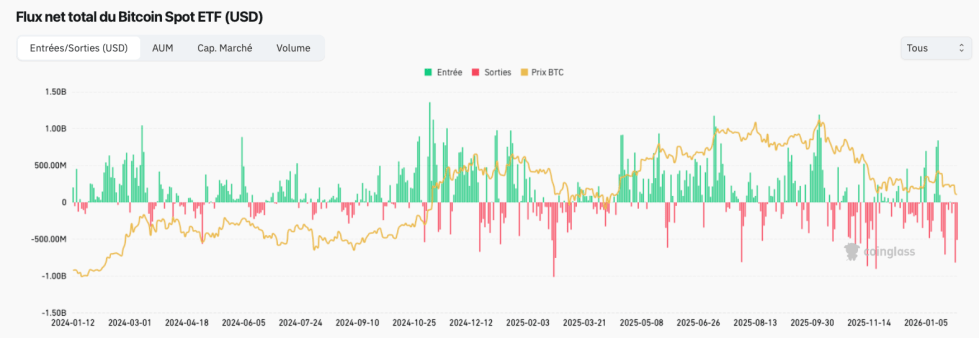
Crypto ETFs, particularly U.S. spot bitcoin ETFs, are experiencing significant and sustained outflows, with a notable peak of approximately $818 million in net withdrawals on January 29th. This trend reflects a broader tactical pullback by investors amid renewed market volatility and a shift towards risk reduction, coinciding with turbulence in other risk-sensitive assets. While ETFs remain a crucial gateway for institutional crypto access due to their convenience and compliance benefits, their flows have become procyclical—amplifying bullish trends and exacerbating downturns. Meanwhile, the memecoin sector continues to develop actively, with new projects like MAXI Doge emerging. In January, U.S. spot bitcoin ETFs saw an estimated $1.6 billion in net outflows, indicating a more defensive start to the year than anticipated.

After a turbulent start to the year, exchange-traded funds (ETFs) backed by cryptocurrencies continue to record significant outflows. The movement, concentrated on spot Bitcoin ETFs, fuels the idea of a tactical withdrawal by investors in the face of renewed volatility. In this context, the market is watching a key indicator: the ability of ETFs to cushion stress phases, rather than amplify them.

Repeated Outflows from Spot Bitcoin ETFs

Withdrawals have accelerated over several sessions, with a notable peak on January 29, when U.S.-listed spot Bitcoin ETFs recorded approximately $818 million in net outflows, according to data tracked by Farside Investors and cited by market aggregators.
This mechanism is important because net redemptions mean that intermediaries are reducing exposure, which can lead to sales of underlying Bitcoins when shares are destroyed. In other words, the ETF becomes a rapid transition mechanism between market sentiment and the pressure that builds on-chain, especially when leverage deflates across the entire ecosystem.

The concentration of outflows on the largest vehicles is also being scrutinized. Even though major managers like BlackRock, Fidelity, or Grayscale remain structural for institutional access, short-term arbitrage is taking over during correction phases.

A Reduction in On-Chain Risk for Crypto Investors

These outflows are part of a broader climate of risk reduction, where investors are arbitrating towards more liquidity as the trajectory of U.S. monetary policy becomes uncertain again. Movements in Bitcoin and Ether have thus coincided with shocks in other assets deemed riskier, and with renewed nervousness in traditional markets.

Nevertheless, the interpretation remains open. ETFs retain a gateway role, as they simplify ownership, compliance, and portfolio integration. The question is therefore less about their utility and more about the pace, with flows becoming procyclical again, favorable in an upward trend, unfavorable when volatility dominates.

Another factor is the monthly reading. Several market summaries indicate that in January, U.S. spot Bitcoin ETFs would have accumulated approximately $1.6 billion in net outflows, a sign of a more defensive start to the year than expected given the geopolitical context.

Amid ETFs, Memecoins Show No Weakness and Accelerate Development

While ETFs are gaining ground, the world of memecoins is far from buried; on the contrary. The future is being built with new presales, notably MAXI Doge, which aims to do even better than DOGE in 2026. With a TGE approaching at high speed, this new figure in the crypto ecosystem is very promising.

Indeed, the Maxi Doge project features a token called MAXI, presented as a meme-inspired token. Its communication emphasizes a highly speculative identity and a market culture focused on performance. So, is a gain of over 300% within reach? This makes it an asset to watch closely.


This article does not constitute investment advice in any way. The information provided here should not be used as a basis for making financial decisions. Cryptocurrency investments carry risks and can lead to significant losses. You should only invest what you can afford to lose and conduct your own research before making any investment decision.


Связанные с этим вопросы

QWhat is the main trend observed in cryptocurrency ETFs according to the article?

ACryptocurrency ETFs are experiencing significant outflows, particularly spot Bitcoin ETFs, indicating a tactical pullback by investors due to increased market volatility.

QWhat was the peak net outflow amount for US spot Bitcoin ETFs on January 29th?

AUS spot Bitcoin ETFs recorded approximately $818 million in net outflows on January 29th.

QHow does the outflows from ETFs impact the underlying Bitcoin market?

ANet redemptions mean intermediaries are reducing their exposure, which can lead to sales of the underlying Bitcoins when the shares are destroyed, making ETFs a rapid transition tool between market sentiment and on-chain selling pressure.

QWhat broader market context are these crypto ETF outflows a part of?

AThe outflows are part of a broader climate of risk reduction, where investors are moving towards more liquidity as the trajectory of US monetary policy becomes uncertain, coinciding with shake-ups in other risky assets and traditional markets.

QDespite the outflows from ETFs, what other part of the crypto ecosystem is showing strong development?

AThe memecoin sector is not weakening but accelerating its growth, with new projects like MAXI Doge emerging and aiming for high performance, presenting itself as a promising asset to watch.

Похожее

Stuck Polymarket: The Real Test After Riding the Traffic Boom Has Arrived

Polymarket, a leading prediction market platform, is facing significant technical challenges as its growth outpaces its current infrastructure on Polygon. Users are experiencing laggy transactions, unresponsive orders, and delayed confirmations, severely impacting the trading experience. In response, DeFi Engineering VP Josh Stevens outlined a comprehensive engineering overhaul. The plan includes reducing on-chain data delays, fixing order cancellation issues, rebuilding the central limit order book (CLOB), improving website performance, and developing a unified SDK and API. A major revelation was the ongoing "chain migration," indicating a potential move away from Polygon. The core issue is that Polymarket has evolved from a simple prediction market into a high-frequency trading platform, making Polygon's limitations—such as block space, gas fees, and block time—a ceiling for further growth. The migration is not just a simple chain switch but a fundamental rebuild of its trading system to support more complex products like perpetual contracts (Perps). This announcement has sparked competition among chains like Solana, Sui, and Algorand, all vying to host Polymarket. For Polygon, losing this key application, which contributes significantly to its gas fee revenue, would be a major setback. The real test for Polymarket is no longer attracting users but proving it can provide a stable, reliable trading environment that retains them.

Odaily星球日报4 мин. назад

Stuck Polymarket: The Real Test After Riding the Traffic Boom Has Arrived

Odaily星球日报4 мин. назад

Lowering Expectations for BTC's Next Bull Market

The author, Alex Xu, explains his decision to significantly reduce his Bitcoin holdings (from full to ~30% of his portfolio) during the current bull cycle, citing a lowered long-term outlook for BTC's price appreciation in the next cycle. He outlines six key reasons for this reduced expectation: 1. **Diminished Growth Drivers:** The narrative of exponential user adoption has largely played out with institutional ETF adoption. The next major growth phase—adoption by sovereign national reserves or central banks—seems unlikely in the near future. 2. **Personal Opportunity Cost:** More attractive investment opportunities have emerged in other assets, such as undervalued companies. 3. **Industry-Wide Contraction:** The broader crypto industry is struggling, with most Web3 business models (SocialFi, GameFi, DePIN) failing. This overall萧条 (depression) reduces the fundamental demand and consensus for Bitcoin. 4. **Strain on Major Buyer:** MicroStrategy, a major corporate buyer of BTC, faces rising financing expenses for its debt, which could slow its purchasing rate and create significant marginal pressure on the market. 5. **Increased Competition from Gold:** The emergence of "tokenized gold" has closed the functional gap (portability, divisibility) between physical gold and Bitcoin, offering a strong competitor in the non-sovereign store-of-value space. 6. **Security Budget Concerns:** The block reward halving continues to exacerbate the long-standing issue of funding Bitcoin's network security, with new fee source explorations like Ordinals and L2s largely failing. The author's decision to hold a significant (though reduced) position reflects a cautious, not bearish, outlook. He remains open to increasing his exposure if the fundamental reasons for his skepticism change or if new positive catalysts emerge.

marsbit42 мин. назад

Lowering Expectations for BTC's Next Bull Market

marsbit42 мин. назад

Can Iran 'Control' the Strait of Hormuz?

Iran has announced a comprehensive plan to assert control over the strategic Strait of Hormuz, a critical global oil shipping chokepoint. The proposed measures include requiring all vessels to obtain Iranian permission for passage, imposing fees for security, environmental protection, and navigation management—preferably paid in Iranian rials—and absolutely banning Israeli ships. Vessels from countries deemed hostile by Iran’s top security bodies may also be barred. Analysts suggest Iran’s motives are multifaceted: increasing pressure on the U.S. and Israel by leveraging control over oil transit to influence global prices and inflation; creating a new revenue stream, potentially exceeding $7.7 billion annually, to counter Western sanctions and support postwar reconstruction; and using transit permissions as bargaining chips in future negotiations, notably with the U.S. However, the plan faces significant practical and diplomatic challenges. Enforcing comprehensive interception and fee collection in the busy waterway, patrolled by international military forces, would be difficult. The U.S. has already countering with a blockade of Iranian ports and threats to intercept any ship paying fees, potentially strangling Iran’s oil exports and fee revenue. Broad international opposition, led by European and Gulf states, and legal controversies further complicate implementation. The proposal may ultimately serve more as a negotiating tactic than a feasible policy, with its execution remaining highly uncertain.

marsbit1 ч. назад

Can Iran 'Control' the Strait of Hormuz?

marsbit1 ч. назад

Торговля

Спот
Фьючерсы
活动图片