Crypto could rally in Q2: But tensions rise, as do real-world risks

ambcryptoОпубликовано 2026-03-20Обновлено 2026-03-20

Введение

Based on historical trends, there is potential for a bullish Q2 in the crypto market, as seen in 2025 when the total market cap surged 23.4% and Bitcoin gained 30% following a Q1 correction. This year's 20% Q1 drop has already been exceeded, indicating the market's ability to rebound quickly. However, currently down 18%, faces rising real-world risks. Geopolitical tensions, such as the West Asia crisis, and hotter-than-expected inflation data have triggered risk-off sentiment, causing significant sell-offs. Additionally, political uncertainty, including a high probability of a U.S. presidential impeachment, reflects broader economic weaknesses. These macro factors are increasingly influencing crypto, making a strong Q2 rally far less certain than before.

Is it still too early to project a bullish Q2 for the crypto market?

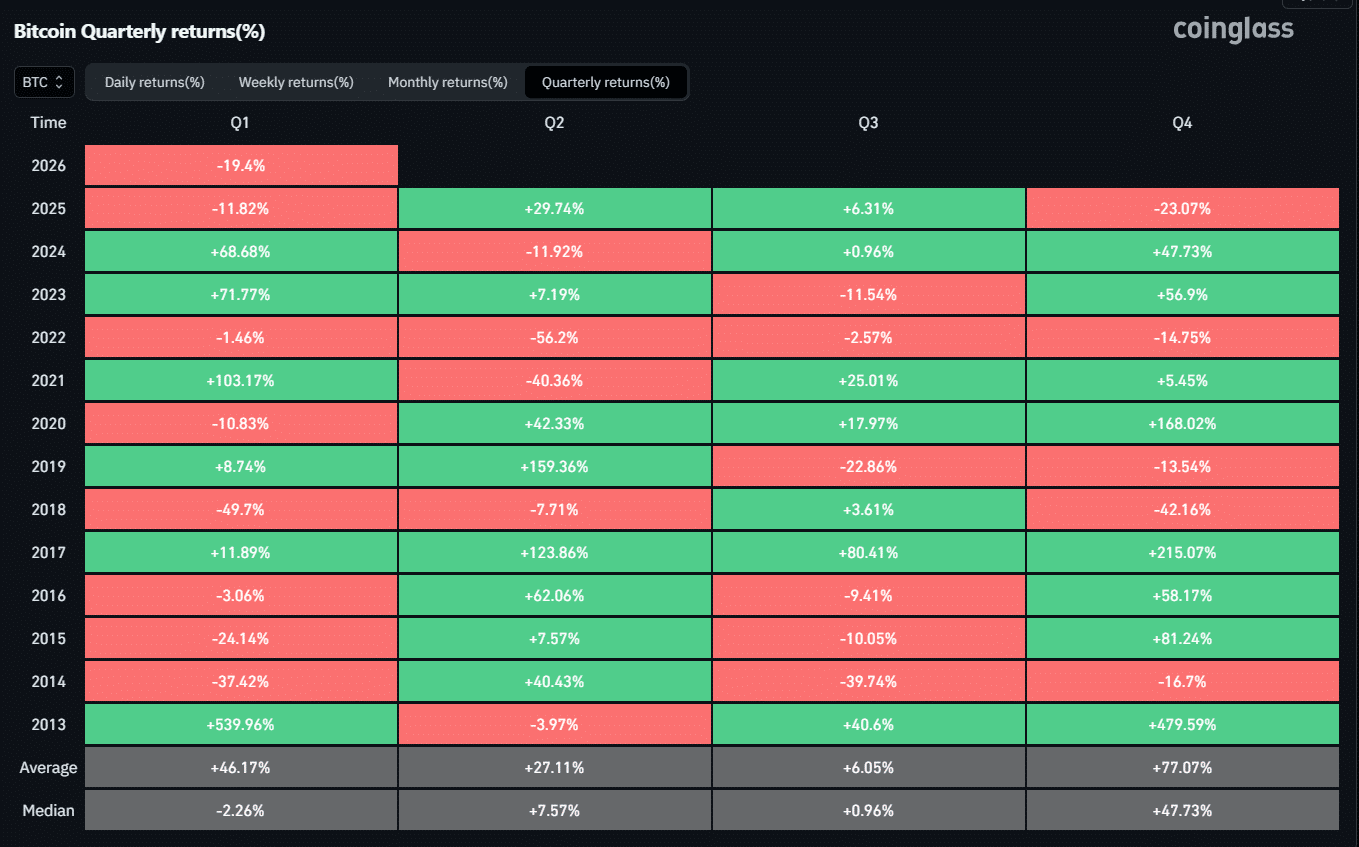
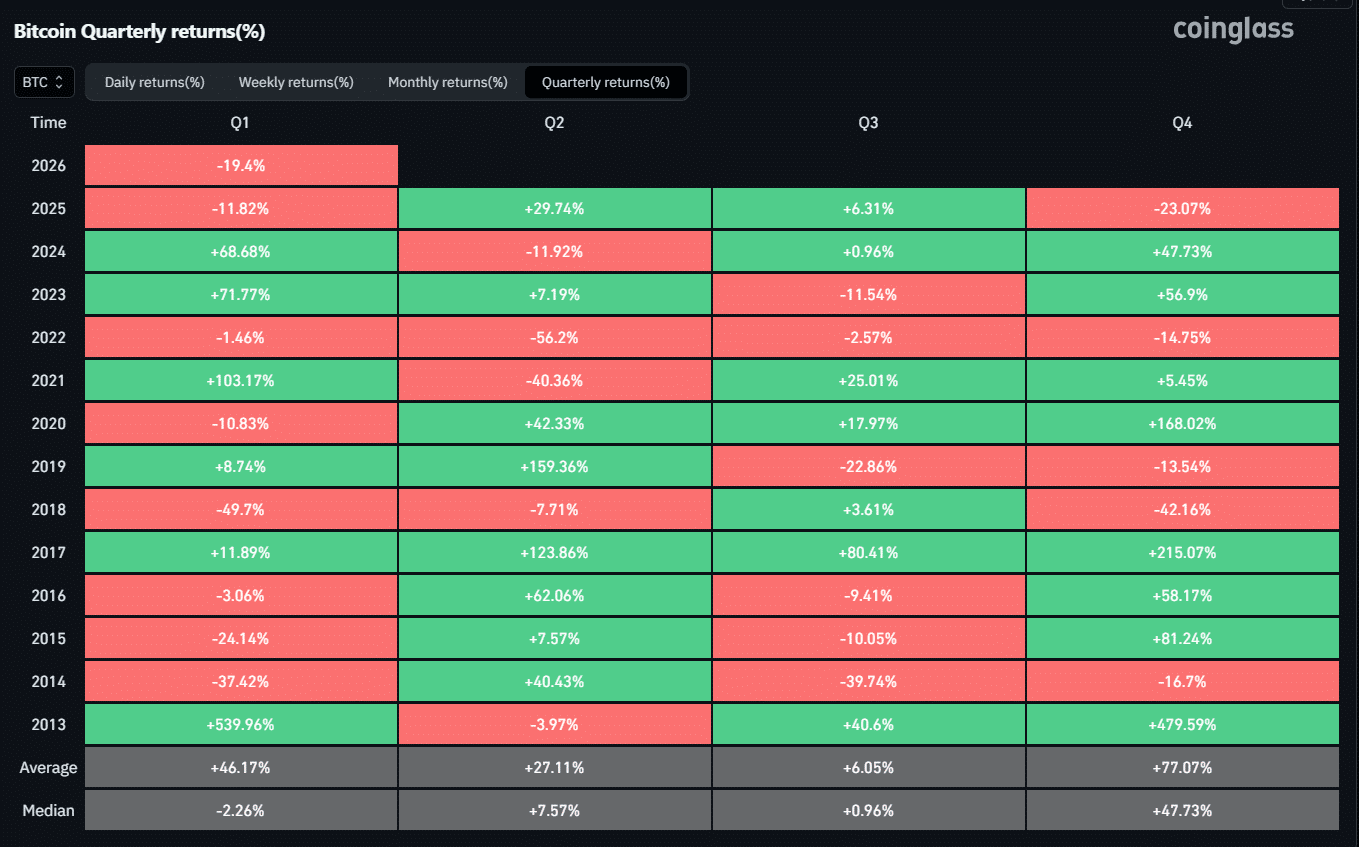
The discussion is certainly worth exploring, especially when we consider historical trends. Looking back at the 2025 cycle, Q2 clearly emerged as the most bullish quarter of the year.

During this period, the total crypto market cap increased by 23.4%, which translated into roughly $640 billion in fresh inflows.

Bitcoin [BTC] mirrored this momentum, closing the quarter up 30% and achieving the highest ROI of the year.

However, the main takeaway? This surge followed BTC’s roughly 12% correction in Q1, and the market has already outpaced that pullback with this year’s roughly 20% drop so far, showing how quickly it can rebound and adapt.

Source: CoinGlass

Against this backdrop, we cannot dismiss the possibility of a repeat run for crypto as overly optimistic.

In fact, it becomes even more compelling when we consider how the market has so far shrugged off the FUD stemming from the West Asia crisis, despite surging oil prices. Meanwhile, traditional safe havens have been under pressure, with gold posting nearly twice the weekly losses of Bitcoin.

Taken together, this suggests that the crypto market could be setting the stage for another strong rally. However, when we step back and look at the bigger picture, the total crypto market cap is still down roughly 18%, a stark contrast to the S&P 500’s 3.23% quarterly decline.

Naturally, the key question becomes: Can crypto’s relative strength hold up against a double-digit pullback and still power a bullish Q2?

The crypto market faces a real-world test

The crypto market stumbled on fresh macro data, sparking another wave of risk-off activity.

As AMBCrypto flagged, the latest PPI report came in hotter than expected, showing that inflation concerns continue to keep the Federal Reserve hawkish on interest rates. Still, the market had mostly priced this in, with nearly 99% expecting rates to remain unchanged.

And yet, crypto closed the session down 3.24%, reminding investors that even priced-in data can shake sentiment.

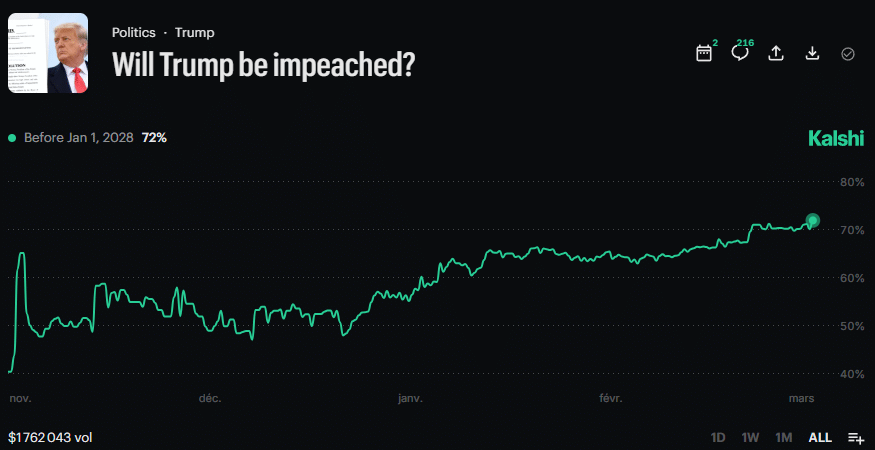
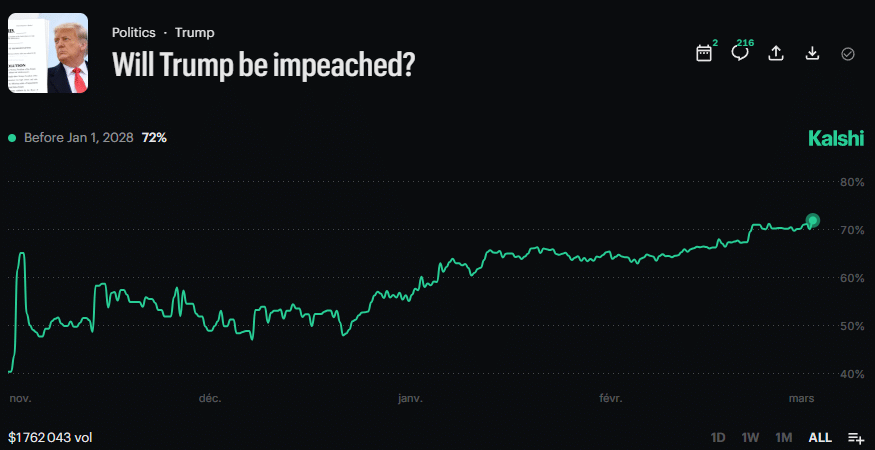
This naturally puts the spotlight on recent prediction market data, which highlights that the probability of U.S. President Donald Trump being impeached before 2028 has risen to 72%, trending steadily higher over the past few months.

Source: Kalshi

Most importantly, this isn’t a one-off signal. The data also reflects a weakening U.S. economy across multiple sectors, from unemployment to GDP, underscoring that the impeachment prediction is supported by broader economic trends.

In this context, the recent PPI report represents just one piece of a much larger picture, highlighting ongoing inflation pressures and the challenges policymakers face. Against this backdrop, it’s no surprise that the market reacted.

After Israel struck Iran’s critical energy infrastructure, crypto lost billions, with Bitcoin falling more than 2%. This shows that real-world events are starting to feed into investor sentiment, testing the crypto market’s recent resilience.

This in turn makes the odds of a bullish Q2 highly unlikely, as macro FUD now plays a larger role in shaping investor expectations than it did earlier this year.


Final Summary

  • Historical trends suggest Q2 could be bullish, as BTC and the overall crypto market have rebounded strongly after Q1 pullbacks.
  • Macro and geopolitical risks are beginning to influence investor sentiment, making a repeat Q2 rally far from guaranteed.

Похожее

Banks Battle Stablecoins: Where Will Deposits Ultimately Flow?

"Banks vs. Stablecoins: Where Will Deposits Flow?" By: Prathik Desai The traditional banking model, where banks profit from lending out low-interest deposits, faces a fundamental challenge from blockchain-based stablecoins. While U.S. savings accounts offer ~0.6% interest, stablecoins provide near-instant, low-cost global transfers and, via DeFi protocols, access to 5-8% yields. This threatens bank deposit bases and their net interest margins. History offers a parallel: In the 1970s, Merrill Lynch's Cash Management Account (CMA) circumvented Regulation Q's interest caps by sweeping funds into money market funds, causing massive deposit outflows until banks responded with their own high-yield accounts. Today, two competing "digital dollar" models are emerging: 1. **Stablecoins (e.g., USDC):** Funds leave the banking system to back the tokens. While laws like the GENIUS Act forbid issuers from paying interest, users can earn yield via DeFi. This poses an existential threat, especially to regional banks. Predictions suggest significant deposit migration to stablecoins. 2. **Tokenized Deposits:** Banks convert deposits into on-chain tokens for fast, cheap transfers, while the original funds remain on their balance sheets, protected by FDIC insurance and available for lending. Two major bank consortia are developing platforms: one for institutions (led by JPMorgan, Citi, etc.) and Cari Network (regional banks) for retail users. The competition centers on control. Stablecoins offer openness and programmability but lack insurance. Tokenized deposits offer safety and yield but within the traditional, regulated system. A third path, exemplified by SoFi Bank's launch of SoFiUSD, aims to bridge this divide. SoFi integrates a stablecoin, a tokenized deposit (with yield and FDIC insurance), and a bank account in one app, allowing seamless switching based on the user's need for yield, safety, or liquidity. The core insight is that the future belongs not to a single product form, but to the *ability to frictionlessly switch* between forms—optimizing for security, yield, or liquidity as needed. Blockchain technology is becoming financial infrastructure, not to replace banks, but to force them to deconstruct and rebuild their services. The ultimate winners will be institutions that enable this seamless conversion, forcing an evolution similar to the post-Regulation Q era, where traditional finance absorbed innovations to survive.

Foresight News10 мин. назад

Banks Battle Stablecoins: Where Will Deposits Ultimately Flow?

Foresight News10 мин. назад

Exclusive | ByteDance's AI Drug Discovery Unit Initiates Spinoff and Funding, AI4S Enters Industrialization Phase

Exclusive | ByteDance’s AI Drug Discovery Unit Initiates Spin-off for Financing, Signaling Industrialization Phase for AI4S. ByteDance’s AI drug discovery business line has begun the process of spinning off as an independent entity to raise outside funding, marking a key step toward industrializing its AI for Science (AI4S) efforts. Post-spin-off, ByteDance will remain the controlling shareholder. The new company will inherit the core team, algorithms, technology platform, and existing pipeline assets. It will also continue to receive computing power support from ByteDance's Volcano Engine. The AI drug discovery team, established in 2021 and led by Liu Kai with a core team of about 50 AI and pharmaceutical experts, has been responsible for foundational model research and industrialization. It has consolidated ByteDance's protein structure prediction model team and launched several key technologies. These include the molecular structure prediction models Protenix and Seedfold, the protein design tool PXDesign, and the AI drug discovery platform "Anew Labs." Anew Labs has produced research covering protein-ligand dynamics, molecular generation, and free energy calculation, and has developed early-stage drug pipelines like IL-17 and IL4R inhibitors. Notably, its IL-17 small molecule program, presented in April 2026, demonstrated the first small-molecule blockade of three IL-17 dimers, a significant step in autoimmune disease research. This progress demonstrates ByteDance’s AI capabilities have advanced from model development to validating specific drug targets and molecules. The company believes the opportunity to transition from research to industry is now ripe. The spin-off aims to establish an organizational structure better suited to the business's unique needs—long R&D cycles and complex validation processes involving wet labs and clinical trials—to attract top talent and drive deeper integration of AI with the pharmaceutical industry. The move responds to the pharmaceutical industry's pressing need to improve efficiency amid high R&D costs, long timelines, and high failure rates. The field of AI4S is rapidly advancing, as seen with tools like AlphaFold evolving from protein prediction to modeling complex biological interactions and the emergence of multimodal molecular generation models for drug design. ByteDance has been building its AI4S capabilities for years, exploring areas like computational biology, molecular simulation, and materials science. This spin-off represents its first major attempt to industrialize AI4S. An insider stated the company attaches great importance to this move, hoping that an independent entity with greater decision-making flexibility can pioneer a viable industrial path for AI4S in China.

marsbit48 мин. назад

Exclusive | ByteDance's AI Drug Discovery Unit Initiates Spinoff and Funding, AI4S Enters Industrialization Phase

marsbit48 мин. назад

Galaxy Deep Dive: How Does Hyperliquid's HIP-4 Upgrade Change the Predictive Markets Landscape?

Galaxy Research Report: How Hyperliquid's HIP-4 Upgrade Changes the Prediction Market Landscape. Hyperliquid's HIP-4 protocol upgrade, activated on May 2, introduces a third model for prediction markets. While incumbents like Polymarket focus on consumer discovery and Kalshi on regulated US access, HIP-4 integrates outcome markets directly into Hyperliquid's "house of all finance." This embeds binary event contracts within HyperCore, its native on-chain order book, sharing a single margin account with perpetual and spot trading. HIP-4 offers distinct advantages: superior infrastructure with sub-second finality, ~200k orders/sec throughput, and unified cross-margin, enabling novel hedges for perpetual traders. It also features a unique validator-curated oracle model for off-chain events (e.g., Fed decisions, CPI, sports) and zero fees on opening positions. Early traction shows HIP-4 capturing ~20% of combined BTC prediction market volume within 25 days. The report highlights a broader industry trend of convergence: all major platforms are moving towards a "trade everything from one account" model. HIP-4's challenge lies in expanding market breadth and consumer discovery, currently lagging behind Polymarket's flexible UMA oracle/Kalshi's sports depth. Key risks include validator centralization, US regulatory exposure (mitigated by potential pathways like the CLARITY Act), and competitive pressure from Kalshi's newly CFTC-approved Bitcoin perpetual contract. Ultimately, HIP-4's strongest case is its technically superior, unified execution stack—a harder advantage for competitors to replicate than building consumer layers atop it. The upgrade positions Hyperliquid to contest the lucrative institutional hedging flow in the evolving prediction market arena.

marsbit2 ч. назад

Galaxy Deep Dive: How Does Hyperliquid's HIP-4 Upgrade Change the Predictive Markets Landscape?

marsbit2 ч. назад

Торговля

Спот
Фьючерсы
活动图片