Convicted FTX CEO SBF Cries ‘Biden Lawfare’ In Trump Pardon Pitch

bitcoinistОпубликовано 2026-02-10Обновлено 2026-02-10

Введение

Sam Bankman-Fried (SBF) claimed in a February 9th X thread that his criminal conviction was part of "Biden’s political lawfare," comparing his case to those of Donald Trump and former FTX executive Ryan Salame in what many interpreted as a direct appeal for a future pardon. He argued that the Biden administration and the DOJ brought bogus charges and prevented him from presenting evidence, specifically claiming the court "gagged" him and hid proof that FTX was solvent and that no money was stolen. SBF criticized Judge Lewis Kaplan, who also presided over a Trump case, for rubber-stamping DOJ requests and imposing a gag order. He drew parallels between his pretrial detention and Trump's legal battles. The thread was widely seen as a political maneuver rather than a legal argument, with critics accusing him of angling for a pardon from Trump.

Sam Bankman-Fried (SBF) used a new X thread on Feb. 9 to reframe his criminal case as “Biden’s political lawfare,” positioning himself alongside Donald Trump and former FTX executive Ryan Salame in what read like a direct appeal for a future pardon.

“Biden’s lawfare machine threw bogus charges at me, Donald Trump, Ryan Salame, etc.,” Bankman-Fried wrote. “To make the charges stick, they prevented us from even being allowed to respond.” He opened with a blunt claim about process rather than facts: “Rule No. 1 of Biden’s political lawfare: Don’t let them present evidence.”

SBF Cries ‘Gagged Trial,’ Claims DOJ Hid Evidence

SBF’s argument hinges on the idea that authorities and the court curtailed what the jury could hear. He repeatedly singled out Judge Lewis Kaplan, who presided over his trial, claiming the court “rubber-stamped everything Biden’s DOJ wanted” and “made sure I couldn’t show the jury the truth.”

The “truth,” as SBF cast it, is a solvency narrative: “So they lied, said I stole billions of dollars and bankrupted FTX. But the money was always there and FTX was always solvent.” He also argued that restrictions prevented him from advancing that line at trial, writing that he was “prohibited” from “pointing out FTX was solvent” and from “even mentioning lawyers.”

In the thread, SBF linked to a court filing he said was authored by his prosecutor, “Sassoon,” describing it as “a 70-page document on all the evidence they didn’t want the jury to see,” and he framed the episode as part of a broader political effort to “silence the truth.”

A significant chunk of the thread is dedicated to Trump’s New York hush-money bookkeeping case, which Bankman-Fried portrayed as a routine classification dispute blown into criminality. “Charged him with 34 crimes over his bookkeeping of an NDA expense—should it be legal, campaign, or personal?,” he wrote. “These questions come up all the time when you’re running a business, and it’s often unclear.”

He then drew a parallel between court-imposed limits on Trump and his own pre-trial detention. “They then got the judge to impose a gag order on Donald Trump,” he wrote. “Biden’s DOJ silenced me, too—getting Judge Kaplan to gag and then jail me before trial. President Trump also had Kaplan as a judge.”

Bankman-Fried also amplified Salame’s complaints about licensing advice and charging decisions, alleging prosecutors leaned on pressure tactics to force a plea, including claims involving Salame’s fiancée, assertions presented as fact in the thread but not accompanied by supporting documentation beyond links to Salame’s posts.

The reaction underneath was unsparing, with multiple industry figures interpreting the thread less as a legal critique than a political pitch. “You’re a Delusional criminal who is now angling for a pardon,” wrote trader Bob Loukas. Attorney Ariel Givner was even more direct: “We GET it. You want a pardon from Trump.”

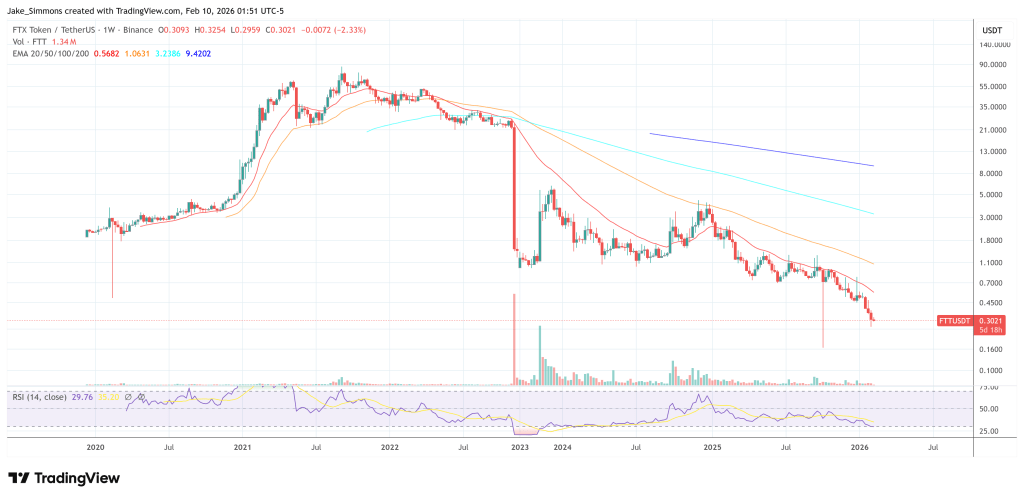
At press time, FTT traded at $0.3021.

FTT continues its freefall, 1-week chart | Source: FTTUSDT on TradingView.com

Связанные с этим вопросы

QWhat is the main argument in his recent X thread regarding his criminal case?

AHe argues that his criminal case is 'Biden's political lawfare,' claiming the Biden administration prevented him from presenting evidence and responding to the charges.

QWho did SBF specifically single out as being responsible for curtailing what the jury could hear in his trial?

AHe singled out Judge Lewis Kaplan, claiming the judge 'rubber-stamped everything Biden's DOJ wanted' and ensured he 'couldn't show the jury the truth.'

QWhat does SBF claim was the 'truth' about FTX that he was prevented from presenting in court?

AHe claims the 'truth' was that 'the money was always there and FTX was always solvent,' and he was prohibited from pointing this out or even mentioning lawyers.

QHow does SBF attempt to draw a parallel between his own case and that of former President Donald Trump?

AHe draws a parallel by claiming both were subjected to Biden's 'lawfare machine,' faced gag orders and pre-trial detention, and were prevented from presenting evidence, noting that Trump also had Judge Kaplan in one of his cases.

QHow did some industry figures interpret SBF's thread, according to the article?

AIndustry figures like trader Bob Loukas and attorney Ariel Givner interpreted it less as a legal critique and more as a political pitch, specifically an attempt to angle for a pardon from Donald Trump.

Похожее

A Clod of Chinese Soil Chokes Two Japanese Giants

"Chinese Soil Chokes Japanese Giants" The production of a key electronic specialty gas, tungsten hexafluoride (WF6), vital for manufacturing AI chips, was halted by two leading Japanese producers—Kanto Denka and Central Glass. Their shutdown was not due to a technological failure but a sudden, critical shortage of a raw material they had long taken for granted: ultra-high-purity (6N-grade) tungsten powder, which is almost entirely sourced from China. Following a quiet Chinese export announcement in January 2026, tungsten powder shipments to Japan dropped to zero for months. Despite frantic efforts, Japanese companies found no viable alternative; imported powder was three times more expensive and lacked the required purity. Their existing stockpiles were exhausted by mid-2026. WF6 is essential for depositing tungsten into the microscopic contact holes of High Bandwidth Memory (HBM) chips, which are crucial for advanced processors like those from Nvidia. While Japanese firms had mastered producing ultra-pure WF6 gas, their entire supply chain relied on China's 6N tungsten powder—a dependency now revealed as a fatal vulnerability. China's dominance in this "soil" results from decades of painstaking R&D by companies like Xiamen Tungsten and China Tungsten & Hightech. They overcame immense technical hurdles, such as separating chemically similar molybdenum from tungsten, to achieve mass production of the world's purest tungsten powder. With their primary suppliers gone, Kanto Denka and Central Glass announced a permanent halt to WF6 production starting July 1, 2026. This immediately created a supply crisis for major semiconductor manufacturers like Samsung and SK Hynix, forcing them to urgently seek and certify new Chinese suppliers for WF6 itself. The reversal marks a dramatic shift: China has moved from exporting low-value raw materials to controlling the high-purity foundation of a critical global tech supply chain, upending a long-established industrial hierarchy.

marsbit31 мин. назад

A Clod of Chinese Soil Chokes Two Japanese Giants

marsbit31 мин. назад

Without Tencent, What's Left for Suiyuan?

The article centers on the crucial question posed in the title: what is Seyond Technology really worth if its dominant customer, Tencent, were to stop purchasing its AI chips? As the last of China's "Four AI Chip Dragons" to secure approval for a public listing, Seyond's IPO filing reveals a profound and controversial dependency. In 2025, 74.9% to over 80% of its revenue came from Tencent. The piece argues that this extreme customer concentration is not merely a vulnerability but a strategic outcome of China's AI industry evolution. It contrasts Seyond's path with its peers (Moore Thread, Biren Technology, and MetaX), noting that while others raced to market with ambitious stories, Seyond focused first on securing and delivering for a major client. Its explosive revenue growth—with Q1 2026 up 1474.85% year-on-year—is driven by concentrated orders from Tencent, which itself faces massive, escalating AI compute demands for products like its Yuanbao and Hunyuan models. The relationship is framed as a deliberate, symbiotic cultivation of a supply chain. As both a major shareholder (20.26%) and primary client, Tencent is actively fostering Seyond to build a controllable, stable alternative to NVIDIA, similar to how global tech giants historically nurtured key suppliers. The high switching costs—involving software stacks and deployed systems—create a deep "ecological moat" for Seyond within Tencent's ecosystem. The analysis positions the AI chip landscape in three tiers: NVIDIA as the global leader, Huawei's Ascend as the state-backed player, and commercial firms like Seyond competing for market orders. Seyond is increasingly seen as "Tencent's compute foundation," with its product roadmap closely aligned with the tech giant's needs. The conclusion is that the industry's metric for success is shifting from fundraising and technical specs to real orders, delivery capability, and ecosystem binding. Seyond's value, therefore, lies not just in its chips but in holding a massive, multi-year procurement order from China's largest internet company—a tangible asset arguably more telling than any technical whitepaper in the current climate. The core insight is that for domestic chips, the ultimate challenge isn't just catching up technologically with NVIDIA, but earning the trust, scenarios, and recurring orders from a major anchor client.

marsbit1 ч. назад

Without Tencent, What's Left for Suiyuan?

marsbit1 ч. назад

War Trade Unwinding | TradeXYZ Weekend Observations

Weekend markets saw a clear return of risk appetite. Major indices rose broadly, with significant gains in tech and precious metals, while energy sectors fell sharply on the "end of war" narrative. On June 14, oil prices initially rose on reports Iran had not yet finalized a memorandum of understanding. Later, YNET reported Trump might immediately lift the maritime blockade on Iran and the Strait of Hormuz. At 21:30, Trump confirmed on Truth Terminal that a deal with Iran was done, authorizing an immediate end to the US blockade and toll-free opening of the Strait. Iran's deputy foreign minister simultaneously announced an immediate and permanent halt to military actions on multiple fronts. Oil prices had already fallen to weekend boundaries, pre-pricing the news. The S&P 500 subsequently touched 7530. Markets will likely remain in a waiting period until the formal peace deal signing on June 19. At the moment of the deal announcement, gold jumped from ~4,221 to a high of 4,337, and silver from ~67.85 to 70.83, before stabilizing at higher levels. Individual stocks and ETFs like NBIS, RKLB, and LITE performed strongly. NBIS, added to the Nasdaq index, saw a target price increase due to strong AI cloud growth. RKLB, also added to the index, benefited from positive SpaceX valuation sentiment. LITE received a $1,130 target from JPMorgan. SPCX rose quickly after Musk tweeted SpaceX could potentially reach ~$1 trillion in revenue by 2030. In summary, the market shock from the multi-month war is beginning to dissipate. Israel's actions remain the key variable before the June 19 signing. Upcoming events like Fed Chair Warsh's debut and BoJ rate hike expectations will also significantly impact markets this week.

marsbit2 ч. назад

War Trade Unwinding | TradeXYZ Weekend Observations

marsbit2 ч. назад

Торговля

Спот
Фьючерсы
活动图片