Coinbase Posts $394 Million Loss In Q1 2026 — And The Worst May Not Be Over

bitcoinistОпубликовано 2026-05-08Обновлено 2026-05-08

Введение

Coinbase reported a net loss of $394 million for Q1 2026, a sharp reversal from a $65.6 million profit a year ago. This missed analyst expectations as total revenue fell 30.5% to $1.41 billion, largely driven by a 23% decline in transaction revenue due to lower crypto trading volumes and prices. A significant factor was $482 million in unrealized losses on crypto holdings, primarily linked to Bitcoin's price drop. Excluding that, the adjusted net loss was $46 million. While subscription and services revenue remained strong at $584 million and adjusted EBITDA was positive, the results highlight the exchange's continued sensitivity to crypto market cycles. This follows recent workforce reductions and shows operating margin collapsing to -1.5%. The quarter underscores that despite its institutional standing, Coinbase's path to durable profitability remains tied to volatile crypto market conditions.

Coinbase reported a net loss of $394 million for the first quarter of 2026, swinging from a $65.6 million profit in the same period last year and missing Wall Street expectations on both revenue and earnings per share — as a sharp pullback in crypto prices and trading volumes hit the exchange’s core business harder than analysts had anticipated.

The results, reported by Bloomberg after market close on May 7, showed total revenue of $1.41 billion — a 30.5% year-over-year decline and a miss against the analyst consensus of approximately $1.51 billion. On a per-share basis, Coinbase posted a GAAP loss of $1.49 against expectations of a $0.29 profit — a significant miss that sent shares down roughly 4% in after-hours trading.

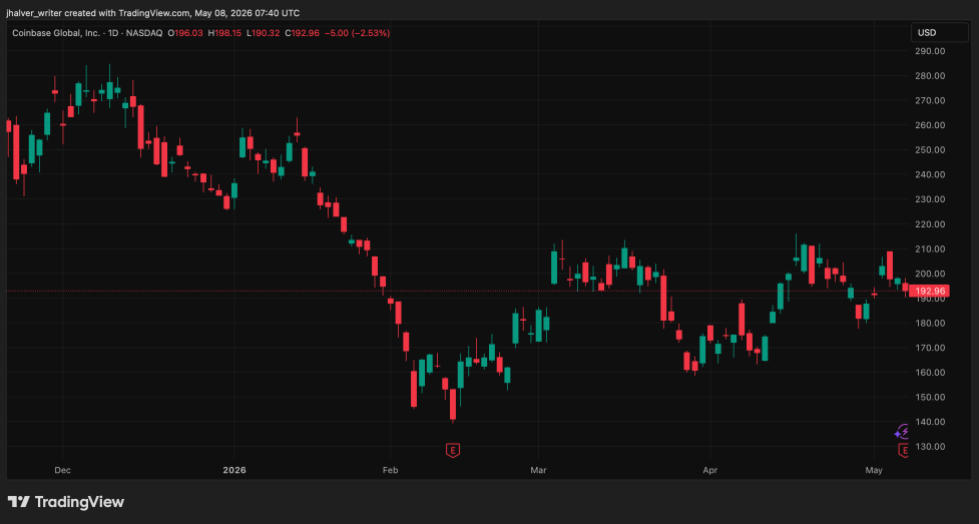
COIN's price records a modest loss following their Q1 earnings report, as seen on the daily chart. Source: COINUSD on Tradingview

What Drove Coinbase To A Loss

The single largest drag on the quarter was $482 million in unrealized losses on crypto assets held for investment, tied primarily to Bitcoin’s roughly 23% decline during Q1, a separate report from TheStreet crypto claims. Strip out that mark-to-market impact and the adjusted net loss narrows to $46 million — a meaningful distinction, but one that still reflects a materially weaker operating environment than the prior year.

Transaction revenue, the exchange’s primary revenue engine, came in at $755.8 million — down 23% quarter-over-quarter and below the $805.2 million analysts had projected. The main driver was straightforward: total crypto market capitalization and spot trading volumes declined more than 20% quarter-over-quarter, per Investing.com, pulling Coinbase’s most volatile revenue line with it.

Not everything was negative. Subscription and services revenue reached $584 million — representing 44% of net revenue — while stablecoin revenue hit $305 million on record average USDC holdings of $19 billion in Coinbase products. Adjusted EBITDA came in at $303 million, marking the company’s 13th consecutive positive quarter on that metric, per CFO Alesia Haas on the earnings call.

A Quarter That Confirms The Pattern

The Q1 loss arrives just days after Coinbase announced a 14% reduction in its workforce — approximately 700 roles — citing the need to restructure around AI-driven operations. Taken together, the layoffs and the earnings miss paint the picture of an exchange managing through a difficult cycle rather than riding one.

Operating margin collapsed to -1.5% from 34.7% in the year-ago quarter, underlining how quickly Coinbase’s profitability profile can shift when crypto markets pull back. The company closed the quarter with over $10 billion in cash and equivalents, per the earnings call transcript, which provides a substantial buffer — but does little to address the structural revenue sensitivity that has defined every down cycle in the exchange’s short public history.

For the nascent sector, Coinbase’s Q1 results serve as a reminder that even the most institutionally established crypto exchange remains tightly tethered to market conditions — and that the road to durable profitability runs directly through the unpredictable terrain of crypto price cycles.

Cover image from Grok, COINUSD chart from Tradingview

Связанные с этим вопросы

QWhat were Coinbase's reported Q1 2026 financial results in terms of net loss and revenue?

ACoinbase reported a net loss of $394 million for Q1 2026, swinging from a $65.6 million profit in Q1 2025. Total revenue was $1.41 billion, a 30.5% year-over-year decline.

QWhat was the largest single factor contributing to Coinbase's Q1 2026 loss according to the article?

AThe single largest drag was $482 million in unrealized losses on crypto assets held for investment, primarily tied to Bitcoin's roughly 23% decline during the quarter.

QHow did Coinbase's transaction revenue perform in Q1 2026 compared to analyst expectations?

ATransaction revenue came in at $755.8 million, which was down 23% quarter-over-quarter and below the $805.2 million analysts had projected.

QDespite the overall loss, which areas of Coinbase's business showed positive performance in Q1 2026?

ASubscription and services revenue reached $584 million, representing 44% of net revenue. Stablecoin revenue hit $305 million on record average USDC holdings. Adjusted EBITDA was $303 million, marking the 13th consecutive positive quarter on that metric.

QWhat recent operational decision by Coinbase, mentioned alongside the earnings, highlights its response to a difficult cycle?

AJust days before the earnings report, Coinbase announced a 14% reduction in its workforce (approximately 700 roles), citing a restructuring around AI-driven operations.

Похожее

ChatGPT Might Be Disappearing Soon

OpenAI announced at its "Intelligence at Work" event that its coding assistant, Codex, will be fully integrated into the ChatGPT app within weeks. This move marks a strategic shift from a conversational AI (Chat) towards a unified "agentic" platform capable of execution. Codex, originally launched to compete with Anthropic's Claude Code, has grown rapidly to 5 million weekly active users, with 20% being non-developers like analysts and designers. Its enterprise revenue now constitutes 40% of OpenAI's total. The integration is the first step in creating a super-app combining ChatGPT (interface), Codex (execution engine), and the Atlas browser (web access). OpenAI also unveiled new Codex features: specialized Agent plugins for six professional roles, an "Annotations" tool for direct document editing, and a "Sites" function to turn work into shareable web apps. Internally, this reflects a power shift; the Codex team now leads core product strategy. While the ChatGPT brand remains for its vast user base, the platform's future is focused on autonomous agents that perform tasks, not just chat. The article notes that competition with Claude Code pushed OpenAI's development, with Codex competing on cost-effectiveness and accessibility rather than raw coding quality. It concludes that the essence of "ChatGPT" is evolving from a chatbot into an AI agent platform, with the name potentially becoming a legacy symbol of its original function.

marsbit7 мин. назад

ChatGPT Might Be Disappearing Soon

marsbit7 мин. назад

WWDC26 Ultimate Preview: The All-New Siri is the Main Course, iOS 27 is Another Year of Refinements

Apple has confirmed WWDC26 will begin on June 8, with the keynote at 10 AM PT (1 AM Beijing Time, June 9). This year's focus is expected to shift significantly from routine OS updates to Apple's progress in AI, particularly a major overhaul of Siri. Reports indicate the highlight will be a new Siri, reportedly powered by Google's Gemini technology. This upgraded assistant is expected to appear as a lightweight bubble from the Dynamic Island and be accessible via a unified "Search or Ask" system-wide entry point. It aims to deeply integrate with iOS 27, iPadOS 27, and macOS 27, accessing personal data like messages, photos, and documents, with a potential standalone Siri app also in development. For iOS 27, leaks suggest incremental improvements rather than major redesigns. Key updates may include a redesigned, more customizable Camera app, enhanced photo editing tools within the Photos app, and potential early system optimizations for a future foldable iPhone. The update is also rumored to prioritize bug fixes, stability, and performance optimization. iPadOS 27 is anticipated to focus on improving productivity features like window management, file systems, and external display support to better utilize the iPad's hardware. macOS 27 is seen as a core platform for Apple Intelligence, likely receiving an optimized Siri, new AI features, and continued refinement of the "Liquid Glass" design language. Notably, macOS 27 may finally drop support for Intel-based Macs. The overarching theme for WWDC26 is whether Apple can effectively integrate AI across its ecosystem. The success of the new Siri and Apple Intelligence will be judged on their ability to move beyond standalone features and become a cohesive, context-aware system layer that understands user workflows across iPhone, iPad, Mac, and other devices, while maintaining Apple's emphasis on privacy and stability. The conference represents Apple's critical attempt to catch up and redefine the AI assistant experience after a perceived slow start in the generative AI era.

marsbit33 мин. назад

WWDC26 Ultimate Preview: The All-New Siri is the Main Course, iOS 27 is Another Year of Refinements

marsbit33 мин. назад

Торговля

Спот
Фьючерсы
活动图片