Coinbase CLO turns bullish on CLARITY: ‘Confident we’re going to see progress’

ambcryptoОпубликовано 2026-04-02Обновлено 2026-04-02

Введение

Coinbase Chief Legal Officer Paul Grewal expressed strong optimism about the imminent passage of the Digital Asset Market CLARITY Act of 2025, predicting a breakthrough in U.S. crypto regulation within the next 48 hours. Despite resistance from traditional banks, Grewal emphasized the importance of the bill in fulfilling former President Trump’s vision of making the U.S. a global crypto capital. He differentiated crypto from fractional-reserve banking, dismissing concerns about deposit flight due to stablecoins. His shift in stance surprised Patrick Witt of the President’s Council on Digital Assets, given Coinbase’s previous hesitation. Polymarket odds of the bill becoming law by 2026 rose to 65%, reflecting growing confidence.

An interesting plot twist has emerged in the ongoing chatter around the Digital Asset Market CLARITY Act of 2025.

Coinbase Chief Legal Officer (CLO) Paul Grewal, in a recent television appearance, has shared his optimism about the passage of the crypto bill. He believes that the U.S. is on the verge of a major crypto breakthrough despite banks’ resistance.

More importantly, Grewal revealed that the deal between crypto and banks will likely pass within the next 48 hours.

I’m very confident we’re going to see progress.

However, he also pointed out that,

Other key elements of the bill are critically important to making sure that President Trump’s vision of the United States as the crypto capital world is fulfilled.

Coinbase’s CLO is confident about the CLARITY Act passage

Explaining his stance, Coinbase CLO underlined that rules might be different for banks and crypto because “the game is very different”.

While comparing traditional banks and stablecoins, Grewal highlighted how banks operate on fractional reserve lending—where they hold less and focus more on deposits and lend-outs.

However, as the ongoing debate around ‘yield generations’ surges, critics believe that stablecoin could halt people from withdrawing money from banks. But speaking in defense, Grewal rejected that notion, stating,

There has been no evidence of deposit flight whatsoever.

He also stressed how the GENIUS Act introduced the initial rule for crypto and that the CLARITY Act is the finish line for a complete regulatory framework.

Shift in stance shocks executives

This optimism from Grewal comes after Coinbase’s recent holdout. For those unaware, this stepback had pushed Patrick Witt, the executive director of the President’s Council on Digital Assets, to issue a hidden warning at Coinbase.

However, after hearing Paul Grewal’s shift in stance. Witt expressed his surprise.
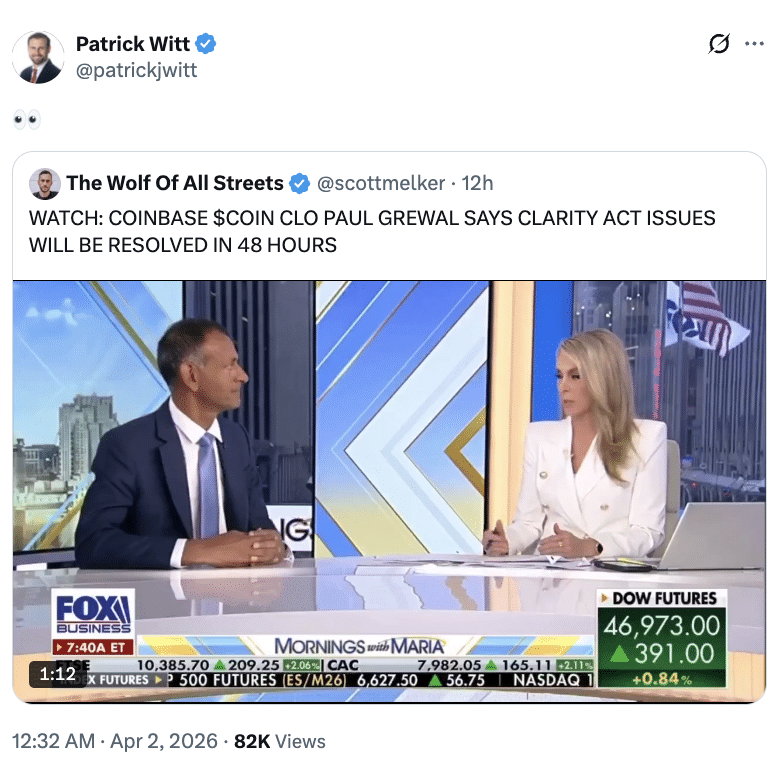
Source: Patrick Witt/X

Meanwhile, the Polymarket odds of the CLARITY Act being signed into law in 2026 confirmed the positive sentiment, as it stood at 65% at the time of reporting.
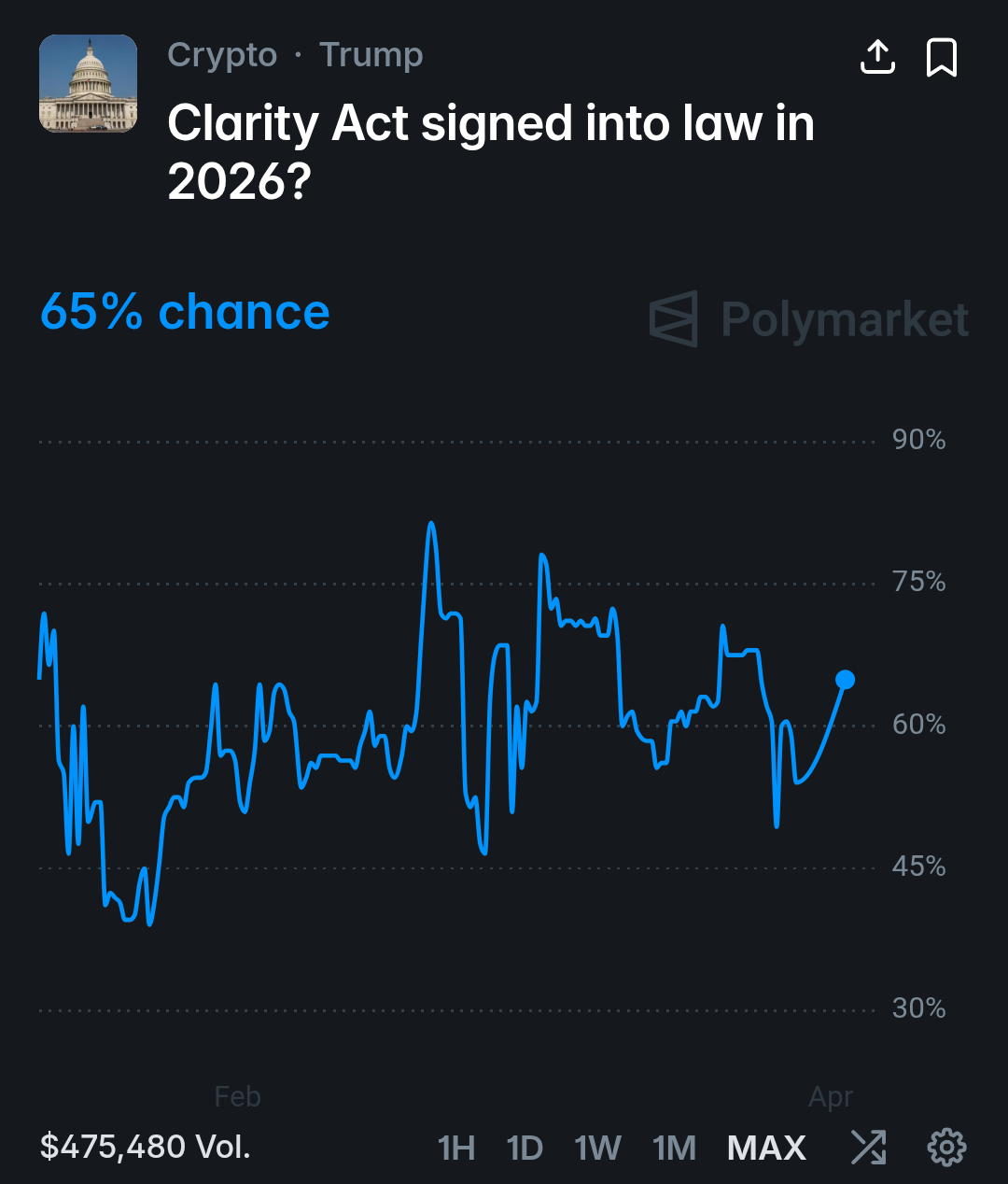
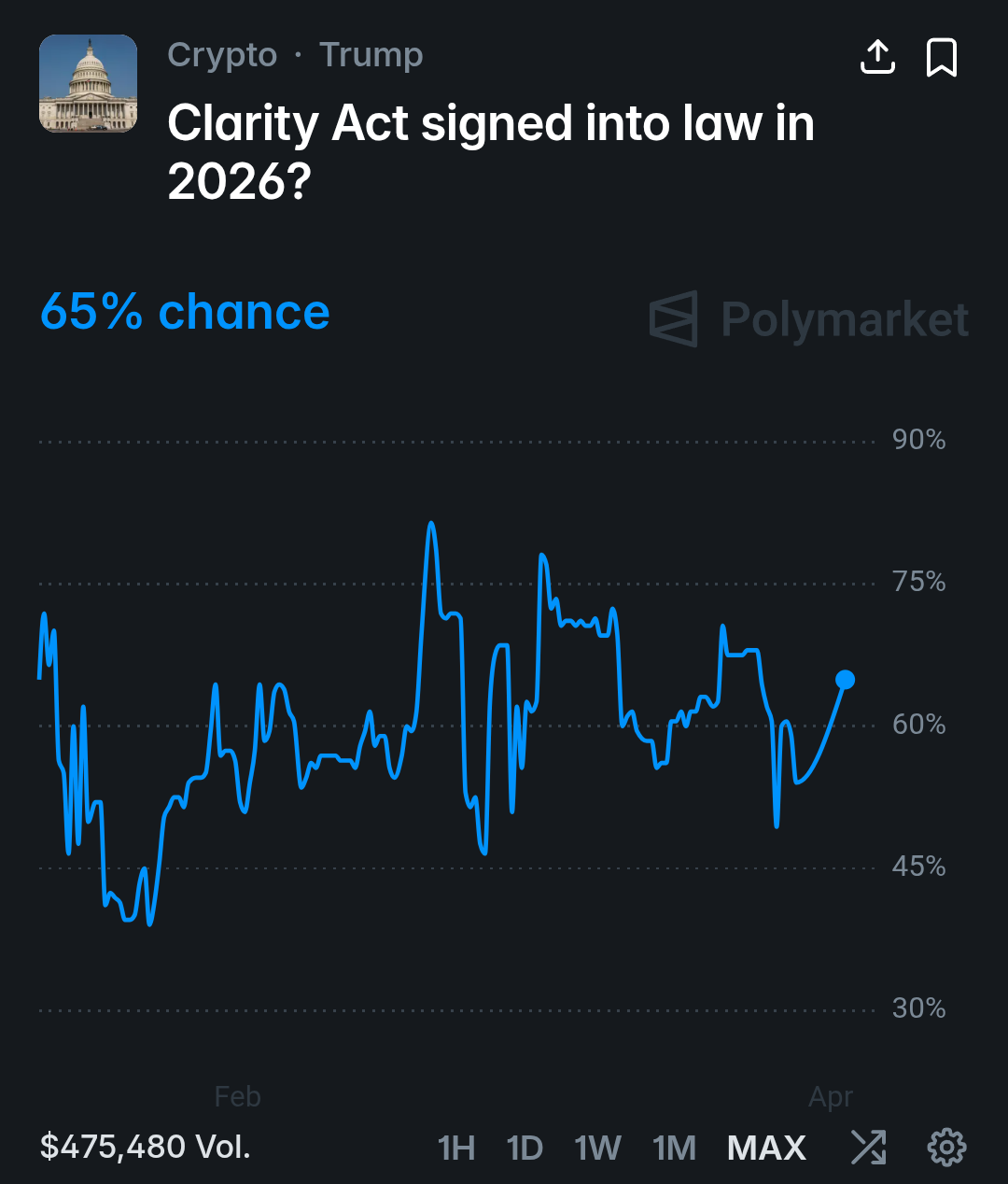
Source: Polymarket

Final Summary

  • Paul Grewal’s optimism about the CLARTY Act shocks Patrick Witt, considering Coinbase’s past holdout.
  • Polymarket odds rocketed to 65%, reflecting this increased optimism.

Связанные с этим вопросы

QWhat is Paul Grewal's position at Coinbase and what is his recent stance on the CLARITY Act?

APaul Grewal is the Chief Legal Officer (CLO) of Coinbase, and he has recently expressed optimism and confidence about the passage of the CLARITY Act.

QAccording to Grewal, when is the deal between crypto and banks likely to pass?

AGrewal revealed that the deal between crypto and banks is likely to pass within the next 48 hours.

QHow did Patrick Witt react to Paul Grewal's shift in stance on the CLARITY Act?

APatrick Witt, the executive director of the President’s Council on Digital Assets, expressed surprise at Paul Grewal's shift in stance, considering Coinbase's previous holdout.

QWhat were the Polymarket odds for the CLARITY Act being signed into law in 2026 at the time of reporting?

AThe Polymarket odds for the CLARITY Act being signed into law in 2026 stood at 65% at the time of reporting.

QWhat key difference did Grewal highlight between traditional banks and stablecoins?

AGrewal highlighted that traditional banks operate on fractional reserve lending, where they hold less and focus more on deposits and lend-outs, while implying stablecoins operate differently.

Похожее

AI Giants Enter the Dark Forest

In the AI industry's "dark forest," major players like Anthropic, OpenAI, and DeepSeek are strategically withholding their most advanced models to avoid becoming targets in a high-stakes competitive landscape. Anthropic released Claude Opus 4.7 but admitted it underperforms compared to their unreleased model Mythos, citing safety concerns. They delayed addressing user complaints about performance regression until OpenAI’s GPT-5.5 launch, highlighting a tactic of controlled disclosure aligned with competitors’ moves. OpenAI’s GPT-5.5, though a full retrain since GPT-4.5, was seen as incremental rather than revolutionary. Leaks revealed internal models like Glacier and Heisenberg, indicating significant unreleased capabilities. OpenAI acknowledges a "capability overhang," where real model power exceeds what users experience, often due to infrastructure-driven throttling. DeepSeek launched V4 Preview, a cost-efficient model, but its full potential (V4 Pro Max) awaits Huawei’s Ascend 950 super-nodes量产 in late 2026. Their strategy focuses on affordability and scalability, aiming to democratize AI access globally, a move noted even by NVIDIA’s CEO as a disruptive threat. Together, these actions reflect a broader trend: leading AI labs are deliberately pacing releases, hiding strengths, and aligning disclosures with competitive dynamics—each avoiding the risk of exposure in a forest where first movers become targets.

marsbit46 мин. назад

AI Giants Enter the Dark Forest

marsbit46 мин. назад

Naval Steps Into the Arena: A Historic Collision Between Ordinary People and Venture Capital

Naval Ravikant, co-founder of AngelList and a prominent Silicon Valley thinker, has taken a hands-on role as the chairman of the investment committee at USVC—a new SEC-registered fund allowing non-accredited investors to access high-growth private tech companies with a minimum investment of $500. The fund’s initial portfolio includes leading AI firms like OpenAI, Anthropic, xAI, and others. This move represents a significant shift in democratizing access to venture capital, a space traditionally dominated by institutional investors and high-net-worth individuals. USVC aims to let ordinary investors participate in the high-alpha, pre-IPO growth phase of tech companies—a stage where much of the value creation now occurs before public listings. However, the fund is not without complexities. It offers limited liquidity, with potential quarterly redemptions capped at 5%, and charges an all-in fee of 2.5% in its first year. While this is higher than traditional ETFs, it is positioned as a more accessible alternative to conventional VC fee structures. Ultimately, USVC symbolizes a broader movement toward financial inclusion in high-stakes tech investing—not through crypto or Web3 mechanisms, but via regulated, retail-friendly investment vehicles. It offers a ticket to early-stage innovation, though risks typical of venture capital remain.

marsbit48 мин. назад

Naval Steps Into the Arena: A Historic Collision Between Ordinary People and Venture Capital

marsbit48 мин. назад

Торговля

Спот
Фьючерсы
活动图片