Coinbase ‘cautiously optimistic’ on 2026 as crypto nears institutional inflection point

cointelegraphОпубликовано 2025-12-19Обновлено 2025-12-19

Введение

Coinbase Institutional's 2026 outlook is cautiously optimistic, forecasting a potential institutional inflection point for crypto driven by regulatory clarity, stablecoin adoption, and an improving macro backdrop. The report highlights key U.S. policy developments, including stablecoin legislation and market structure bills, as crucial for institutional integration. It projects the stablecoin market could grow to $1.2 trillion by 2028. Bitcoin's volatility has moderated, now resembling high-growth tech stocks, with 90-day historical volatility declining to 35-40% by end-2025. Despite 2025's price swings and leverage-induced corrections, Bitcoin is now seen as an established part of the global financial conversation.

After a year of unexpected turbulence for crypto markets, 2026 could mark a turning point driven by regulatory clarity, accelerating stablecoin adoption and an improving macroeconomic backdrop, according to a new outlook from Coinbase Institutional.

In its 70-page report, Coinbase Institutional said digital assets have evolved “from a niche market to an emerging pillar of global market infrastructure,” even as price volatility and uneven liquidity defined much of 2025.

Looking ahead, Coinbase’s institutional arm expects clearer global regulatory frameworks to provide stronger policy guardrails, supporting innovation and long-term market maturation.

Rather than another retail-driven boom-and-bust cycle, 2026 is framed as a year of institutional integration and regulatory maturity, with clearer rules enabling deeper participation from traditional financial players.

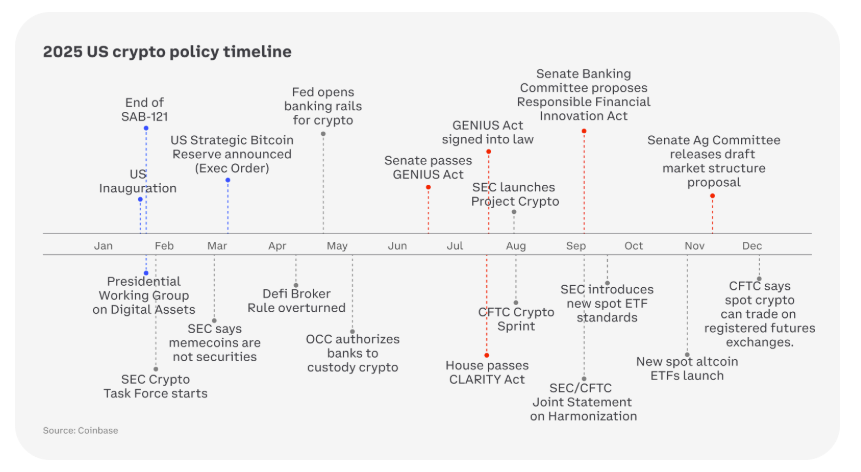
In the United States, Coinbase Institutional pointed to landmark policy developments, including progress on stablecoin legislation such as the GENIUS Act and momentum toward a broader crypto market structure bill, as key factors shaping the next phase of adoption.

These efforts are expected to influence everything from risk management and compliance standards to institutional portfolio strategies.

Coinbase Institutional flags the evolution of US crypto policy as a key driver of a potentially transformative 2026. Source: Coinbase Institutional

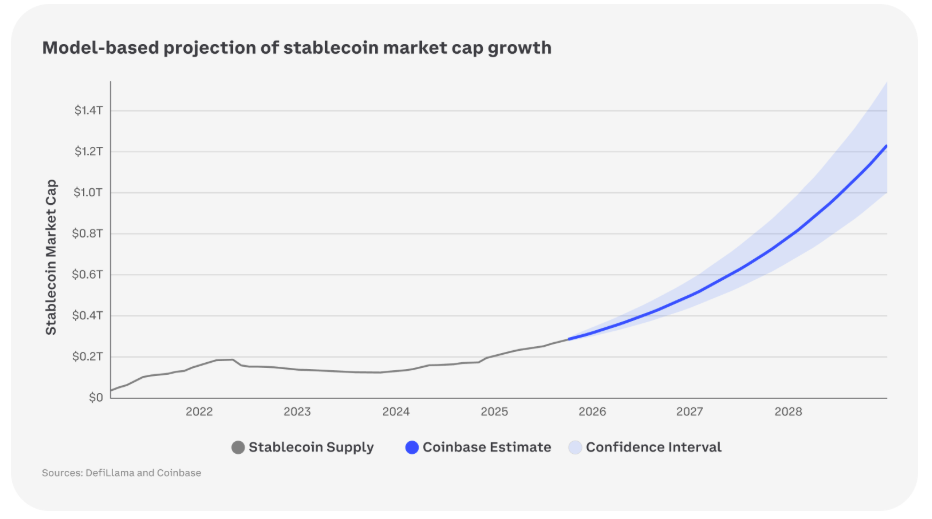
Stablecoins remain one of crypto’s most established use cases, with Coinbase Institutional projecting significant expansion in the years ahead. Its model forecasts that the stablecoin market could grow to about $1.2 trillion by 2028, driven by increased use in payments, settlement, payroll and cross-border remittances.

After years of rapid expansion, Coinbase Institutional’s model forecasts that the stablecoin market could reach $1.2 trillion by 2028. Source: Coinbase Institutional

Still, the outlook stops short of outright optimism. Coinbase Institutional described its macroeconomic expectations as “cautiously optimistic,” arguing that while economic growth may remain uneven, the US economy has shown greater resilience than recent data implies.

Persistent inflation risks and the timing of potential interest rate cuts remain key variables that could influence crypto market recovery heading into 2026.

Related: US banks may soon issue stablecoins under FDIC plan to implement GENIUS Act

Bitcoin’s volatility profile is shifting

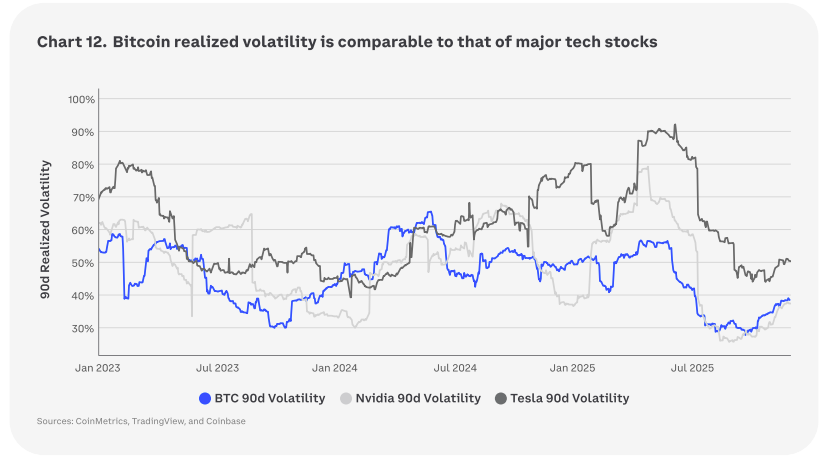
One of Coinbase Institutional’s key observations is that Bitcoin’s volatility profile has gradually evolved. Rather than standing out as an extreme outlier among major asset classes, Bitcoin’s volatility now resembles that of high-growth technology stocks, the report said.

Coinbase pointed to Bitcoin’s (BTC) 90-day historical volatility, which declined to about 35% to 40% by the end of 2025, down from levels above 60% in mid-2024. The moderation occurred even as the market absorbed major structural changes, including the approval and rollout of spot Bitcoin exchange-traded funds.

Bitcoin’s volatility profile is now comparable to major technology stocks. Source: Coinbase Institutional

Still, 2025 proved to be a volatile and emotionally charged year for Bitcoin holders. The asset experienced sharp price swings, reaching new cycle highs before undergoing a steep correction later in the year amid elevated leverage and forced liquidations across crypto markets.

While such moves have renewed debate around Bitcoin’s role as a safe-haven asset, Coinbase Institutional said that 2025 ultimately marked a milestone year. The report described Bitcoin as having been “firmly established as a critical component of the global financial conversation,” even as it remains subject to the growing pains of a maturing asset class.

Related: Why the ‘great China Bitcoin mining crackdown’ fell short of early claims

Связанные с этим вопросы

QWhat is Coinbase Institutional's overall outlook for the crypto market in 2026?

ACoinbase Institutional is 'cautiously optimistic' about 2026, framing it as a potential turning point driven by regulatory clarity, accelerating stablecoin adoption, and an improving macroeconomic backdrop, rather than another retail-driven boom-and-bust cycle.

QWhat key US policy developments does the report highlight as factors shaping the next phase of crypto adoption?

AThe report highlights landmark policy developments, including progress on stablecoin legislation such as the GENIUS Act and momentum toward a broader crypto market structure bill.

QWhat is the projected growth for the stablecoin market by 2028 according to Coinbase's model?

ACoinbase Institutional's model forecasts that the stablecoin market could grow to about $1.2 trillion by 2028.

QHow has Bitcoin's volatility profile changed, according to the report?

ABitcoin's volatility profile has evolved to resemble that of high-growth technology stocks, with its 90-day historical volatility declining to about 35% to 40% by the end of 2025, down from levels above 60% in mid-2024.

QWhat are the key macroeconomic variables that could influence the crypto market recovery heading into 2026?

APersistent inflation risks and the timing of potential interest rate cuts remain key variables that could influence the crypto market recovery.

Похожее

SpaceX, OpenAI, Anthropic: The Three AI Giants Racing for IPO, Which One Is Worth Betting On?

SpaceX, OpenAI, and Anthropic are poised for historic IPOs within weeks, potentially raising a combined $180 billion—a sum exceeding the entire internet bubble's fundraising. The hosts of the Limitless Podcast argue this isn't just individual company financing but an unprecedented capital concentration for AI infrastructure, driven by an insatiable need for compute, data centers, power, and chips. SpaceX's IPO is notable for reportedly changing market index rules to allow faster inclusion, potentially funneling trillions in passive retirement funds into its stock, despite its unproven space-based data center business model. In contrast, Anthropic demonstrates explosive growth, with ARR reportedly hitting $45 billion and approaching profitability, fueled by strong enterprise adoption of products like Claude Code. Google's separate $80 billion raise highlights the immense capital pressure, even for giants. The discussion acknowledges bubble risks but leans optimistic. The hosts contend the massive spending is building essential physical infrastructure for the next technological era. A key bottleneck isn't capital but the real-world limits of chip manufacturing and construction speed. As long as demand for AI compute outstrips supply, this investment cycle represents a foundational build-out rather than a purely financial bubble. All three companies are seen as foundational bets on the future, with Anthropic often cited as the most immediately compelling due to its proven revenue trajectory.

marsbit2 ч. назад

SpaceX, OpenAI, Anthropic: The Three AI Giants Racing for IPO, Which One Is Worth Betting On?

marsbit2 ч. назад

From 'Old Guys' to 'New Favorites': How AI Is Revaluing Old Infrastructure from Dell to Nokia?

From "Vintage Tech" to "New AI Darlings": How AI Revalues Old Infrastructure One year ago, tech giants like Dell, Nokia, Cisco, and Western Data were seen as slow-growth, low-valuation stories, far from the AI spotlight dominated by players like Nvidia. Now, these legacy tech stocks are gaining market attention, sparking debate on whether this is genuine industry revaluation or a temporary narrative. As AI moves from model parameters to real-world data centers, the market is recognizing companies with proven delivery and infrastructure capabilities. This shift marks a change in the AI investment thesis: from pure model and GPU focus to the complex systems engineering required for deployment. Companies like Dell, HPE, and Corning are being revalued not for being "sexy" AI innovators, but for their decades of accumulated expertise in supply chains, enterprise delivery, and infrastructure—assets that have become critical in the AI buildout phase. The revaluation is unfolding across three key infrastructure lines: 1. **Servers & System Integration:** Dell and HPE are emerging as crucial system integrators or "general contractors" for AI data centers, translating GPU orders into complete, deployable server racks integrated with power, cooling, and networking. 2. **Networking & Connectivity:** AI's scale demands robust high-speed connections. Corning (fiber optics), Nokia (AI-RAN, 6G), and Cisco (data center switches) are gaining importance for enabling efficient data transfer within and between AI clusters. 3. **Storage:** Beyond high-speed memory (HBM/DRAM), the AI data explosion is driving demand for high-capacity hard drives (HDDs) from companies like Western Digital and Seagate to handle training data, logs, and cold storage cost-effectively. For this revaluation to be substantive and not just a narrative, three criteria are key: 1) Concrete AI-related order and revenue growth (e.g., Dell's AI server sales), 2) Upward revisions to company financial guidance, and 3) Sustainable improvements in profit quality, not just top-line revenue spikes. In essence, AI's transition to a real construction phase is re-pricing "old assets" against "new demand." The opportunity, however, is selective. Only those legacy firms that are demonstrably integrated into the capital expenditure chains of data center and enterprise AI deployment are likely to experience a true "logic re-rating" rather than just a temporary valuation bounce.

marsbit2 ч. назад

From 'Old Guys' to 'New Favorites': How AI Is Revaluing Old Infrastructure from Dell to Nokia?

marsbit2 ч. назад

Торговля

Спот
Фьючерсы
活动图片