Coinbase-Backed Stand With Crypto Discloses Political Plan For 2026 Midterm Elections

bitcoinistОпубликовано 2026-03-27Обновлено 2026-03-27

Введение

Coinbase-backed advocacy group Stand With Crypto has announced its first endorsements for the 2026 U.S. midterm elections and launched an online voter hub to mobilize pro-crypto voters. The group endorsed six incumbent lawmakers from both major parties and will focus on competitive House races where crypto issues may be decisive. The voter hub provides information on candidates' positions, including scorecards based on public statements and legislative records. With over 2.7 million advocates, the group aims to turn crypto supporters into a influential voting bloc. A survey revealed that 59% of crypto owners are swing voters, and 80% are highly motivated to vote. Nearly two-thirds would support candidates backing the crypto industry, and 74% favor those supporting clearer regulations.

Stand With Crypto, an advocacy group backed by crypto exchange Coinbase (COIN), has unveiled its first endorsements for the upcoming midterm elections in the United States and unveiled a new online voter hub aimed at mobilizing pro-crypto voters.

Stand With Crypto Builds Voter Tools

In a Thursday press release, the organization said it will back six incumbent lawmakers from both major parties and focus resources on a set of competitive House contests where it believes crypto issues could be decisive.

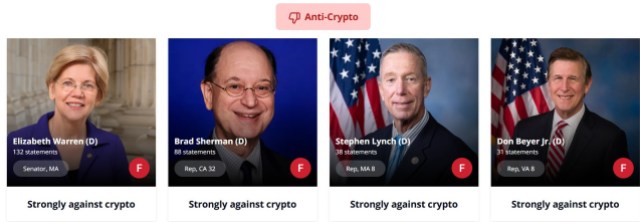
The voter hub, the group said, will compile up-to-date information on congressional candidates’ positions on digital assets, including scorecards that rate candidates’ favorability based on public statements, legislative records, and responses to a Stand With Crypto questionnaire.

The group described the hub as a tool to equip its network — more than 2.7 million advocates nationwide — with the information needed to cast informed ballots in November.

Stand With Crypto’s scorecard for each candidate

Mason Lynaugh, executive director of the Coinbase-backed group, framed the initiative as an effort to convert crypto supporters into an influential voting bloc, stating:

This year, crypto voters are poised to play a powerful and decisive role at the ballot box — our goal is to equip our more than 2.7 million advocates across the country with the tools they need to make informed choices this November.

Lynaugh added that the organization’s priority races are intended to help ensure that the 120th Congress is “the most pro-crypto session in America’s history,” and that the initial slate of endorsed candidates already has a record of supporting clear, pragmatic policies that foster innovation.

Stand With Crypto named six members of Congress in its first endorsement round: Representative Zach Nunn (R-Iowa), Rep. Susie Lee (D-Nevada), Rep. Mike Lawler (R-New York), Rep. Don Davis (D-North Carolina), Rep. Greg Landsman (D-Ohio), and Rep. Rob Borsellino Bresnahan (R-Pennsylvania).

Majority Of Crypto Owners Want Clearer Rules

The group also reported that among 1,000 crypto owners and advocates polled, 59% of crypto owners and 77% of Stand With Crypto advocates are heterogeneous voters who do not reliably vote for a single party.

The group noted that nearly a third of these voters are persuadable in their respective US Senate contests, suggesting that candidates’ positions on cryptocurrencies could sway outcomes.

Survey results also suggest crypto owners are highly motivated to vote: nearly 80% described themselves as “almost certain” to vote in 2026, and more than 75% said they were enthusiastic about participating in the general election — figures Stand With Crypto said outpace the broader adult population.

A majority (64%) of crypto owners said they would be enthusiastic about supporting candidates who back the cryptocurrency industry, and about 47% said they could back a candidate who agreed with them on crypto even if they disagreed on other policy areas.

Importantly for ongoing congressional negotiations on the anticipated CLARITY Act, 74% of crypto owners said they would be more likely to support candidates who favor clearer regulatory frameworks for the sector, with 31% saying they would be much more likely to do so.

The daily chart shows Coinbase’s stock dropping near $170 on Thursday trading session. Source: COIN on TradingView.com

Featured image from OpenArt, chart from TradingView.com

Связанные с этим вопросы

QWhat is the main goal of Stand With Crypto's new political initiative for the 2026 midterm elections?

AThe main goal is to mobilize pro-crypto voters by providing them with information and tools, and to help ensure that the 120th Congress becomes 'the most pro-crypto session in America's history'.

QHow many advocates does Stand With Crypto claim to have in its nationwide network?

AStand With Crypto claims to have more than 2.7 million advocates in its nationwide network.

QWhich six incumbent lawmakers did Stand With Crypto endorse in its first round?

AThe endorsed lawmakers are Rep. Zach Nunn (R-Iowa), Rep. Susie Lee (D-Nevada), Rep. Mike Lawler (R-New York), Rep. Don Davis (D-North Carolina), Rep. Greg Landsman (D-Ohio), and Rep. Rob Borsellino Bresnahan (R-Pennsylvania).

QAccording to the group's survey, what percentage of crypto owners are 'almost certain' to vote in the 2026 election?

ANearly 80% of the crypto owners surveyed described themselves as 'almost certain' to vote in the 2026 election.

QWhat key piece of legislation is mentioned in relation to the survey results on regulatory frameworks?

AThe anticipated CLARITY Act is mentioned, with 74% of crypto owners saying they would be more likely to support candidates who favor clearer regulatory frameworks for the sector.

Похожее

$292 Million KelpDAO Cross-Chain Bridge Hack: Who Should Foot the Bill?

On April 18, 2026, an attacker stole 116,500 rsETH (worth ~$292M) from KelpDAO’s cross-chain bridge in 46 minutes—the largest DeFi exploit of 2026. The stolen assets were deposited into Aave V3 as collateral, causing $177–200M in bad debt and triggering a cascade of losses across nine DeFi protocols. Aave’s TVL dropped by ~$6B overnight. This legal analysis argues that KelpDAO and LayerZero Labs share concurrent liability, with fault apportioned 60%/40%. KelpDAO negligently configured its bridge with a 1-of-1 decentralized verifier network (DVN)—a single point of failure—despite LayerZero’s explicit recommendation of a 2-of-3 setup. LayerZero, which operated the compromised DVN, failed to secure its RPC infrastructure against a known poisoning attack vector. Both protocols’ terms of service cap liability at $200 (KelpDAO) or $50 (LayerZero), but these limits are likely unenforceable due to unconscionability, gross negligence exceptions, and potential securities law invalidation (if rsETH is deemed a security under the Howey test). Aave’s governance also faces fiduciary duty claims for raising rsETH’s loan-to-value ratio to 93%—far above competitors’ 72–75%—without adequately assessing bridge risks, amplifying the systemic fallout. Practical recovery targets include LayerZero Labs (a registered Canadian entity), KelpDAO’s founders, auditors, and identifiable Aave governance delegates. The incident underscores escalating legal risks for DeFi protocols, infrastructure providers, and governance participants.

marsbit35 мин. назад

$292 Million KelpDAO Cross-Chain Bridge Hack: Who Should Foot the Bill?

marsbit35 мин. назад

Insider Trading in War: 5 People Involved, the Highest Earner Was Arrested

On April 24, the U.S. Department of Justice arrested U.S. Army Special Forces Staff Sergeant Gannon Ken Van Dyke for insider trading related to the capture of Venezuelan President Nicolás Maduro on January 3. Van Dyke allegedly profited over $400,000 by placing bets on a prediction market, Polymarket, using insider knowledge of the covert operation. According to the indictment, Van Dyke registered an account (0x31a5) on December 26 and made a series of bets predicting Maduro’s capture and U.S. military involvement in Venezuela. He withdrew most of his funds on the day of the operation and attempted to obscure his tracks by transferring assets through crypto and brokerage accounts. This case marks the first time the DOJ has prosecuted insider trading on Polymarket. PolyBeats had previously identified five suspicious accounts, including Van Dyke’s—the highest earner—in January. The other accounts, with profits ranging from $34,000 to $145,000, remain under unofficial scrutiny but have not been charged. Their lower profits, indirect access to information, and unclear legal boundaries may complicate prosecution. Polymarket has since strengthened its market integrity rules, explicitly prohibiting trading based on confidential or insider information. Van Dyke’s arrest, nearly four months after his trades, signals increased regulatory attention and the persistent traceability of blockchain-based transactions.

marsbit37 мин. назад

Insider Trading in War: 5 People Involved, the Highest Earner Was Arrested

marsbit37 мин. назад

Bitwise: Bullish on Bitcoin's Performance in the Second Half of the Year, AI and Regulation Will Spark a New Altcoin Season

Bitwise CIO Matt Hougan and Research Lead Ryan Rasmussen express strong bullish sentiment on Bitcoin's long-term prospects, suggesting that its $1 million price target may be too conservative. They argue Bitcoin serves a dual role: as digital gold and a potential global settlement asset, especially amid declining trust in traditional monetary systems. Despite a weak Q1 2026 where nearly all crypto assets and prices saw double-digit declines, the analysts remain optimistic due to strong forward-looking catalysts, including institutional adoption via Bitcoin ETFs from major firms like Morgan Stanley and Goldman Sachs. Geopolitical instability, such as Iran’s mention of using Bitcoin for international payments, increases the value of Bitcoin’s “out-of-the-money call option” as a non-political, global settlement currency. This enhances its appeal beyond a mere store of value. . Additionally, Hougan highlights that a clearer regulatory token framework under current SEC leadership, combined with AI efficiency gains and high-performance blockchains, could fuel a new “altseason” by late 2026. This may lead to a wave of legitimate, value-capturing token projects, unlike the earlier ICO boom. . Bitwise also announced an Avalanche ETF, citing its unique architecture and rapid growth in real-world asset (RWA) tokenization, which has surged 10x to nearly $30 billion in two years. The firm believes Layer 1 blockchains are still early in their growth cycle, with significant potential ahead.

marsbit1 ч. назад

Bitwise: Bullish on Bitcoin's Performance in the Second Half of the Year, AI and Regulation Will Spark a New Altcoin Season

marsbit1 ч. назад

Торговля

Спот
Фьючерсы
活动图片