CLARITY Act Could Unlock Wider Tech Growth In America, Says a16z

bitcoinistОпубликовано 2026-05-17Обновлено 2026-05-17

Введение

The CLARITY Act, a crypto market structure bill, faces its main hurdle in securing bipartisan Senate support, according to Grayscale. While it advanced from committee with mostly Republican votes, achieving the needed 60 votes will require significant Democratic support. Analysts cite the bipartisan passage of the GENIUS Act as a hopeful precedent. Venture firm a16z argues the bill's impact extends beyond crypto, claiming a clear U.S. legal framework would drive wider domestic innovation and bolster the dollar's global standing. Internationally, the legislation is seen as a regulatory signal for other countries. The outcome now depends on Senate vote counts.

Bipartisan support remains the main obstacle standing between the CLARITY Act and becoming law. That was the assessment from asset management firm Grayscale on Friday, even as the company said it believes the bill has a strong chance of passing.

Republicans hold 53 Senate seats, meaning at least seven Democrats would need to cross the aisle for the legislation to clear the full chamber.

CLARITY Act Advances

The CLARITY Act advanced out of the US Senate Banking Committee last Thursday after a vote that split mostly along party lines. All 13 Republican members voted in favor, joined by two Democrats.

Nine Democrats voted against it. The bill, which aims to give the crypto industry clearer rules around market structure, has been a subject of intense debate since its introduction in July 2025.

Grayscale pointed to the GENIUS Act as a possible guide for what comes next. That stablecoin legislation passed the Senate with 66 votes, including 18 Democrats.

Based on that track record, Grayscale said it believes similar bipartisan backing for the CLARITY Act is achievable, though it acknowledged that several hurdles remain before it can be signed into law.

Broader Economic Stakes

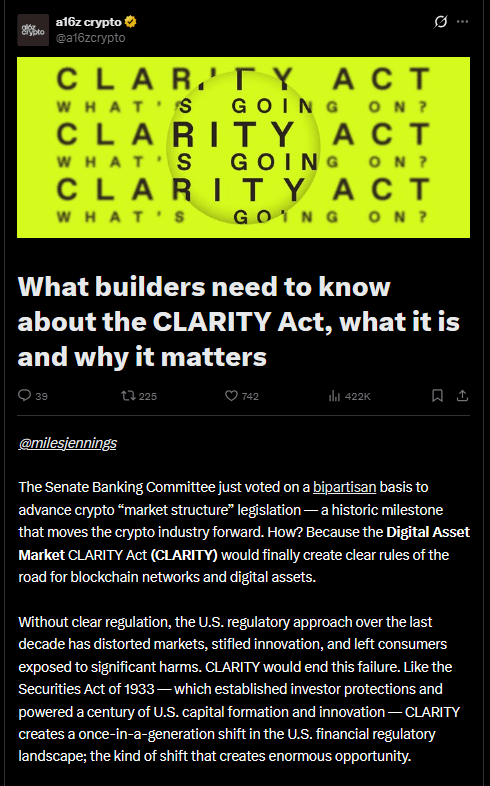
Venture capital firm a16z crypto argued Friday that the implications of the bill go well beyond the crypto sector. According to the firm, giving builders in the US a clear legal framework would drive wider domestic innovation.

BTCUSD now trading at $78,417. Chart: TradingView

It cited the GENIUS Act’s passage as a precedent, saying that legislation produced strong growth and adoption that it described as beneficial not just for the US economy but for the long-term position of the US dollar globally.

The US dollar index, which measures the dollar’s strength against a basket of major currencies, stood at 99.26 at the time of publication, up 1.25% over the prior 30 days, according to TradingView data.

Image: IQ.wiki

Global Signal

Sharplink Gaming CEO Joseph Chalom added another dimension to the conversation, saying the bill is being watched far beyond US borders.

While many see the legislation as a domestic matter, Chalom said other countries are treating it as a signal for how they might approach their own crypto regulations.

A16z framed the broader stakes plainly: when US legal frameworks balance innovation with consumer protection, the country tends to lead and the rest of the world follows.

Whether the Senate delivers that framework is now a question of vote counting.

Featured image from MadebyBaurley, chart from TradingView

Связанные с этим вопросы

QWhat is the main obstacle for the CLARITY Act to become law according to Grayscale?

ABipartisan support remains the main obstacle for the CLARITY Act to become law.

QHow did the US Senate Banking Committee vote on the CLARITY Act, and what was the party-line split?

AThe CLARITY Act advanced out of the US Senate Banking Committee with all 13 Republican members voting in favor, joined by two Democrats, while nine Democrats voted against it.

QWhat precedent does a16z crypto cite to argue for the potential benefits of the CLARITY Act?

Aa16z crypto cites the passage of the GENIUS Act as a precedent, saying it produced strong growth and adoption beneficial for the US economy and the long-term global position of the US dollar.

QAccording to Sharplink Gaming CEO Joseph Chalom, how are other countries viewing the CLARITY Act?

AJoseph Chalom said that other countries are treating the CLARITY Act as a signal for how they might approach their own crypto regulations, watching it far beyond US borders.

QWhat does a16z crypto argue is the broader implication of passing the CLARITY Act for US innovation?

Aa16z crypto argues that giving builders in the US a clear legal framework through the CLARITY Act would drive wider domestic innovation.

Похожее

Claude Code Introduces Dynamic Workflows: Enabling AI to Form Teams and Collaborate

Claude Code introduces dynamic workflows, enabling AI to coordinate teams of specialized agents for complex tasks. This transforms Claude from a code assistant into a programmable workbench. Workflows address key limitations of single-agent systems: agentic laziness (premature task completion), self-preferential bias (favoring own outputs), and goal drift (losing sight of original objectives). The system allows Claude to dynamically create execution frameworks using JavaScript. It can split tasks, dispatch parallel agents for isolated work (e.g., in separate worktrees), implement adversarial validation, run tournaments, and synthesize results. This multi-agent approach is valuable for tasks requiring deep research, factual verification, code migration, root cause analysis, large-scale triage, and qualitative sorting. Key patterns include: classify-and-route, fan-out-and-synthesize, adversarial verification, generate-and-filter, tournaments, and loop-until-done. While token usage is higher, workflows excel where tasks resemble programming—needing problem decomposition, isolated context, hypothesis testing, and handling many details. They extend Claude Code's utility beyond technical work to areas like business plan review, resume screening, and naming brainstorm. The feature is not a universal solution but points to a future where AI tool competitiveness depends on organizing reliable, reusable, and auditable execution flows for complex goals.

marsbit2 мин. назад

Claude Code Introduces Dynamic Workflows: Enabling AI to Form Teams and Collaborate

marsbit2 мин. назад

Hyperliquid, Wall Street's 24/7 Trading Convenience Store

Hyperliquid: The 24/7 Trading "Convenience Store" for Wall Street Hyperliquid, a decentralized cryptocurrency exchange, has become a go-to platform for Wall Street traders seeking to trade around the clock, especially during traditional market closures. Founded by Jeff Yan, a former quantitative trader, after the FTX collapse, the platform emphasizes user self-custody of assets. It offers a wide range of perpetual contracts—leveraged derivatives with no expiry—on assets from Bitcoin and crude oil to the S&P 500 and even pre-IPO companies like SpaceX. A notable example involves a hedge fund trader who capitalized on geopolitical news over a weekend, securing a 243% return on oil derivatives before markets reopened. The platform, run by just 11 employees, generated approximately $800 million in revenue last year, and its native token HYPE has seen significant growth. Its rise highlights the merging of traditional finance and crypto. While U.S. users are currently restricted, recent CFTC rule changes could open access. The platform is known for its transparency, having processed $10 billion in liquidations during a market crash while competitors faltered. Regulators warn of the high risks and complexity of perpetual contracts for retail investors. Key to its appeal is a strong community culture, direct engagement with founders, and a simple interface. Despite rules against VPN use, it attracts global users with its permissionless approach. Hyperliquid plans to expand into prediction markets and options, aiming to eventually host all financial activity.

marsbit2 мин. назад

Hyperliquid, Wall Street's 24/7 Trading Convenience Store

marsbit2 мин. назад

Who Funds the Agents?

**Summary: Who Funds AI Agents?** OpenAI recently shut down a feature allowing AI agents to shop for users, highlighting the challenge of creating a secure and regulated environment for agent-driven transactions. While payment infrastructure exists, a crucial governance layer—defining spending limits, fraud detection, tax handling, and return policies—is largely missing. The potential is enormous: AI agents already processed $73M across 176M transactions last year, with McKinsey forecasting this could grow to $3-5T in global consumer commerce by 2030. The core competition isn't just about processing payments, which can be very cheap (especially with crypto-based settlement), but about controlling the rules that govern agent spending. Key players like Stripe and Coinbase are racing to dominate this governance layer. Stripe's acquisition of wallet provider Privy allows it to set spending policies, identity checks, and human-in-the-loop approvals directly at the wallet level. Similarly, Coinbase's stack, including its x402 protocol and AgentKit, embeds governance rules. This vertical integration across settlement, wallet, and governance layers is becoming the dominant strategy. Control over the governance layer is where significant future value lies. If agents handle trillions in transactions, even a small fee for managing compliance, fraud prevention, and policy enforcement could generate billions in annual revenue. The companies that successfully integrate across the payment stack will capture value from idle agent balances, transaction fees, and governance services, positioning themselves as the foundational banks of the AI agent economy.

marsbit30 мин. назад

Who Funds the Agents?

marsbit30 мин. назад

Торговля

Спот
Фьючерсы
活动图片