Circle's Pullback: Still Worth Buying?

marsbitОпубликовано 2026-04-04Обновлено 2026-04-04

Введение

Circle: Still Worth Buying After the Pullback? Circle, the issuer of the second-largest stablecoin USDC, is at a critical juncture. Its current valuation of $15-20B primarily reflects its interest income from $770B in USDC reserves. However, data suggests a potential transformation into a fee-based digital dollar infrastructure network. Key evidence for this shift includes: * USDC's on-chain transaction volume grew 247% in FY2025, far outpacing its 72% circulation growth, indicating it's being *used* more, not just held. * Adjusted for on-chain noise, USDC dominates real economic settlement volume (64% per Visa data), despite USDT having 2.4x its market cap. Circle's three-layer revenue structure is evolving: 1. **Interest Income (95% of current revenue):** Tied to USDC circulation and interest rates. Faces headwinds from potential Fed cuts and a revenue-sharing agreement with Coinbase. 2. **Payment & Transaction Fees:** The key to becoming an infrastructure play. The Circle Payments Network (CPN) is scaling rapidly ($5.7B annualized TPV), and non-interest revenue surged to $37M/quarter. 3. **Settlement Platform (Arc):** A long-term bet on becoming an institutional settlement standard, though its value remains unproven. Near-term catalysts include the Coinbase revenue-sharing agreement renewal (Aug 2026) and potential full OCC bank charter approval. A 3-5x return is plausible if USDC circulation grows at 40% CAGR. A 10x return requires multiple successes: CPN scal...

Author: Leo Z

I. What is Circle

Circle is the issuer of USDC. USDC is the world's second-largest stablecoin, with a circulation of approximately $770 billion. Each USDC is backed by an equivalent amount of US dollar assets (primarily short-term US Treasury bonds) as reserves.

Circle's revenue source is simple: it invests these reserves in US Treasury bonds to earn an interest spread. FY2025 total revenue was $2.75 billion, with 95% coming from reserve interest. It went public in June 2025, with a current market capitalization of approximately $150-200 billion.

The market's pricing of Circle is essentially equal to "USDC circulation × interest rate × a conservative multiple." This means: if you believe Circle is merely a company that earns interest, the current pricing is roughly fair. If you believe it is transforming into a fee-based digital dollar infrastructure network, then the current price does not reflect this value at all.

This article aims to answer: Is this transformation happening? How much evidence is there? What is it worth?

II. Core Question: Is USDC Being "Held" or "Used"?

Before discussing valuation, answer a question more important than any financial model.

For the same $770 billion USDC, if it is just held by institutions to earn interest spread, then Circle is an interest rate-sensitive financial company, valued at 10-15x. If it is being frequently used for payments, settlements, cross-border transfers, and developer calls, then Circle is growing into a fee-based infrastructure network, valued at 25-30x.

Two key data points can help you judge:

First, the growth rate of USDC's on-chain transaction volume far exceeds its circulation growth rate. In FY2025, USDC circulation grew by 72%, but on-chain transaction volume grew by 247%. This means each USDC dollar is being used more frequently. This is not "the stock is getting larger," but "the flow velocity is increasing."

Second, USDC has surpassed USDT to become the largest settlement asset. Visa Onchain Analytics filters out approximately 85% of on-chain noise (bots, internal exchange transfers, high-frequency arbitrage). After this adjustment, USDC accounts for 64% of real economic settlement volume (Mizuho, February 2026), while USDT accounts for only about 28%—even though USDT's circulation is 2.4 times that of USDC.

This gap itself is the strongest signal: USDC is transitioning from an "asset people hold" to a "network people use." But this transition is not yet complete—later we will discuss the conditions needed for it to be confirmed.

III. Three-Tier Revenue Structure

Circle's revenue is divided into three tiers. The market is almost only pricing the first tier.

Tier 1: USDC Interest Income—How Circle Makes Money Today

USDC is Circle's starting point and the source of 95% of its current revenue. As of the end of 2025, USDC circulation was $753 billion, a year-on-year increase of 72%, far exceeding Circle's own annualized growth target of 40%.

The revenue logic is simple: approximately 80% of USDC reserves are invested in short-term US Treasury bonds (via the BlackRock-managed USDXX fund), earning an interest spread.

Interest Income ≈ Average USDC Circulation × Reserve Yield

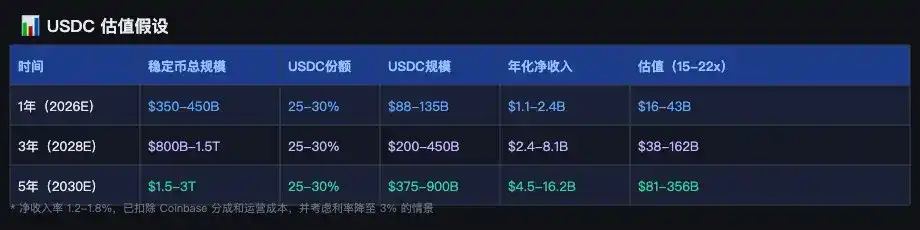
The reserve yield in Q4 2025 was 3.81%, down 68 basis points from the previous quarter. This exposes the core contradiction: circulation is growing rapidly, but interest rates are falling, and the two are offsetting each other. If the Fed's target rate drops to 3%, Circle would need USDC to grow to over $1.5 trillion to maintain its current income level.

Structural issue: Coinbase takes most of the revenue. According to the revenue-sharing agreement signed in 2023, 100% of the interest on USDC on the Coinbase platform goes to Coinbase, and Coinbase takes 50% of the interest off-platform. In FY2025, for every $1 of interest Circle earned, about 60 cents was given to distribution partners.

The good news is that margins are improving. The RLDC (Revenue Less Distribution Costs) margin expanded from 30.0% in Q4 2024 to 40.1% in Q4 2025. The net income rate is 1.2-1.8%, after deducting Coinbase's share and operating costs.
Tier 2: Payment & Transaction Revenue—The New Business in Development

This is the key to determining whether Circle can shed the "interest rate company" label.

CPN (Circle Payments Network) launched in May 2025, providing banks, payment companies, and enterprises with 24/7 cross-border settlement based on USDC. As of February 2026, the annualized TPV reached $5.7 billion, growing about 100-fold since launch. 55 institutions are connected, 74 are under review, and 500+ are in the pipeline. It covers 14 markets including Brazil, Canada, Hong Kong, India, Mexico, Nigeria, and the US.

But $5.7 billion compared to the global cross-border payment market of $160 trillion is still less than 0.04%. The value of CPN lies not in its current scale but in whether its growth can be sustained. If it captures 1% of the cross-border market, that would be $1.6 trillion in annualized transaction volume—the fees generated could approach or even exceed interest income and are not affected by interest rates.

CCTP (Cross-Chain Transfer Protocol) enables native cross-chain transfer of USDC through "burn-mint." It processed $41.3 billion in Q4 2025, a year-on-year increase of 3.7 times. USDC's cross-chain market share rose from 25% at the end of 2024 to 62% in January 2026, covering 30 chains. CCTP V2 introduced Fast Transfer fees—a new revenue source.

Other Revenue (non-interest income) is the most direct "evidence of transformation." In FY2025, it surged from $3 million per quarter to $37 million per quarter, including $24.7 million from subscription services, $12.2 million from transaction revenue, and $7 million from Canton Network validator node revenue. Management guidance for 2026 is $150-170 million.

This revenue is not affected by interest rates and does not require sharing with Coinbase. When it exceeds 10% of total revenue, the market may start to view Circle with a different valuation method. Currently, it is about 4%.

Tier 3: Settlement Platform—Long-Term Possibility

Arc is an institutional-grade settlement chain planned by Circle to launch its mainnet in 2026, with USDC as the native gas token. The testnet has already processed over 166 million transactions, with a confirmation time of 0.5 seconds, and 100+ institutions participating (including Goldman Sachs and Mastercard).

Arc's roadmap is divided into four phases:

M1 Public Testnet (completed) → M2 Real Funds On-Chain (2026) → M3 Margin/Collateral/Settlement Scenarios Live (2027-28) → M4 Integrated into Institutional Standard Operating Procedures (2029-30)

Before M2, Arc's value is zero. But if it eventually becomes the institutional settlement standard, Circle's value will no longer be that of a "fee company" but a "platform company." This is a necessary condition for 10x+ returns.

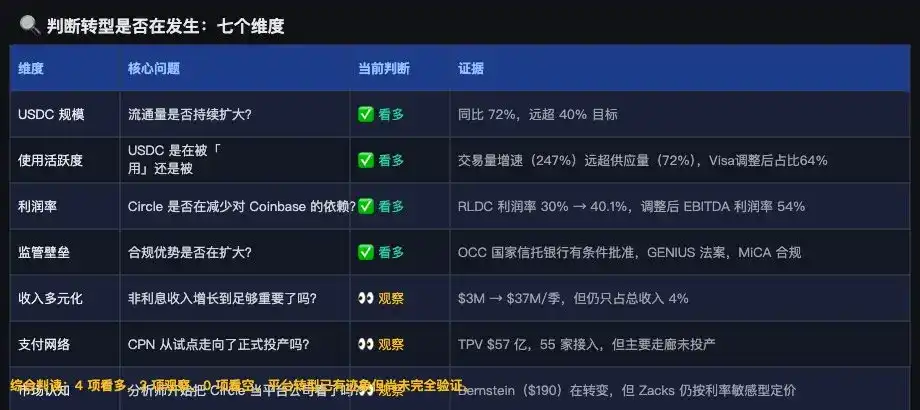
IV. Judging Whether the Transformation Is Happening: Seven Dimensions

Looking at any single indicator can be misleading. The key is to see if multiple dimensions are improving simultaneously—when scale, activity, margins, new revenue, and user growth all point in the same direction, the transformation is happening.
V. Three Most Important Tracking Metrics

1 USDC Circulation (Check Daily)

The base of Circle's income. Circulation × Reserve Yield = Interest Income. Track "Quarterly Average Circulation" rather than the end-of-period snapshot. Currently about $770 billion.

Data Sources: defillama.com/stablecoin/usd-coin (updated daily), circle.com/transparency (weekly reserve attestation)

2 USDC's Share of Visa-Adjusted Transaction Volume (Check Weekly)

Answers the core question: Is USDC being used or held? Supply is only 25%, but adjusted transaction volume is 64%—each USDC dollar does 2-3 times more work than a USDT dollar.

Data Source: visaonchainanalytics.com → Filter by Stablecoin → Click "Show % of Total" → Read the USDC line

3 Other Revenue, Non-Interest Income (Check Quarterly)

The only indicator that directly proves Circle is making money beyond interest. Not affected by interest rates, no sharing with Coinbase. Currently $37 million/quarter, guidance $150-170 million (2026). Valuation methods will change when it breaks through 10% of total revenue.

Data Sources: circle.com/pressroom (quarterly earnings reports), SEC EDGAR search for Circle Internet Group

VI. Near-Term Catalysts

Coinbase Revenue-Sharing Agreement Expiration (August 2026)

This is the single biggest catalyst within 24 months. Currently, Circle gives about 60% of its revenue to distribution partners. If renegotiation raises the RLDC margin from 40% to 50-55%, the effect would be equivalent to an instant 25-35% increase in profit. But Coinbase has little incentive to concede significantly—USDC distribution on the Coinbase platform remains Circle's biggest growth engine. The outcome is uncertain, but the direction is likely better than the status quo.

OCC National Trust Bank Charter

Conditionally approved in December 2025. Full approval would mean:可以直接在美联储开主账户 (earn IORB rate, eliminate counterparty risk), bypass commercial banks to handle the annual $483 billion mint/redemption flow, and build an insurmountable trust barrier for corporate and government adoption of USDC. No other stablecoin issuer has this.

x402 Foundation (Established April 2026)

Coinbase contributed the x402 payment protocol to the Linux Foundation. x402 activates the HTTP 402 status code as an internet-native payment layer, enabling AI agents, APIs, and applications to settle directly within HTTP interactions—using USDC by default.

Participants: Google, AWS, Stripe, Visa, Mastercard, Amex, Shopify, Microsoft, Cloudflare, Circle. If x402 becomes the standard for AI agent payments, every machine-to-machine microtransaction would increase USDC's usage (velocity) without needing to increase holdings (supply).

Note: x402 is led by Coinbase, not Circle. Impact on CRCL: mildly bullish, expands USDC's use cases but does not change the magnitude of the fundamentals.

VII. Conditions for 5-10x Returns

3-5x (High Confidence)—Purely from USDC Growth

USDC at a 40% CAGR reaches approximately $2-3 trillion by 2028. Even if rates drop to 3%, $2.5T × 1.5% net spread = $37.5 billion net income. At 20x, market cap is $750 billion. From the current $150-200 billion to $750 billion is about 4x. Requires no contribution from CPN or Arc.

10x (Requires Multiple Conditions to Materialize Simultaneously)

From $15-20B to $150-200B, must happen simultaneously:

1. CPN TPV breaks through $100 billion in 2-3 years, with at least one major corridor entering full production.

2. Coinbase revenue-sharing agreement improves, RLDC margin reaches 50%+.

3. Other Revenue exceeds 10% of total revenue, proving scalable non-interest income.

4. Arc reaches at least the M2 stage (real funds on-chain), starts being priced by the market.

Currently, only the second condition (margin) is clearly improving. A 10x return is a position you "earn," not one you "gamble" on.

VIII. Main Risks

Interest Rates Fall Faster Than USDC Grows

Q4 2025 already showed this signal: rates fell 68bps, partially offsetting 100% circulation growth. If the Fed drops to 2.5-3% in 2026-2027, there could be a window of 1-2 quarters of earnings below expectations.

Tether's Compliance

USDC's biggest differentiating advantage is compliance. But Tether earned $10 billion in the first three quarters of 2025 and is in talks with the Big Four accounting firms for a full audit. If Tether gains compliant status within 2-3 years, USDC's differentiated advantage could be significantly weakened. USDT currently has over 60% market share and a market cap of $1.83 trillion—it has ample resources.

Competition from New Yield-Bearing Stablecoins & Payment Giants Like Stripe

Ethena (USDe), Sky, and other new stablecoins are grabbing market share by paying yields directly to holders. Circle, bound by its regulatory compliance position, currently cannot pay interest directly to USDC holders.

Stripe is a founding member of the x402 Foundation and is also building its own stablecoin payment system. Stripe's strategy is to integrate all potential winning standards—its involvement does not represent exclusive support for USDC, nor does it preclude Stripe from launching its own stablecoin or deeply integrating USDT in the future.

IX. Conclusion

Circle is not a company that "will definitely become a trillion-dollar" company. But it might be one of the few fintech companies today that has the structural conditions to potentially reach that ceiling.
Current pricing almost only reflects USDC interest income. The market is asking: Is Circle an interest rate-driven financial company, or a fee-based digital dollar infrastructure? The answer is not yet certain—but the data is leaning towards the latter.

The core things to track are three: Is USDC circulation growing? Is each USDC dollar being used more frequently? Is non-interest income increasing? When all three improve simultaneously, the transformation is happening.

Data Sources: Circle IR, SEC EDGAR, DefiLlama, Visa Onchain Analytics, Artemis Terminal, CoinDesk, Mizuho Research

Disclaimer: This article does not constitute investment advice. All data is as of April 2026.

Связанные с этим вопросы

QWhat is the core business model of Circle and its primary source of revenue?

ACircle is the issuer of USDC, the world's second-largest stablecoin. Its core business model involves investing the dollar-denominated reserves backing USDC (primarily in short-term U.S. Treasuries) and earning the interest spread. For FY2025, approximately 95% of its total revenue of $2.75 billion came from this reserve interest income.

QWhat are the two key data points that suggest USDC is transitioning from an asset being 'held' to being 'used'?

AThe two key data points are: 1) USDC's on-chain transaction volume grew 247% in FY2025, significantly outpacing its 72% circulation growth, indicating each dollar is being used more frequently. 2) Adjusted data from Visa Onchain Analytics shows USDC accounts for 64% of real economic settlement volume, despite having a circulation only about 40% the size of USDT's, demonstrating it is the dominant asset for actual economic activity.

QWhat are the three layers of Circle's revenue structure as described in the article?

ACircle's three-layer revenue structure consists of: 1) USDC Interest Income: The primary current revenue from reserve investments. 2) Payment & Transaction Revenue: Income from new services like the Circle Payments Network (CPN) and the Cross-Chain Transfer Protocol (CCTP). 3) Settlement Platform: The potential long-term revenue from Arc, an institutional-grade settlement chain with USDC as its native gas token, which is not yet operational with real funds.

QWhat is identified as the single biggest catalyst for Circle within the next 24 months?

AThe expiration of the revenue-sharing agreement with Coinbase in August 2026 is identified as the single biggest catalyst. Currently, Circle shares approximately 60% of its interest revenue with partners like Coinbase. A renegotiation that improves Circle's Revenue Less Distribution Costs (RLDC) margin could significantly boost its profitability.

QAccording to the article, what conditions are necessary for Circle to achieve a potential 10x return on investment?

AA 10x return requires multiple conditions to be met simultaneously: 1) Circle Payments Network (CPN) TPV exceeding $100 billion within 2-3 years. 2) An improved Coinbase revenue-sharing agreement, raising RLDC margins to 50%+. 3) Non-interest revenue ('Other Revenue') exceeding 10% of total revenue. 4) The Arc settlement platform progressing to at least its M2 stage (real funds on-chain), allowing the market to begin pricing in its value.

Похожее

An Open-Source AI Tool That No One Saw Predicted Kelp DAO's $292 Million Vulnerability 12 Days Ago

An open-source AI security tool flagged critical risks in Kelp DAO’s cross-chain architecture 12 days before a $292 million exploit on April 18, 2026—the largest DeFi incident of the year. The vulnerability was not in the smart contracts but in the configuration of LayerZero’s cross-chain bridge: a 1-of-1 Decentralized Verifier Network (DVN) setup allowed an attacker to forge cross-chain messages with a single compromised node. The tool, which performs AI-assisted architectural risk assessments using public data, identified several unremediated risks, including opaque DVN configuration, single-point-of-failure across 16 chains, unverified cross-chain governance controls, and similarities to historical bridge attacks like Ronin and Harmony. It also noted the absence of an insurance pool, which amplified losses as Aave and other protocols absorbed nearly $300M in bad debt. The attack unfolded over 46 minutes: the attacker minted 116,500 rsETH on Ethereum via a fraudulent message, used it as collateral to borrow WETH on lending platforms, and laundered funds through Tornado Cash. While an emergency pause prevented two subsequent attacks worth ~$200M, the damage was severe. The tool’s report, committed to GitHub on April 6, scored Kelp DAO a medium-risk 72/100—later acknowledged as too lenient. It failed to query on-chain DVN configurations or initiate private disclosure, highlighting gaps in current DeFi security approaches that focus on code audits but miss config-level and governance risks. The incident underscores the need for independent, AI-powered risk assessment tools that evaluate protocol architecture, not just code.

marsbit59 мин. назад

An Open-Source AI Tool That No One Saw Predicted Kelp DAO's $292 Million Vulnerability 12 Days Ago

marsbit59 мин. назад

Торговля

Спот
Фьючерсы

Популярные статьи

Как купить USDC

Добро пожаловать на HTX.com! Мы сделали приобретение USD Coin (USDC) простым и удобным. Следуйте нашему пошаговому руководству и отправляйтесь в свое крипто-путешествие.Шаг 1: Создайте аккаунт на HTXИспользуйте свой адрес электронной почты или номер телефона, чтобы зарегистрироваться и бесплатно создать аккаунт на HTX. Пройдите удобную регистрацию и откройте для себя весь функционал.Создать аккаунтШаг 2: Перейдите в Купить криптовалюту и выберите свой способ оплатыКредитная/Дебетовая Карта: Используйте свою карту Visa или Mastercard для мгновенной покупки USD Coin (USDC).Баланс: Используйте средства с баланса вашего аккаунта HTX для простой торговли.Третьи Лица: Мы добавили популярные способы оплаты, такие как Google Pay и Apple Pay, для повышения удобства.P2P: Торгуйте напрямую с другими пользователями на HTX.Внебиржевая Торговля (OTC): Мы предлагаем индивидуальные услуги и конкурентоспособные обменные курсы для трейдеров.Шаг 3: Хранение USD Coin (USDC)После приобретения вами USD Coin (USDC) храните их в своем аккаунте на HTX. В качестве альтернативы вы можете отправить их куда-либо с помощью перевода в блокчейне или использовать для торговли с другими криптовалютами.Шаг 4: Торговля USD Coin (USDC)С легкостью торгуйте USD Coin (USDC) на спотовом рынке HTX. Просто зайдите в свой аккаунт, выберите торговую пару, совершайте сделки и следите за ними в режиме реального времени. Мы предлагаем удобный интерфейс как для начинающих, так и для опытных трейдеров.

837 просмотров всегоОпубликовано 2024.04.18Обновлено 2025.06.06

Как купить USDC

Что такое $USDC

Классический USDC: Полный обзор Введение в Классический USDC В быстро развивающемся мире рынка криптовалют стейблкоины стали важной частью, особенно в обеспечении стабильности на фоне волатильности, которая характеризует цифровые активы. Один из таких проектов - Классический USDC, инициатива цифровой валюты, которая нацелена на предоставление стабильного и надежного средства обмена. Поддерживая привязку 1:1 к доллару США, Классический USDC стремится предложить пользователям надежный цифровой актив, пригодный для различных применений в экосистемах web3 и криптовалют. Что такое Классический USDC? Классический USDC по своей сути является стейблкоином, который представляет собой тип криптовалюты, предназначенной для минимизации ценовой волатильности, обычно наблюдаемой на рынке цифровых активов. В частности, Классический USDC стремится близко отражать стоимость доллара США, обеспечивая пользователям возможность использовать эту цифровую валюту для транзакций, сбережений и других финансовых операций без страха перед внезапными колебаниями цен, которые могут беспокоить многие криптовалюты. Основная цель Классического USDC - предоставить надежный и доверенный цифровой аналог доллара США, разработанный для бесшовной интеграции в широкий спектр приложений web3, платформ децентрализованных финансов (DeFi) и других финансовых систем, связанных с криптовалютой. Создавая стабильную цифровую валюту, Классический USDC стремится облегчить повседневную торговлю, сделать технологии блокчейна более удобными для пользователей и способствовать принятию криптовалют для массового использования. Создатель Классического USDC Личность создателя или команды разработчиков Классического USDC остается в значительной степени неизвестной, и отсутствие прозрачности создало определенную степень неопределенности относительно происхождения проекта. В то время как многие криптовалютные инициативы открыто представляют своих основателей и команды разработчиков, Классический USDC не предоставляет четкой информации о своих создателях, что ставит под угрозу доверие потенциальных пользователей или инвесторов, оценивающих надежность и состоятельность проекта. Инвесторы Классического USDC Помимо неопределенности относительно его создателей, Классический USDC также не имеет конкретной информации о своих инвесторах. Финансовая поддержка проекта может часто придавать ему авторитет и стабилизировать его операционную деятельность; однако отсутствие задокументированных инвестиционных фондов или организаций, поддерживающих Классический USDC, вызывает вопросы о его структуре финансирования. Эта неопределенность может потенциально подорвать доверие заинтересованных сторон к проекту. Как работает Классический USDC? Операционные механизмы Классического USDC во многом зависят от его резервной системы, которая является основополагающей для любого стейблкоина. Классический USDC обязуется поддерживать резерв активов, который напрямую соответствует стоимости цифровой валюты в обращении. В частности, за каждые выпущенные токены Классического USDC сохраняется эквивалентная сумма резервных активов, будь то наличные или эквиваленты близкие к наличным. Эта стратегия нацелена на поддержание стоимости Классического USDC, предлагая пользователям уверенность в том, что они могут в любой момент обменять свои токены на доллары США. Эта резервная структура направлена на повышение стабильности и надежности Классического USDC, позиционируя его как безопасную альтернативу на рынке криптовалют. Обеспечивая постоянную корреляцию стоимости Классического USDC с долларом США, проект стремится вызывать доверие среди пользователей, которые могут быть насторожены по поводу более широких рыночных динамик. Хронология Классического USDC История Классического USDC отмечена несколькими ключевыми вехами, отражающими его путешествие и эволюцию в экосистеме криптовалют: 2021: Отмечено начало Классического USDC, введение нового варианта цифровой валюты, разработанного для стабильности. В этом году появились первые записи о деятельности токена, и были установлены его первоначальные уровни цен. 2024: Классический USDC начинает испытывать значительные колебания цен, поскольку крипторынок в целом сталкивается с различными тенденциями и настроениями пользователей. Появляются прогнозы относительно его будущего потенциала, указывающие на сильный интерес со стороны наблюдателей и аналитиков рынка, которые предвидят возможности для роста. Будущие прогнозы Эксперты предполагают, что Классический USDC может достичь более высоких уровней принятия и стабильности в ближайшие годы, с потенциальными дальнейшими разработками, ожидаемыми около 2025 и 2026 года. Однако к этим прогнозам следует подходить с осторожным оптимизмом, поскольку рынок криптовалют по своей природе непредсказуем, и различные внешние факторы могут повлиять на траекторию Классического USDC. Ключевые моменты о Классическом USDC Стабильность: Основное предложение Классического USDC заключается в предоставлении цифровой валюты, параллельной стоимости доллара США, тем самым обеспечивая стабильность на часто волатильном рынке. Резервная система: Обязательство проекта поддерживать резерв активов для обеспечения своей стоимости подчеркивает его надежность и операционную устойчивость. Интеграция в Web3 и крипто: Классический USDC разработан для облегчения интеграции в различные приложения, стремясь улучшить пользовательский опыт и расширить принятие криптовалюты в повседневных транзакциях. Потенциал будущего роста: Несмотря на то что он еще только начинает, Классический USDC имеет перспективные направления для роста по мере увеличения осведомленности и использования стейблкоинов в контексте web3 и криптовалют. Заключение Классический USDC представляет собой заметную инициативу стейблкоина в сфере криптовалют, стремясь предоставить пользователям надежную цифровую валюту, которая воплощает стабильность доллара США. Несмотря на неопределенности относительно его создателей и финансовой поддержки, основополагающие принципы Классического USDC - сосредотачивающиеся на обеспеченных резервами гарантиях - стремятся позиционировать его как надежный вариант для индивидуумов и бизнеса, ориентированных на цифровую экономику. С учетом будущего, аналитики рынка с нетерпением ожидают, как Классический USDC будет эволюционировать в ответ на изменяющуюся динамику рынка криптовалют, потенциально устанавливая себя в качестве значительного игрока в области стейблкоинов.

57 просмотров всегоОпубликовано 2024.05.01Обновлено 2024.12.03

Что такое $USDC

HTX Learn: Изучите "Layer3" и Разделите 6000 USDC

Участники, которые изучат обучающий курс и пройдут тест, получат шанс выиграть потрясающие призы.

3.1k просмотров всегоОпубликовано 2024.12.11Обновлено 2024.12.12

HTX Learn: Изучите "Layer3" и Разделите 6000 USDC

Обсуждения

Добро пожаловать в Сообщество HTX. Здесь вы сможете быть в курсе последних новостей о развитии платформы и получить доступ к профессиональной аналитической информации о рынке. Мнения пользователей о цене на USDC (USDC) представлены ниже.

活动图片