BTC Market Pulse: Week 50

insights.glassnodeОпубликовано 2025-12-08Обновлено 2025-12-08

Введение

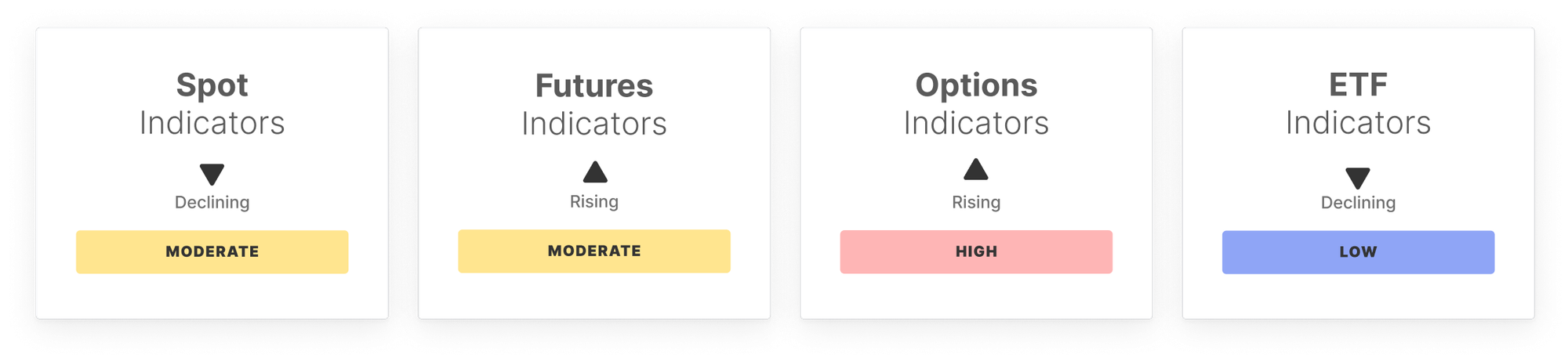
BTC's market pulse showed mixed signals in Week 50. Momentum strengthened as the 14-day RSI rose to 58.2 and spot volume increased 13.2% to $11.1B. However, Spot CVD weakened significantly, indicating stronger underlying sell pressure. Derivatives remained cautious with lower futures open interest and mixed options sentiment, including a high demand for downside protection. ETF flows turned negative, shifting from a $134.2M inflow to a $707.3M outflow, suggesting profit-taking or reduced institutional interest. Despite this, ETF trade volume rose 21.33% and ETF MVRV increased, pointing to higher holder profitability and potential distribution.

Momentum firmed as the 14-day RSI climbed from 38.6 to 58.2, while spot volume rose 13.2 percent to $11.1B. However, Spot CVD weakened from -$40.8M to -$111.7M, pointing to stronger underlying sell pressure.

Derivatives remained cautious. Futures open interest fell to $30.6B, perpetual CVD improved slightly, and funding turned more supportive with long-side payments up to $522.7K. Options showed mixed sentiment: steady OI at $46.3B, a sharply negative volatility spread at -14.6 percent, and a high 25-delta skew at 12.88 percent, indicating demand for downside protection.

ETF flows added a clear headwind. Netflows flipped from a $134.2M inflow to a $707.3M outflow, signalling profit-taking or softer institutional interest. Yet ETF trade volume rose 21.33 percent to $22.6B, and ETF MVRV increased to 1.67, pointing to higher holder profitability and some potential for distribution..

Off-Chain Indicators
On-Chain Indicators
🔗 Access the full report in PDF

Don't miss it!

Smart market intelligence, straight to your inbox.

Subscribe now
  • Follow us and reach out on X
  • Join our Telegram channel
  • For on-chain metrics, dashboards, and alerts, visit Glassnode Studio

Disclaimer: This report does not provide any investment advice. All data is provided for information and educational purposes only. No investment decision shall be based on the information provided here and you are solely responsible for your own investment decisions.

Exchange balances presented are derived from Glassnode’s comprehensive database of address labels, which are amassed through both officially published exchange information and proprietary clustering algorithms. While we strive to ensure the utmost accuracy in representing exchange balances, it is important to note that these figures might not always encapsulate the entirety of an exchange’s reserves, particularly when exchanges refrain from disclosing their official addresses. We urge users to exercise caution and discretion when utilizing these metrics. Glassnode shall not be held responsible for any discrepancies or potential inaccuracies.

Please read our Transparency Notice when using exchange data.
Похожее

Farcaster Is Not a Pivot, It's Evolution: The True Ambition from Social to Wallet

Recently, Farcaster co-founder Dan Romero announced a shift in the project’s focus from "social-first" to "wallet-first," sparking widespread discussion. While some interpreted this as Farcaster abandoning social features or even signaling the failure of Web3 social networks, the move is better understood as a strategic evolution rather than a pivot. Farcaster’s integration of a built-in wallet is not a replacement for social functionality but an upgrade to improve user experience. It enables seamless on-chain interactions, especially as Frames evolve into more powerful Mini Apps. This enhancement allows users to mint NFTs, execute trades, and engage with decentralized applications without leaving the app—reducing friction and supporting richer crypto-native experiences. The shift reflects a broader trend: social apps are integrating wallets, and wallet apps are adding social features. This convergence is becoming the natural direction for consumer crypto applications. By combining social graphs with built-in wallets and Mini Apps, Farcaster enables closed-loop scenarios for asset creation, discovery, trading, and community interaction—all within a unified experience. Other platforms like Telegram, Zapper, Base App, and Binance are also exploring similar integrations, highlighting the growing importance of blending social context with financial activity. Farcaster’s open and composable social protocol allows developers to build diverse clients and applications, further expanding its ecosystem. In summary, Farcaster is not moving away from social—it is enhancing it. The integration of wallet functionality aims to drive growth, improve utility, and solidify its unique value proposition in the crypto space.

marsbit31 мин. назад

Farcaster Is Not a Pivot, It's Evolution: The True Ambition from Social to Wallet

marsbit31 мин. назад

Central Bank Names Bitcoin the Most Loss-Making Asset in November When Invested in Rubles

The Central Bank of Russia, in its latest "Financial Market Risks Review," identified Bitcoin as the worst-performing asset in November for ruble-denominated investments. The regulator included Bitcoin in its comparative table of asset returns, as it has done routinely. The list includes instruments from the Russian market, as well as gold, US government bonds, and other assets. In contrast to previous months, Russian stocks demonstrated the highest total returns in November. Although Bitcoin reached a new all-time high exceeding $126,000 on October 6th, this peak was not achieved against several currencies, including the euro, Swiss franc, and the Russian ruble. Against the ruble, the price remained below its December 2024 peak. According to the regulator's calculations, Bitcoin showed the worst returns in ruble terms for November (-19.9%), since the start of 2025 (-25.7%), and over the past 12 months (-31.9%). Notably, in reports prior to and including September 2025, Bitcoin was consistently among the top performers. However, since the beginning of 2022, Bitcoin remains the second-best performing asset after gold, having gained over 100% and significantly outperforming other assets. The report also provided data on Russian crypto investment activity. The volume of open positions held by individuals in cryptocurrency futures on the Moscow Exchange reached 3.5 billion rubles by the end of November. The majority of investors hold small positions, but the largest share of the volume comes from major participants. Additionally, thousands of investors have allocated funds to crypto CFAs and copy-trading strategies linked to crypto assets. Over 500 people participate in OTC crypto derivatives. The report also noted an 18% decline in the volume of transactions by Russians on foreign crypto exchanges in Q2 and Q3 2025 compared to the previous two quarters, alongside a decrease in estimated ruble balances on crypto exchanges and traffic to crypto platforms from Russia.

RBK-crypto55 мин. назад

Central Bank Names Bitcoin the Most Loss-Making Asset in November When Invested in Rubles

RBK-crypto55 мин. назад

Торговля

Спот
Фьючерсы
活动图片