Breaking: OpenAI Loses Key Figure, Father of Sora Departs, Turmoil Continues on the Eve of IPO

marsbitОпубликовано 2026-04-18Обновлено 2026-04-18

Введение

OpenAI is undergoing significant internal turmoil ahead of its planned IPO, marked by high-profile executive departures and strategic shifts. Key figures including Sora project lead Bill Peebles and Chief Product Officer Kevin Weil have announced their exits. The company is consolidating projects, discontinuing standalone products like the research tool Prism and integrating it into Codex, while also halting the video project Sora. Simultaneously, CEO Sam Altman faces renewed allegations of conflicts of interest. Reports reveal he attempted to have OpenAI invest in his personal ventures, such as nuclear fusion company Helion and space firm Stoke Space, raising internal concerns about transparency and governance. These moves come as OpenAI, valued at around $850 billion, shifts from rapid expansion to focusing resources on core priorities like enterprise products and AGI development, under pressure from competitors and the upcoming IPO.

Zhixiandao, April 18th report—Early this morning, OpenAI was hit with a series of changes including executive departures, project scaling back, and questions regarding personal conflicts of interest involving co-founder and CEO Sam Altman. This AI star company, sprinting towards an IPO, is once again facing a storm of personnel and trust issues.

On one hand, multiple executives including Sora core lead Bill Peebles and Chief Product Officer Kevin Weil have successively announced their departures, with projects like the video project Sora and the scientific research tool Prism heading towards shutdown, consolidation, or reorganization.

On the other hand, The Wall Street Journal reported that Sam Altman had previously attempted to push OpenAI to support his personally backed nuclear fusion and space projects. This move has also plunged the company, at the critical juncture of preparing for a listing with a valuation of approximately $850 billion (about RMB 5.8 trillion), into renewed questioning over conflicts of interest.

Sora Architect Departs

OpenAI's Video Division Loses Another Key Player

Early this morning, Sora project core lead Bill Peebles announced his departure on a social platform, sharing a photo of himself working alongside Sam Altman.
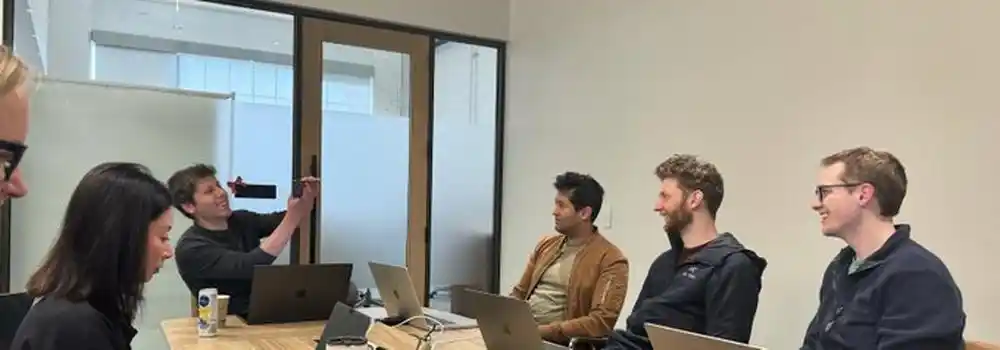
▲ Work photo of Bill Peebles (left 1) with Sam Altman (right 3) (Source: Bill Peebles)

In an open letter, Bill reviewed the development journey of Sora from scratch, calling the experience of building this project with the team the "most honorable and most like an adventure" of his career. He also thanked Sam Altman and others for fostering an inclusive research environment for the team, and stated outright that Sora "could almost certainly not have been born outside of OpenAI".
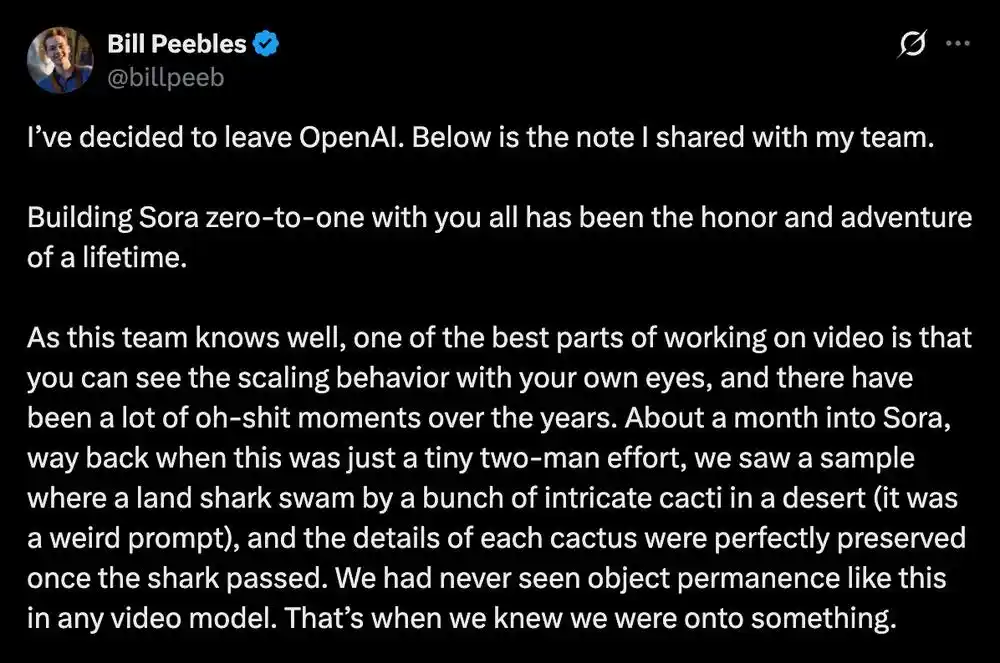
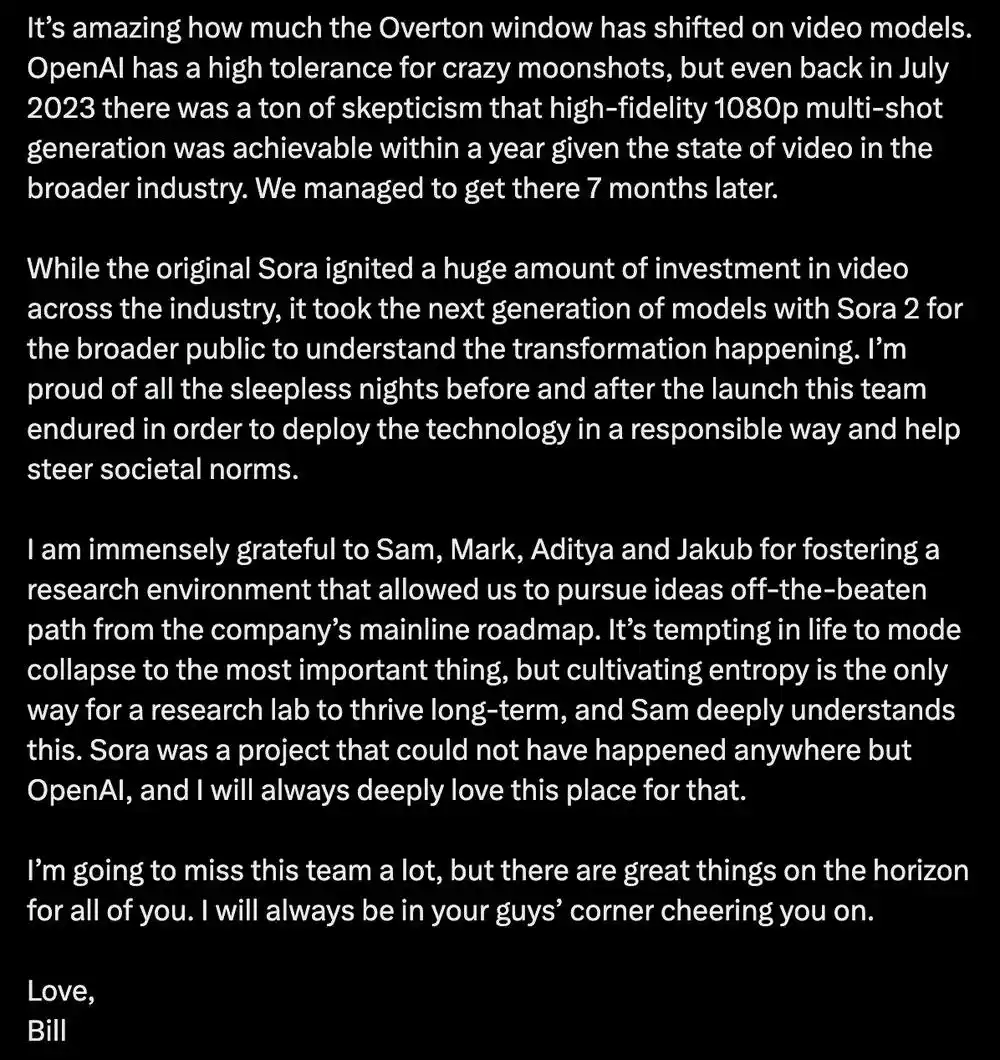
▲ Bill Peebles' resignation letter

Sam Altman later responded in the comments section, "Will miss Bill a lot", stating that his creativity pushed OpenAI and the entire industry to experience AI video in new ways, while also expressing anticipation for his next moves. Bill subsequently replied, "Thanks for everything".
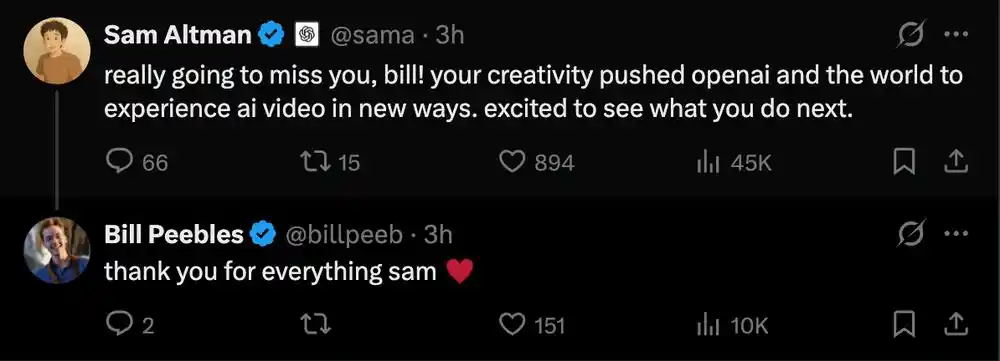
▲ Comments section interaction between Sam Altman and Bill Peebles

Chief Product Officer Departs Same Day

Prism Merged into Codex

On the same day, OpenAI Chief Product Officer, former Instagram executive Kevin Weil, also announced his departure.

He posted that with the "OpenAI for Science" initiative he led being dispersed into other research teams, today would be his last day at the company, emphasizing that accelerating scientific development would be one of the most positive outcomes on the path to AGI.
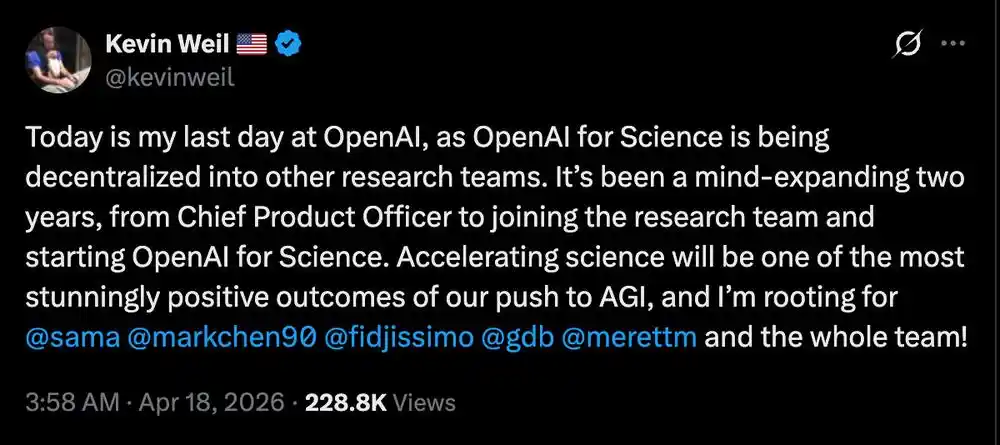
▲ Kevin Weil's resignation letter

ChatGPT product lead Nick Turley subsequently interacted in the thread, thanking Kevin Weil for his guidance and inspiration in building ChatGPT together. Kevin Weil replied that he also enjoyed the process of working together, joking "Keep making ChatGPT better, I'm a DAU (daily active user)".
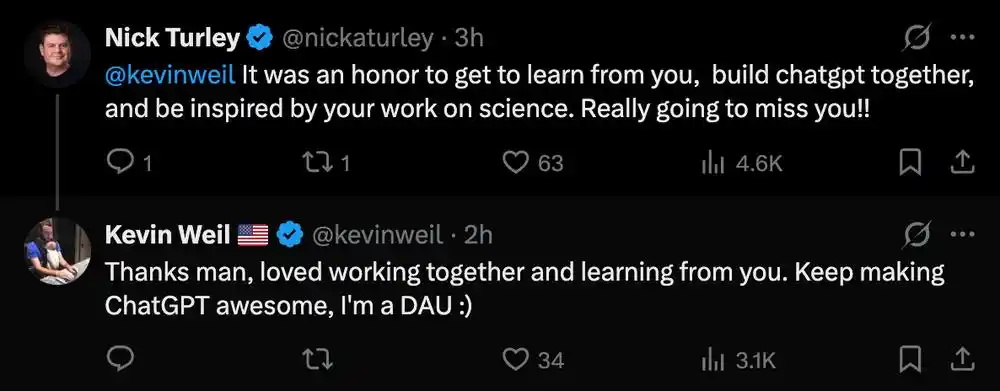
▲ Comments section interaction between Nick Turley and Kevin Weil

According to WIRED, behind Kevin Weil's departure, OpenAI is not just losing a former executive, but also undergoing a reorganization of its scientific application direction.

The report stated that OpenAI has decided to stop independently advancing Prism. Prism was a web application for researchers launched by OpenAI in January this year, originally attempting to provide scientists with AI tools better suited for scientific workflows.

Now, this product and its team of about 10 people will be merged under Thibault Sottiaux, head of Codex, with subsequent related capabilities to be integrated into the desktop version of the Codex application.

According to an OpenAI spokesperson, this change is part of the company's unified business and product strategy. More specifically, OpenAI hopes to further push Codex from a programming tool towards a "super app" direction, with Prism no longer existing as a separate product line.

Kevin Weil joined OpenAI in June 2024 and publicly announced the launch of the OpenAI for Science project in September of the same year. Now, less than two years later, the team members have been dispersed to various departments including product, research, and infrastructure.

Personnel Shake-up Extends Beyond Two

OpenAI is Accelerating Consolidation

The departure of these two individuals is only one aspect of a new round of internal contraction at OpenAI.

According to WIRED, in addition to Kevin Weil and Bill Peebles, OpenAI CTO of Enterprise Applications Srinivas Narayanan has also announced his departure, citing a desire to spend more time with family. Narayanan previously served as OpenAI's VP of Engineering and was an important executive for OpenAI's enterprise product direction.

This series of changes occurs amidst a "major reshuffle" of the executive team. Previously, AGI deployment lead Fidji Simo, who attempted to build a "super app", and Chief Marketing Officer Kate Rouch both took medical leave. President Greg Brockman temporarily took over product management, Chief Operating Officer Brad Lightcap moved to special projects, and the once industry-sensation Sora video application has currently been halted.

As Sam Altman admitted in a blog post published on April 10th, OpenAI is transitioning from "a chaotic but driven startup" to "a large platform that needs to operate in a more predictable way". He wrote that the company's development in recent years has been "extremely high-pressure, chaotic, and intense".
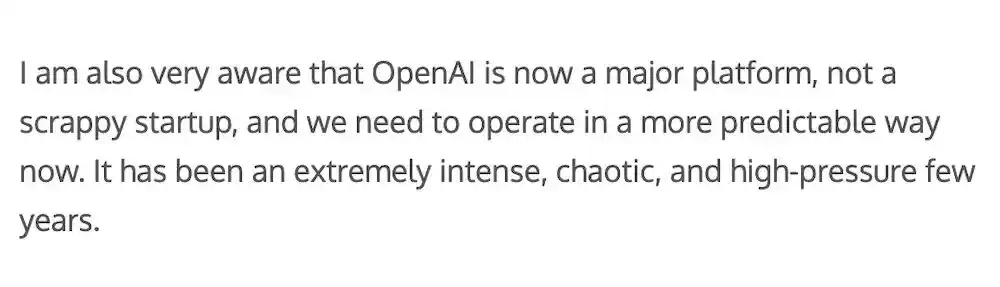
▲ Sam Altman's long response after his residence was firebombed.

Under pressure from competitor Anthropic and with an IPO planned for later this year, OpenAI is internally pushing to simplify its product lines, shifting resources from peripheral projects to areas with higher strategic priority.

In other words, Bill Peebles' departure and Prism's merger into Codex are consecutive actions in OpenAI's shift from "multiple experimental lines" to "consolidating main lines".

Turmoil on the Eve of IPO

Altman Again Embroiled in Conflict of Interest Allegations

As OpenAI accelerates its transformation, the issue of the "opacity" of Sam Altman's personal investment portfolio is being brought to the forefront.

According to The Wall Street Journal, after Sam Altman was briefly ousted and reinstated in 2023, the OpenAI board had promised to strengthen management of his potential conflicts of interest, but this issue has not truly disappeared.

Now, with OpenAI's valuation pushed to around $850 billion, questions about whether "company decisions are for OpenAI or indirectly serving Sam Altman's personal investment portfolio" have become more prominent.

The most typical case is the nuclear fusion company Helion.
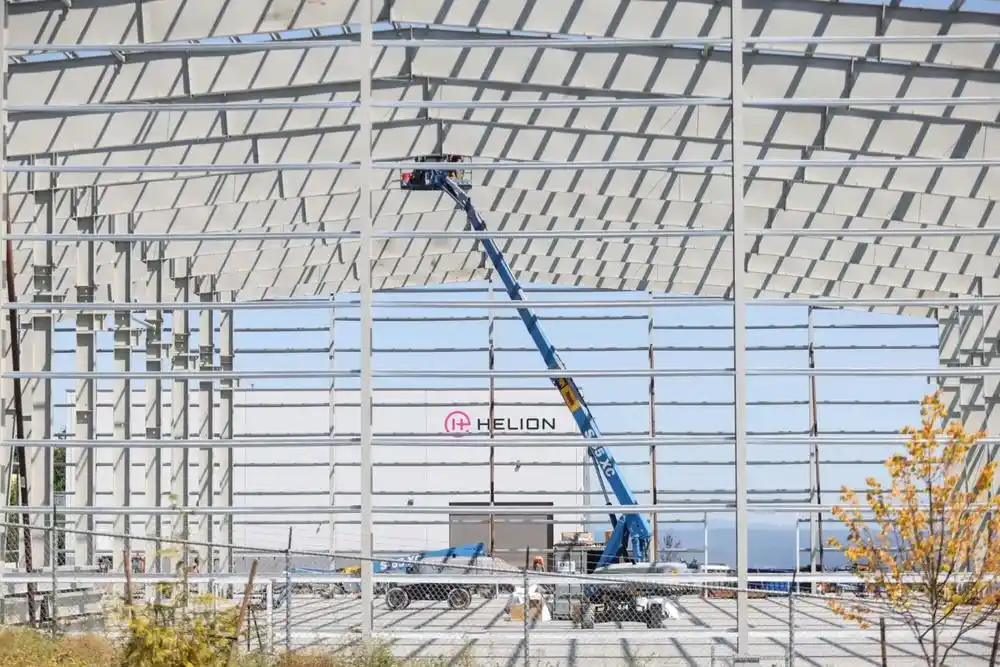
▲ Nuclear fusion company Helion

Sam Altman is a major investor in Helion, with a significant portion of his personal net worth tied to the company. Helion has experienced delays in delivering on its technology and begun facing funding pressures. Subsequently, Sam Altman pushed for OpenAI to lead a new round of financing for Helion, proposing an investment of about $500 million (approx. RMB 3.4 billion), which would have valued Helion at around $35 billion (approx. RMB 238.6 billion) under the proposed plan.

This proposal caused noticeable unease within OpenAI. Some employees believed Sam Altman was asking the company he leads to endorse an enterprise from which he directly benefits, with no immediately obvious business value for OpenAI in the transaction.

Some employees were even concerned that internal Slack discussions might become legal review material in the future, thus avoiding participation in related discussions.

OpenAI ultimately did not participate in this round of investment, but still signed an energy purchase agreement with Helion, agreeing to purchase up to 50 gigawatts of electricity by 2035, equivalent to the output of 25 Hoover Dams. Helion later used this agreement as an important endorsement in communications with investors.

With OpenAI withdrawing from the financing, Helion has now reduced its fundraising target to $250 million (approx. RMB 1.7 billion), with a valuation target lowered to $15 billion (approx. RMB 102.2 billion). Sam Altman resigned from the Helion board last month, explaining on social media that as Helion and OpenAI began exploring large-scale cooperation, it was no longer appropriate for him to sit on both boards.

Besides Helion, The Wall Street Journal also disclosed that Sam Altman had attempted to push for deeper cooperation between OpenAI and rocket company Stoke Space, even exploring having OpenAI acquire or control the company to support ideas like "space data centers".

Sam Altman himself has financial ties to Stoke through his family office, Hydrazine. Although Sam Altman publicly called the idea of "building data centers in space" "ridiculous" in India this February, the report cited informed sources stating that related cooperation discussions actually continued, with some OpenAI board members previously unaware.

Conclusion: Sora Reeled In, Prism Dismantled

What's Left on OpenAI's Main Line?

OpenAI's current situation is quite clear: it is actively compressing non-core businesses, concentrating resources on a few directions that can better support the IPO narrative and commercial returns.

The Wall Street Journal also mentioned that Fidji Simo told employees last month that Anthropic's progress should serve as a "wake-up call", and the company needs to direct more resources towards products for professional work scenarios.

Against this backdrop, some of Sam Altman's past product concepts, which were more personal in color, are gradually being scaled back. Simultaneously, his focus is quietly shifting: from product management to research, financing, and the acquisition of computing resources.

On one side, star employees announce their departures; on the other, product lines are merged. Coupled with multiple controversies on the eve of the IPO, OpenAI is transitioning from an expansion phase of "wanting to do everything" to a contraction phase of "having to succeed in a few things first".

Under the triple pressure of capital markets, competitors, and internal governance, the keyword for OpenAI's next stage is no longer all-out expansion, but concentrated firepower.

Sources: The Wall Street Journal, WIRED, Kevin Weil, Bill Peebles

This article is from the WeChat public account "Zhixiandao" (ID: zhidxcom), author: Jiang Yu

Связанные с этим вопросы

QWho are the key executives that recently left OpenAI, and what were their roles?

ABill Peebles, the core leader of the Sora project, and Kevin Weil, the Chief Product Officer, recently left OpenAI. Additionally, Srinivas Narayanan, the CTO of enterprise applications, also announced his departure.

QWhat projects at OpenAI are being shut down or restructured?

AThe video project Sora is being halted, and the scientific research tool Prism is being discontinued as a standalone product. The Prism team is being merged into the Codex team under Thibault Sottiaux.

QWhat personal利益冲突 issues involving Sam Altman were reported by The Wall Street Journal?

AThe Wall Street Journal reported that Sam Altman attempted to push OpenAI to invest in Helion, a nuclear fusion company he personally backed, and explored deeper cooperation or even control of Stoke Space, a rocket company, both of which involve his personal financial interests.

QWhy is OpenAI undergoing internal restructuring and project consolidation?

AOpenAI is shifting from a 'multi-line experimentation' phase to a 'mainline consolidation' strategy to focus resources on strategic priorities, streamline product lines, and prepare for its upcoming IPO, amid pressure from competitors like Anthropic.

QWhat is the current valuation of OpenAI and what challenges does it face before its IPO?

AOpenAI is valued at approximately $850 billion and faces challenges including executive departures, project restructuring, and concerns over Sam Altman's potential利益冲突, all occurring during its critical IPO preparation phase.

Похожее

Свадебное дело Чхве Тхэвона закрыто: раскрывая скрытые линии наследования за триллионной империей SK Hynix

Дело о разводе главы SK Group Чхве Тхэвона завершилось, раскрывая сложные сценарии наследования в конгломерате, стоящем за SK Hynix, чья капитализация превысила 1000 трлн вон. В отличие от традиционных сценариев наследования в чеблях, где ключевую роль играют первенец, доли, брачные связи и отцовское признание, трое детей Чхве Тхэвона от бывшей жены Но Соён — дочь Чхве Юнджон (1989 г.р.), дочь Чхве Минджон (1991 г.р.) и сын Чхве Ингын (1995 г.р.) — следуют разными путями. Чхве Юнджон, названная СМИ «наиболее очевидным кандидатом», занимает руководящую должность в SK Inc. и работает над стратегией развития в области биотехнологий и точной медицины, сочетая научную подготовку с бизнес-опытом. Её брак с основателем ИИ-стартапа символизирует новый тип элитных союзов. Чхве Минджон, добровольно служившая в ВМС Республики Корея и работавшая в сфере международной политики в SK Hynix в США, сейчас является основателем ИИ-стартапа в сфере здравоохранения. Её брак с бывшим офицером морской пехоты США подчёркивает связь с геополитическим контекстом, в котором теперь существует полупроводниковый гигант. Чхве Ингын, единственный сын и, казалось бы, естественный наследник по старой логике, сохраняет молчание. Имея образование в области физики, он покинул SK E&S, чтобы присоединиться к McKinsey, что рассматривается как стандартная внешняя стажировка, но без явных сигналов о наследовании. Громкое судебное разбирательство по разводу родителей, связанное с разделом активов на триллионы вон, стало фоном для их путей. По мере того как SK Hynix становится глобальным геополитическим активом в эпоху ИИ, наследование в SK перестаёт быть семейным делом, превращаясь в публичный экзамен на легитимность в новой, сложной реальности. Наследникам предстоит найти свои собственные ответы на вызовы эпохи.

marsbitВчера 09:08

Свадебное дело Чхве Тхэвона закрыто: раскрывая скрытые линии наследования за триллионной империей SK Hynix

marsbitВчера 09:08

Банки выступают против компромисса по доходности стейблкоинов – Найдёт ли закон CLARITY 60 голосов?

Американский Банковский институт политики выступил против нового проекта закона CLARITY Act, указав на пробелы в регулировании доходности стейблкоинов и мерах по борьбе с незаконными финансами. Банковский сектор добивается полного запрета любых форм вознаграждений по стейблкоинам и лоббирует сенаторов, что снижает поддержку со стороны республиканцев. Из-за смерти сенатора Грэма и болезни Макконнелла у республиканцев стало 51 голос. Если сенаторы Кёртис и Корнин откажут в поддержке, эта цифра упадет до 49, а для принятия закона потребуется 60 голосов. Необходимость заручиться поддержкой 11 демократов осложняется тем, что некоторые про-крипто демократы также выступают против законопроекта. Сроки ограничены: до августовских каникул Сената осталось две недели. Лидер большинства Джон Тюн сомневается в успехе до перерыва. Советник Белого дома по криптовалютам Патрик Уитт призывает провести голосование, утверждая, что новые этические нормы устраняют возражения демократов. Вероятность принятия закона в 2026 году, по рыночным оценкам, упала до 32%.

ambcryptoВчера 09:03

Банки выступают против компромисса по доходности стейблкоинов – Найдёт ли закон CLARITY 60 голосов?

ambcryptoВчера 09:03

За 2 месяца оценка выросла с 8,8 до 68 млрд юаней! Крупнейший AI-хаб OpenRouter может быть куплен

Stripe ведет переговоры о приобретении стартапа OpenRouter, агрегатора API крупных языковых моделей, за сумму около 100 миллиардов долларов. Это представляет собой семикратный рост по сравнению с оценкой OpenRouter в 13 миллиардов долларов двумя месяцами ранее. OpenRouter выступает в качестве «маршрутизатора» или агрегатора для более чем 400 AI-моделей (таких как GPT, Claude и множество открытых), позволяя разработчикам через единый API выбирать наиболее подходящую модель для каждой задачи на основе стоимости, скорости и сложности. Это помогает приложениям снижать расходы, автоматически направляя простые запросы к более дешевым моделям. Компания, основанная соучредителем OpenSea Алексом Аталлой, демонстрирует быстрый рост: ее ежегодный доход достиг 50 миллионов долларов, увеличившись в пять раз за полгода. Для Stripe, крупнейшего процессора онлайн-платежей, это вторая крупная сделка в сфере AI-инфраструктуры после приобретения платформы биллинга Metronome в 2025 году. Стратегия Stripe заключается в создании комплексного предложения для AI-экономики: OpenRouter будет «выбирать модель», Metronome — «подсчитывать потребление», а существующие платежные сервисы Stripe — «обрабатывать оплату». Таким образом, Stripe стремится контролировать ключевой уровень инфраструктуры, который определяет распределение трафика между моделями и формирует счета для конечных предприятий. Сделка подчеркивает растущую важность промежуточного слоя, который управляет стоимостью и выбором моделей для миллионов пользователей AI-приложений.

链捕手Вчера 09:00

За 2 месяца оценка выросла с 8,8 до 68 млрд юаней! Крупнейший AI-хаб OpenRouter может быть куплен

链捕手Вчера 09:00

От OpenSea до OpenRouter: Алекс Аталлах повторяет сценарий «ухода на пике»?

Автор: Нэнси, PANews Алекс Аталла, соучредитель NFT-платформы OpenSea, покинул компанию на пике пузыря NFT четыре года назад. Сейчас он снова оказывается в центре внимания на волне бума ИИ, готовясь продать созданную им агрегирующую платформу AI-моделей OpenRouter по высокой цене. По данным The Wall Street Journal от 23 июля, платежный гигант Stripe ведет переговоры о приобретении OpenRouter, при этом потенциальная оценка сделки может приблизиться к 100 миллиардам долларов. Если сделка состоится, это станет еще одним успехом Аталлы в создании компании на уровне ста миллиардов долларов после OpenSea. Ранее в этом месяце появились сообщения о том, что OpenRouter получил предложения о покупке от нескольких крупных технологических компаний. Потенциальная сделка со Stripe рассматривается как важный шаг для инфраструктурного гиганта в сфере платежей по расширению своего присутствия в области инфраструктуры ИИ. По данным информированных источников, если сделка будет заключена, оценка OpenRouter может приблизиться к 100 миллиардам долларов, что значительно превышает его предыдущие оценки при финансировании. Всего за три года компания добилась быстрого роста благодаря буму больших моделей. Это не первая компания Аталлы стоимостью в сто миллиардов. Ранее он был соучредителем OpenSea, ведущей мировой платформы для торговли NFT, пиковая оценка которой превысила 130 миллиардов долларов. Его уход с OpenSea до серьезного спада на рынке NFT рассматривался как знаковый сигнал. OpenRouter стала крупнейшим хабом в эпоху ИИ, подключившись к более чем 400 AI-моделям, имея около 10 миллионов пользователей и обрабатывая более 200 триллионов токенов в месяц. Однако, несмотря на быстрый рост, это бизнес с большими объемами, но ограниченной рентабельностью. Его основная бизнес-модель заключается в взимании комиссии за платформу (около 5-5,5%) при вызове разработчиками AI-моделей. Конкуренция на рынке агрегации AI-моделей также обостряется. Высокая оценка OpenRouter, возможно, больше отражает его будущий потенциал, чем текущую прибыльность. Для потенциальных покупателей наиболее ценным активом могут быть не текущие доходы, а накопленные реальные данные об использовании ИИ, которые трудно быстро воспроизвести. От NFT к ИИ Алекс Аталла дважды поймал волну технологического бума. Если продажа OpenRouter состоится с оценкой в 100 миллиардов долларов, это может означать либо переоценку стоимости инфраструктуры ИИ, либо сигнал о новом пике цикла. Ответ на этот вопрос даст только время.

链捕手Вчера 08:44

От OpenSea до OpenRouter: Алекс Аталлах повторяет сценарий «ухода на пике»?

链捕手Вчера 08:44

Приближается ли Биткойн к очередной зоне накопления? ЭТОТ сигнал говорит «да»

Аналитики отмечают, что Bitcoin (BTC) переживает один из самых длительных медвежьих периодов, охватывающий три квартала и два календарных года, при этом его динамика отклонилась от рынка акций. Однако сохраняется корреляция с акциями Apple (AAPL). График соотношения BTC/AAPL с 2017 года движется в восходящем канале, где его нижняя граница традиционно сигнализирует о зоне недооценки (накопления) для Bitcoin, а верхняя — о перекупленности. В настоящее время соотношение приближается к линии поддержки, что, по историческим данным, может предшествовать новой фазе роста BTC. При этом в 2025 году нарушилась многолетняя корреляция годовой доходности Bitcoin с индексами S&P 500 и Nasdaq 100, что объясняется его более резкой реакцией на макроэкономические потрясения. В качестве подтверждающего сигнала для разворота рассматриваются поступления стейблкоинов на криптобиржи, которые указывают на готовность капитала к реинвестированию. За последние семь дней чистый приток составил $1,42 млрд, что значительно меньше оттока в $10 млрд за предыдущие 30 дней и пока недостаточно для уверенного старта ралли. Таким образом, соотношение BTC/AAPL указывает на возможное приближение к зоне накопления, но для подтверждения тренда необходимы более значительные притоки стейблкоинов.

ambcryptoВчера 08:24

Приближается ли Биткойн к очередной зоне накопления? ЭТОТ сигнал говорит «да»

ambcryptoВчера 08:24

Торговля

Спот
活动图片