Blockchain Is South Korea’s New Fiscal Weapon — A Blow To Privacy?

bitcoinistОпубликовано 2026-04-16Обновлено 2026-04-16

Введение

South Korea is launching a pilot program to replace government expense credit cards with blockchain-based deposit tokens for treasury fund execution. This initiative, led by the Ministry of Finance and Economy, builds on a previous project with the Ministry of Environment. Deposit tokens are digital representations of bank deposits on permissioned blockchains, enabling programmable settlement, transparent tracking, and real-time reporting. Unlike CBDCs, they are issued by commercial banks. The pilot aims to enhance spending transparency, reduce intermediaries, and eliminate card-processing fees for small merchants. While improving efficiency, it raises privacy concerns. If successful, South Korea could become a model for blockchain-based fiscal systems.

South Korea is kicking off a pilot that will replace government expense credit cards with blockchain‐based deposit tokens.

Blockchain Goes TradFi?

The Ministry of Finance and Economy announced on an official press release that the pilot project for the execution of national treasury funds using blockchain‐based digital currency has been approved.

This new official venture marks the second time in which South Korea’s government uses digital currency and deposit tokens for the execution of national treasury funds, following another pilot project for building electric‐vehicle charging facilities and paying national subsidies together with the Ministry of Environment.

Deposit tokens are digital claims on commercial bank deposits, issued on permissioned blockchain rails, spendable by citizens and companies at participating merchants and service providers.

In simpler words, deposit tokens are digital versions of the money already kept in a normal bank account. The bank “wraps” those deposits into tokens on a private (permissioned) blockchain, and you can then spend those tokens at approved shops or service providers, just like using a card or mobile wallet.

In contrast with Central Bank Digital Currencies (CBDCs), that are digital versions of a country’s official money, created and managed directly by its central bank, deposit tokens have programmable settlement, transparent tracking of public money, and real‐time reporting for the state.

Pilot Details

The press release states that under the current National Treasury Funds Management Act, business promotion costs and related operating expenses are required to be paid with government purchase cards, effectively blocking the use of deposit tokens. Thanks to the new regulatory sandbox, those same payments can now be made with deposit tokens, creating a real‐world testbed for a new government payment and settlement method.

The new pilot is expected to serve as an opportunity to put blockchain‐based fiscal execution on a full footing and eliminate frictions in the current card‐payment setup by using blockchain’s built‐in transparency.

Quoting the press release, translated by Bitcoinist:

This pilot will allow us to preset and manage in advance the spending time and permitted business categories when business promotion expenses are executed using deposit tokens that leverage blockchain technology. This is not only expected to improve the transparency of spending but, by eliminating intermediaries in the payment structure, completely remove card‐processing fees borne by small merchants.

A Trade-Off For Traders

South Korea continues moving ahead with its Digital Asset Basic Act, a broad crypto rulebook that will set standards for stablecoins, tokenized real‐world assets, and crypto ETFs in the local market. A few weeks ago, the National Policy Committee of Korea pushed the “second‐phase” of the debate until after the June 3 local elections.

The trade‐off for South Korean traders is evident: they gain efficiency and control vs. losing some privacy and risking potential overreach. It is safe to expect tailwind for bank‐chain infrastructure, permissioned blockchain providers, and tokenization narratives.

Future “state money on chain” flows may favor bank‐issued tokens over fully open stablecoins, which could reshape liquidity, FX corridors, and on‐chain yield strategies.

If the pilot scales, South Korea could become the reference model for how blockchains handle real‐world fiscal flows.

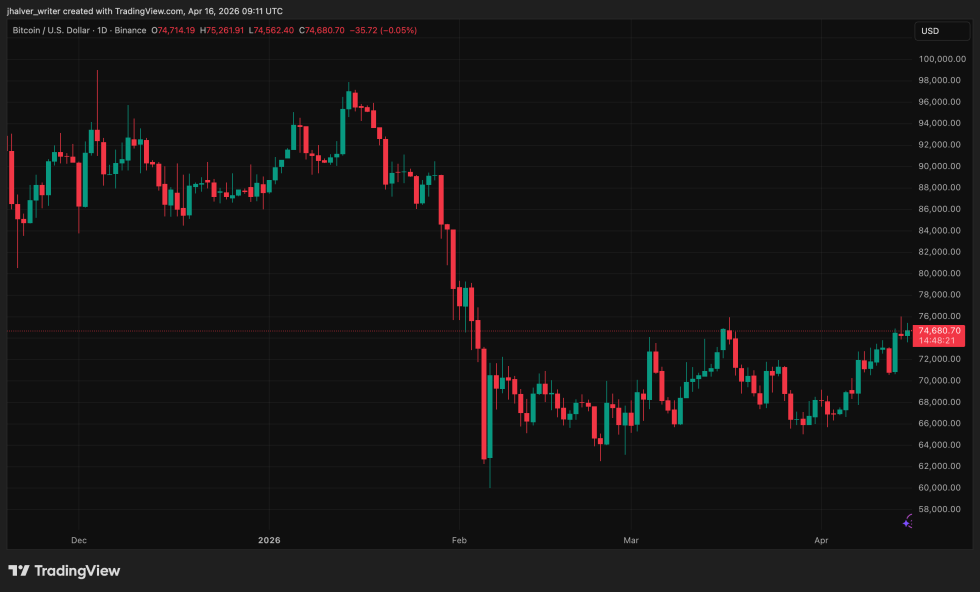
At the moment of writing, BTC trades for the highs $74ks on the daily chart. Source: BTCUSD on Tradingview.

Cover image from Perplexity. BTCUSD chart from Tradingview.

Связанные с этим вопросы

QWhat is the South Korean government piloting to replace government expense credit cards?

AThe South Korean government is piloting the use of blockchain-based deposit tokens to replace government expense credit cards.

QHow do deposit tokens differ from Central Bank Digital Currencies (CBDCs)?

ADeposit tokens are digital claims on commercial bank deposits issued on permissioned blockchains, while CBDCs are digital versions of a country's official money created and managed directly by its central bank. Deposit tokens offer programmable settlement, transparent tracking, and real-time reporting.

QWhat are the expected benefits of using blockchain-based deposit tokens for government spending according to the press release?

AThe benefits include improved spending transparency by allowing preset management of spending time and permitted business categories, and the elimination of card-processing fees for small merchants by removing intermediaries.

QWhat is the potential trade-off mentioned for South Korean traders in adopting this system?

AThe trade-off is that traders gain efficiency and control but may lose some privacy and risk potential government overreach.

QWhat broader legislative framework is South Korea advancing alongside this pilot project?

ASouth Korea is advancing the Digital Asset Basic Act, a comprehensive crypto rulebook that will set standards for stablecoins, tokenized real-world assets, and crypto ETFs in the local market.

Похожее

WSJ: Unveiling the Secret Jury That Controls Disputes on Polymarket

Last month, Garrick Wilhelm lost a $567 bet on the Polymarket prediction platform about whether a ceasefire would be reached with Hezbollah. When a truce was announced, some traders argued it counted, but Wilhelm disagreed. The dispute was settled not by Polymarket, but by a decentralized group of UMA token holders who vote on such disagreements. As trading surges, resolving ambiguous outcomes is a growing challenge for prediction markets. Unlike competitors like Kalshi that decide internally, Polymarket outsources dispute resolution to UMA. Its token holders, mostly anonymous and with voting power weighted by holdings, arbitrate cases. Critics argue this system is prone to manipulation, as voters can also bet on the same markets they judge. A Wall Street Journal analysis found that over the past year, at least 60% of active UMA voters had corresponding Polymarket accounts and held positions in disputes they voted on. Voting power is also concentrated among a few large holders. Polymarket says only 0.2% of bets go to UMA and that the system disperses authority. Its founder has acknowledged flaws and promised fixes. UMA's backers deny any proven manipulation, dismissing critics as sore losers. The platform penalizes voters in the minority to incentivize "correct" outcomes. Disputes are rising, covering topics from a streamer's pregnancy announcement to Iran. This model also helps Polymarket argue it's an offshore platform outside U.S. regulation, a shift made after a 2022 settlement with the CFTC. Some losing traders have formed groups to protest, targeting entities like UMA.rocks, which aggregates votes. Its founder says traders often blame UMA for their own mistakes. A recently ousted committee member, Scout, admitted to both betting and voting but argued involved voters research more thoroughly. He highlighted the dilemma: "Either you have conflicted traders deciding, or you have uninformed outsiders voting. There is no perfect answer right now."

marsbit32 мин. назад

WSJ: Unveiling the Secret Jury That Controls Disputes on Polymarket

marsbit32 мин. назад

China's AI Circle Has Just Established a Pecking Order, and Capital Is Already Changing the Rules Again

The article describes how the valuation logic for major Chinese AI model companies has undergone three dramatic shifts between 2022 and 2026, driven by capital's changing priorities. The first phase (around 2022) was **technology-driven valuation**, where funding was based on model performance and benchmark scores. This logic was disrupted when DeepSeek's R1 model demonstrated that comparable capabilities could be achieved at a fraction of the cost, challenging the notion of technical superiority as an unassailable moat. The second phase shifted to **IPO window-driven valuation**. Following favorable listing conditions in Hong Kong, capital flowed to companies like Zhipu and MiniMax with the clearest path to a public listing. However, this focus on liquidity over fundamentals became apparent as their Annual Recurring Revenue (ARR) lagged far behind international peers like Anthropic. The third and current phase is **national strategy-driven valuation**. This shift was marked by the state-backed "Big Fund" leading a major investment in DeepSeek, signaling that leading domestic AI models are now viewed as strategic national assets comparable to semiconductor manufacturing. This new logic, combined with soaring US valuation benchmarks (e.g., OpenAI at $850B), propelled the combined valuation of China's top AI firms ("The Four Dragons"/"Five Strong") past 1 trillion RMB. The article presents a "pricing leap model": each shift is triggered by a key event that invalidates the old logic, leading to rapid capital reallocation under a new narrative before its flaws (particularly the gap in fundamental ARR metrics) become evident. It concludes that the next major test for these valuations will be a return to scrutinizing core business fundamentals, specifically ARR growth, suggesting a fourth pricing shift is imminent.

marsbit57 мин. назад

China's AI Circle Has Just Established a Pecking Order, and Capital Is Already Changing the Rules Again

marsbit57 мин. назад

'Stock God' Trump's 3,642 Trades Disclosed: The 'Perfect Closed Loop' of Policy and Portfolio

Summary: Donald Trump's First Quarter stock trades, totaling 3,642 transactions, have been disclosed. While the White House maintains the trades were managed by an advisor and complied with disclosure laws, they reveal a portfolio heavily aligned with his policy agenda. The trades show a rotation away from major tech stocks like Microsoft, Amazon, and Meta, and into semiconductor and AI hardware companies such as NVIDIA, AMD, Broadcom, Dell, and Intel. Notably, Trump's account purchased Dell stock before he publicly praised the company, after which its stock rose. The Dell family also pledged funds to a Trump-affiliated policy project. A critical case is Intel. The Trump administration converted $8.9 billion in CHIPS Act subsidies into a 9.9% equity stake, making the U.S. government Intel's largest shareholder. Months later, Trump's personal account also bought Intel stock. This intertwines national industrial policy with potential personal financial interest. Unlike typical insider trading concerns, this situation creates a "closed loop": policy decisions (e.g., subsidies, tariffs, crypto regulation) can boost the value of his holdings, and those holdings may, in turn, influence future policy directions. This blending of presidential power and personal portfolio, while legally disclosed, raises profound questions about conflicts of interest that current rules do not address.

marsbit1 ч. назад

'Stock God' Trump's 3,642 Trades Disclosed: The 'Perfect Closed Loop' of Policy and Portfolio

marsbit1 ч. назад

Dialogue with Figure Robotics Founder: Behind the $39 Billion Valuation Lies Ambition to Mass-Produce Millions of Units

Title: Figure's Founder on the $39B Valuation and the Ambition to Mass Produce a Million Humanoid Robots In a Sourcery podcast interview, Figure founder and CEO Brett Adcock discusses the rapid rise of his humanoid robotics company. With a valuation that surged 15x in 18 months to $39 billion, Figure aims to create general-purpose humanoid robots for work in factories and homes. Adcock states that the company's primary goal is to make robots that perform real, paid work autonomously. He shares Figure's aggressive scaling plan: producing thousands of robots this year, with an ultimate ambition to reach one million units annually. Adcock explains Figure's vertically integrated strategy, designing its own motors, sensors, and joints to control its supply chain and destiny. He details the challenges, including achieving long-term, reliable, end-to-end autonomous operation—a feat no one has yet accomplished. The biggest risk is executing this complex vision at scale, but Adcock believes the potential market is enormous, representing a significant portion of global GDP. The interview also covers his departure from OpenAI, citing that Figure's internal AI team eventually surpassed OpenAI's capabilities for robotics applications. Adcock concludes by highlighting his focus for the year: large-scale commercial deployment of robots and advancing toward a "general robot" capable of any human task, potentially seeing the first signs of AGI (Artificial General Intelligence) in the physical world at Figure.

marsbit1 ч. назад

Dialogue with Figure Robotics Founder: Behind the $39 Billion Valuation Lies Ambition to Mass-Produce Millions of Units

marsbit1 ч. назад

Торговля

Спот
Фьючерсы
活动图片