Blockchain and no-code tools challenge AWS' dominance: Crypto exec

cointelegraphОпубликовано 2025-12-20Обновлено 2025-12-20

Введение

The rise of AI-powered no-code tools and blockchain technology is challenging Amazon Web Services' dominance in cloud computing, according to Lomesh Dutta of the Dfinity Foundation. These tools democratize app creation and enable AI-driven, continuously updated user experiences without relying on centralized servers. Blockchain provides a secure, tamper-resistant infrastructure that operates without constant human intervention. Despite promoting decentralization, many crypto and Web3 projects still depend on AWS, as seen in multiple 2025 outages that disrupted major platforms like Binance, Coinbase, and MetaMask. Industry executives argue that true decentralization must extend beyond the ledger to infrastructure to avoid reliance on centralized providers.

The rise of AI-powered no-code tools that allow users to create applications through linguistic prompts rather than computer code, decentralized through blockchain technology, will challenge Amazon Web Services’ (AWS) dominance of the cloud computing market.

No-code tools will democratize access to app creation and custom-tailored user experiences that will require constant updates and maintenance from AI, Lomesh Dutta, vice president of growth at the Dfinity Foundation, a non-profit organization that guides development of the Internet Computer Protocol (ICP) ecosystem, told Cointelegraph.

This rise of user-created applications eliminates the need for centrally managed software solutions stored on centralized servers.

AWS continues to dominate the cloud-computing market in 2025. Source: Statista

“When applications are continuously generated and evolved by AI, you need infrastructure that is secure, tamper-resistant, and able to stay online without constant human intervention,” he said. Lomesh added:

“Decentralized blockchain networks introduced a revolutionary computing paradigm: by eliminating central points of control, they enable the creation of secure, reliable, and fault-tolerant software.”

A significant portion of crypto companies and Web3 projects rely on centralized AWS infrastructure to power their consumer-facing applications and websites, Internet Computer founder Dominic Williams told Cointelegraph.

Related: Cloudflare outage shows why crypto needs end-to-end decentralization

AWS outages rock the crypto industry in 2025

Several AWS outages occurred in 2025, impacting multiple crypto platforms and exchanges using AWS servers and data centers to host their applications.

The first outage occurred in April, causing disruptions to centralized crypto exchanges, including Binance, KuCoin and MEXC. At the time, Binance temporarily paused withdrawals until normal service was restored.

AWS experienced another outage in October, causing disruptions in crypto exchange Coinbase’s mobile application, with users reporting login problems, slowdowns and withdrawal issues.
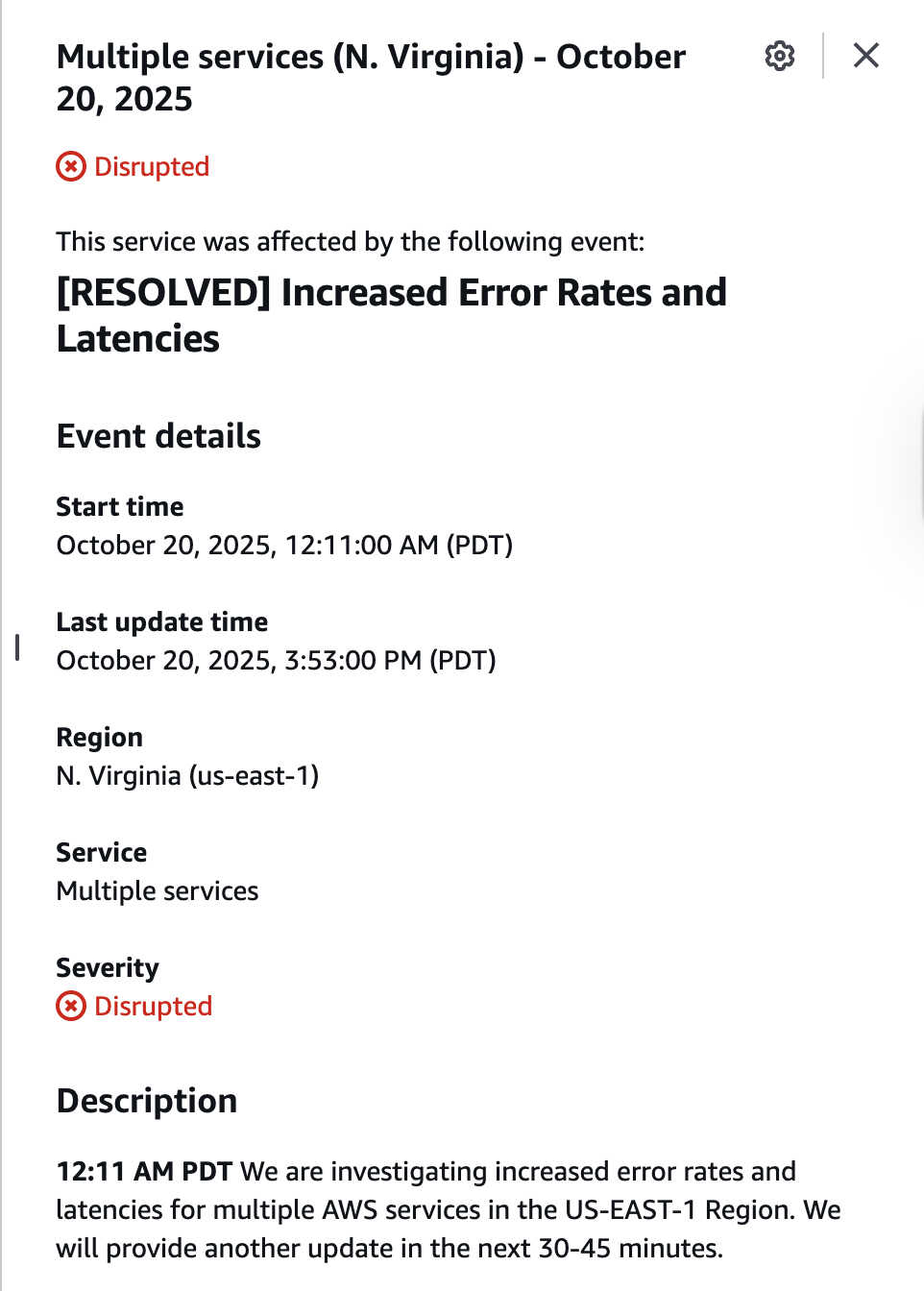
AWS reports an outage on October 20. Source: AWS Health Dashboard

Other financial applications were impacted by the outage, including the mixed-asset brokerage platform Robinhood and Web3 wallet MetaMask.

The October AWS outage lasted for about 15 hours and underscored the level of reliance crypto and Web3 projects, which market themselves as decentralized alternatives, have on centralized cloud infrastructure providers.

Crypto’s reliance on centralized infrastructure has drawn criticism from several crypto industry executives, including Jamie Elkaleh, chief marketing officer at crypto wallet company Bitget Wallet, and Carlos Lei, co-founder of decentralized physical infrastructure network (DePIN) marketplace Uplink.

“Decentralization has succeeded at the ledger layer but not yet at the infrastructure layer,” Elkaleh told Cointelegraph in October.

Magazine: Meet the onchain crypto detectives fighting crime better than the cops

Связанные с этим вопросы

QAccording to the article, how will no-code tools and blockchain technology challenge AWS' dominance in cloud computing?

ANo-code tools democratize app creation through AI-powered linguistic interfaces, while blockchain provides decentralized, secure, and tamper-resistant infrastructure that eliminates reliance on centralized servers and reduces need for constant human maintenance.

QWhat specific problems did AWS outages cause for crypto platforms in 2025 as mentioned in the article?

AAWS outages in April and October 2025 caused disruptions including Binance pausing withdrawals, Coinbase experiencing login problems and withdrawal issues, and affecting platforms like KuCoin, MEXC, Robinhood, and MetaMask.

QWhat criticism did crypto executives have regarding the industry's infrastructure according to the article?

AExecutives like Jamie Elkaleh criticized that 'decentralization has succeeded at the ledger layer but not yet at the infrastructure layer,' highlighting the contradiction between Web3's decentralized ideals and its reliance on centralized cloud providers like AWS.

QWhat advantages does Lomesh Dutta attribute to decentralized blockchain networks for AI-generated applications?

AHe stated decentralized blockchain networks provide 'a revolutionary computing paradigm' by eliminating central points of control, enabling the creation of secure, reliable, and fault-tolerant software that can stay online without constant human intervention.

QWhich major companies and projects were mentioned as being affected by the AWS outages in the article?

AThe affected entities included crypto exchanges Binance, KuCoin, MEXC, and Coinbase; mixed-asset brokerage Robinhood; and Web3 wallet MetaMask.

Похожее

Vietnam Crypto Payments Field Report: From Street Stalls to Coffee Shops

Vietnam, a top-ranked country in global crypto adoption, presents a fascinating case study in real-world use of digital currencies. This on-the-ground exploration reveals a complex ecosystem where crypto payment adoption is both emerging and encountering hurdles. The author's experience began when a spa owner in Nha Trang offered a discount for cash over credit card payments, citing high fees and tax implications. This preference for cash hinted at a potential openness to dollar-denominated stablecoins like USDT. Subsequent testing showed that using a crypto wallet (Bitget Wallet) for everyday purchases—from ride-hailing and street food to massages—was often seamless, thanks to widespread acceptance of the VietQR system. The experience was described as nearly equivalent to using Alipay. However, a failed payment at a seafood restaurant exposed a critical vulnerability. A transaction from the crypto wallet showed as completed on-chain but failed to register on the merchant’s older, non-standard QR system, highlighting compatibility issues and the "last mile" problem for crypto payments. Public perception also varies greatly. In northern cities like Hanoi, crypto is often viewed negatively, associated with money laundering and gambling. This contrasts sharply with the vibrant, tech-savvy crypto culture observed in the south, particularly in Ho Chi Minh City, where young people in cafes are seen trading on Binance or even writing Solidity code. This creates a "Vietnamese crypto fold": a dichotomy between a surface-level skepticism and a deep, grassroots penetration of digital assets, driven by a young population eager for financial advancement. The author concludes that Vietnam’s demographic trends and open attitude position it as a key economy to watch for Web3 growth in the next decade.

比推1 ч. назад

Vietnam Crypto Payments Field Report: From Street Stalls to Coffee Shops

比推1 ч. назад

Торговля

Спот
Фьючерсы
活动图片