Bitwise crypto index fund moves from over-the-counter to NYSE Arca for trading

cointelegraphОпубликовано 2025-12-09Обновлено 2025-12-09

Введение

Bitwise Asset Management's 10 Crypto Index Fund (BITW) is transitioning from the over-the-counter market to NYSE Arca, marking a significant step toward mainstream adoption. The fund, which offers diversified exposure to the top 10 cryptocurrencies like Bitcoin and Ethereum, will now trade as an exchange-traded product on a major regulated securities exchange. This move is expected to reduce investment friction and provide a safer, more accessible entry point for investors hesitant about direct crypto exposure. Bitwise, an early issuer of a spot Bitcoin ETF, has seen growing institutional interest amid regulatory developments and market volatility, including recent large liquidations and subsequent inflows into crypto ETPs.

Bitwise Asset Management’s 10 Crypto Index Fund (BITW) is moving from the over-the-counter market to NYSE Arca, a shift that brings crypto exposure further into mainstream trading infrastructure.

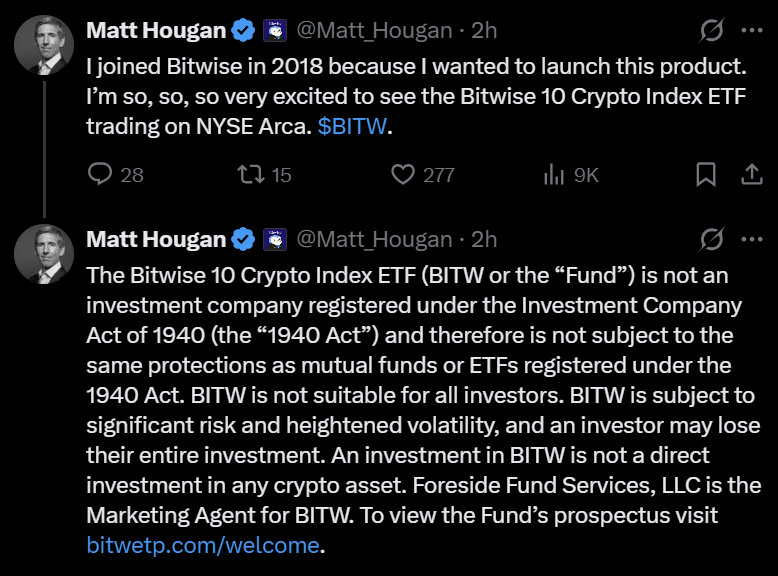
Beginning Tuesday, BITW is officially uplisted to NYSE Arca — one of the New York Stock Exchange’s electronic markets for exchange-traded products — where it will trade as an exchange-traded product, the company announced.

Launched in 2017, BITW offers diversified exposure to the 10 largest cryptocurrencies by market capitalization, including Bitcoin (BTC), Ether (ETH), Solana (SOL) and XRP (XRP). The fund rebalances monthly to reflect changes in the broader crypto market.

Listing on NYSE Arca places a crypto-linked product on a major regulated securities exchange, the same type of venue where traditional exchange-traded funds (ETFs) trade. The move is expected to reduce friction for investors who may be hesitant to navigate crypto exchanges.

“Most investors we meet are convinced crypto is here to stay, but they don't know who the winners will be or how many will succeed," said Bitwise CIO Matt Hougan. “The index approach is a way for people to invest in the thesis without having to predict the future.”
Source: Matt Hougan

Bitwise was among the first issuers to receive approval for a spot Bitcoin ETF in January 2024. Its Bitwise Bitcoin ETF Trust (BITB) was one of the fastest 25 exchange-traded products to reach $1 billion in assets, hitting the milestone roughly a month after launch.

Related: Bitwise files for stablecoin, tokenization ETF with US SEC

Institutional adoption and market volatility

Institutional interest in digital assets has expanded rapidly since the approval of US spot Bitcoin ETFs in early 2024. The arrival of the more crypto-friendly Trump administration has further accelerated adoption through increased regulatory attention, new legislation and a federal mandate to support the industry’s development.

At the same time, institutional investors have been reminded of the sector’s inherent volatility, which remains elevated even as larger and more established participants enter the market.

Crypto markets saw their largest-ever liquidation event on Oct. 10, when roughly $19 billion in positions were wiped out. The resulting turbulence over the following month triggered sharp withdrawals and significant outflows from crypto exchange-traded products.

However, inflows have resumed in the last two weeks, with ETP inflows exceeding $1.7 billion over that period, according to CoinShares data.
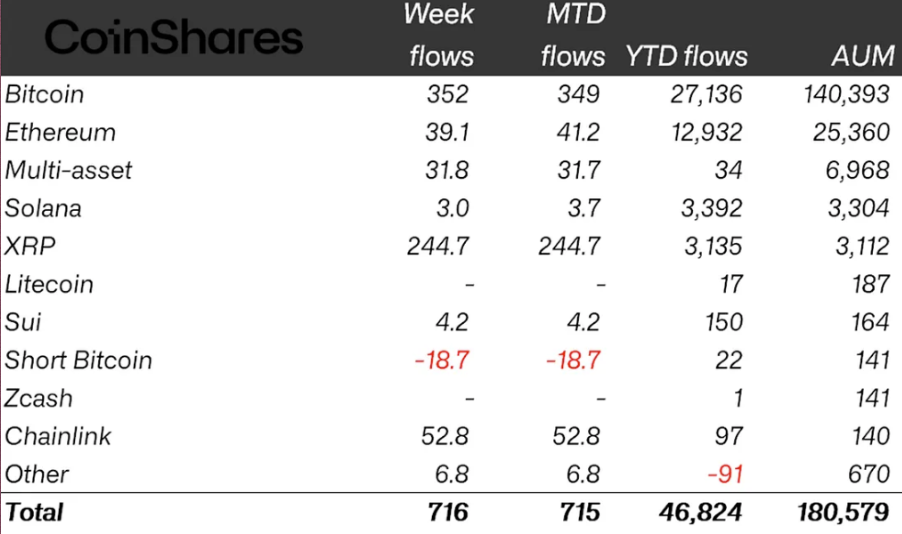
Inflows into crypto ETPs flip positive for two consecutive weeks. Source: CoinShares


Magazine: Decade after Ethereum ICO: Blockchain forensics end double-spending debate

Похожее

New Huo Tech Livio: Ethereum Fusaka Upgrade Value Underestimated

New Huo Tech's Livio argues that the Ethereum Fusaka upgrade, completed on December 3, is significantly undervalued by the market. Occurring during a period of extreme pessimism and a major crypto market correction, the upgrade went largely unnoticed but represents a critical strategic improvement to Ethereum’s economic model and ecosystem performance. Fusaka systematically tackles two core bottlenecks: high costs and poor user experience. It achieves a "cost revolution" by dramatically reducing Layer-2 (L2) transaction fees—potentially as low as $0.001 per transaction—without overburdening the Layer-1 (L1) mainnet. This enables economically viable high-frequency applications like on-chain gaming, social dApps, AI agent settlements, and RWA (Real World Asset) trading. The upgrade also delivers a user experience leap by natively supporting Passkey authentication, allowing users to sign transactions using biometrics like fingerprints or FaceID instead of managing complex seed phrases. This shift makes using crypto wallets as seamless as conventional apps, lowering the barrier to entry for mainstream adoption. Most importantly, Fusaka fundamentally overhauls Ethereum’s tokenomics. It establishes a structured "taxation" system where L2s must pay fees to the L1 for security and data capacity. These fees are burned, creating a stable, endogenous "buyback" mechanism for ETH. As L2 activity grows, this is projected to result in an additional 3,000–10,000 ETH burned annually, shifting Ethereum from an inflationary to a deflationary or slightly inflationary model. This ties ETH's value directly to network usage, strengthening its role as the risk hub and settlement layer for the entire L2 economy. With Fusaka, Ethereum’s scaling roadmap is affirmed, with potential L2 TPS reaching 10,000 and eventually 100,000+. The upgrade is a pivotal step towards mass Web3 commercialization, and its strategic long-term value is currently underestimated by the market.

marsbit13 мин. назад

New Huo Tech Livio: Ethereum Fusaka Upgrade Value Underestimated

marsbit13 мин. назад

Торговля

Спот
Фьючерсы
活动图片