BitMine Copies Saylor’s Strategy Playbook With Ethereum Preferred Stock Offering

bitcoinistОпубликовано 2026-06-04Обновлено 2026-06-04

Введение

BitMine Immersion Technologies is following a strategy similar to Michael Saylor's MicroStrategy, but for Ethereum. The company has filed for a public offering of 3 million shares of 9.50% Series A Perpetual Preferred Stock, with a stated value of $100 per share, to raise capital for expanding its Ethereum holdings and staking infrastructure. Proceeds are earmarked for acquiring ETH and other digital assets, expanding its "MAVAN" validator network, and other corporate purposes. The preferred stock will pay cumulative dividends at 9.50% annually and includes provisions for dividend penalties and company redemption options. BitMine has applied to list the shares on the NYSE under the ticker BMNP.

BitMine Immersion Technologies is moving deeper into the public-market crypto treasury trade, filing for a preferred stock offering that could help fund additional Ethereum purchases and validator infrastructure. The structure puts the company closer to the capital-markets model popularized by Michael Saylor’s Strategy, but with ETH rather than Bitcoin as the core reserve asset.

The Norwalk, Connecticut-based company said it intends to offer 3,000,000 shares of 9.50% Series A Perpetual Preferred Stock in a public offering registered under the Securities Act. The preferred shares carry a stated amount of $100 per share, implying a potential $300 million stated-value issuance if sold at that level, though the company said the deal remains subject to market and other conditions.

BitMine Files Yield Offering As It Builds Ethereum Treasury

BitMine framed the proceeds broadly, but Ethereum sits at the center of the filing. The company said it intends to use net proceeds “for general corporate purposes, which may include the acquisition of additional ETH and other digital assets; the expansion of the Company’s staking and validator infrastructure, including through MAVAN; working capital; strategic investments aligned with the Ethereum ecosystem and broader digital asset adoption; and/or repurchases of the Company’s common stock under its share repurchase program.”

BitMine has committed to ETH as its primary treasury reserve asset and says it is using native protocol-level activity, including staking and decentralized finance mechanisms, as part of that strategy. In 2026, the company launched MAVAN, or Made-in America VAlidator Network, as dedicated staking infrastructure for BitMine assets.

The comparison with Saylor’s Strategy comes from the financing mechanism. Strategy built its Bitcoin treasury model not only through common stock and convertible debt, but also through preferred equity products (STRC and STRF) designed to attract yield-oriented investors while raising capital for digital asset accumulation.

BitMine is now applying a similar template to Ethereum: issue a yield-bearing security in the public markets, use the proceeds flexibly, and route part of the capital toward a crypto treasury asset with institutional-market packaging around it.

The preferred stock itself is structured as a cash-paying instrument. BitMine said the Series A Preferred Stock will accumulate cumulative dividends at a fixed rate of 9.50% per year on the $100 stated amount, whether or not dividends are declared or funds are legally available for payment. “Regular dividends on the Series A Preferred Stock will be payable when, as and if declared by BMNR’s board of directors, out of funds legally available for their payment, weekly in arrears,” the company said. “Declared regular dividends on the Series A Preferred Stock will be payable solely in cash.”

The filing also includes a penalty mechanism if dividends are not paid on schedule. Any unpaid accumulated regular dividend would itself begin accumulating additional dividends, compounded weekly. The compounded dividend rate initially equals 9.50% plus 5 basis points, based on a weekly regular dividend period, and increases by another 5 basis points for each subsequent period until paid in full, capped at 15% per year.

BitMine will retain redemption flexibility. The company can redeem the preferred stock in whole or in part for cash at 110% of stated amount during the first 18 months after issuance, 105% from 18 months to three years, and 100% after three years, plus accumulated and unpaid dividends. It can also redeem all outstanding preferred shares if the total remaining falls below 25% of the original issuance, or if certain tax events occur.

Holders also receive protection in the event of a “fundamental change.” If such an event occurs under the certificate of designations, preferred shareholders can require BitMine to repurchase some or all of their shares for cash at the stated amount, plus accumulated and unpaid regular dividends.

BitMine has applied to list the preferred stock on the New York Stock Exchange under the ticker BMNP. If approved, the company expects trading to begin within 30 days after the shares are first issued. Moelis & Company and Cantor are acting as joint lead bookrunners.

At press time, Ethereum traded at $1,793.
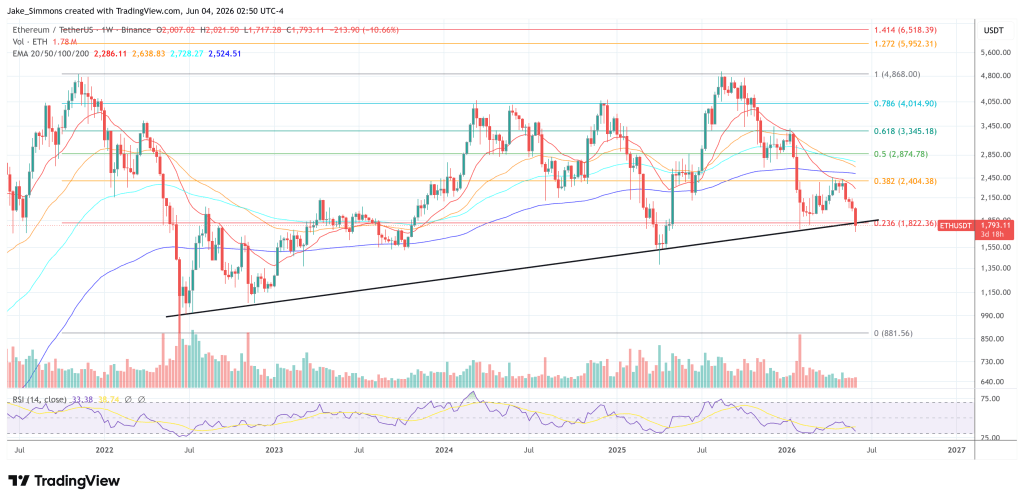
Ethereum bulls must defend the multi-year uptrend, 1-week chart | Source: ETHUSDT on TradingView.com

Связанные с этим вопросы

QWhat type of securities offering is BitMine Immersion Technologies filing for, and what is its primary purpose?

ABitMine is filing for a public offering of 3,000,000 shares of 9.50% Series A Perpetual Preferred Stock. The primary purpose of the proceeds is for general corporate purposes, which include the acquisition of additional Ethereum, the expansion of its staking and validator infrastructure (including through MAVAN), working capital, strategic investments in the Ethereum ecosystem, and/or repurchases of the company's common stock.

QHow does BitMine's strategy compare to Michael Saylor's approach, and what is the key difference?

ABitMine's strategy is compared to Michael Saylor's capital-markets model, which uses financial instruments to raise capital for acquiring a crypto reserve asset. The key difference is that while Saylor's company, MicroStrategy, focuses on Bitcoin as its core reserve asset, BitMine is applying a similar template to Ethereum.

QWhat are the key financial terms of BitMine's Series A Perpetual Preferred Stock?

AThe Series A Perpetual Preferred Stock has a stated amount of $100 per share and accumulates cumulative dividends at a fixed annual rate of 9.50% on that amount. Dividends are payable weekly in arrears, in cash, when declared. If dividends are not paid, they compound weekly with a penalty rate that starts at 9.55% and can increase, capped at 15% per year.

QUnder what conditions can BitMine redeem the preferred shares, and what are the redemption prices?

ABitMine can redeem the preferred stock for cash at 110% of the stated amount within the first 18 months after issuance, at 105% from 18 months to three years, and at 100% after three years, plus any accumulated and unpaid dividends. The company can also redeem all outstanding shares if the total remaining falls below 25% of the original issuance or if certain tax events occur.

QWhat exchange does BitMine plan to list its preferred stock on, and what is the proposed ticker symbol?

ABitMine has applied to list the preferred stock on the New York Stock Exchange (NYSE) under the ticker symbol BMNP.

Похожее

Agents Take Over Traffic Distribution Power: What Are Tencent, ByteDance, and Alibaba Competing For?

In the race to dominate the AI era's entry point, China's tech giants—Tencent, ByteDance, and Alibaba—are aggressively deploying AI Agents to control the future of traffic distribution. Alibaba is pursuing a dual-track "closed loop + openness" strategy. Its Qianwen app is evolving into a super-Agent integrated across its ecosystem (Taobao, Alipay, etc.) to handle complex tasks like travel planning. Concurrently, it is opening its platform to external brands (Luckin Coffee, KFC) and has launched a B2B Agent platform, "Wukong," targeting enterprise automation. Its other flagship, Quark, aims to be an "AI super search box" for information and tasks. ByteDance is executing an omnipresent "sprawl strategy." Its Doubao app boasts over 300 million monthly active users and is evolving into a default AI entry point for daily life, with plans for paid versions and e-commerce integration. Its core weapon is the Kouzi platform, a visual "AI assembly factory" for developers to build custom Agents. ByteDance is also pushing hardware integration, collaborating on AI phones and developing smart glasses to embed Doubao everywhere. Tencent is playing its long-held "ultimate card" by quietly embedding an AI Agent directly into WeChat. This Agent, accessible via a swipe, can understand user commands and automatically execute tasks by calling upon WeChat's millions of mini-programs (e.g., finding and ordering coffee). This leverages WeChat's unparalleled 1.4-billion-user ecosystem to position the app as an AI-powered "service operating system," a move that could dramatically reshape the competitive landscape. The core battleground is shifting from competing for "user screen time" to competing to be the "default execution layer" for user intent. The business model is evolving from an "attention economy" to an "intent economy," where the Agent that can most efficiently fulfill a user's need gains control over service access and token flow. This represents a fundamental change in how users connect with digital services, making the fight for the Agent入口 (entry point) a pivotal moment for redefining industry leadership in the AI age.

marsbit32 мин. назад

Agents Take Over Traffic Distribution Power: What Are Tencent, ByteDance, and Alibaba Competing For?

marsbit32 мин. назад

From Banning Doubao to Embracing Honor: Why Did WeChat Suddenly 'Change Its Face'?

The article explores the sudden shift in WeChat's strategy towards AI assistants from mobile phone manufacturers, transitioning from strict opposition to active collaboration. For over a year, WeChat fiercely resisted attempts by phone AI assistants (like ByteDance's Doubao in late 2025) to control its features via GUI automation ("simulated clicking"), citing security and data control concerns. This stance created a significant barrier for system-level AI integration. Now, Tencent has initiated A2A (Agent-to-Agent) partnerships with major phone brands like Honor, Xiaomi, OPPO, and vivo. This model allows a phone's system AI (e.g., Honor's YOYO) to parse a user's voice command and send a structured request directly to WeChat's own internal AI agent via secure APIs. WeChat then executes the action (e.g., sending a message) and returns the result. The article attributes Tencent's "change of face" to strategic pressure. While leading in social app usage, Tencent trails rivals like ByteDance and Alibaba in standalone AI app popularity. WeChat, with its vast mini-program ecosystem, is Tencent's key asset for an AI comeback. The upcoming WeChat AI agent aims to handle tasks like booking and payments within the app. However, phone system assistants remain the primary AI entry point for most users. The A2A collaboration allows Tencent to extend WeChat's AI reach to this crucial system layer while maintaining control over its core functions and data. For phone manufacturers, embracing A2A is a pragmatic move. The GUI route proved unviable due to WeChat's blocks. A2A offers a compliant path to integrate a vital service, enhancing their AI assistants' usefulness. It allows them to focus on developing their own AI ecosystems for other services while cooperating on WeChat access. The collaboration is framed as a mutual, strategic necessity: Tencent gains a distribution channel, and manufacturers gain a key functionality. The partnership relies on a "dual authorization" mechanism for security, requiring both user and app consent for each action. While questions about long-term data privacy practices remain, experts note A2A is more secure and compliant than GUI automation. Ultimately, this cooperation is seen as a tentative, calculated truce. Tencent's long-term goal is to make WeChat an AI-powered "service OS." Phone manufacturers aim to make their system AI the central user interface. Their paths may converge or clash in the future, but for now, the A2A deal represents the opening chapter in the battle for the AI-era user入口, driven by necessity and strategic calculus on both sides.

marsbit2 ч. назад

From Banning Doubao to Embracing Honor: Why Did WeChat Suddenly 'Change Its Face'?

marsbit2 ч. назад

Торговля

Спот
Фьючерсы

Популярные статьи

Как купить S

Добро пожаловать на HTX.com! Мы сделали приобретение Sonic (S) простым и удобным. Следуйте нашему пошаговому руководству и отправляйтесь в свое крипто-путешествие.Шаг 1: Создайте аккаунт на HTXИспользуйте свой адрес электронной почты или номер телефона, чтобы зарегистрироваться и бесплатно создать аккаунт на HTX. Пройдите удобную регистрацию и откройте для себя весь функционал.Создать аккаунтШаг 2: Перейдите в Купить криптовалюту и выберите свой способ оплатыКредитная/Дебетовая Карта: Используйте свою карту Visa или Mastercard для мгновенной покупки Sonic (S).Баланс: Используйте средства с баланса вашего аккаунта HTX для простой торговли.Третьи Лица: Мы добавили популярные способы оплаты, такие как Google Pay и Apple Pay, для повышения удобства.P2P: Торгуйте напрямую с другими пользователями на HTX.Внебиржевая Торговля (OTC): Мы предлагаем индивидуальные услуги и конкурентоспособные обменные курсы для трейдеров.Шаг 3: Хранение Sonic (S)После приобретения вами Sonic (S) храните их в своем аккаунте на HTX. В качестве альтернативы вы можете отправить их куда-либо с помощью перевода в блокчейне или использовать для торговли с другими криптовалютами.Шаг 4: Торговля Sonic (S)С легкостью торгуйте Sonic (S) на спотовом рынке HTX. Просто зайдите в свой аккаунт, выберите торговую пару, совершайте сделки и следите за ними в режиме реального времени. Мы предлагаем удобный интерфейс как для начинающих, так и для опытных трейдеров.

1.4k просмотров всегоОпубликовано 2025.01.15Обновлено 2026.06.02

Как купить S

Sonic: Обновления под руководством Андре Кронье – новая звезда Layer-1 на фоне спада рынка

Он решает проблемы масштабируемости, совместимости между блокчейнами и стимулов для разработчиков с помощью технологических инноваций.

2.3k просмотров всегоОпубликовано 2025.04.09Обновлено 2025.04.09

Sonic: Обновления под руководством Андре Кронье – новая звезда Layer-1 на фоне спада рынка

HTX Learn: Пройдите обучение по "Sonic" и разделите 1000 USDT

HTX Learn — ваш проводник в мир перспективных проектов, и мы запускаем специальное мероприятие "Учитесь и Зарабатывайте", посвящённое этим проектам. Наше новое направление .

1.8k просмотров всегоОпубликовано 2025.04.10Обновлено 2025.04.10

HTX Learn: Пройдите обучение по "Sonic" и разделите 1000 USDT

Обсуждения

Добро пожаловать в Сообщество HTX. Здесь вы сможете быть в курсе последних новостей о развитии платформы и получить доступ к профессиональной аналитической информации о рынке. Мнения пользователей о цене на S (S) представлены ниже.

活动图片