Bitcoin Social Euphoria Hits Yearly High Amid CLARITY Act Buzz

bitcoinistОпубликовано 2026-05-18Обновлено 2026-05-18

Введение

Bitcoin social sentiment has surged to a yearly high following the U.S. Senate Banking Committee's bipartisan approval of the CLARITY Act. Data from Santiment shows a ratio of 1.55 bullish comments for every 1 bearish comment, indicating a "FOMO zone" similar to a peak in late April. Analysts note such high optimism often signals a short-term profit-taking opportunity, contrasting with the better contrarian buy signal seen during recent "FUD zone" pessimism. Despite near-term caution, the CLARITY Act is viewed as a long-term positive, aiming to establish a clearer federal regulatory framework for digital assets by defining roles for the SEC and CFTC. The bill, supported by major crypto firms, now awaits a full Senate vote, with a critical window for passage before the August recess.

The CLARITY Act’s landmark committee approval has sent Bitcoin sentiment soaring to its highest point in months.

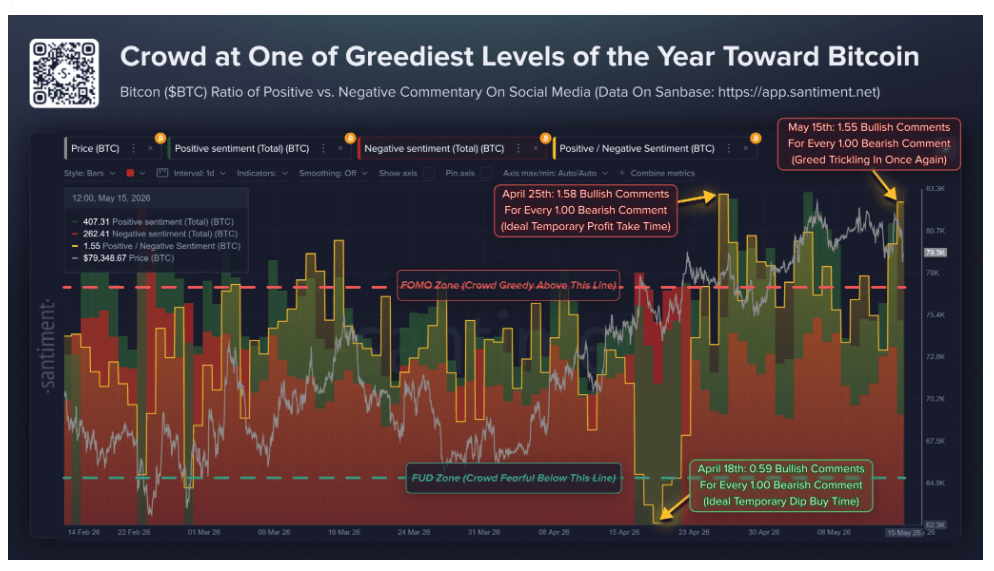
Data from Santiment shows that bullish Bitcoin commentary on social media has climbed to one of its greediest readings of the year, with 1.55 bullish comments for every 1.00 bearish comment. The on-chain data, however, indicates that the crowd may be getting ahead of itself.

Bitcoin Sentiment Points To Greed After CLARITY Act Vote

The passage of the Digital Asset Market Clarity Act through the Senate Banking Committee moved both price and crowd psychology simultaneously. The move came after the US Senate Banking Committee advanced the CLARITY Act in a 15-9 bipartisan vote, sending the important market-structure bill to the full Senate.

Interestingly, Santiment’s data shows that Bitcoin social sentiment has moved back into a FOMO zone. On May 15, Santiment’s social sentiment ratio for Bitcoin reached 1.55 bullish comments for every 1.00 bearish comment, placing it within a FOMO Zone.

That reading mirrors a prior peak recorded on April 25, when the ratio reached 1.58 bullish-to-bearish. Any time the ratio of positive to negative commentary on social media crosses this FOMO zone, then it is an ideal temporary profit-taking moment.

This does not mean Bitcoin has to crash because the crowd has turned optimistic. The same Santiment chart shows that the better contrarian setup came on April 18, when the bullish-to-bearish ratio dropped to 0.59. This was deep in the FUD Zone, before Bitcoin mounted a recovery.

Bitcoin Ratio Of Positive vs. Negative Commentary. Source: @SantimentData On X

CLARITY Act Still Bullish For Bitcoin In The Long Run

The caution around short-term sentiment does not cancel the long-term importance of the CLARITY Act. The bill is designed to create a clearer federal framework for digital assets, including a more defined division of authority between the Securities and Exchange Commission and the Commodity Futures Trading Commission.

BTCUSD currently trading at $78,486. chart: TradingView

The bill was championed by major crypto companies, including Coinbase, Circle, and Ripple, all of which have sought a degree of regulation for the crypto industry. Senior figures linked to these companies also reacted positively on social media after the Senate Banking Committee advanced the legislation.

Coinbase CEO Brian Armstrong, for instance, stated in a post on X: “looking forward to a bipartisan law that cements the US as the world’s crypto capital. Let’s get CLARITY done.”

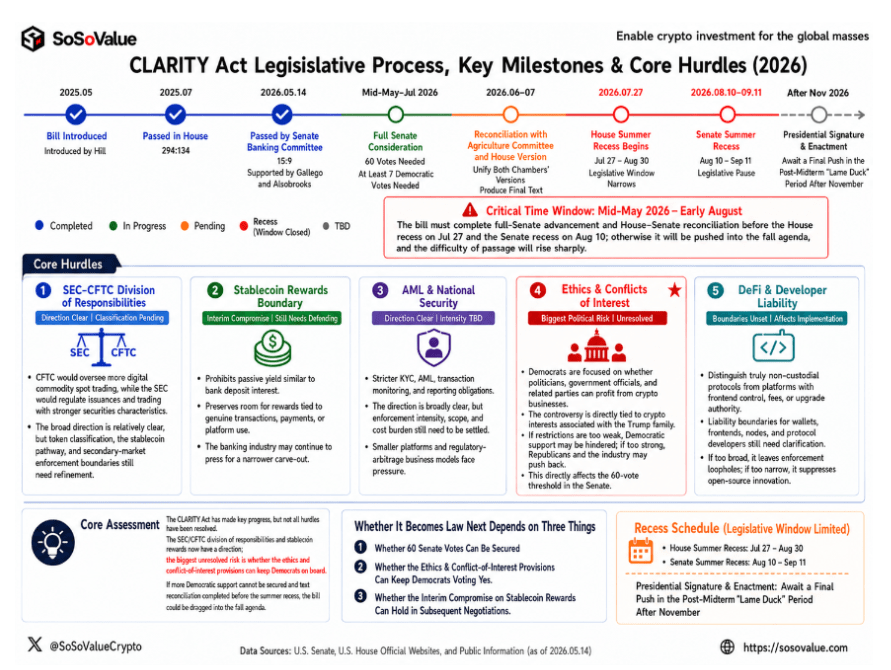
The bill still needs to be available for a vote from the full Senate, where 60 yes votes will be required. Projections from SoSoValue show a key window between mid-May and early August, with the House recess beginning July 27 and the Senate recess beginning August 10.

If lawmakers fail to complete full Senate consideration and reconciliation before that period, the bill could be pushed deeper into the fall agenda, and the difficulty of passage will rise significantly.

Clarity Act Legislative Process. Source: SoSoValue

Featured image from Unsplash, chart from TradingView

Связанные с этим вопросы

QWhat specific event caused Bitcoin social sentiment to reach a yearly high?

AThe landmark committee approval of the CLARITY Act by the US Senate Banking Committee caused Bitcoin social sentiment to soar to its highest point in months.

QAccording to Santiment's data, what was the ratio of bullish to bearish Bitcoin comments on social media on May 15?

AOn May 15, Santiment's data showed a ratio of 1.55 bullish comments for every 1.00 bearish comment regarding Bitcoin on social media.

QWhat is the main purpose of the CLARITY Act as described in the article?

AThe CLARITY Act is designed to create a clearer federal framework for digital assets, including a more defined division of authority between the Securities and Exchange Commission (SEC) and the Commodity Futures Trading Commission (CFTC).

QWhich major crypto companies are mentioned as champions of the CLARITY Act?

AMajor crypto companies championing the CLARITY Act include Coinbase, Circle, and Ripple.

QWhat are the key legislative deadlines mentioned for the CLARITY Act to be passed by the full Senate?

AProjections show a key window between mid-May and early August, with the House recess beginning July 27 and the Senate recess beginning August 10. If not passed before this period, the bill could be pushed into the fall agenda, making passage significantly more difficult.

Похожее

SpaceX, OpenAI, Anthropic: The Three AI Giants Racing for IPO, Which One Is Worth Betting On?

SpaceX, OpenAI, and Anthropic are poised for historic IPOs within weeks, potentially raising a combined $180 billion—a sum exceeding the entire internet bubble's fundraising. The hosts of the Limitless Podcast argue this isn't just individual company financing but an unprecedented capital concentration for AI infrastructure, driven by an insatiable need for compute, data centers, power, and chips. SpaceX's IPO is notable for reportedly changing market index rules to allow faster inclusion, potentially funneling trillions in passive retirement funds into its stock, despite its unproven space-based data center business model. In contrast, Anthropic demonstrates explosive growth, with ARR reportedly hitting $45 billion and approaching profitability, fueled by strong enterprise adoption of products like Claude Code. Google's separate $80 billion raise highlights the immense capital pressure, even for giants. The discussion acknowledges bubble risks but leans optimistic. The hosts contend the massive spending is building essential physical infrastructure for the next technological era. A key bottleneck isn't capital but the real-world limits of chip manufacturing and construction speed. As long as demand for AI compute outstrips supply, this investment cycle represents a foundational build-out rather than a purely financial bubble. All three companies are seen as foundational bets on the future, with Anthropic often cited as the most immediately compelling due to its proven revenue trajectory.

marsbit1 ч. назад

SpaceX, OpenAI, Anthropic: The Three AI Giants Racing for IPO, Which One Is Worth Betting On?

marsbit1 ч. назад

From 'Old Guys' to 'New Favorites': How AI Is Revaluing Old Infrastructure from Dell to Nokia?

From "Vintage Tech" to "New AI Darlings": How AI Revalues Old Infrastructure One year ago, tech giants like Dell, Nokia, Cisco, and Western Data were seen as slow-growth, low-valuation stories, far from the AI spotlight dominated by players like Nvidia. Now, these legacy tech stocks are gaining market attention, sparking debate on whether this is genuine industry revaluation or a temporary narrative. As AI moves from model parameters to real-world data centers, the market is recognizing companies with proven delivery and infrastructure capabilities. This shift marks a change in the AI investment thesis: from pure model and GPU focus to the complex systems engineering required for deployment. Companies like Dell, HPE, and Corning are being revalued not for being "sexy" AI innovators, but for their decades of accumulated expertise in supply chains, enterprise delivery, and infrastructure—assets that have become critical in the AI buildout phase. The revaluation is unfolding across three key infrastructure lines: 1. **Servers & System Integration:** Dell and HPE are emerging as crucial system integrators or "general contractors" for AI data centers, translating GPU orders into complete, deployable server racks integrated with power, cooling, and networking. 2. **Networking & Connectivity:** AI's scale demands robust high-speed connections. Corning (fiber optics), Nokia (AI-RAN, 6G), and Cisco (data center switches) are gaining importance for enabling efficient data transfer within and between AI clusters. 3. **Storage:** Beyond high-speed memory (HBM/DRAM), the AI data explosion is driving demand for high-capacity hard drives (HDDs) from companies like Western Digital and Seagate to handle training data, logs, and cold storage cost-effectively. For this revaluation to be substantive and not just a narrative, three criteria are key: 1) Concrete AI-related order and revenue growth (e.g., Dell's AI server sales), 2) Upward revisions to company financial guidance, and 3) Sustainable improvements in profit quality, not just top-line revenue spikes. In essence, AI's transition to a real construction phase is re-pricing "old assets" against "new demand." The opportunity, however, is selective. Only those legacy firms that are demonstrably integrated into the capital expenditure chains of data center and enterprise AI deployment are likely to experience a true "logic re-rating" rather than just a temporary valuation bounce.

marsbit1 ч. назад

From 'Old Guys' to 'New Favorites': How AI Is Revaluing Old Infrastructure from Dell to Nokia?

marsbit1 ч. назад

The Merger of Codex and ChatGPT Marks the Beginning of a Major Reshuffle in Programming Tools

OpenAI is shifting its strategic focus from ChatGPT to Codex, merging them along with the browser tool Atlas into a unified desktop super-app. This move signals an internal belief that Codex, originally a programming tool, represents the next evolution of AI more than conversational models like ChatGPT. Over the past year, Codex's weekly active users have surged past 5 million. The key distinction is that while ChatGPT answers questions, Codex executes tasks. Enterprises increasingly value this ability to get work done over simply receiving advice. Consequently, Codex is attracting professionals beyond developers, including analysts, bankers, marketers, and product managers. OpenAI's reorganization and increased investment in Codex stem from recognizing that the future of AI competition lies in execution capabilities, not just conversation. The company is launching role-specific plugins (e.g., for data analysis, sales, design) to transform Codex into a broad knowledge work platform that automates and redefines white-collar workflows. Beyond being a tool, Codex reflects OpenAI's ambition to redefine software. New features like "Sites"—which generates interactive websites from documents—and collaborative "Annotations" aim to create a paradigm where the AI understands the goal and handles the tools and steps, functioning more like a digital colleague than traditional software. The ultimate goal is a unified experience where the user cares only about the completed task.

marsbit2 ч. назад

The Merger of Codex and ChatGPT Marks the Beginning of a Major Reshuffle in Programming Tools

marsbit2 ч. назад

Торговля

Спот
Фьючерсы
活动图片