Bitcoin Hyper Raises $29.5M — Market Believes Bitcoin's Development Will Extend Beyond the Main Network

bitcoinistОпубликовано 2025-12-16Обновлено 2025-12-16

Введение

Bitcoin faces a core paradox: its growing value as a "trust base" increases the desire to use it for payments, DeFi, and on-chain products, but its base layer is slow, limited, and expensive. This has reignited the 2025 narrative around Bitcoin Layer 2 (L2) solutions, driven by user experience demands and economic concerns over low transaction fees threatening miner revenue post-halving. Against this backdrop, projects like Bitcoin Hyper are gaining significant attention and investment. It recently raised $29.5 million in a presale by betting on a specific technical approach: integrating the Solana Virtual Machine (SVM) to create a high-speed Bitcoin L2. Its promise is extremely low-latency smart contract execution, potentially "faster than Solana," targeting DeFi, gaming, and high-frequency use cases. Architecturally, it follows a modular design where Bitcoin L1 provides base-layer security while computations are off-chain in L2. A key compromise is its use of a single trusted sequencer, introducing centralization risks, but the market currently seems to prioritize speed and ecosystem growth over perfect decentralization. The substantial investment signals strong demand for the narrative of combining Bitcoin's security with fast, scalable smart contracts, with success ultimately hinging on bridge quality, real-world performance, and developer adoption.

Bitcoin once again faces its own paradox: the more valuable it becomes as a "trust base," the stronger the desire to use it not just as a store of value, but also for payments, DeFi, and on-chain products. And here the problems begin. The base layer of Bitcoin is by design slow, limited in throughput, and expensive during periods of high congestion. You can't get very far on it. Yes, there are windows of a "cheap" mempool—but the market has already realized that a stable UX model isn't built on luck.

In 2025, this topic is even louder due to the debate around the network's "fee future." When fees fall, users are happy, miners are not, and this raises unpleasant questions about the long-term sustainability of the security model after the halving. Cointelegraph, citing Galaxy Digital, reported that Bitcoin's daily fees have plummeted by over 80% compared to April 2024, with some blocks being virtually "almost free."

Against this backdrop, the attention on Bitcoin Layer 2 and the infrastructure around $BTC looks not like a trend, but like pragmatism. If liquidity and trust are in Bitcoin, then where will the "fast" financial layer be executed? This is precisely why stories like Bitcoin Hyper are generating demand even before the product's release: the market is buying not just a token, but a bet on an architectural shift—execution off L1, final security via L1.

BUY BITCOIN HYPER

Why the Bitcoin Layer 2 Narrative is Returning in 2025

The rally in interest in Bitcoin L2 is fueled by two forces simultaneously: UX and economics. UX—because users and builders are accustomed to near-instant confirmations and penny fees in other ecosystems. Economics—because an "empty mempool" sounds good until you ask the question: what will sustain the fee market in the long run? Hence the growth in discussions about the thesis of moving activity, which generates fees and retains users, into "add-ons" around Bitcoin.

In the competitive field, an interesting stratification is also occurring. Some teams are moving towards the BitVM/zk-narratives and bridges, trying to minimize trust in bridges and increase the security of exiting to $BTC. For example, Citrea in 2025 rolled out major testnet upgrades and worked on a BitVM-based bridge architecture, while simultaneously reducing system-level fees.

Other ecosystems are betting on "Bitcoin-oriented" smart contracts and accelerating transaction execution on top of Bitcoin settlement (Stacks has historically moved in this direction through major upgrades). In this landscape, Bitcoin Hyper is another betting option, but with a different technical intonation: speed and a developer stack as the main hook. And, to be honest, this is what currently "sells" best to developers: less waiting, more results.

Why SVM on Bitcoin Could Become a Real Demand Magnet

Bitcoin Hyper's bet is extremely clear (and slightly audacious): bring the Solana Virtual Machine (SVM) to Bitcoin Layer 2 and achieve smart contract execution with extremely low latency—the project directly promises performance "faster than Solana." This is important because for DeFi, games, and high-frequency scenarios, latency is not a cosmetic issue but the economics of the product: arbitrage, liquidations, MEV dynamics, payment UX. The faster the execution "kitchen," the higher the ceiling for scenarios.
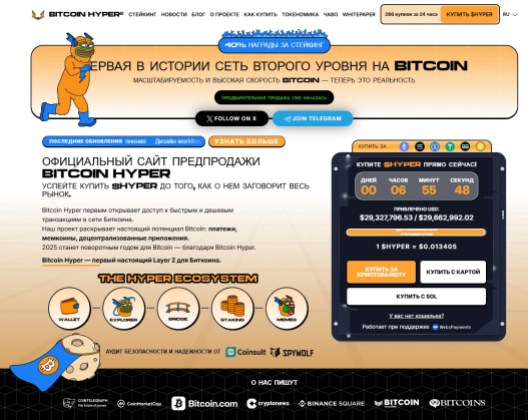
Architecturally, the message also hits a market nerve: a modular scheme where Bitcoin L1 acts as the base layer, and real calculations are moved to L2. Yes, the model has a compromise—a stated single trusted sequencer with periodic state anchoring in L1. The risk here is obvious: centralization of transaction sequencing and potential points of failure/censorship at the sequencer level (no matter how beautiful the bridge and SDK are). But here's what many miss: in the early stage, the market often buys not "perfect decentralization," but the speed of ecosystem launch and time to product-market fit. More precisely—a balance: a little less ideal today to not lose pace tomorrow.

Demand for the story is also supported by numbers: the presale has already raised $29.5 million at a token price of $0.013435. In addition, data on large addresses shows two notable purchases of approximately $396k; the largest transaction was about $53k (November 19, 2025). This is not a guarantee of growth, but a signal: some capital clearly wants exposure to the "Bitcoin L2 + fast smart contracts" narrative. And yes—for many, this looks more logical than just holding another "L1 for L1's sake."

What will decide the future is not the slogan, but three metrics: the quality of the bridge for BTC inflows, the actually achievable latency/execution cost, and the ability to attract builders (the Rust-oriented SDK plays a plus here). For understanding, it's useful to compare what the market is actually "buying" now: technology, brand, or liquidity—see the list of top coins for 2025.


Похожее

You Bet on the News, the Pros Read the Rules: The True Cognitive Gap in Losing Money on Polymarket

The article explains that the key to profiting on Polymarket, a prediction market platform, lies not just predicting real-world events correctly, but in meticulously understanding the specific rules that govern how each market will be resolved. It illustrates this with examples, such as a market on Venezuela's 2026 leader, where the official rules defining "officially holds" the office overruled the intuitive answer of who was in practical control. Other examples include debates over the definition of a "token" or what constitutes an "agreement." The core argument is that a "reality vs. rules" gap creates pricing discrepancies that savvy traders ("车头" or "whales") exploit. The platform has a formal dispute resolution process managed by UMA token holders to settle ambiguous outcomes. This process involves proposal submission, a challenge window, a discussion period, and a final vote. However, the article highlights a critical flaw in this system compared to a traditional court: the lack of separation between the arbiters (UMA voters) and the interested parties (traders with financial stakes in the outcome). This conflict of interest undermines the discussion phase, leads to herd mentality, and results in opaque final decisions without explanatory rulings. Consequently, the system lacks a body of precedent, making it difficult for users to learn from past disputes. The ultimate takeaway is that success on Polymarket requires a lawyer-like scrutiny of the rules to identify and capitalize on the cognitive gap between how events appear and how they are contractually defined for settlement.

marsbit49 мин. назад

You Bet on the News, the Pros Read the Rules: The True Cognitive Gap in Losing Money on Polymarket

marsbit49 мин. назад

Will the Fed Still Cut Interest Rates? Tonight's Data Is Crucial

The core debate surrounding the Federal Reserve's potential interest rate cuts is intensifying amid geopolitical conflict and rebounding inflation. The key question is whether high energy prices will cause persistent inflation or weaken consumer demand enough to force the Fed to cut rates. Citigroup presents a bullish case for cuts, arguing that oil supply disruptions from the Strait of Hormuz are temporary and will not lead to lasting inflationary pressure. They point to receding bond yields and oil prices as evidence the market is pricing in a short-lived shock. Citi's data also shows tightening financial conditions, a stabilizing labor market, and healthy tax returns, supporting their view that the path to lower rates remains open. Conversely, Deutsche Bank offers a starkly contrasting, more hawkish outlook. They argue the Fed's current policy is already neutral and expect rates to remain unchanged indefinitely. Their view is based on stalled disinflation progress and a shift toward more hawkish rhetoric from key Fed officials like Waller, who cited risks from prolonged Middle East conflict and tariffs. Other officials, including Williams and Hammack, signaled rates would likely stay on hold for a "considerable time." The market pricing has shifted dramatically, now forecasting zero cuts in 2026. The imminent release of the March retail sales "control group" data is highlighted as a critical test. This metric, which excludes gas station sales, will reveal if high gasoline prices are eroding consumer spending in other areas. A weak reading could support the case for imminent rate cuts, while a strong one would bolster the argument for the Fed to hold steady. This data is pivotal for determining the near-term policy path.

marsbit1 ч. назад

Will the Fed Still Cut Interest Rates? Tonight's Data Is Crucial

marsbit1 ч. назад

Торговля

Спот
Фьючерсы

Популярные статьи

Как купить S

Добро пожаловать на HTX.com! Мы сделали приобретение Sonic (S) простым и удобным. Следуйте нашему пошаговому руководству и отправляйтесь в свое крипто-путешествие.Шаг 1: Создайте аккаунт на HTXИспользуйте свой адрес электронной почты или номер телефона, чтобы зарегистрироваться и бесплатно создать аккаунт на HTX. Пройдите удобную регистрацию и откройте для себя весь функционал.Создать аккаунтШаг 2: Перейдите в Купить криптовалюту и выберите свой способ оплатыКредитная/Дебетовая Карта: Используйте свою карту Visa или Mastercard для мгновенной покупки Sonic (S).Баланс: Используйте средства с баланса вашего аккаунта HTX для простой торговли.Третьи Лица: Мы добавили популярные способы оплаты, такие как Google Pay и Apple Pay, для повышения удобства.P2P: Торгуйте напрямую с другими пользователями на HTX.Внебиржевая Торговля (OTC): Мы предлагаем индивидуальные услуги и конкурентоспособные обменные курсы для трейдеров.Шаг 3: Хранение Sonic (S)После приобретения вами Sonic (S) храните их в своем аккаунте на HTX. В качестве альтернативы вы можете отправить их куда-либо с помощью перевода в блокчейне или использовать для торговли с другими криптовалютами.Шаг 4: Торговля Sonic (S)С легкостью торгуйте Sonic (S) на спотовом рынке HTX. Просто зайдите в свой аккаунт, выберите торговую пару, совершайте сделки и следите за ними в режиме реального времени. Мы предлагаем удобный интерфейс как для начинающих, так и для опытных трейдеров.

1.1k просмотров всегоОпубликовано 2025.01.15Обновлено 2025.03.21

Как купить S

Sonic: Обновления под руководством Андре Кронье – новая звезда Layer-1 на фоне спада рынка

Он решает проблемы масштабируемости, совместимости между блокчейнами и стимулов для разработчиков с помощью технологических инноваций.

2.2k просмотров всегоОпубликовано 2025.04.09Обновлено 2025.04.09

Sonic: Обновления под руководством Андре Кронье – новая звезда Layer-1 на фоне спада рынка

HTX Learn: Пройдите обучение по "Sonic" и разделите 1000 USDT

HTX Learn — ваш проводник в мир перспективных проектов, и мы запускаем специальное мероприятие "Учитесь и Зарабатывайте", посвящённое этим проектам. Наше новое направление .

1.8k просмотров всегоОпубликовано 2025.04.10Обновлено 2025.04.10

HTX Learn: Пройдите обучение по "Sonic" и разделите 1000 USDT

Обсуждения

Добро пожаловать в Сообщество HTX. Здесь вы сможете быть в курсе последних новостей о развитии платформы и получить доступ к профессиональной аналитической информации о рынке. Мнения пользователей о цене на S (S) представлены ниже.

活动图片