Bankless | Hyperliquid's Epic Battle in 2025, Can It Hold Its Ground in 2026?

比推Опубликовано 2025-12-11Обновлено 2025-12-11

Введение

Hyperliquid dominated the perpetual futures exchange landscape in 2025, rising from a major airdrop in late 2024 to become the fourth-largest crypto ecosystem by revenue, earning over $650 million and at one point capturing 70% of all perp trading volume. Its success was driven by a crypto-native strategy, including quickly listing trending tokens like TRUMP, the launch of its HyperEVM smart contract layer, and key integrations with major wallets like Phantom and MetaMask via its builder codes program. However, facing rising competition from platforms like Aster and Lighter, along with an automatic deleveraging (ADL) event and team token unlocks in Q4, Hyperliquid’s market share fell to around 17% by year-end. The question for 2026 is whether it can maintain its lead through organic growth and decentralization as the perp market grows more competitive.

Author: David Christopher

Original Title: Hyperliquid & The Year Perps Caught Fire

Compiled and Edited: BitpushNews


The frenzy around perpetual contract exchanges swept through 2025, and Hyperliquid led the charge. As competition intensifies, can it maintain its lead?

Looking back at the crypto industry's growth in 2025, Hyperliquid is an unavoidable focal point.

The exchange ended 2024 with an epic airdrop and price performance, drawing massive attention from Crypto Twitter back to the product.

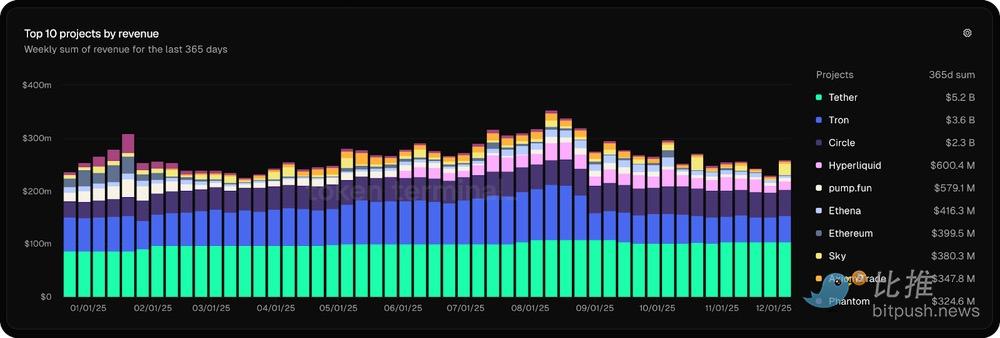
By the end of 2025, it had completely transformed—becoming a paradigm-breaking platform, ranking fourth in revenue across the entire crypto ecosystem with total revenue exceeding $650 million, and at one point capturing 70% of the perpetual contract trading volume.

(Data Source: Token Terminal)

If you haven't been tracking Hyperliquid's every move, this breakthrough success might seem to have come out of nowhere. But its path to conquest was the product of meticulous design, unconventional growth strategies, and well-deserved external recognition.

Here is a complete review of Hyperliquid's journey through 2025 (and why it will be truly tested in 2026):

Q1 2025: The Crypto-Native Edge

Hyperliquid's year of rapid growth began with a stark reminder of what it means to be truly in tune with the industry.

When the TRUMP token launched in January, Hyperliquid listed perpetual contracts almost immediately, beating other exchanges to the punch and kickstarting its winning streak as the "go-to venue for pre-launch token trading."

Of course, its ability to move fast was because it wasn't hindered by the "corporate guardrails" that large exchanges use to protect users and the company.

But a key factor was its firm "inside knowledge"—its team is deeply intertwined with on-chain dynamics, able to spot opportunities and recognize the advantage of being first to list these tokens. This solidified Hyperliquid's reputation as the preferred place to trade new assets before the established giants could react.

In February, HyperEVM was released—a general-purpose smart contract layer built on top of HyperCore (Hyperliquid's exchange engine). Although it took some time to find its footing, its success came without any top-down incentive programs. This meant that when it gained traction in Q2, it had already built a core user base who stayed not for "farming" rewards, but because they believed in the chain's vision and wanted to leverage its unique features (like interoperability with HyperCore), rather than just extracting incentives.

Q2 2025: The Breakout

Market attention came faster than most expected. Besides the HYPE token rising nearly 4x from its April lows, by May Hyperliquid captured 70% of all on-chain perpetual trading volume—a staggering figure for a platform with zero VC backing and zero token incentives.

The HYPE token's highs, the explosive growth of HyperCore activity, and the development of the HyperEVM ecosystem all spread the Hyperliquid story.

As the market came back to life, Hyperliquid's smooth user experience (UX) and deep liquidity captured a massive order flow, with total trading volume climbing to $1.5 trillion.

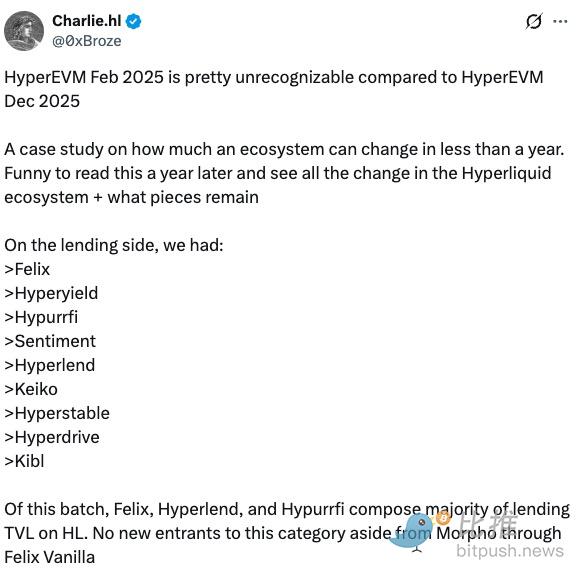
As mentioned, HyperEVM also hit its stride simultaneously, with its Total Value Locked (TVL) growing from $350 million in April to $1.8 billion by mid-June, fueled by the launch of projects (like Kinetiq, Felix, and Liminal) and users exploring new earning opportunities—all while continuously burning HYPE tokens in the background.

Amid this rapid growth, Hyperliquid seemed to be everywhere.

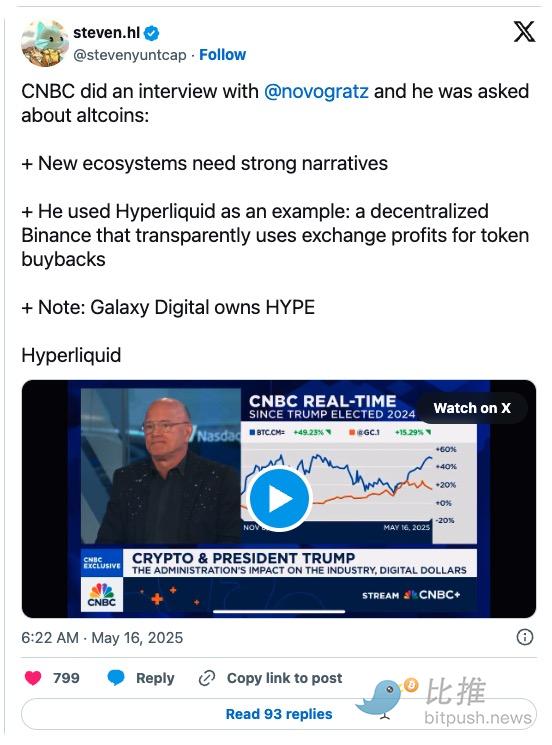
It appeared on national TV, was covered by Bloomberg, and became a focal point in CFTC policy discussions. This exchange became impossible to ignore.

Q3 2025: Peak Momentum and the Beginning of Fragmentation

Q3 began with a signal that Hyperliquid's infrastructure was becoming indispensable even outside its own ecosystem.

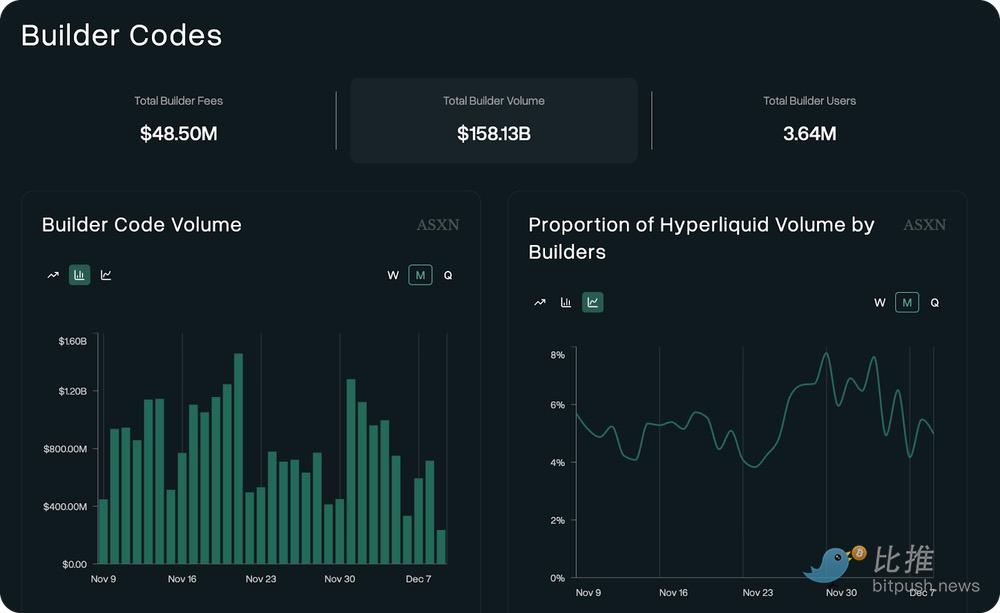
Phantom wallet bypassed Solana-based perpetual platforms, choosing to integrate Hyperliquid via builder codes. Builder codes are a Hyperliquid mechanism that allows external platforms to earn fees by routing trades to HyperCore.

Rabby followed suit. Then MetaMask.

A wave of mobile trading apps went live via builder codes.

In total, through these integrations, "partners" have earned nearly $50 million in fees, routing $158 billion in trading volume.

(Data Source: Hyperscreener)

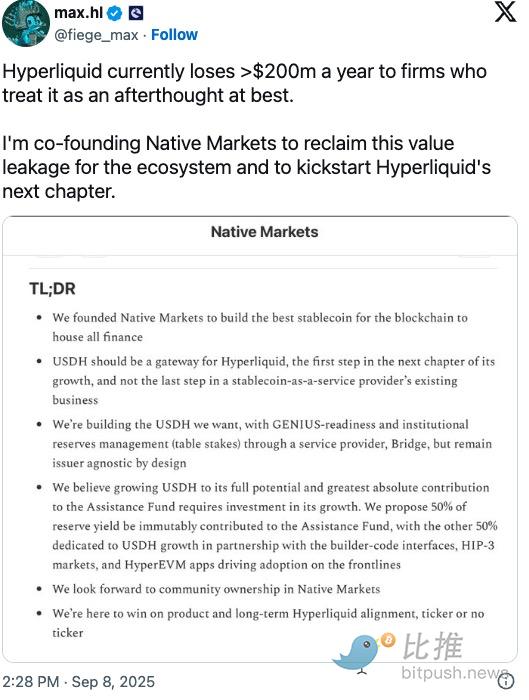
Then, in September, the USDH bidding war erupted—revealing just how valuable and prominent Hyperliquid had become.

The issue was simple: Hyperliquid held about 8% of Circle's USDC supply in its bridge, leaking roughly $100 million in annual yield to a direct competitor (Coinbase), while Hyperliquid's own ecosystem couldn't recapture these earnings. Launching a native stablecoin could solve this, potentially redirecting $200 million in annual revenue back to Hyperliquid.

A proposal for issuing a stablecoin was invited, and heavyweights joined the bidding.

Ethena offered a $75 million growth commitment and institutional partnerships. Paxos dangled PayPal and Venmo integrations, even getting PayPal to tweet about Hyperliquid.

But ultimately, Native Markets won the bid—a team led by respected HYPE contributor Max Fiege, former Uniswap Labs COO MC Lader, and Paradigm researcher Anish Agnihotri.

Why did a smaller, less capitalized team beat these giants? Because they were more favored, more aligned with Hyperliquid's ethos: bootstrapped, aligned in goals, and ready to build something truly genuine—just like Hyperliquid itself was built.

The ripple effects extended beyond Hyperliquid itself. MegaETH soon announced its own native stablecoin plans. Sui followed suit in November.

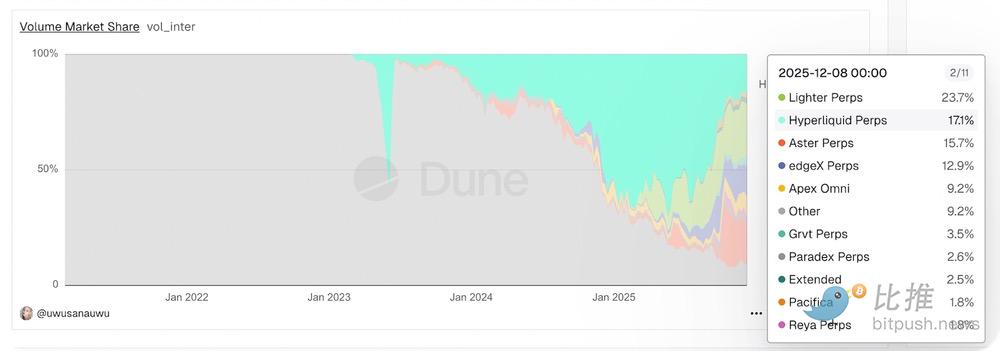
However, USDH also marked the peak of the HYPE token in mid-September—and the moment competition began to show. Aster (a Binance-backed exchange supported by CZ) and Lighter (an Ethereum L2 perpetual platform) both launched with aggressive airdrop campaigns. Trading volume continued to fragment, Hyperliquid's market share split, standing at just 17.1% at the time of writing.

(Data Source: @uwusanauwu | Dune)

Q4 2025: Maturation and Growing Pains

In October, the long-awaited HIP-3 went live, enabling permissionless listings on HyperCore, driving the exchange's expansion and decentralization.

Anyone staking 500,000 HYPE can now deploy custom markets, such as:

  • Equity perpetuals from Unit's Trade.xyz and Felix Protocol

  • Perpetual markets using yield-bearing collateral like sUSDE from protocols like Ethena

  • Markets offering synthetic exposure to private companies like SpaceX or Anthropic via platforms like Ventuals

However, despite the HIP-3 launch, the HYPE token price fell nearly 50% from its September peak.

Why? Besides market conditions and competition, two things stood out.

First, this quarter Hyperliquid experienced its first ADL (Auto-Deleveraging) event in over two years. During the market crash on October 10th, over-leveraged positions drained margin faster than the liquidation engine and HLP (Hyperliquid Liquidity Provider) could absorb. The protocol triggered over 40 auto-deleveragings in 12 minutes, forcibly reducing the most profitable positions to rebalance the books. While some argued the affected positions were still "closed in profit," others contended the mechanism liquidated more than necessary to cover the bad debt. Yes, the system remained solvent without external capital injection, but Hyperliquid, like the broader market, might need time to recover from this event.

Second, in November, team token unlocks began. Although the total unlocked was lower than expected, this vesting schedule likely also contributed to HYPE's underperformance. The sell-off volume was small—only 23% went to OTC desks, while 40% was re-staked—but the pace of future unlocks remains unclear. My interpretation is the core team might still be finalizing the schedule to balance contributor fairness with ecosystem health. But for a protocol known for transparency and "honesty," this ambiguity might cause market unease.

Hyperliquid's first unlock released 1.75 million HYPE after the lock-up period ended, but the pace of future team unlocks hasn't been fully disclosed.

The Perpetual Proving Ground

Despite the cooling market and trading activity, we shouldn't overlook the profound evolution the perpetual ecosystem has undergone alongside Hyperliquid's own development when trying to understand Hype's underperformance.

Lighter and Aster are just two examples of on-chain competition. Although their volumes might be inflated by airdrop hunting, they do offer real alternatives.

In the off-chain realm, Coinbase's perpetual product will soon compete with Robinhood's moves in this space. As perpetuals continue going mainstream, more competitors will emerge.

In other words, Hyperliquid is in its proving phase, and it will continue into 2026.

The question isn't whether it truly had a remarkable 2025—it did. The question is, as the space gets crowded, can this exchange prove that its path to growth through integrations like builder codes and decentralized models like HIP-3 still holds an advantage.

What got them here was building a better product and a better ecosystem, without taking shortcuts. What keeps them ahead will be doing it all over again.


Twitter:https://twitter.com/BitpushNewsCN

Bitpush TG Discussion Group:https://t.me/BitPushCommunity

Bitpush TG Subscription: https://t.me/bitpush
Original Link:https://www.bitpush.news/articles/7595102

Связанные с этим вопросы

QWhat were the key factors that contributed to Hyperliquid's dominant position in the perpetual futures market in 2025?

AHyperliquid's success was driven by its crypto-native agility in quickly listing new tokens like TRUMP, its zero VC backing and token incentives, the launch of HyperEVM which built an organic user base, superior user experience with deep liquidity, and strategic integrations via builder codes with major wallets like Phantom and MetaMask.

QHow did Hyperliquid's market share in perpetual futures trading change throughout 2025, and what caused the decline?

AHyperliquid reached a peak of 70% market share in Q2 2025 but declined to around 17.1% by year-end due to increased competition from platforms like Aster and Lighter, which used aggressive airdrop campaigns, and market fragmentation from new entrants.

QWhat was the significance of the USDH bidding war, and which team won it?

AThe USDH bidding war was significant because it aimed to create a native stable币 to recapture ~$200M in annual yields leaking to competitors. Native Markets, led by Max Fiege, MC Lader, and Anish Agnihotri, won the bid by aligning with Hyperliquid's bootstrapped and organic ethos, despite larger offers from Ethena and Paxos.

QWhat challenges did Hyperliquid face in Q4 2025 that impacted its performance?

AIn Q4, Hyperliquid faced an Automatic Deleveraging (ADL) event during a market crash, triggering over 40 ADLs in 12 minutes, and began team token unlocks, which created market uncertainty despite low initial sell pressure. These factors contributed to a nearly 50% drop in HYPE token price from its September peak.

QWhat is HIP-3, and how did it affect Hyperliquid's ecosystem?

AHIP-3 enabled permissionless listings on HyperCore, allowing anyone staking 500,000 HYPE to deploy custom markets like stock perpetuals, yield-bearing collateral markets, and synthetic exposure to private companies. It expanded Hyperliquid's offerings and decentralization but coincided with market challenges.

Похожее

Apple Also Has to Pay Rent Now

Apple Pays Rent Too: The Two-Way Flow of "Traffic Tax" and "AI Capability Rent" Between Tech Giants For over two decades, Google has paid Apple an estimated $20 billion annually to remain the default search engine on Safari, a "traffic tax" for a critical user entry point. However, in 2026, the direction of this cash flow partially reversed. Apple agreed to pay Google roughly $1 billion per year to license its Gemini AI models, as Apple's own models reportedly struggled with complex tasks. This creates a unique dynamic: Apple acts as the "landlord" in the established search ecosystem, collecting rent from Google for access. Simultaneously, in the emerging AI arena, Apple becomes the "tenant," paying Google for access to cutting-edge AI capabilities it cannot currently match internally. While Apple claims its new models are "distilled" from Gemini outputs and contain "not a drop" of Google's original code, core dependencies remain. Its knowledge base is refined using Gemini's outputs, and its most powerful cloud model runs on Google's infrastructure. Apple has structured the deal as non-exclusive, allowing it to theoretically switch AI suppliers—a hedge against over-reliance. The future hinges on whether advanced AI models become a commodity (cheap and abundant) or remain a concentrated, scarce resource (expensive and controlled by few). Apple is betting on the former, leveraging its massive device ecosystem to be a powerful, choosy customer. If the latter proves true, its bargaining power could erode. This power dynamic is extending to developers. Apple, Google, and WeChat are all pushing for apps to expose their core functions as standardized "actions" or "intents" that their respective AI assistants (Siri, Gemini, WeChat AI) can directly call. The new scarce resource is no longer just app store visibility, but "being selected by the AI." The currency of "rent" has changed from a 30% revenue share to ceding control over how users interact with an app's functions.

marsbit1 ч. назад

Apple Also Has to Pay Rent Now

marsbit1 ч. назад

Missed the SpaceX IPO? WEEX's "First Trade Protection" Lets You Experience US Stock Trading Risk-Free.

With the excitement around SpaceX's recent public listing reigniting interest in the US stock market, Chinese investors face significant challenges accessing compliant and convenient trading channels following regulatory actions against major online brokers. This article explores the available options, highlighting their risks and limitations. Traditional paths for US stock investments remain problematic. Qualified Domestic Institutional Investor (QDII) and Listed Open-Ended Fund (LOF) products, while compliant, suffer from high fees, significant purchase premiums, and a very limited selection of assets. Small, unregulated offshore brokers pose substantial risks, including potential insolvency. While secure, VIP accounts at banks in Hong Kong or Singapore require high minimum deposits (often 1-2 million RMB) and in-person visits, placing them out of reach for most retail investors. The article positions cryptocurrency exchanges, specifically their TradFi (traditional finance on-chain) offerings, as a compelling alternative. Platforms like WEEX are noted for providing access to a wide range of US stocks and ETFs, including SpaceX (SPCXON), through tokenized assets. This method offers advantages such as a single account for both crypto and traditional assets, USDT-based settlement avoiding fiat complexities, flexible leverage, and robust risk management. To attract users, WEEX is promoting a "First Trade Guarantee" campaign. Running from June 15 to July 8 (UTC+8), it features a $30,000 prize pool. Users who trade $500 worth of US stock contracts can qualify for a guarantee on their first eligible trade: 100% loss coverage up to $30 or a 20% bonus on profits up to $30. The campaign is presented as a low-risk opportunity for both crypto natives and traditional investors to experience US stock trading.

marsbit1 ч. назад

Missed the SpaceX IPO? WEEX's "First Trade Protection" Lets You Experience US Stock Trading Risk-Free.

marsbit1 ч. назад

How Difficult is Chip Making? A Division Error Costs 475 Million Dollars

How Hard Is It to Make a Chip? A Division Error Cost $475 Million Chip expert Shi Kan, a researcher at the Chinese Academy of Sciences and a popular tech creator, explains the immense challenges of chip development. Chips are foundational to modern technology, but their creation is extraordinarily difficult. The journey from sand to a functional chip involves complex design and manufacturing, but a critical bottleneck is verification—ensuring the design works flawlessly before costly production. A single, undetected bug can have catastrophic consequences, as illustrated by the infamous 1994 Intel Pentium FDIV bug. A flaw in the floating-point division unit forced a recall costing $475 million. Unlike software, chips cannot be easily patched after manufacture, making "first-time success" paramount. However, industry surveys show only 24% of chip projects achieve this; over three-quarters require at least one costly re-spin due to design flaws. Verification has thus become the dominant phase, consuming up to 70% of the design cycle. The core challenge is a "verification impossible triangle" between high performance, good debuggability, and low cost. Exhaustively verifying a modern CPU core could take 15,000 years with software simulation, or 30 years with advanced hardware emulation—timeframes utterly impractical for development. Despite being essential, verification is often seen as unglamorous "dirty work," receiving less academic attention than fields like AI. Shi and his team are tackling this by developing an agile verification research framework called ENCORE, based on FPGA technology, to improve verification efficiency and debug capability. Beyond research, Shi engages in public science communication through long-form video content, aiming to demystify chip technology, AI, and computer science. He argues for the value of pursuing "hard and long-term" endeavors, whether in the meticulous world of chip verification or in creating substantive educational content, believing such sustained effort is likely the right path forward.

marsbit1 ч. назад

How Difficult is Chip Making? A Division Error Costs 475 Million Dollars

marsbit1 ч. назад

Торговля

Спот
Фьючерсы

Популярные статьи

Как купить S

Добро пожаловать на HTX.com! Мы сделали приобретение Sonic (S) простым и удобным. Следуйте нашему пошаговому руководству и отправляйтесь в свое крипто-путешествие.Шаг 1: Создайте аккаунт на HTXИспользуйте свой адрес электронной почты или номер телефона, чтобы зарегистрироваться и бесплатно создать аккаунт на HTX. Пройдите удобную регистрацию и откройте для себя весь функционал.Создать аккаунтШаг 2: Перейдите в Купить криптовалюту и выберите свой способ оплатыКредитная/Дебетовая Карта: Используйте свою карту Visa или Mastercard для мгновенной покупки Sonic (S).Баланс: Используйте средства с баланса вашего аккаунта HTX для простой торговли.Третьи Лица: Мы добавили популярные способы оплаты, такие как Google Pay и Apple Pay, для повышения удобства.P2P: Торгуйте напрямую с другими пользователями на HTX.Внебиржевая Торговля (OTC): Мы предлагаем индивидуальные услуги и конкурентоспособные обменные курсы для трейдеров.Шаг 3: Хранение Sonic (S)После приобретения вами Sonic (S) храните их в своем аккаунте на HTX. В качестве альтернативы вы можете отправить их куда-либо с помощью перевода в блокчейне или использовать для торговли с другими криптовалютами.Шаг 4: Торговля Sonic (S)С легкостью торгуйте Sonic (S) на спотовом рынке HTX. Просто зайдите в свой аккаунт, выберите торговую пару, совершайте сделки и следите за ними в режиме реального времени. Мы предлагаем удобный интерфейс как для начинающих, так и для опытных трейдеров.

1.5k просмотров всегоОпубликовано 2025.01.15Обновлено 2026.06.02

Как купить S

Sonic: Обновления под руководством Андре Кронье – новая звезда Layer-1 на фоне спада рынка

Он решает проблемы масштабируемости, совместимости между блокчейнами и стимулов для разработчиков с помощью технологических инноваций.

2.3k просмотров всегоОпубликовано 2025.04.09Обновлено 2025.04.09

Sonic: Обновления под руководством Андре Кронье – новая звезда Layer-1 на фоне спада рынка

HTX Learn: Пройдите обучение по "Sonic" и разделите 1000 USDT

HTX Learn — ваш проводник в мир перспективных проектов, и мы запускаем специальное мероприятие "Учитесь и Зарабатывайте", посвящённое этим проектам. Наше новое направление .

1.8k просмотров всегоОпубликовано 2025.04.10Обновлено 2025.04.10

HTX Learn: Пройдите обучение по "Sonic" и разделите 1000 USDT

Обсуждения

Добро пожаловать в Сообщество HTX. Здесь вы сможете быть в курсе последних новостей о развитии платформы и получить доступ к профессиональной аналитической информации о рынке. Мнения пользователей о цене на S (S) представлены ниже.

活动图片