Aptos introduces post-quantum signatures before they’re urgently needed

cointelegraphОпубликовано 2025-12-18Обновлено 2025-12-18

Введение

Aptos is advancing a proposal to introduce post-quantum digital signatures as an optional security upgrade, addressing growing concerns that future quantum computers could eventually break current cryptographic systems. The Aptos Improvement Proposal AIP-137 would integrate the SLH-DSA (FIPS 205) signature scheme at the account level, making Aptos one of the first major blockchains to natively support quantum-resistant accounts. Existing accounts would remain unchanged, and adoption would be opt-in. This move reflects broader industry attention to quantum risks, with other networks like Solana also testing quantum-resistant solutions. While some in the crypto space, including Bitcoin pioneers, view the quantum threat as distant or overhyped, Aptos and others are taking proactive steps to prepare for a post-quantum era.

Blockchain network Aptos is moving toward a post-quantum signature option, reflecting growing concern that advances in quantum computing are no longer purely theoretical and could eventually affect how blockchain networks secure accounts and transactions.

On Thursday, Aptos outlined a proposal to introduce post-quantum signatures, addressing the network’s reliance on digital signatures for ownership, transaction authorization and overall security.

While existing cryptographic schemes remain secure against classical computers, researchers warn that sufficiently powerful quantum machines could one day forge them, potentially compromising account security retroactively.

“Quantum computing is not a distant spectre anymore,” Aptos Labs wrote in a post on X, pointing to early discussions around quantum scaling by IBM and growing regulatory momentum, including the publication of post-quantum cryptography standards by the US National Institute of Standards and Technology (NIST).

“This matters for networks like Aptos because Cryptographically Relevant Quantum Computers (CRQCs) can make today’s signature schemes forgeable, possibly breaking security models,” the post said.

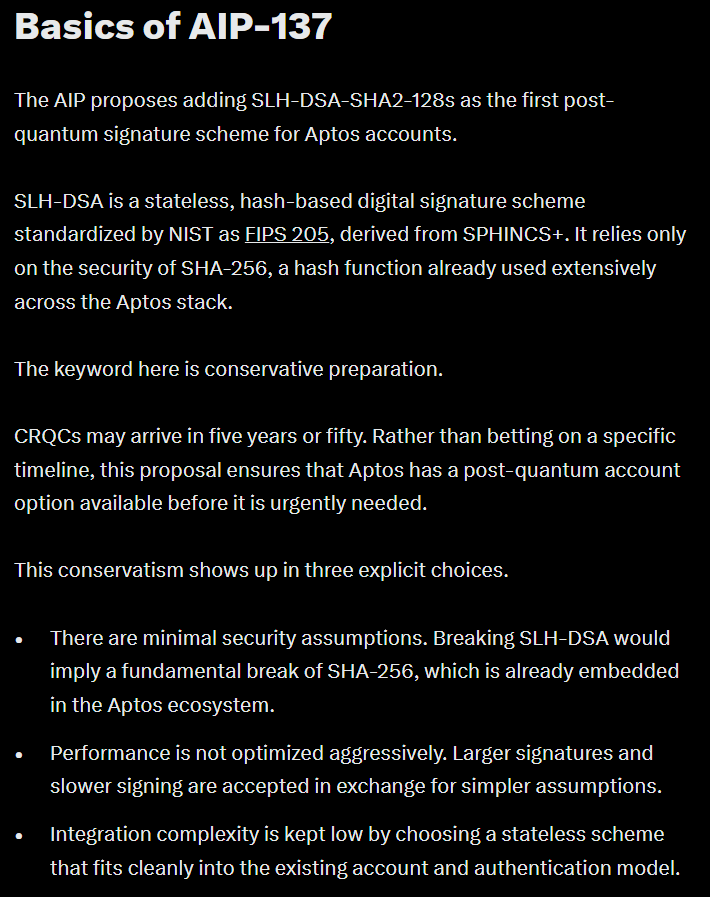
In response, developers have proposed AIP-137, an Aptos Improvement Proposal authored by cryptographers at Aptos Labs, which would add support for a post-quantum signature scheme at the account level.
Source: Aptos Labs

If approved through governance, AIP-137 would introduce SLH-DSA, a hash-based digital signature scheme standardized as FIPS 205, as an optional account signature type. The change would make Aptos one of the earliest production blockchains to natively support post-quantum accounts.

However, existing accounts would remain unaffected. Post-quantum accounts would be opt-in only, allowing users to adopt selectively.

Aptos is one of the larger layer-1 proof-of-stake blockchains, designed primarily to support decentralized applications. Earlier this year, its head of ecosystem, Ash Pampati, told Cointelegraph that consumer-focused applications were gaining traction on the network, particularly those blending elements of Web2 and Web3.

As Cointelegraph previously reported, Aptos has also emerged as a venue for tokenized real-world assets, with asset managers including Franklin Templeton and BlackRock deploying products on the network.

Related: Google announces quantum advantage, 13,000 times faster than supercomputers

The race against quantum

While many in the crypto industry argue that quantum threats to blockchains, particularly Bitcoin, remain years away, networks are increasingly taking preparatory steps, with Aptos far from alone in doing so.

Earlier this month, Solana tested quantum-resistant transactions on a dedicated testnet, an experiment aimed at evaluating how post-quantum signature schemes could be integrated into its transaction model without disrupting existing accounts.

Within the Bitcoin community, a smaller but vocal group of developers, researchers and fund managers has also begun pushing for faster progress on quantum-resistant cryptography.

Some have rallied around BIP-360, a proposed Bitcoin Improvement Proposal that would introduce quantum-resistant signature options. However, the idea remains in its early stages and is subject to debate.
Source: Adam Back

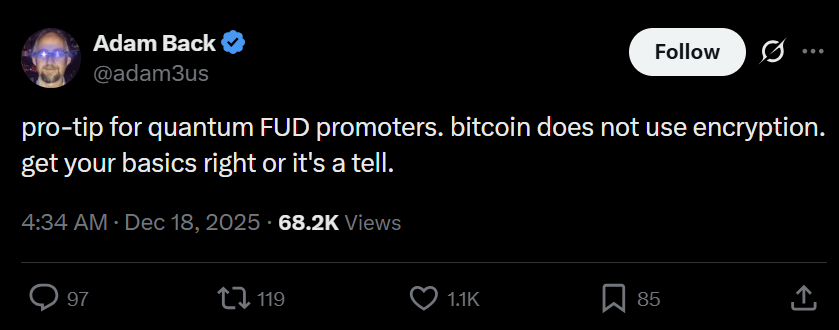
Others, including early Bitcoin figure Adam Back, have dismissed near-term quantum concerns as a form of fear, uncertainty and doubt, or FUD, arguing that Bitcoin does not rely on encryption for its core security model. Instead, Bitcoin uses digital signature schemes and cryptographic hash functions, which are not imminently threatened by practical quantum computers.

Related: Are quantum computers stealing Bitcoin? Inside Josh Mandell’s claim and the pushback


Связанные с этим вопросы

QWhat is the main reason Aptos is introducing post-quantum signatures?

AAptos is introducing post-quantum signatures due to growing concern that advances in quantum computing could eventually compromise the network's security by making today's digital signature schemes forgeable.

QWhat specific proposal has Aptos Labs put forward for post-quantum signatures?

AAptos Labs has proposed AIP-137, which would add support for the SLH-DSA (FIPS 205) hash-based digital signature scheme as an optional account signature type.

QWill existing Aptos accounts be automatically upgraded to post-quantum security?

ANo, existing accounts will remain unaffected. The post-quantum account option will be opt-in only, allowing users to adopt it selectively.

QBesides Aptos, which other blockchain network has recently tested quantum-resistant technology?

ASolana tested quantum-resistant transactions on a dedicated testnet earlier this month to evaluate integration of post-quantum signature schemes.

QWhat is the name of the proposed Bitcoin Improvement Proposal for quantum resistance mentioned in the article?

AThe proposed Bitcoin Improvement Proposal for quantum-resistant signature options is BIP-360.

Похожее

Why Do You Always Lose Money on Polymarket? Because You're Betting on News, While the Pros Read the Rules

Why do you always lose money on Polymarket? Because you bet on news, while the pros study the rules. This article explains how top traders ("che tou") profit by meticulously analyzing market rules, not just predicting events. Polymarket, a prediction market platform, often sees disputes over event outcomes due to ambiguous rule wording. For instance, a market asking "Who will be the leader of Venezuela by the end of 2026?" was misinterpreted by many who bet on Delcy Rodríguez, assuming she held power. However, the rules specified "officially holds" as the formally appointed, sworn-in individual. Since Nicolás Maduro was still recognized as president officially, he won the market—even being in prison. To resolve such disputes, Polymarket uses a decentralized arbitration system via UMA protocol. The process involves: 1. Proposal: Anyone can propose a market outcome by staking 750 USDC, earning 5 USDC if unchallenged. 2. Dispute: A 2-hour window allows challenges with a 750 USDC stake; successful challengers earn 250 USDC. 3. Discussion: A 48-hour period on UMA Discord for evidence and debate. 4. Voting: UMA token holders vote in two 24-hour phases (blind then public). Outcomes require >65% consensus and 5M tokens voted; otherwise, four re-votes occur before Polymarket intervention. 5. Settlement: Results are final and automatic. Unlike traditional courts, Polymarket’s system lacks separation between arbitrators and stakeholders—voters often hold market positions, creating conflicts of interest. This leads to herd mentality in discussions and non-transparent outcomes without explanatory rulings, preventing precedent formation. Thus, success on Polymarket hinges on deep rule interpretation, not just event prediction, exploiting gaps between reality and contractual wording.

marsbit2 ч. назад

Why Do You Always Lose Money on Polymarket? Because You're Betting on News, While the Pros Read the Rules

marsbit2 ч. назад

DeepSeek Funding: Liang Wenfeng's 'Realist' Pivot

DeepSeek, a leading Chinese AI company, has initiated its first external funding round, aiming to raise at least $300 million at a valuation of no less than $10 billion. This move marks a significant shift from its founder Liang Wenfeng’s previous idealistic stance of rejecting external capital to maintain independence. Despite strong financial backing from its parent company, quantitative trading firm幻方量化 (Huanfang Quant), which provided an estimated $700 million in revenue in 2025 alone, DeepSeek faces mounting challenges. Key issues include a 15-month gap in major model updates, delays in its flagship V4 release, and the loss of several core researchers to competitors offering significantly higher compensation. The company is also undergoing a strategic pivot by migrating its infrastructure from NVIDIA’s CUDA to Huawei’s Ascend platform, a move aligned with China’s push for technological self-reliance amid U.S. export controls. However, DeepSeek lags behind rivals like智谱AI and MiniMax—both now publicly listed—in areas such as product ecosystem, multimodal capabilities, and commercialization. The funding round, though relatively small in scale, is seen as a way to establish a market-validated valuation anchor, making employee stock options more competitive and facilitating talent retention. It also signals DeepSeek’s transition from a pure research-oriented organization to a commercially-driven player in the global AI ecosystem.

marsbit2 ч. назад

DeepSeek Funding: Liang Wenfeng's 'Realist' Pivot

marsbit2 ч. назад

Торговля

Спот
Фьючерсы

Популярные статьи

Как купить BASED

Добро пожаловать на HTX.com! Мы сделали приобретение Based (BASED) простым и удобным. Следуйте нашему пошаговому руководству и отправляйтесь в свое крипто-путешествие.Шаг 1: Создайте аккаунт на HTXИспользуйте свой адрес электронной почты или номер телефона, чтобы зарегистрироваться и бесплатно создать аккаунт на HTX. Пройдите удобную регистрацию и откройте для себя весь функционал.Создать аккаунтШаг 2: Перейдите в Купить криптовалюту и выберите свой способ оплатыКредитная/Дебетовая Карта: Используйте свою карту Visa или Mastercard для мгновенной покупки Based (BASED).Баланс: Используйте средства с баланса вашего аккаунта HTX для простой торговли.Третьи Лица: Мы добавили популярные способы оплаты, такие как Google Pay и Apple Pay, для повышения удобства.P2P: Торгуйте напрямую с другими пользователями на HTX.Внебиржевая Торговля (OTC): Мы предлагаем индивидуальные услуги и конкурентоспособные обменные курсы для трейдеров.Шаг 3: Хранение Based (BASED)После приобретения вами Based (BASED) храните их в своем аккаунте на HTX. В качестве альтернативы вы можете отправить их куда-либо с помощью перевода в блокчейне или использовать для торговли с другими криптовалютами.Шаг 4: Торговля Based (BASED)С легкостью торгуйте Based (BASED) на спотовом рынке HTX. Просто зайдите в свой аккаунт, выберите торговую пару, совершайте сделки и следите за ними в режиме реального времени. Мы предлагаем удобный интерфейс как для начинающих, так и для опытных трейдеров.

273 просмотров всегоОпубликовано 2026.03.30Обновлено 2026.03.30

Как купить BASED

Неделя обучения по популярным токенам 10: Обновление Alpenglow ожидается в первой половине 2026 года, долгосрочный прогноз по XAUT и XAG остается позитивным

Ожидается, что в первой половине 2026 года начнется развертывание масштабного обновления Alpenglow SOL.

1.1k просмотров всегоОпубликовано 2026.03.31Обновлено 2026.03.31

Неделя обучения по популярным токенам 10: Обновление Alpenglow ожидается в первой половине 2026 года, долгосрочный прогноз по XAUT и XAG остается позитивным

Обсуждения

Добро пожаловать в Сообщество HTX. Здесь вы сможете быть в курсе последних новостей о развитии платформы и получить доступ к профессиональной аналитической информации о рынке. Мнения пользователей о цене на A (A) представлены ниже.

活动图片