Amid Stock Market Highs, Bond and Oil Markets Are Still 'Casting Dissenting Votes'

marsbitОпубликовано 2026-04-16Обновлено 2026-04-16

Введение

The stock market has fully recovered its losses from the U.S.-Iran conflict, with the S&P 500 nearing all-time highs. However, bond and crude oil markets are signaling a different story. While equities are pricing in an optimistic scenario—low inflation, Fed rate cuts, contained costs, and conflict resolution—bond yields and oil prices suggest persistent inflation, limited Fed flexibility, and ongoing geopolitical risk. The 10-year Treasury yield has risen 30 basis points since the conflict began, reflecting inflation concerns rather than growth optimism. WTI crude is up 37%, indicating the market does not anticipate a near-term resolution to Middle East tensions. The 2-year yield, sensitive to Fed policy expectations, has increased 40 bps, challenging the narrative of imminent rate cuts. This divergence suggests the equity rally may be driven more by momentum than fundamentals. If upcoming inflation data exceeds expectations or geopolitical risks persist, stocks may need to correct downward to align with the realities reflected in bonds and oil. The author remains cautious, preferring to wait for clearer signals rather than chase a rally unsupported by key asset classes.

Original Title: The Bond Market Isn't Buying This Rally. Neither Am I.

Original Author: KURT S. ALTRICHTER, CRPS

Original Compilation: Peggy, BlockBeats

Editor's Note: As the stock market quickly recovers its wartime losses and approaches historical highs, a narrative that 'risks have been cleared' is once again taking dominance. However, this article reminds us that if we only look at the equity market, it is easy to misjudge the current real environment.

The signals from bonds and oil are inconsistent: rising interest rates and high oil prices point to sticky inflation, limited policy space for the Federal Reserve, and geopolitical conflicts that have not truly subsided. In contrast, the stock market is simultaneously pricing in low inflation, the restart of interest rate cuts, controllable costs, and conflict resolution—a highly idealized set of premises.

The author believes that this rally is driven more by momentum than fundamentals. Driven by trading behavior of 'fear of missing out,' prices can deviate from reality in the short term but must eventually return to the range determined by macroeconomic variables.

When divergences occur between different asset classes, the real risk often lies not in who is right or wrong, but in how this divergence is resolved. The current issue is not whether the market is optimistic, but whether this optimism has run ahead of the data.

Below is the original text:

"Rule Two: Excessive volatility in one direction often triggers excessive reversals in the opposite direction." — Bob Farrell

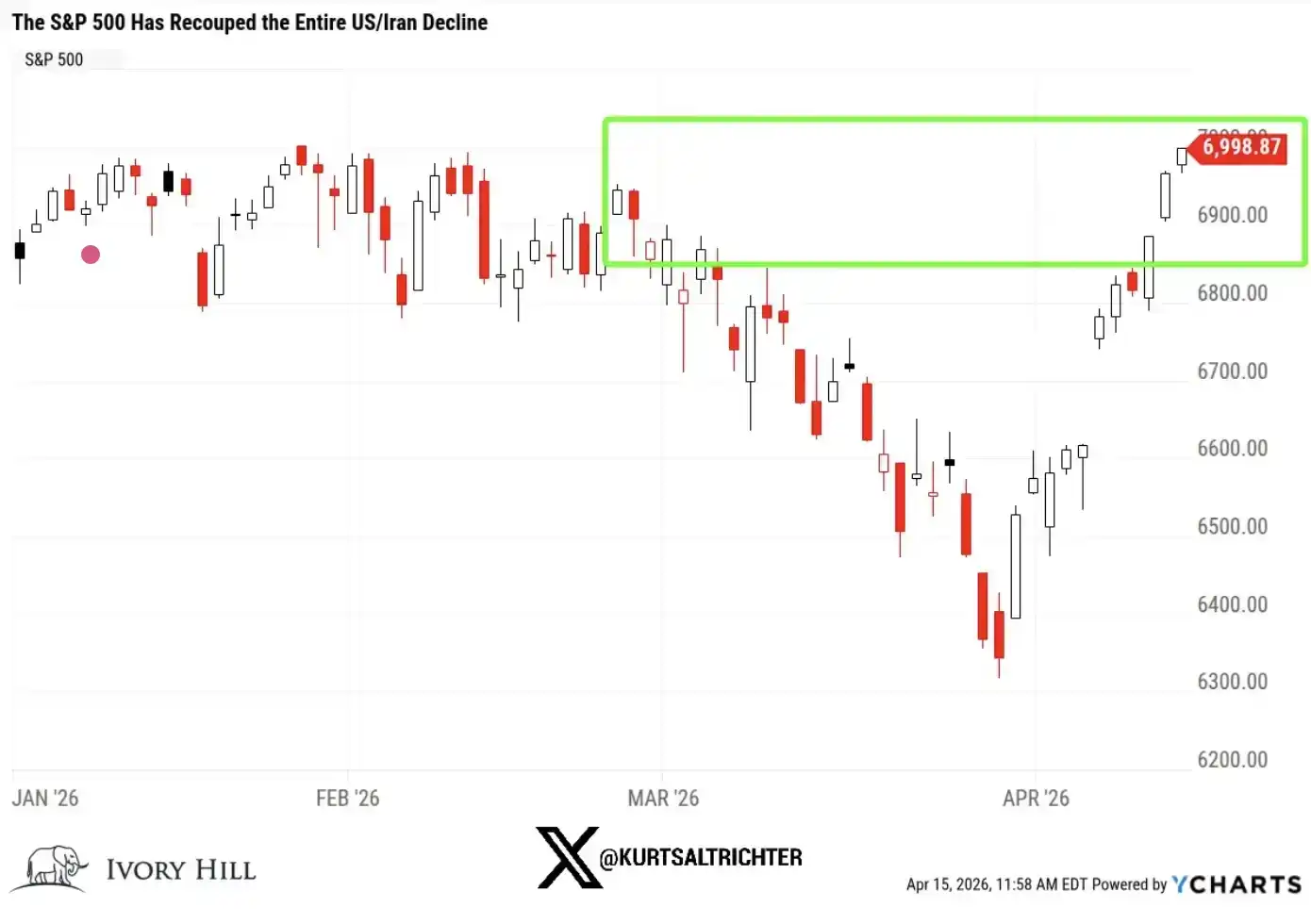
The S&P 500 has completely recovered all its losses during the U.S.-Iran conflict. As of yesterday, the index was 1% higher than on February 27 (the day before the first strike on Iran) and is only a step away from its historical high (less than 1%).

In just 10 trading days, the market has completed a full round trip.

Let me be direct: if you only look at the stock market now, everything seems to be 'back to health.' War breaks out, the market falls, then quickly rebounds, everything returns to normal, and everyone moves on.

But if you broaden your perspective, this is not what is really happening.

The bond market has not confirmed this rally.

The oil market has not confirmed this rally either.

When the two most important global markets are telling a different story from the stock market, this is by no means a signal that can be ignored.

So, what is the stock market pricing in right now?

For the S&P 500 to stand above pre-war levels, the market essentially needs to believe in the following things simultaneously:

Current oil prices are not yet sufficient to substantially suppress consumption.

The Federal Reserve will ignore overheated inflation data and still choose to cut interest rates.

Higher raw material and transportation costs will not erode corporate profit margins.

The Middle East conflict will be sufficiently close to resolution within six months, no longer posing a risk.

Maybe things will indeed develop this way. I'm not saying it's impossible. But this is a rather aggressive set of premises, and the data released by the current bond and oil markets do not support these assumptions.

From a fundamental perspective, the stock market's pricing is already close to a 'perfect expectation.'

Let's look at more specific data

On February 27, the day before the war broke out, the closing levels of key indicators were as follows:

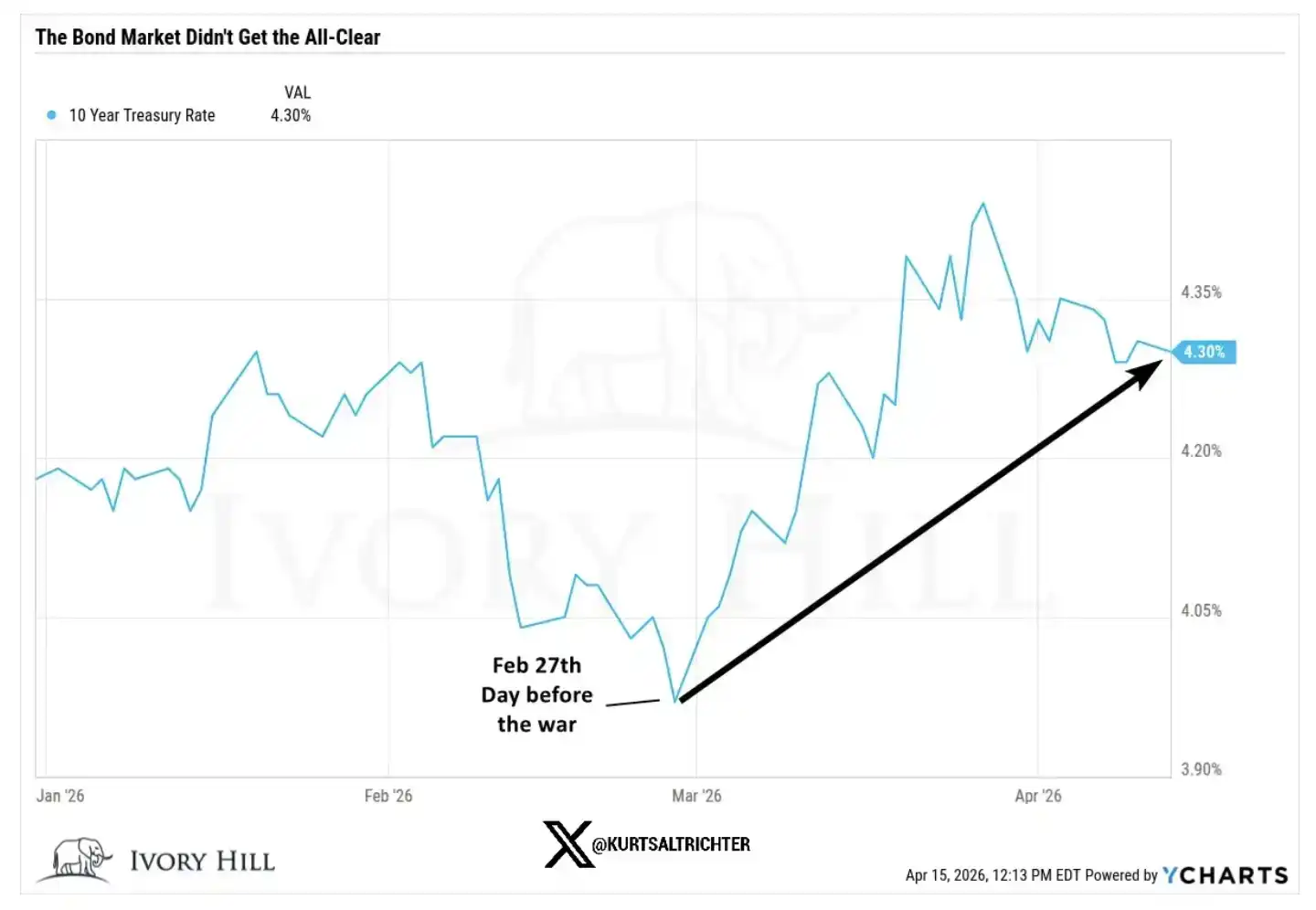
10-year U.S. Treasury yield: 3.95%, while yesterday it closed at 4.25%, up 30 basis points from pre-war levels.

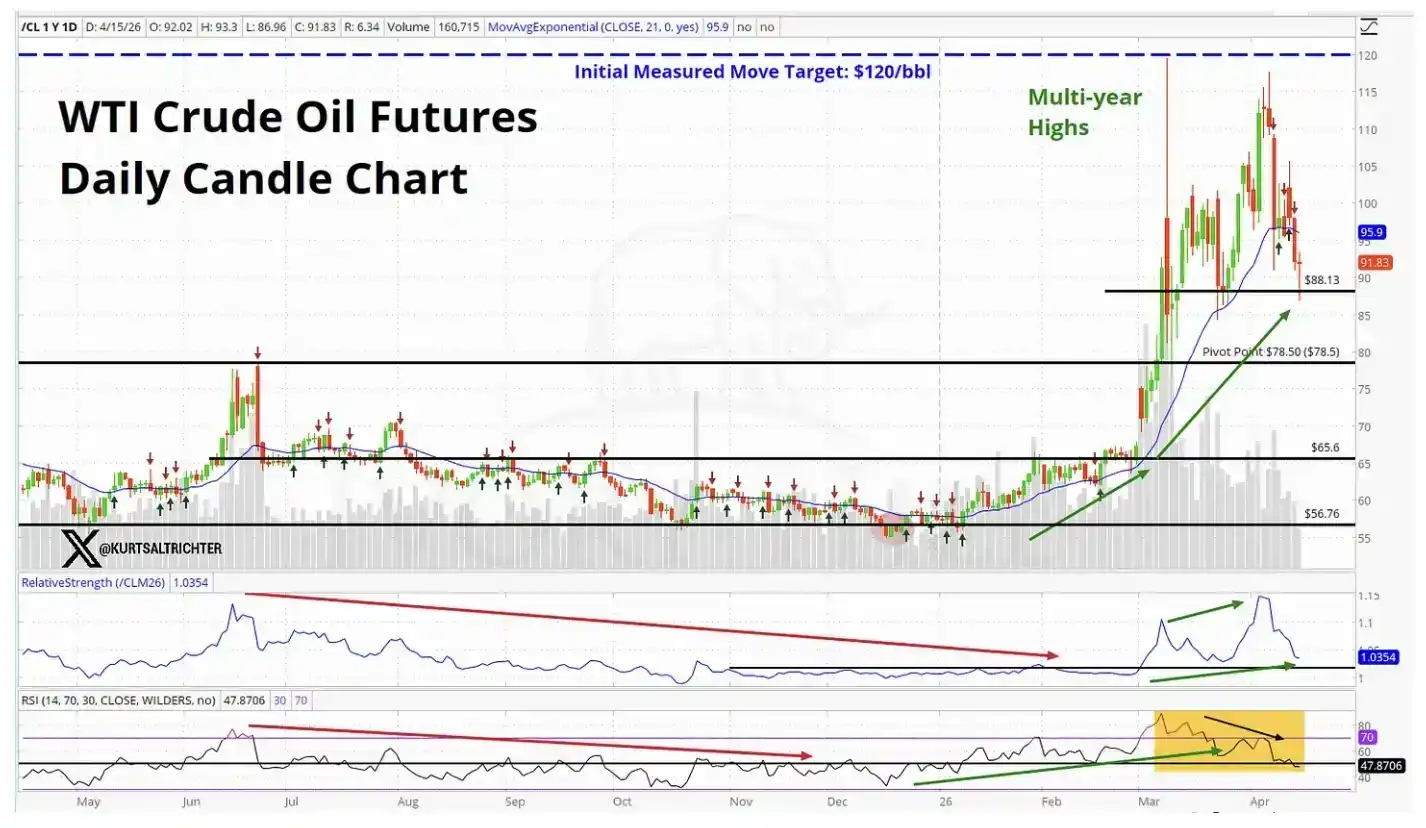
WTI crude oil: $67.02, currently about 37% higher than then.

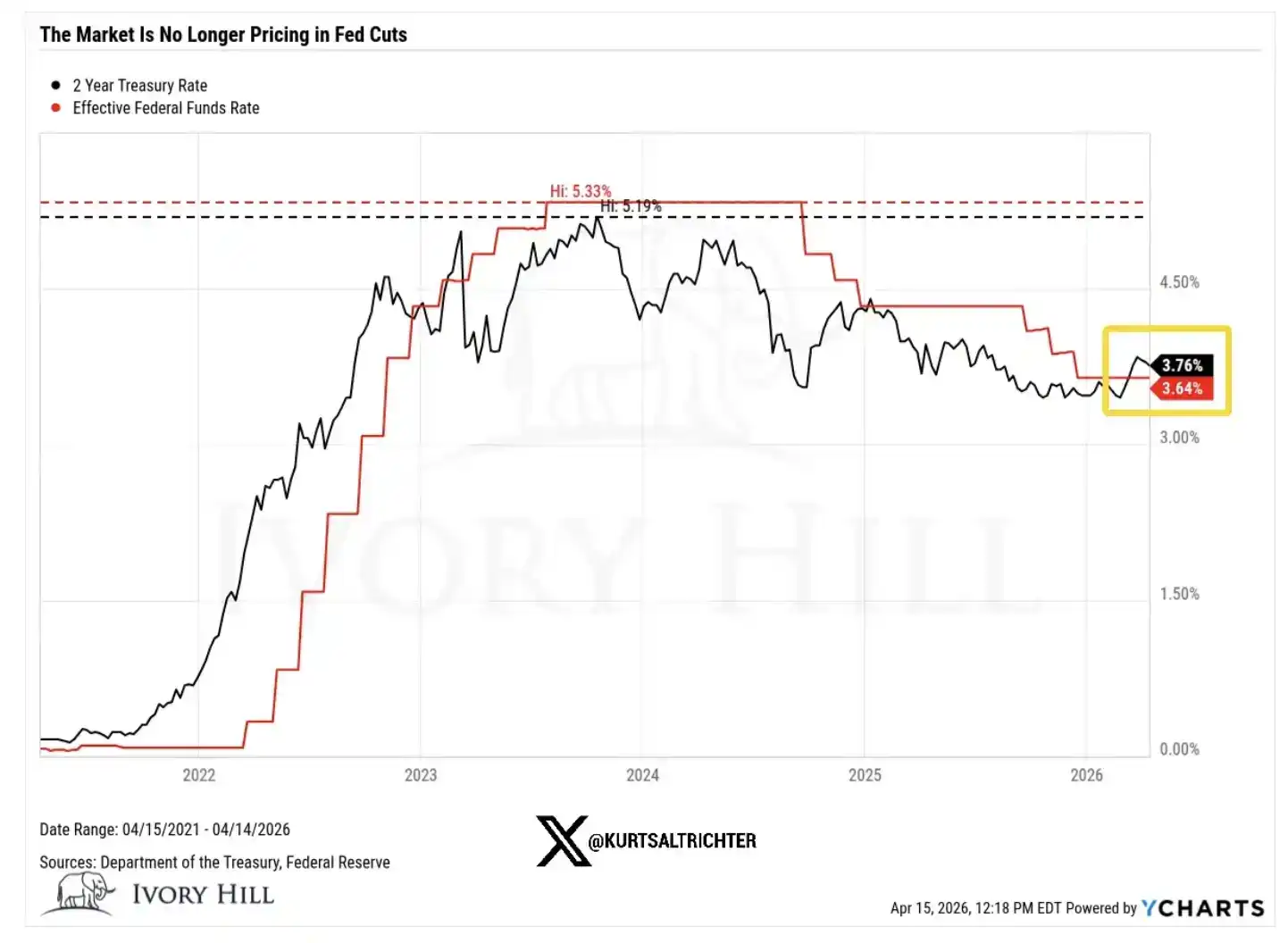
2-year U.S. Treasury yield: 3.38%, yesterday it closed at 3.75%, up nearly 40 basis points from pre-war levels.

Now, let's break down the implications behind these changes one by one.

The 30-basis-point rise in the 10-year yield after the war broke out is not because the bond market is more optimistic about economic growth. Current consumer sentiment is weakening, and confidence remains sluggish. This rise in interest rates is essentially the bond market 'quietly' pricing in inflation.

The signal it sends is clear: higher oil prices are transmitting to the overall price system, and the Federal Reserve's future policy space may not be as accommodative as the stock market assumes.

A 37% rise in oil prices over 6 weeks is not the performance one would expect if the market truly believed that a real, lasting agreement between the U.S. and Iran is imminent.

If traders were truly confident in a stable ceasefire agreement, oil prices should have long fallen back to the $70 range and continued to decline. But that is not the reality. Oil prices remain high, which means the oil market is not pricing in the same 'conflict resolution is imminent' expectation as the stock market.

And the 2-year U.S. Treasury yield is still 40 basis points higher than pre-war levels, which is itself a direct challenge to the narrative that 'the Federal Reserve is about to cut interest rates.'

The 2-year yield is the most sensitive indicator for observing interest rate expectations; it reflects the Federal Reserve's policy path more directly than any other asset. And now, the signal it sends is: the Federal Reserve's room for maneuver is smaller than the market imagines. This affects almost all the valuation logic supporting this stock market rally.

So, who is right?

The stock market might be right, I'm willing to admit that. If a substantive ceasefire agreement really emerges, bond yields could quickly fall back; once supply issues are credibly resolved, oil prices could also drop significantly. This is not the first time the stock market has led, with other markets 'catching up' or following later.

But there is another explanation that I think is currently underestimated.

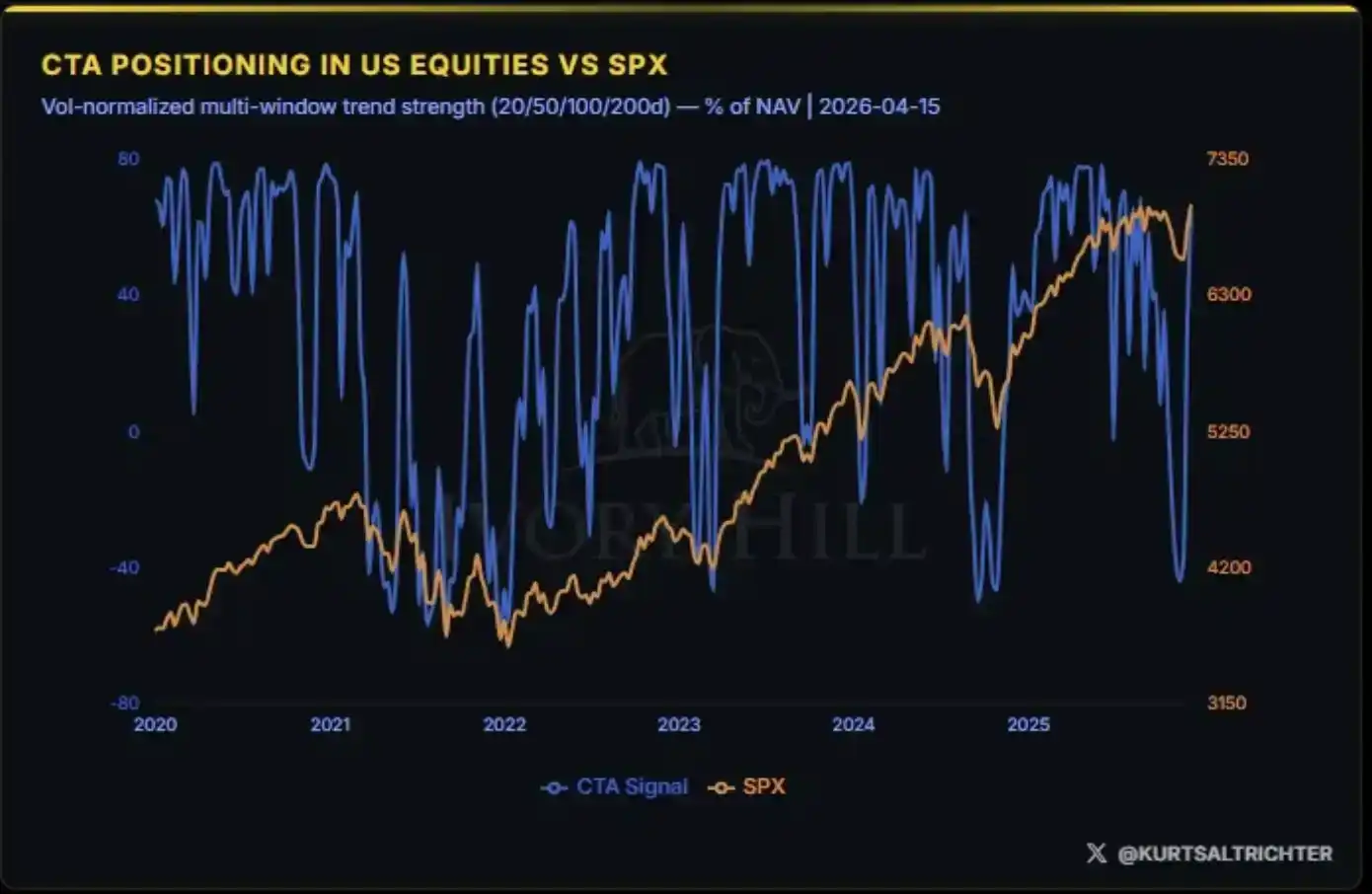
A large part of this rally is not driven by fundamentals but by momentum. Traders' reluctance to short in an upward trend itself continuously pushes the market higher. Such buying can indeed sustain the trend longer than it should.

But it does not change the underlying logic.

And the underlying reality is: oil prices remain high, interest rates are still rising, and the Federal Reserve's room for interest rate cuts is more limited than what the bulls need.

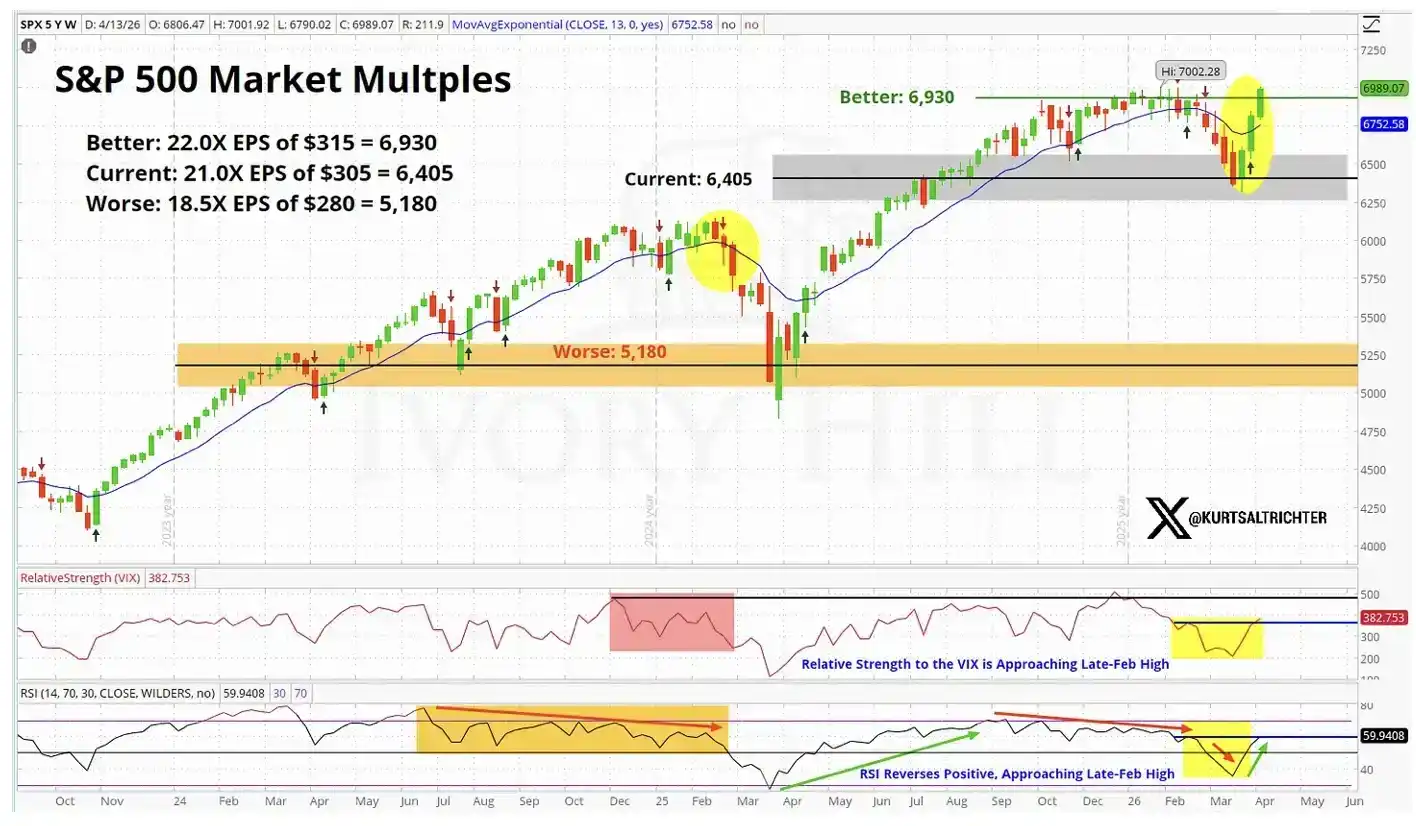
Rallies driven by fundamentals tend to be more sustainable; those driven by momentum are usually more fragile and shorter-lived. When you consider whether to add positions near historical highs, this difference is particularly critical. As the market valuation chart above shows, the current stock market is already pricing in a 'perfect scenario.'

My actual judgment

Over the past 10 days, the situation has indeed improved, I won't deny that. I'm not the type to be bearish for no reason.

But there is still a clear gap between the stock market's pricing and the reality reflected by bonds and oil, and this gap has not narrowed. I am closely watching this.

Currently, the stock market is at the most optimistic end of the range; bonds and oil are closer to the middle, reflecting a world where inflation still exists, the Federal Reserve's policy space is limited, and the conflict is not truly resolved.

This divergence will eventually be resolved, and there are only two paths:

Either a real ceasefire agreement is reached, oil prices fall back to around $70, the Federal Reserve gains clear room to cut rates, ultimately proving the stock market right;

Or none of this happens, and the stock market will fall back, moving closer to the levels currently reflected by bonds and oil.

And for now, bonds and oil show no signs of moving toward the stock market; it seems more like the stock market needs to move down to 'align' with them.

The next inflation data will be released on May 12. If my judgment is correct and CPI is above 3.5%, the narrative of rate cuts in 2026 will basically be over.

If you continue to add positions at this level, you are essentially betting that everything develops in the most ideal direction: the war ends smoothly, without interference from 'Trump's sudden remarks'; inflation remains controllable; the Federal Reserve cuts rates as planned; corporate profits hold steady. These four things must all happen simultaneously. If any one of them deviates significantly, the market's downward adjustment process is likely to be swift and severe.

In comparison, I prefer to remain patient rather than chase a rally that is 'quietly denied' by two key asset classes. If long-term signals point to buying, we will naturally gradually increase positions according to strategy.

And don't forget—the only certainty is that everything will eventually change.

Original link

Связанные с этим вопросы

QWhat are the key signals from the bond and oil markets that contradict the stock market rally?

AThe 10-year Treasury yield has increased by 30 basis points since the pre-war period, indicating bond markets are pricing in persistent inflation rather than economic optimism. The 2-year Treasury yield is up 40 basis points, challenging the narrative of imminent Fed rate cuts. Oil prices have risen 37%, suggesting the market does not believe in a near-term resolution to Middle East conflicts, contrary to equity assumptions.

QAccording to the author, what underlying reality do bond and oil markets reflect compared to equities?

ABond and oil markets reflect a reality where inflation remains sticky, the Fed has limited policy flexibility, and geopolitical conflicts are unresolved. Equities, however, are pricing a 'perfect scenario' of low inflation, Fed rate cuts, controlled costs, and conflict resolution—a highly optimistic set of assumptions.

QWhat two paths could resolve the divergence between equity markets and bond/oil markets?

AEither a genuine ceasefire agreement is reached, causing oil prices to fall and the Fed to gain clear room for rate cuts (validating equities), or these conditions do not materialize, forcing equities to decline and align with the levels reflected in bond and oil markets.

QWhy does the author view the current stock rally as potentially fragile?

AThe rally is driven more by momentum and 'fear of missing out' (FOMO) trading behavior rather than fundamentals. Such momentum-driven gains are often short-lived and vulnerable to abrupt corrections if underlying macroeconomic variables—like inflation data or geopolitical events—disappoint.

QWhat critical data does the author highlight as a potential catalyst for market reassessment?

AThe next CPI data release on May 12th is highlighted. If CPI exceeds 3.5%, it would likely end the narrative of Fed rate cuts in 2026, forcing a reevaluation of equity valuations that rely on accommodative monetary policy.

Похожее

Will the Next Crypto Bull Run Start with On-Chain Trading of SpaceX?

This article presents a scenario-based forecast for the crypto industry from 2026 to 2029, arguing that the next major cycle will be driven not by technological narratives but by legal access to real-world assets. The author predicts that by mid-2026, pre-IPO perpetual contracts for top private companies like SpaceX, OpenAI, and Anthropic on platforms like Hyperliquid will become the primary gateway for accessing quality assets, as most crypto-native tokens fail to capture real value. The much-hyped AI x Crypto intersection largely fails except for prediction markets, which thrive on betting on AI model supremacy. By 2027, public blockchain foundations are forced to choose between catering to retail speculation or building compliant infrastructure for institutions, with many opting for the latter. Growth in stablecoins and tokenized private credit/equity hits a "triple ceiling" due to regulatory and political uncertainty rather than market demand. The pivotal shift is forecast for 2028. A major liquidation event in pre-IPO perpetuals exposes the structural flaw of synthetic markets lacking a real underlying asset anchor. In response, regulatory changes finally allow the public solicitation of private securities resales to verified accredited investors. This creates a legitimate secondary market for real company equity, which then becomes the core asset class of the new bull market, relegating synthetic perps to a niche role. By 2029, the industry becomes "boring" but foundational. Tokens without claims on real cash flows or assets cease trading. Stablecoin growth is steady but politically capped. Crypto infrastructure fades from view as it gets absorbed into traditional finance backends. The article's central thesis is that the key bottleneck for crypto's next phase is legal and regulatory channels for real asset ownership, not technology.

marsbit1 ч. назад

Will the Next Crypto Bull Run Start with On-Chain Trading of SpaceX?

marsbit1 ч. назад

The Value Distribution of Stablecoins

**Summary: The Value Distribution of Stablecoins** The article argues that stablecoins are evolving from mere trading tools into broader channels for dollar access. It divides the stablecoin ecosystem into four layers to analyze how value is distributed: 1. **Issuance Layer:** Mints stablecoins, holds reserve assets, and captures the spread between reserve yield and user costs (e.g., Tether, Circle). This layer currently earns the largest profit margin. 2. **Infrastructure Layer:** Connects stablecoins to the traditional financial system, handling fiat on/off-ramps, banking integration, compliance (KYC/AML), and asset management (e.g., Bridge, BVNK). This is the "unglamorous" but critical work, building the essential bridges between crypto and real-world finance. 3. **Acquiring/Distribution Layer:** Integrates stablecoins into merchant systems, manages payment flows, and provides enterprise financial software (e.g., Stripe, Coinbase). They act as the access point for businesses. 4. **Application Layer:** The end-users and businesses that ultimately use stablecoins for payments, settlements, or as a store of value. They benefit from convenience but have little pricing power. The core thesis is that while the issuance layer currently dominates profits, the often-overlooked **infrastructure layer holds significant long-term potential**. The real challenge and barrier to mass adoption is not the on-chain transfer of stablecoins (which is simple), but the complex "last mile" integration into existing business workflows, banking systems, and regulatory frameworks across different countries. Companies in this layer are currently in a "land grab" phase, investing heavily to build networks, secure bank partnerships, and establish compliance pathways. While their position is currently pressured by the profitable issuers above and distribution platforms below, the article suggests that if stablecoins become a default financial rail for businesses, the infrastructure providers who have done the hard work of integration will ultimately gain strong pricing power and become entrenched, essential players.

marsbit8 ч. назад

The Value Distribution of Stablecoins

marsbit8 ч. назад

The Value Distribution of Stablecoins

The Value Distribution of Stablecoins The article argues that stablecoins are evolving from a mere trading tool into a broad "dollar channel." It analyzes the industry's value chain through four layers: 1. **Issuance Layer (e.g., Tether, Circle):** The top layer that mints stablecoins, holds reserve assets, and captures the thickest interest rate spread. 2. **Infrastructure Layer (e.g., Bridge, BVNK):** Connects stablecoins to the traditional financial system, handling critical but complex "dirty work" like fiat on/off-ramps, banking integration, compliance (KYC/AML), and cross-border settlement. 3. **Acquiring/Distribution Layer (e.g., Stripe, Coinbase):** Embeds stablecoins into merchant systems, manages payment flows, and integrates with enterprise software. 4. **Application Layer:** End-users and businesses that ultimately use stablecoins for payments, settlement, or storing value. The author posits that while the issuance layer currently captures the most profit, the most overlooked and potentially critical layer is infrastructure. The core challenge for stablecoin adoption isn't the on-chain transfer (which is simple), but bridging the gap between blockchain and the real-world financial system. This involves solving practical problems for businesses: fiat conversion, reconciliation, tax handling, and user onboarding. Infrastructure companies are currently in a difficult "land-grab" phase—building networks, securing banking relationships, and achieving compliance country-by-country. They face pressure from both the profitable issuance layer above and distribution platforms below. However, the author suggests this layer is building a crucial moat. Once stablecoins become a default business rail, the infrastructure players who have done the hard work of integration may gain significant, durable value and pricing power.

链捕手8 ч. назад

The Value Distribution of Stablecoins

链捕手8 ч. назад

Торговля

Спот
Фьючерсы
活动图片