a16z Weekly Chart: Tech Giants Rely on 'Side Hustle' Investments for Income, Great AI Products Can Sell Out in a Day

marsbitОпубликовано 2026-05-09Обновлено 2026-05-09

Введение

a16z Weekly Charts: Four Counterintuitive Signals in Tech 1. **Super Platforms' "Other Income"**: Amazon and Google recorded exceptionally high "other income" in Q1, largely from unrealized gains in their private investment portfolios (e.g., Amazon's Anthropic stake). This contributed to over one-third of their net profit, far above the historical 5-10%. The broader trend shows tech capital expenditure is now the primary driver of US GDP growth, accounting for 55% of all business investment. 2. **AI-Generated eBook Proliferation**: Since ChatGPT's launch, monthly eBook releases on Amazon have tripled to over 300,000, flooding the platform with AI-generated content. However, research indicates this has also increased the volume of "decent" books, providing a net gain in consumer surplus by 2025. AI tools have particularly boosted productivity for established authors. 3. **Call Center Jobs Defy AI Replacement**: Contrary to predictions, call center employment in the Philippines has grown steadily from 1.15 million in 2016 to 1.9 million in 2025, with further growth projected. In the US, customer service job postings are outperforming the overall market. The key reason: the full cost of voice AI agents remains roughly equal to human agents (~$92 vs. ~$90 per day). Cases like Klarna show initial replacement can lead to quality issues and re-hiring. 4. **Rapid Adoption of AI Mobile Apps**: AI app downloads, revenue, and user time spent on mobile nearly doubled year-over-year i...

Author: a16z New Media

Compiled by: Deep Tide TechFlow

Deep Tide Intro: This week's a16z Chart covers four topics: Super platforms recorded unusually high 'Other Income' from private investments in Q1; AI-generated eBooks are flooding the market, but the volume of quality content is also growing; Employment in Filipino call centers is rising against the trend, as voice AI costs still haven't caught up with human labor; Mobile AI app downloads, revenue, and usage time have all doubled, with Codex's single-day installs surpassing Claude Code. Four charts, four counter-intuitive signals.

'Other Income': The VC Business of Tech Giants

Profit growth in the public markets is already exaggerated, and Wall Street expects it to be even higher this year.

But beneath the profit figures lies an uncommon detail: not all of the super platforms' income comes from their main businesses. In Q1, 'Other Income' accounted for a surprisingly large portion of net profit.
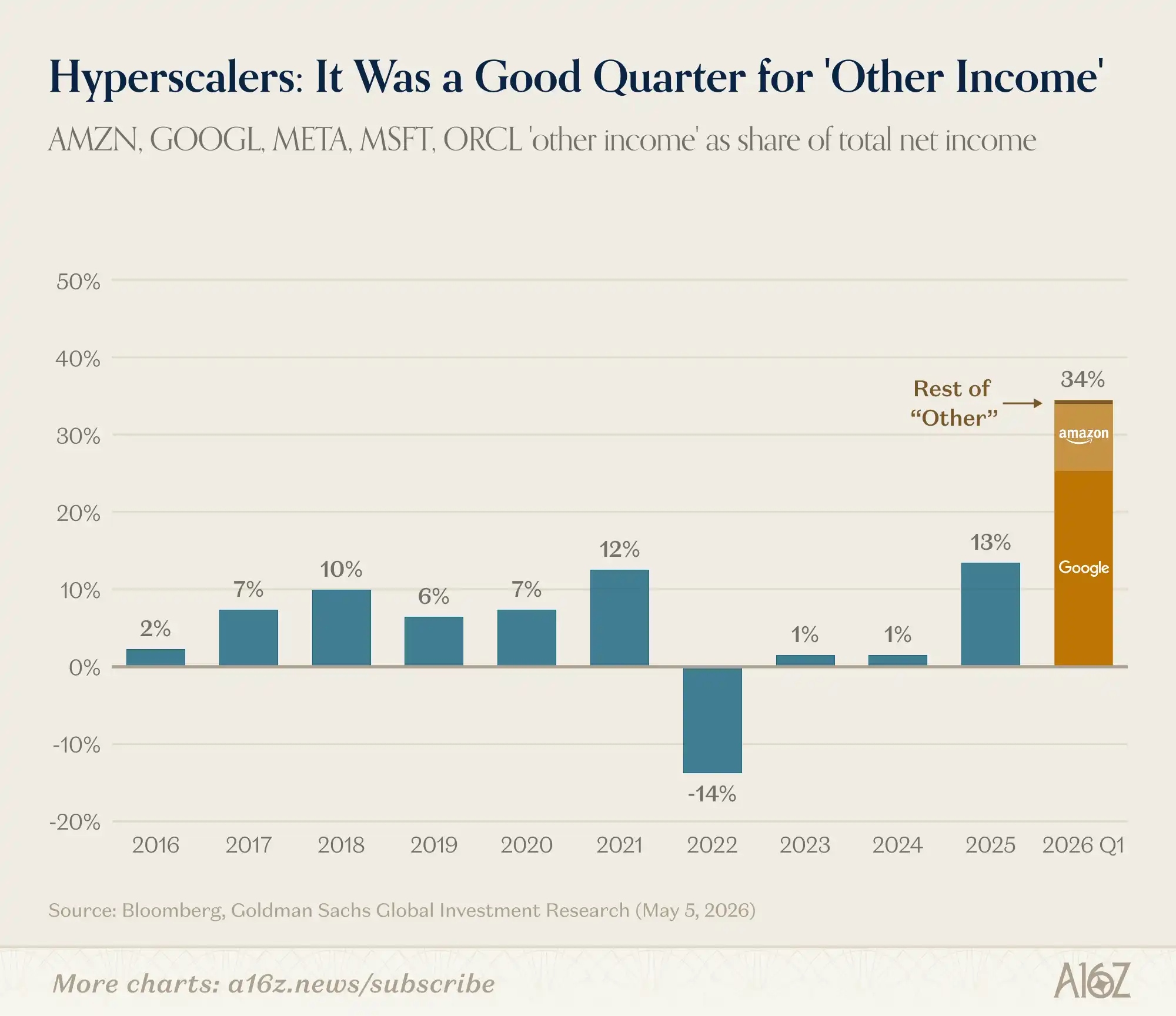
Chart Note: Super platforms' 'Other Income' as a percentage of net profit, exceeding one-third in Q1, historically around 5%-10%.

In Q1, 'Other Income' accounted for over one-third of net profit, historically this figure has been around 5% to 10%.

Where does this money come from? Primarily from private investment returns of Amazon and Google, totaling about $53 billion. Alphabet's CFO stated on the earnings call that 'other income and expense was $37.7 billion, primarily from unrealized gains on non-marketable equity investments'; Amazon disclosed a $15.6 billion net gain from its Anthropic investment in its 10-Q.

In a nutshell: Super platforms are doing pretty well as venture capitalists.

But tech investing is no longer just a game for giants. KKR estimates show that tech-related capital expenditure is currently the only category of capital expenditure driving GDP growth:
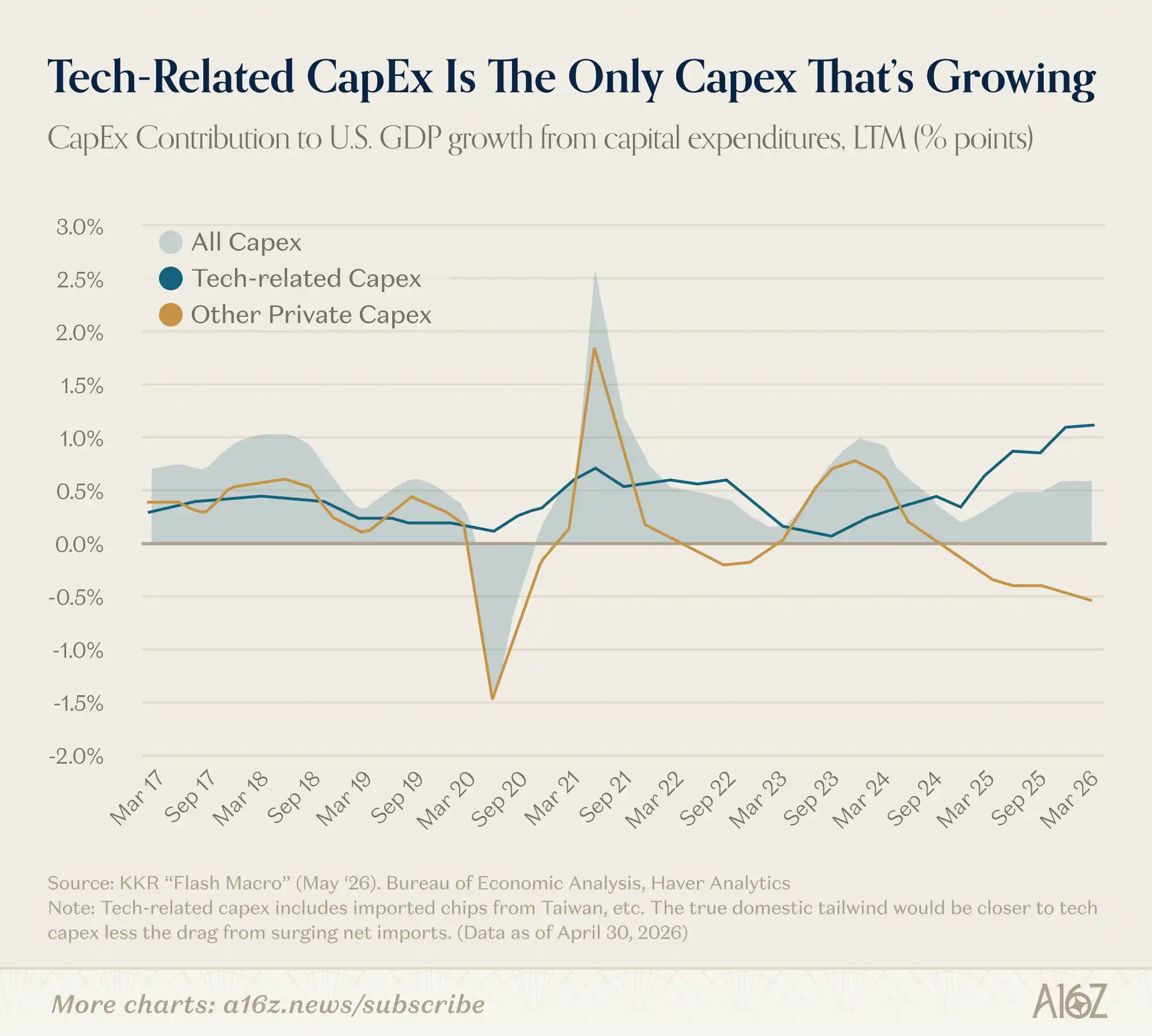
Chart Note: Of the 2% growth in US GDP in Q1, tech capital expenditure contributed 1.9%, accounting for almost all of it.

US GDP grew by 2% in Q1, with tech capital expenditure contributing 1.9%. Meaning, without tech investment, GDP would have basically stagnated.

Taking a broader perspective, according to the Bureau of Economic Analysis (BEA) statistics on total business capital expenditure (including R&D and software), tech now accounts for 55% of all US business investment:
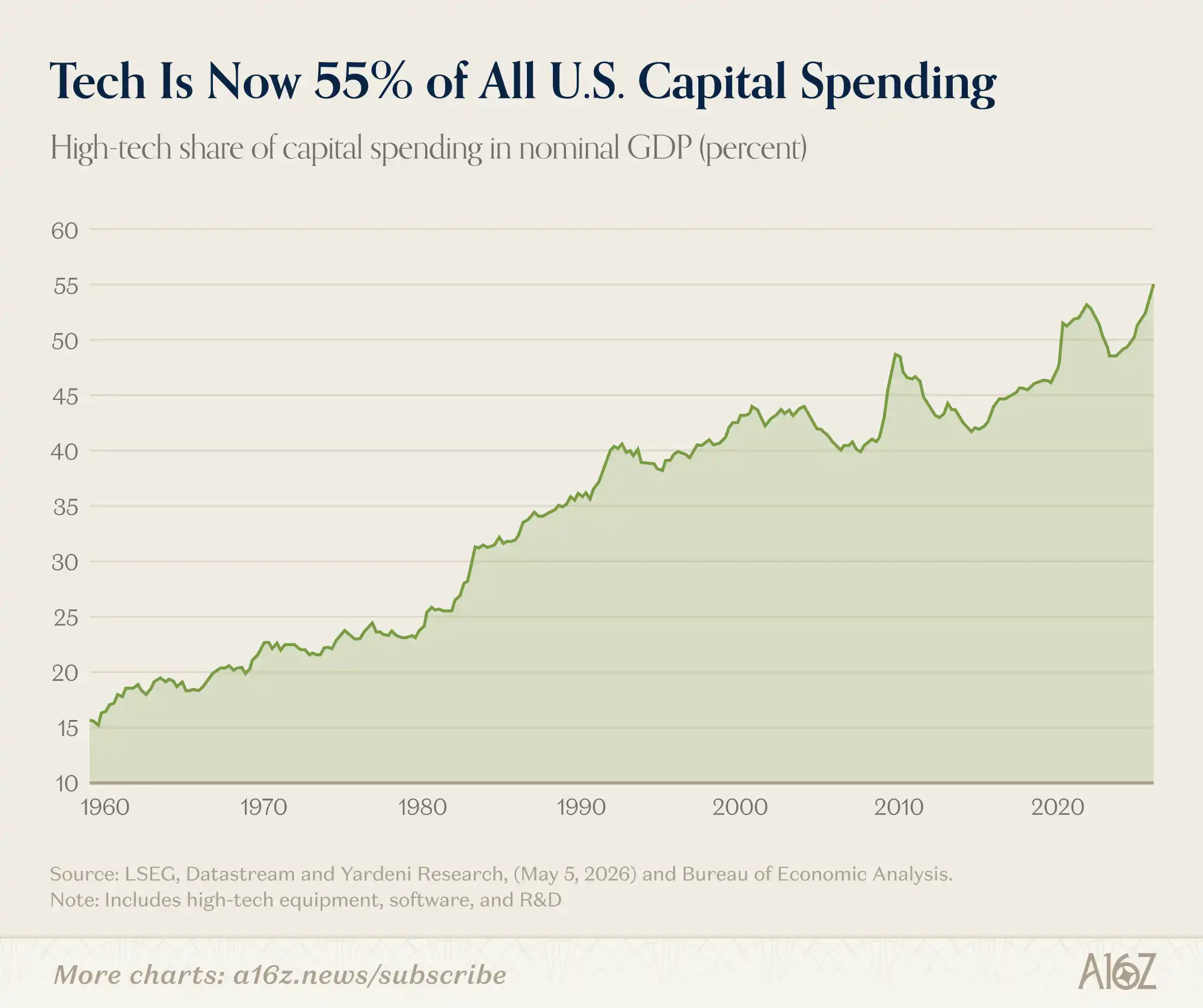
Chart Note: The share of technology in total US business capital expenditure has been climbing steadily and now stands at 55%.

This proportion has been climbing for a long time, and AI might accelerate this trend. Yardeni Research proposes an interesting framework: economics textbooks list three factors of production—land, labor, and capital. Now a fourth should be added: data. AI makes data more useful, and the more useful data becomes, the greater the demand for tools to invest in and process data.

Amazon and Google doing well as VCs is one thing. The bigger reality is: everyone is a tech investor now.

AI Junk Books Are Flooding the Market, But Quality Content Is Also Increasing

Good news: There are far more eBooks on Amazon than before. Bad news: The increase is mostly AI-generated junk.
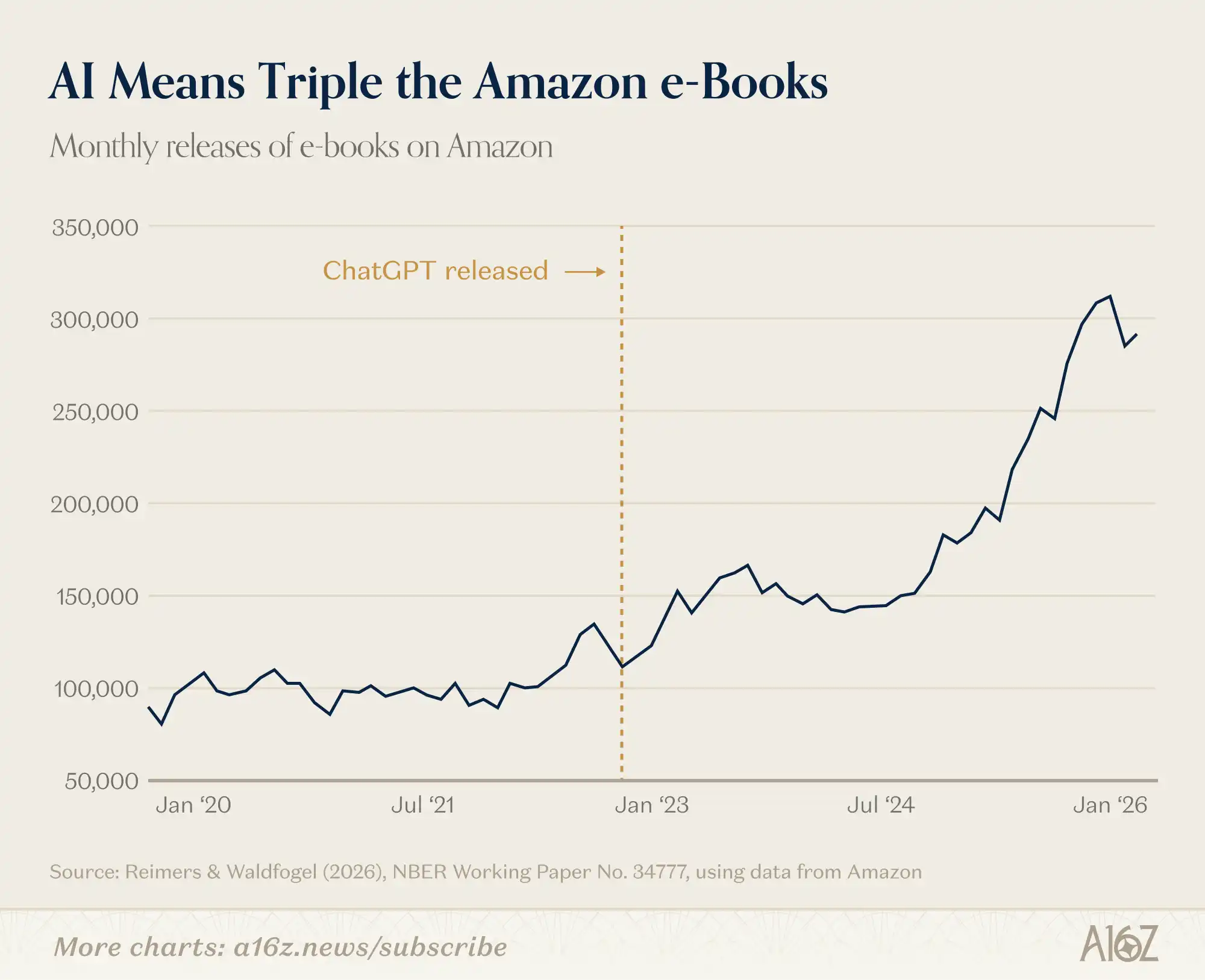
Chart Note: Monthly eBook releases on Amazon have tripled since ChatGPT's launch, exceeding 300,000 per month by late 2025.

Since ChatGPT's launch, monthly eBook releases on Amazon have increased from about 100,000 to over 300,000.

There are two ways to read this chart.

The first is intuitive: AI arrived, a tsunami of junk content followed, and Amazon is flooded with machine-generated low-quality books.

The second is more thought-provoking: Junk has indeed increased, but there are also more 'decent' books than before. A recent NBER paper by professors from Cornell and Minnesota quantified this—using a nested Logit demand model, they estimated the 2025 eBook selection set provided about 7% more consumer surplus compared to a counterfactual baseline of purely human creation. Readers in 2023 gained almost nothing, but by 2025, the gains were perceptible.

Another finding is even more interesting: AI helps 'old authors' (those publishing before LLMs) the most.
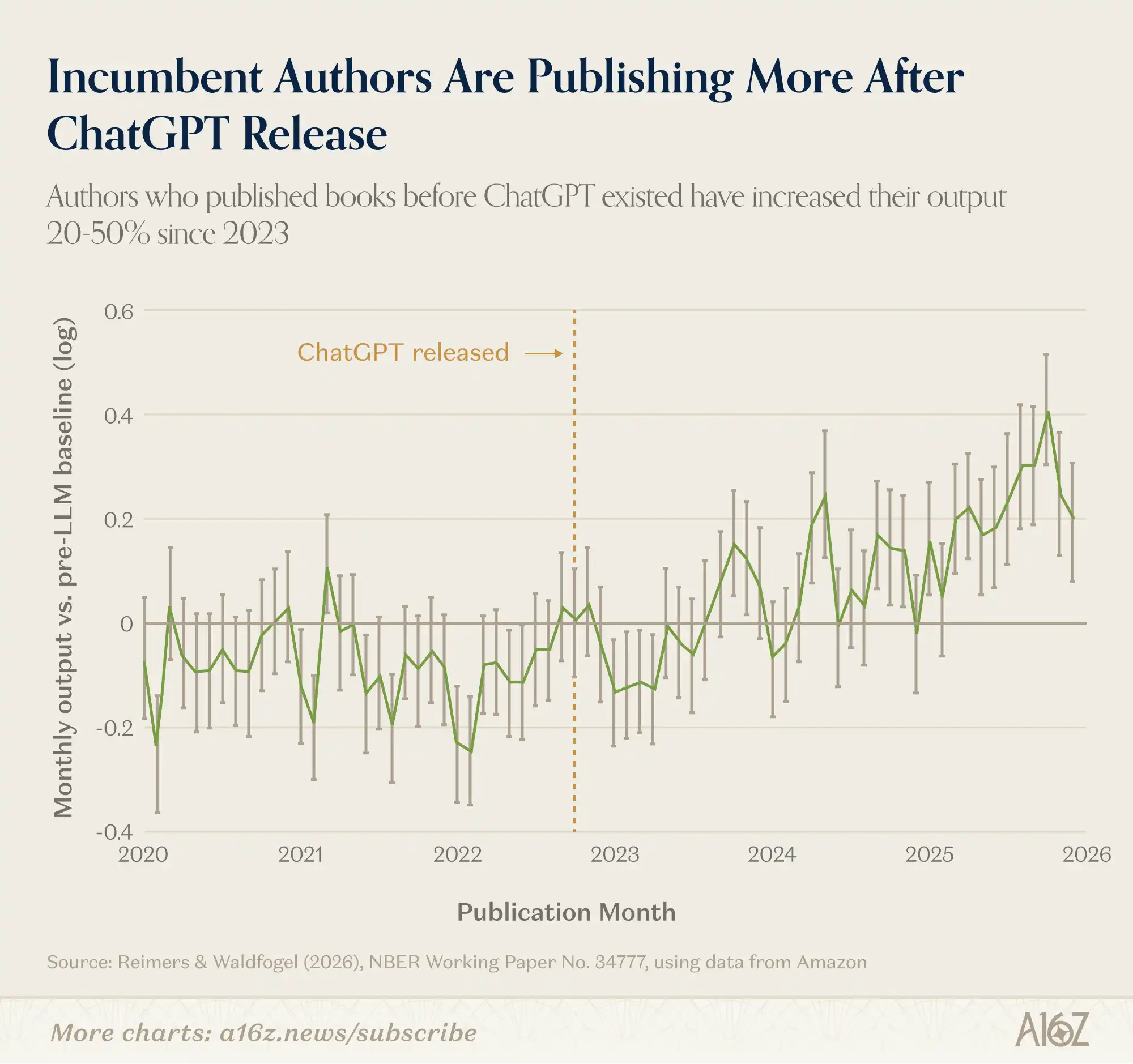
Chart Note: After 2023, output by 'old authors' (those published before LLMs) increased significantly; AI boosted their productivity.

AI didn't just create a bunch of robot authors; it also made human authors more productive.

Marc Andreessen predicted years ago on David Perell's podcast: writing is becoming too easy, so low-quality content will flood the market; but at the same time, with tools this powerful, high-quality content should also experience explosive growth. The junk is real, but the surplus value is also real. Good writers are now writing more.

Call Centers Aren't Dead, Voice AI Is Still Too Expensive

David George just wrote an article arguing that AI replacing jobs is a myth. He distinguishes between 'substitution' and 'augmentation'—customer service is the prime candidate for substitution; AI can answer all questions and has infinite patience.

The logic is sound. But the data doesn't agree.
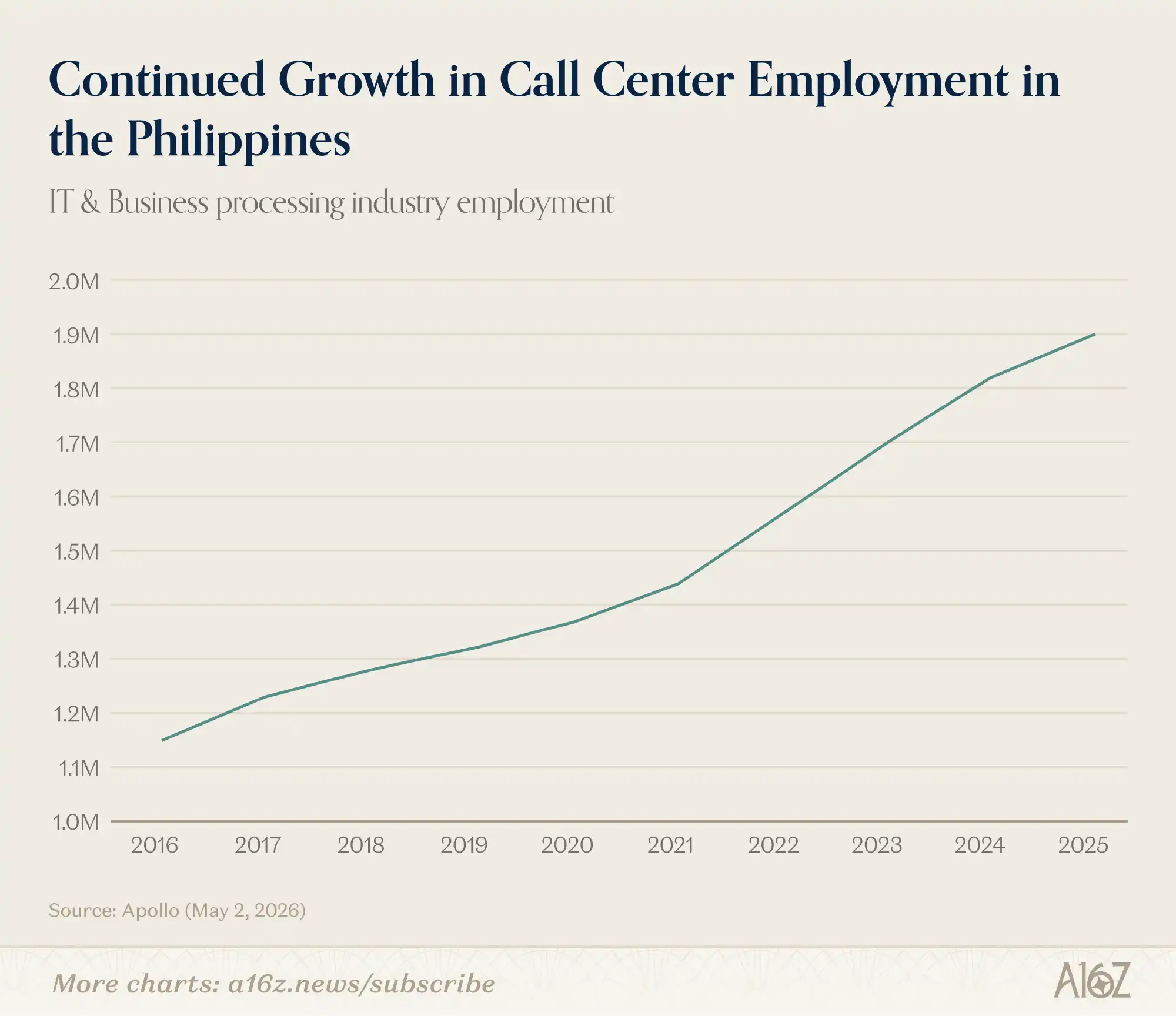
Chart Note: Employment in the Philippines IT and business process outsourcing industry grew from 1.15 million in 2016 to 1.9 million in 2025, spanning every major AI capability leap.

The Philippines is the call center capital of the world. Apollo data shows employment in the IT and business process outsourcing industry grew from 1.15 million in 2016 to 1.9 million in 2025—spanning every major AI upgrade. The industry association projects an additional 70,000 jobs in 2026, a 3.7% year-on-year increase.

The situation in the US is similar. Indeed data shows that customer service job postings haven't decreased; they're actually outperforming the broader market:
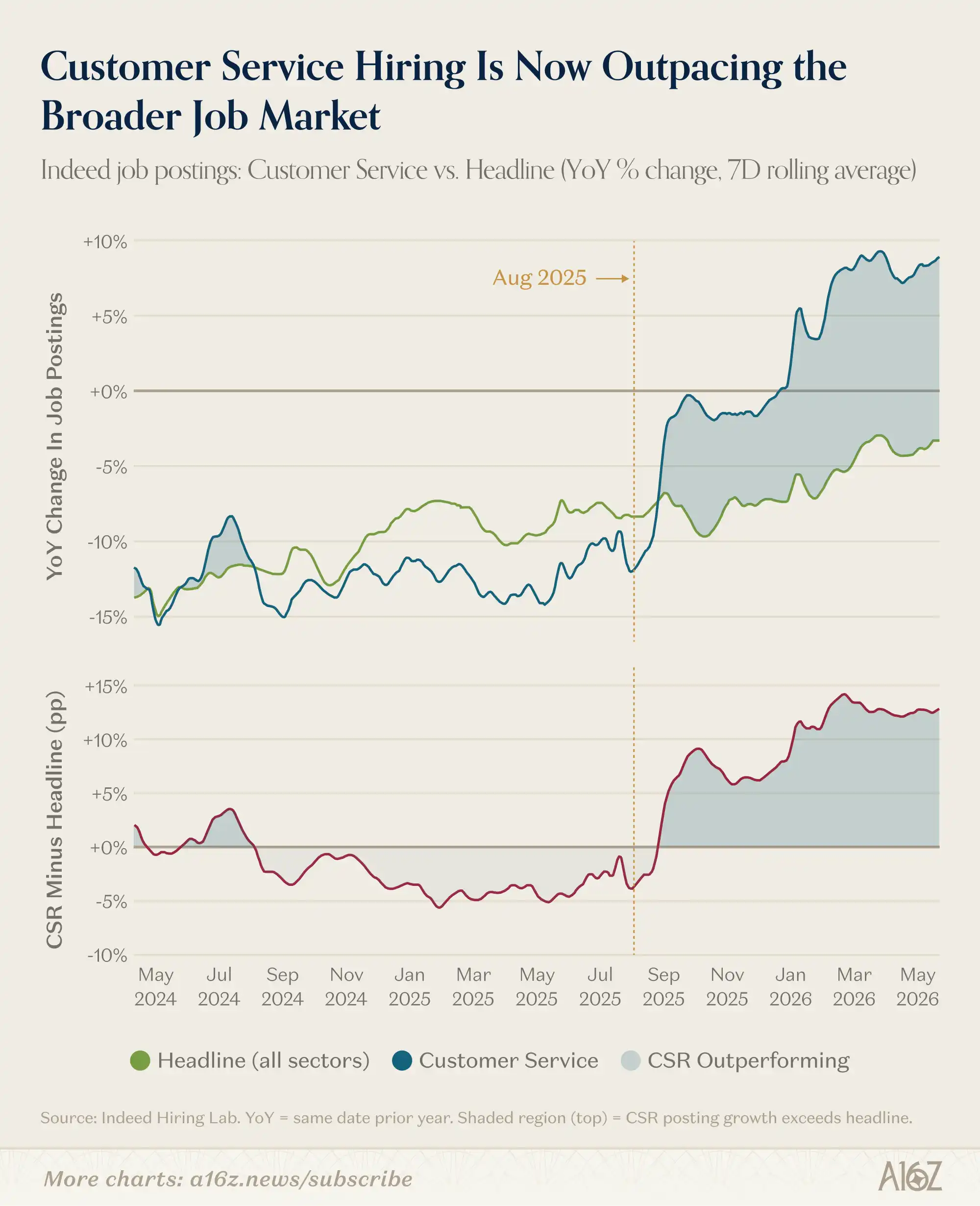
Chart Note: Indeed data shows customer service job postings' year-on-year growth rate is about 10 percentage points higher than overall hiring; the flip happened in August 2025.

The year-on-year growth rate for customer service hiring is about 10 percentage points higher than the overall job market. And this flip only happened recently, in August 2025.

Does this mean AI is actually a boon for the customer service industry? Probably not.

The core reason is cost. Text LLM output is cheap, but voice AI is still expensive. Goldman Sachs conducted an internal test comparing the total cost of AI customer service agents versus human agents:
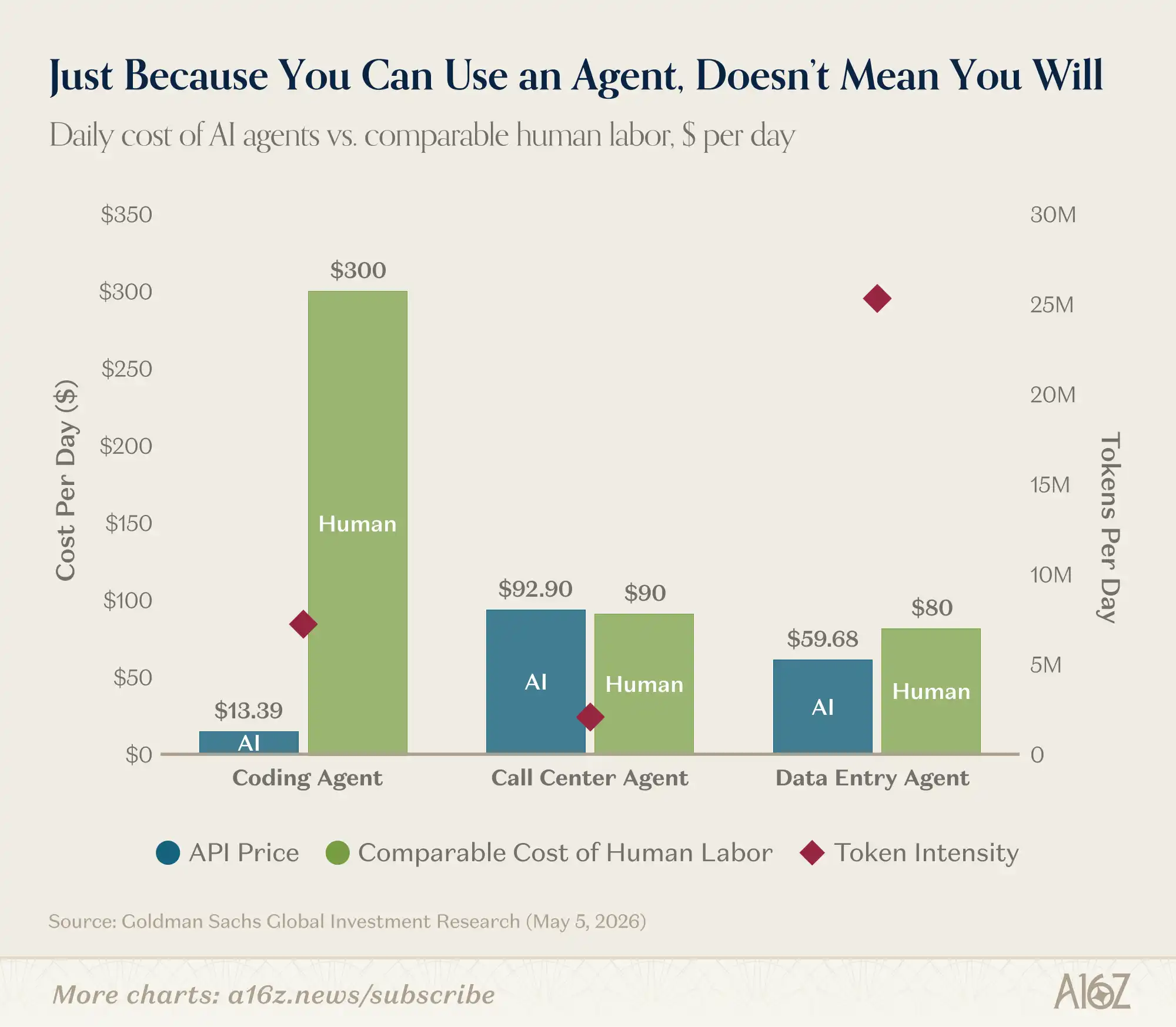
Chart Note: Goldman Sachs estimates the all-in cost of an AI agent is about $92/day, vs. a human agent at about $90/day, roughly equal.

The all-in cost for an AI agent is about $92/day, versus about $90/day for a human agent. Roughly equal. Compare this to coding agents—pure text output, costs are orders of magnitude lower than human labor. The difference between code and customer service is that the potential demand for code far exceeds that for customer service, so the leverage from cost reductions is completely different.

The Klarna story is the best footnote. In early 2024, Klarna announced replacing 700 customer service agents with AI, with the CEO saying AI was doing everyone's job. This became a benchmark case for 'AI replacing humans.' By May 2025, the CEO backtracked, starting to rehire—service quality declined, and users received cookie-cutter responses.

This situation won't last forever. API costs are falling rapidly, companies like Decagon are growing fast, and the cost comparison might look completely different in 18 months.

Great AI Products Explode Rapidly

The penetration speed of AI on mobile is astonishing:
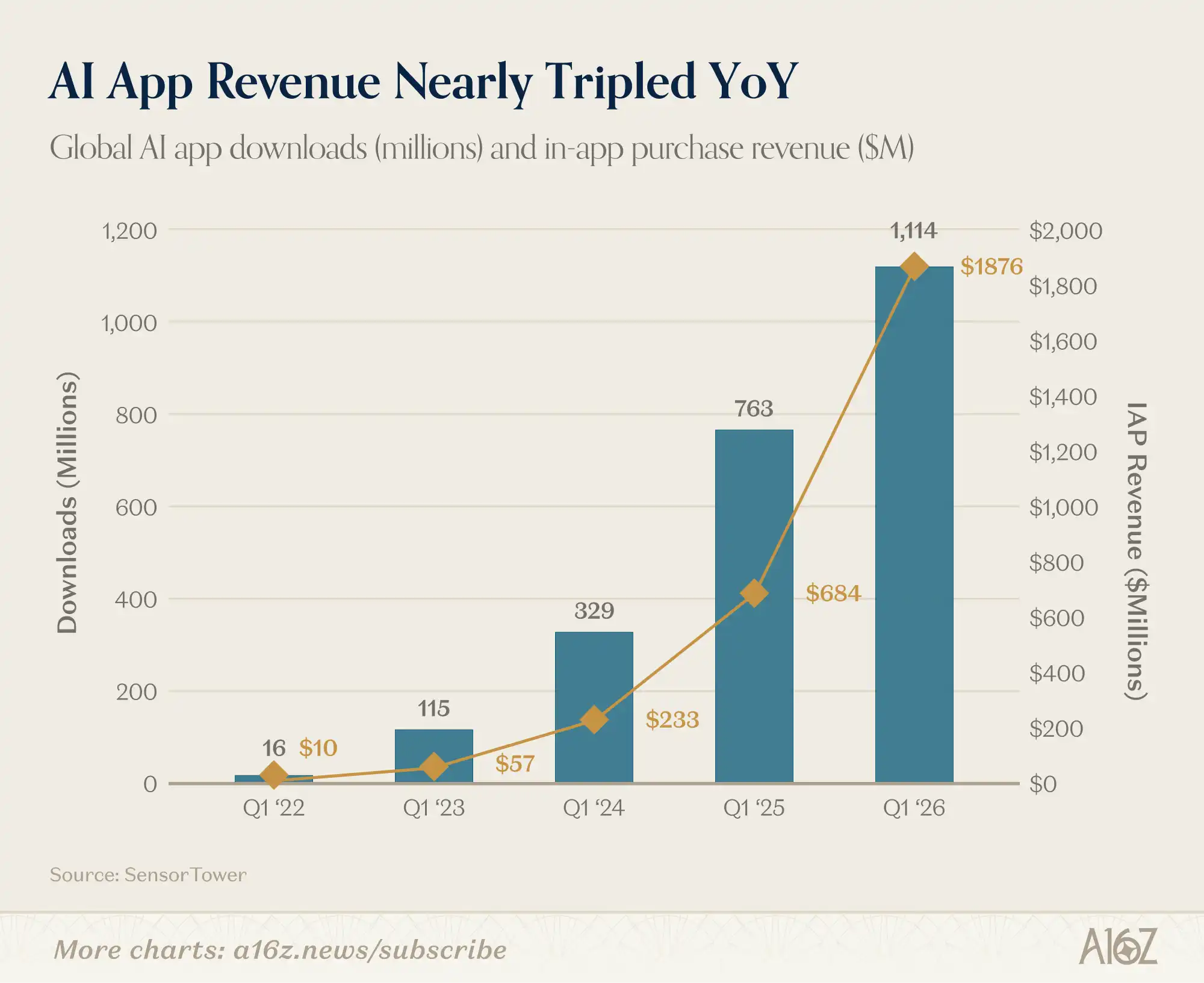
Chart Note: Q1 data for AI app mobile downloads, revenue, and usage time.
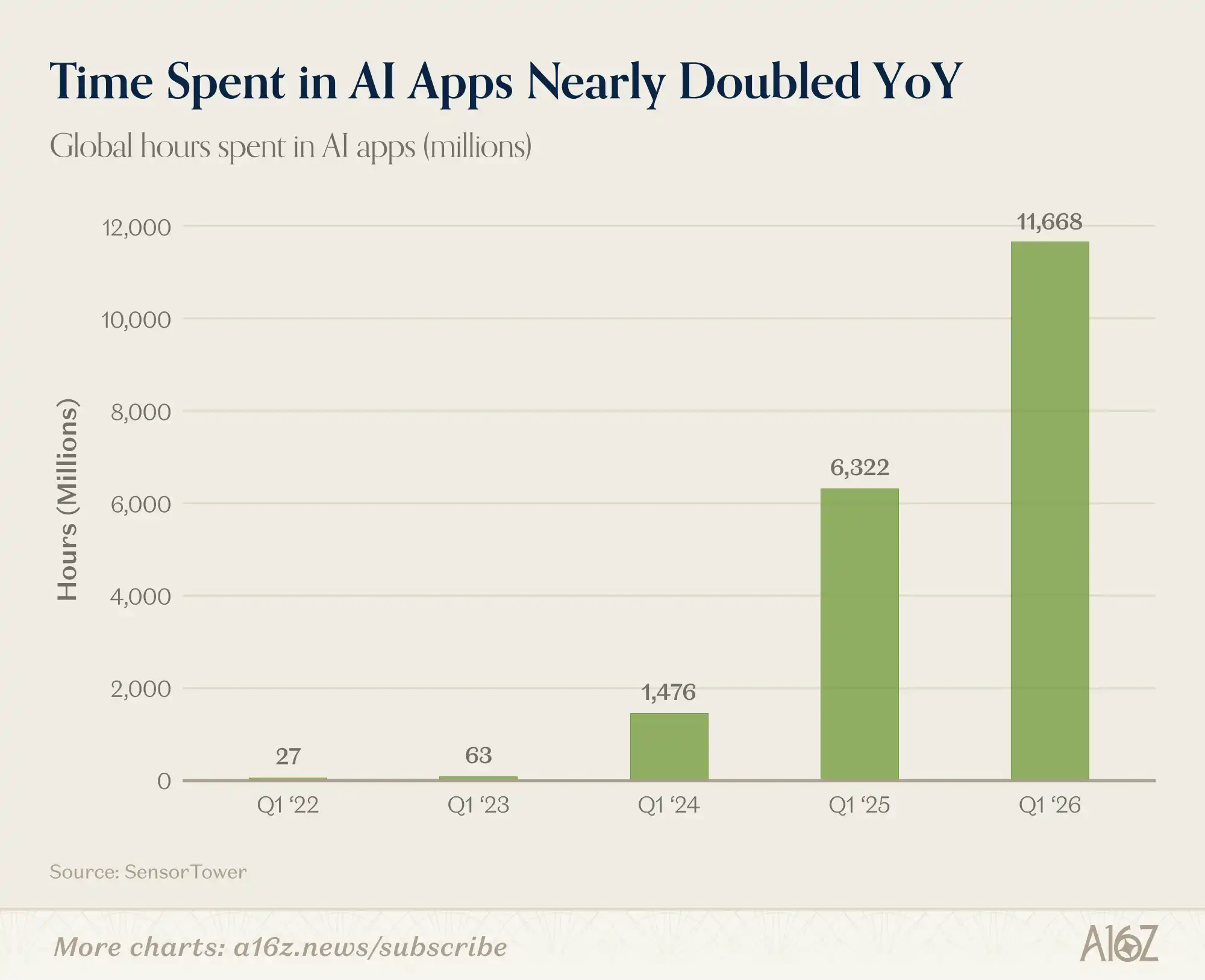
Chart Note: Monetization and usage time for AI apps nearly doubled year-on-year in Q1.

Downloads, monetization, and usage time all turned upward in Q1, with monetization and usage time nearly doubling year-on-year.

Maybe people are spending less time on social media because they're vibe coding with AI on their phones? Not necessarily a bad thing.

Speaking of vibe coding, a new contender has arrived:
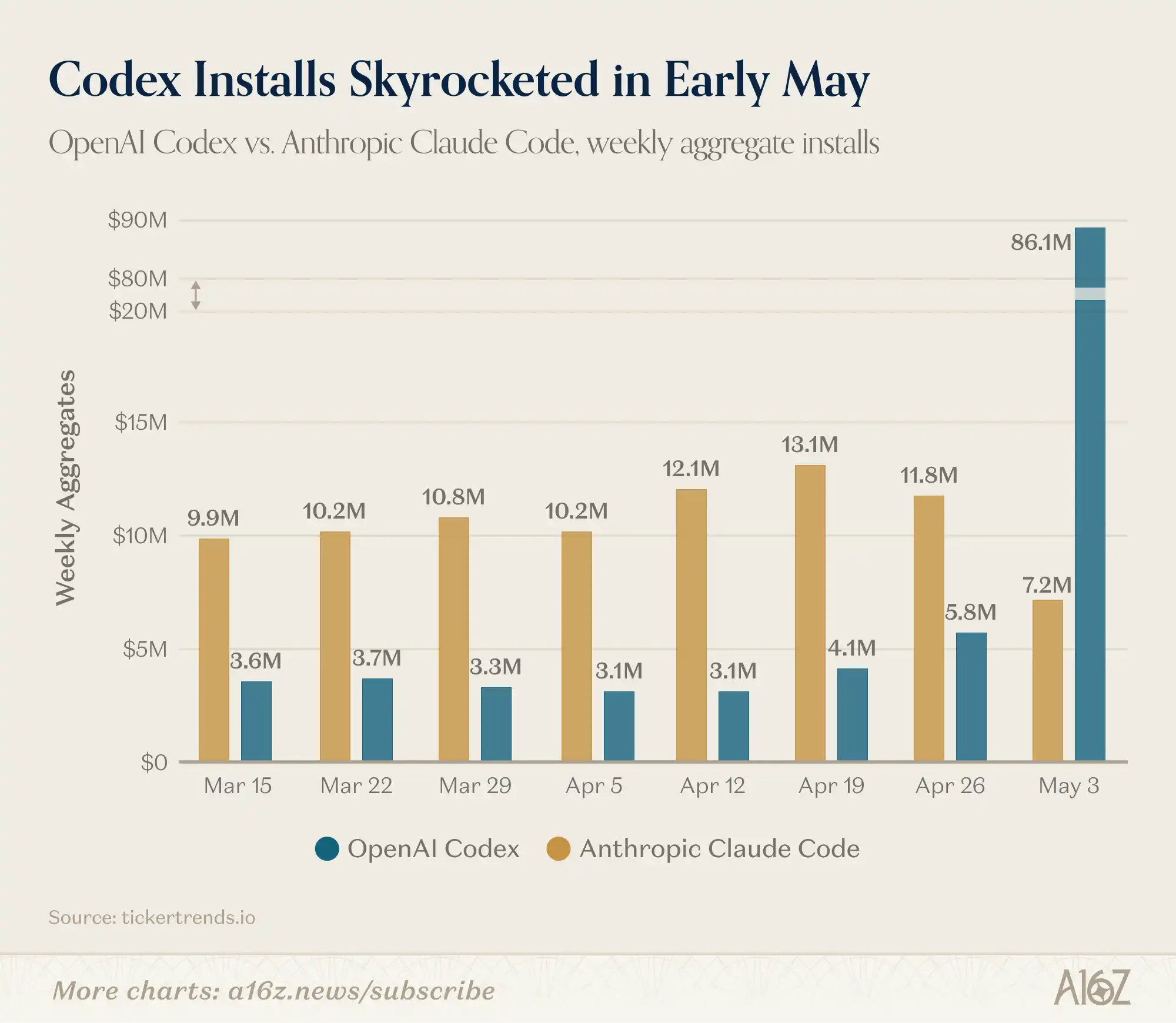
Chart Note: Codex's daily installs surged in May, exceeding Claude Code in a single day—the latter had been the king of code tools for the past year.

Codex's daily installs surged in May, surpassing Claude Code in a single day. Of course, this is just single-day data, and the base is lower, but it illustrates a point: great products spread extremely fast.

Jeff Bezos said something in 2012: You used to be able to sell a mediocre product with marketing, but that's getting harder and harder. A great product will get users to spread the word for you.

In the AI field, this logic is taken to the extreme. Signals propagate quickly, users are highly willing to switch, and no one feels loyalty to a platform or model.

The same holds true in the B2B realm:
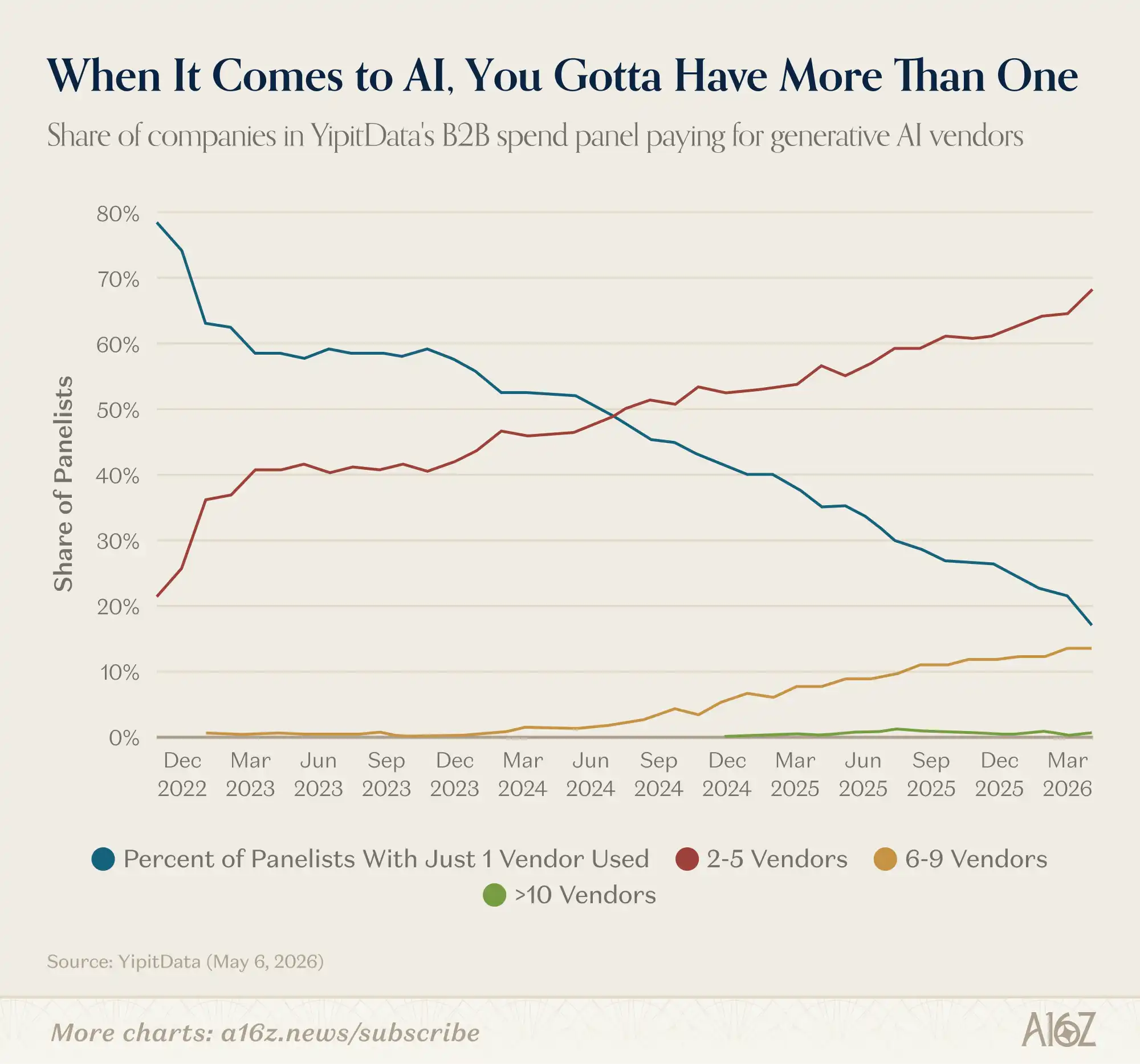
Chart Note: YipitData shows the proportion of enterprises using 2-5 and 6-9 AI vendors is rising steadily, with less than 20% using just one.

The proportion of enterprises using multiple AI vendors continues to rise, with those using just one now below 20%. The B2B AI market has no winner-take-all dynamics, for now.

Связанные с этим вопросы

QAccording to the article, what does the exceptionally high proportion of 'Other Income' in Q1 earnings for super-platforms mainly come from?

AThe exceptionally high proportion of 'Other Income' in Q1 earnings for super-platforms like Amazon and Google mainly comes from their private equity investment returns, specifically from unrealized gains in their non-public equity investment portfolios and investments like Amazon's in Anthropic.

QWhat are the two interpretations the article offers for the surge in e-book titles on Amazon following ChatGPT's release?

AThe two interpretations are: 1) An intuitive view that there has been a 'spam tsunami' of low-quality, AI-generated content flooding Amazon. 2) A more nuanced view that while spam has increased, the number of 'decent' books has also grown, providing measurable consumer surplus gains.

QWhy does the article suggest that voice-based AI hasn't significantly replaced human call center jobs, using the Philippines as a case study?

AThe article suggests voice-based AI hasn't significantly replaced human call center jobs because its cost is still not competitive with human labor. Goldman Sachs estimates show the all-in cost for an AI customer service agent is roughly equal to that of a human agent, making widespread replacement economically unattractive currently.

QWhat trend does the data show about the adoption and usage of AI applications on mobile devices in Q1?

AThe data shows a sharp upward trend for AI applications on mobile devices in Q1, with downloads, revenue, and user engagement (time spent) all increasing significantly. Revenue and time spent nearly doubled year-over-year.

QWhat point does the article make about enterprise adoption of AI, based on the YipitData chart showing vendor usage?

AThe article points out that the enterprise AI market is not currently a winner-takes-all market. The data shows a growing proportion of enterprises using multiple AI vendors (2-5 or 6-9), while the share using only one vendor has fallen below 20%.

Похожее

Apple Also Has to Pay Rent Now

Apple Pays Rent Too: The Two-Way Flow of "Traffic Tax" and "AI Capability Rent" Between Tech Giants For over two decades, Google has paid Apple an estimated $20 billion annually to remain the default search engine on Safari, a "traffic tax" for a critical user entry point. However, in 2026, the direction of this cash flow partially reversed. Apple agreed to pay Google roughly $1 billion per year to license its Gemini AI models, as Apple's own models reportedly struggled with complex tasks. This creates a unique dynamic: Apple acts as the "landlord" in the established search ecosystem, collecting rent from Google for access. Simultaneously, in the emerging AI arena, Apple becomes the "tenant," paying Google for access to cutting-edge AI capabilities it cannot currently match internally. While Apple claims its new models are "distilled" from Gemini outputs and contain "not a drop" of Google's original code, core dependencies remain. Its knowledge base is refined using Gemini's outputs, and its most powerful cloud model runs on Google's infrastructure. Apple has structured the deal as non-exclusive, allowing it to theoretically switch AI suppliers—a hedge against over-reliance. The future hinges on whether advanced AI models become a commodity (cheap and abundant) or remain a concentrated, scarce resource (expensive and controlled by few). Apple is betting on the former, leveraging its massive device ecosystem to be a powerful, choosy customer. If the latter proves true, its bargaining power could erode. This power dynamic is extending to developers. Apple, Google, and WeChat are all pushing for apps to expose their core functions as standardized "actions" or "intents" that their respective AI assistants (Siri, Gemini, WeChat AI) can directly call. The new scarce resource is no longer just app store visibility, but "being selected by the AI." The currency of "rent" has changed from a 30% revenue share to ceding control over how users interact with an app's functions.

marsbit43 мин. назад

Apple Also Has to Pay Rent Now

marsbit43 мин. назад

Missed the SpaceX IPO? WEEX's "First Trade Protection" Lets You Experience US Stock Trading Risk-Free.

With the excitement around SpaceX's recent public listing reigniting interest in the US stock market, Chinese investors face significant challenges accessing compliant and convenient trading channels following regulatory actions against major online brokers. This article explores the available options, highlighting their risks and limitations. Traditional paths for US stock investments remain problematic. Qualified Domestic Institutional Investor (QDII) and Listed Open-Ended Fund (LOF) products, while compliant, suffer from high fees, significant purchase premiums, and a very limited selection of assets. Small, unregulated offshore brokers pose substantial risks, including potential insolvency. While secure, VIP accounts at banks in Hong Kong or Singapore require high minimum deposits (often 1-2 million RMB) and in-person visits, placing them out of reach for most retail investors. The article positions cryptocurrency exchanges, specifically their TradFi (traditional finance on-chain) offerings, as a compelling alternative. Platforms like WEEX are noted for providing access to a wide range of US stocks and ETFs, including SpaceX (SPCXON), through tokenized assets. This method offers advantages such as a single account for both crypto and traditional assets, USDT-based settlement avoiding fiat complexities, flexible leverage, and robust risk management. To attract users, WEEX is promoting a "First Trade Guarantee" campaign. Running from June 15 to July 8 (UTC+8), it features a $30,000 prize pool. Users who trade $500 worth of US stock contracts can qualify for a guarantee on their first eligible trade: 100% loss coverage up to $30 or a 20% bonus on profits up to $30. The campaign is presented as a low-risk opportunity for both crypto natives and traditional investors to experience US stock trading.

marsbit44 мин. назад

Missed the SpaceX IPO? WEEX's "First Trade Protection" Lets You Experience US Stock Trading Risk-Free.

marsbit44 мин. назад

How Difficult is Chip Making? A Division Error Costs 475 Million Dollars

How Hard Is It to Make a Chip? A Division Error Cost $475 Million Chip expert Shi Kan, a researcher at the Chinese Academy of Sciences and a popular tech creator, explains the immense challenges of chip development. Chips are foundational to modern technology, but their creation is extraordinarily difficult. The journey from sand to a functional chip involves complex design and manufacturing, but a critical bottleneck is verification—ensuring the design works flawlessly before costly production. A single, undetected bug can have catastrophic consequences, as illustrated by the infamous 1994 Intel Pentium FDIV bug. A flaw in the floating-point division unit forced a recall costing $475 million. Unlike software, chips cannot be easily patched after manufacture, making "first-time success" paramount. However, industry surveys show only 24% of chip projects achieve this; over three-quarters require at least one costly re-spin due to design flaws. Verification has thus become the dominant phase, consuming up to 70% of the design cycle. The core challenge is a "verification impossible triangle" between high performance, good debuggability, and low cost. Exhaustively verifying a modern CPU core could take 15,000 years with software simulation, or 30 years with advanced hardware emulation—timeframes utterly impractical for development. Despite being essential, verification is often seen as unglamorous "dirty work," receiving less academic attention than fields like AI. Shi and his team are tackling this by developing an agile verification research framework called ENCORE, based on FPGA technology, to improve verification efficiency and debug capability. Beyond research, Shi engages in public science communication through long-form video content, aiming to demystify chip technology, AI, and computer science. He argues for the value of pursuing "hard and long-term" endeavors, whether in the meticulous world of chip verification or in creating substantive educational content, believing such sustained effort is likely the right path forward.

marsbit54 мин. назад

How Difficult is Chip Making? A Division Error Costs 475 Million Dollars

marsbit54 мин. назад

Торговля

Спот
Фьючерсы

Популярные статьи

Неделя обучения по популярным токенам (2): 2026 может стать годом приложений реального времени, сектор AI продолжает оставаться в тренде

2025 год — год институциональных инвесторов, в будущем он будет доминировать в приложениях реального времени.

1.8k просмотров всегоОпубликовано 2025.12.16Обновлено 2025.12.16

Неделя обучения по популярным токенам (2): 2026 может стать годом приложений реального времени, сектор AI продолжает оставаться в тренде

Обсуждения

Добро пожаловать в Сообщество HTX. Здесь вы сможете быть в курсе последних новостей о развитии платформы и получить доступ к профессиональной аналитической информации о рынке. Мнения пользователей о цене на AI (AI) представлены ниже.

活动图片