a16z New Article: Prediction Markets Entering the Fast-Forward Phase

marsbitОпубликовано 2026-04-19Обновлено 2026-04-19

Введение

Prediction markets are evolving from niche tools focused on elections and sports into a broader financial infrastructure for pricing real-world uncertainty. Key shifts include: application expansion beyond sports into entertainment, macro, and CPI markets; the creation of direct price benchmarks for events (e.g., tariffs, Fed decisions), enabling precise hedging without correlated asset risks; and growing institutional adoption, though still early-stage. While sports drive volume, long-tail markets show faster growth. Current institutional use is primarily for data, but progression toward system integration and active trading is expected. Regulatory advancements, like margin trading, are critical for scaling. The market is transitioning toward an essential, institutional-grade tool, similar to the evolution of options markets.

Editor's Note: For a long time, prediction markets have been viewed as a kind of "fringe product": first as academic experiments, later as tools for election season discourse, and then again as an extension of sports betting. They always seemed to attach themselves to some high-attention scenario but were rarely truly understood as financial infrastructure.

However, in the author's view, prediction markets are gradually evolving from a marginal, election-and-sports-focused "event trading tool" into a financial infrastructure capable of pricing uncertainty.

The author points out that key industry changes are evident on three levels: first, application scenarios are expanding—while sports remain the traffic entry point, long-tail markets like entertainment, macroeconomics, and CPI are growing faster and beginning to carry institutional demand; second, prediction markets for the first time provide a tradable price benchmark for the "event itself," enabling institutions to directly hedge political or macro risks instead of making "secondary bets" through correlated assets; third, the path to institutional adoption is advancing, from data reference (checking odds) to system integration, and then to actual trading participation, with the current stage still being early.

Prediction markets are undergoing a process similar to the early days of the options market: "professionalization — institutionalization — infrastructuralization." Once liquidity, leverage, and regulation are gradually perfected in the future, they could become a core market tool connecting retail and institutional investors for hedging and pricing real-world uncertainty.

Finance is a highly "vertically stratified" world, where almost every niche has its own公认的 "annual mecca." Leaders from healthcare providers, payers, and biotech companies gather annually in San Francisco for the J.P. Morgan Healthcare Conference. Heavyweights in global macro and political figures from various countries go to the Swiss Alps for the World Economic Forum Annual Meeting (Davos). TMT, real estate, industrial, financial services, and almost every industry you can think of also have their own most representative flagship summits.

At the end of March this year, Kalshi's academic and institutional research department, Kalshi Research, held its first research conference in New York, bringing together academics, Wall Street executives, former political figures, and the traders who truly drive the markets. The composition of the attendees clearly indicated a trend: this industry is "maturing."

The day's events opened with a conversation between Kalshi co-founders Tarek Mansour and Luana Lopes Lara and Katherine Doherty. Below are some industry observations distilled from that dialogue and the subsequent roundtable discussions:

Markets and Life: More Than Just Elections and Sports.

During major news cycles, a fixed pattern often emerges: a major event (like the 2024 election, the Super Bowl, or more recently, March Madness college basketball) dominates the vast majority of media headlines and consequently dominates the trading volume in prediction markets. This easily creates the impression that "the value of prediction markets is only evident in these events."
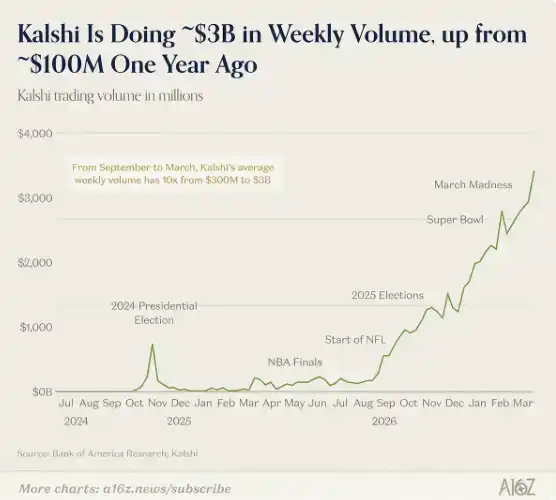
However, although early narratives often framed prediction markets as tools "only meaningful during election cycles," Kalshi's growth in other areas has been equally significant.

At the time of the research conference, weekly trading volume for sports contracts had just approached $3 billion, accounting for about 80% of Kalshi's total volume, largely driven by "March Madness." Tarek and Luana viewed this high concentration as a phased phenomenon.

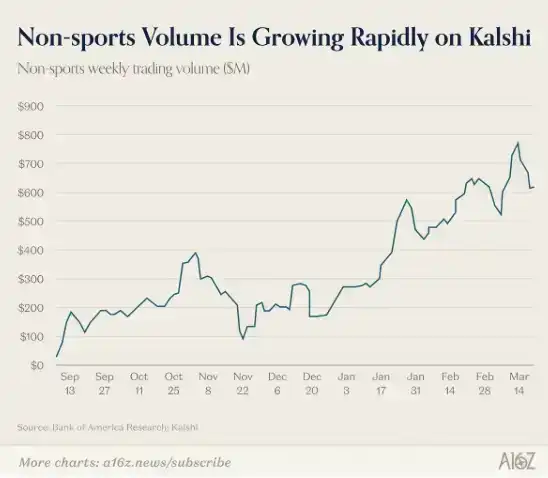
A more explanatory data point: despite the absolute size of sports trading hitting a record high, its share of total trading volume was at a historical low. This means that all other categories were growing faster.

The two founders pointed out that categories like entertainment, crypto, politics, and culture are showing stronger user growth and better trading retention structures than sports. Sports are more like a "trigger" for the mass market—they are highly familiar, have clear temporal rhythms, and strong emotional engagement, making them a typical entry product.

Meanwhile, the company has also observed significant growth in longer-tail markets. These markets currently constitute over 20% of Kalshi's trading volume and will play a more critical role in future institutional hedging and information markets.
A subsequent institutional roundtable confirmed this assessment from the demand side.

Cyril Goddeeris, Co-Head of Global Equities Business at Goldman Sachs, stated that predictions related to macro events and CPI data are the categories Wall Street is most focused on currently. Sally Shin, Executive Vice President of Growth Business at CNBC, mentioned that she already uses prediction markets like "Fed Chair's tenure" and "Non-Farm Payrolls data" as narrative tools for content. Tradeweb's Global Markets Co-Head, Troy Dixon, went further to描绘 a future picture: large investment banks will establish dedicated prediction market trading desks, with financial contracts as core products.

Why Kalshi Attracts Wall Street's Attention

An important reason traditional financial markets can function is that each core asset class has a公认的 benchmark: the S&P 500 index represents the overall performance of 500 stocks, crude oil has benchmark price systems like ICE.

But for political and macroeconomic events (e.g., who wins an election, whether tariffs pass, the outcome of a Supreme Court case), there has long been a lack of widely accepted, dynamically updated "pricing benchmarks." Prediction markets change this—now, the future of almost any event can have a real-time, liquid "price anchor."

Once an event (e.g., "Will a 30% tariff pass?") has a credible price, institutions can trade directly around that price. This allows for both trading the event itself and hedging risks in other parts of a portfolio. As Tradeweb's Troy Dixon said: "Go back to Trump's first election. There was a lot of hedging in the equity market then, the logic being to short the S&P because if Trump wins, the market will definitely fall. But that trade failed. The question was: how do you price these events? Where is the benchmark?"

Tarek also mentioned this was one of his motivations for founding Kalshi. During his tenure at Goldman Sachs, his trading desk had recommended trades based on the 2024 election and Brexit. Without prediction markets, institutions hedging political or macro events through correlated assets were actually betting on two things simultaneously: first, whether the event itself would happen, and second, the correlation between that event and the traded asset. And the second judgment could be wrong on its own.

When the event itself has a direct price benchmark, these two layers of risk are compressed into one. As Tarek said: "Now, this market is starting to price everything."

The Three Stages of True Institutional Adoption of Prediction Markets

It is clearly still too early to say that major Wall Street institutions are trading on Kalshi on a large scale. Currently, most institutions' usage remains at the "data source" level, not the "trading platform" level.

However, Luana pointed out that the path to institutional adoption of this market is clear and can be divided into three stages:

The first stage is data access: getting prediction prices into the daily workflow of institutions. For example, getting Goldman Sachs portfolio managers to habitually check Kalshi's odds data just like they check the VIX index. This stage is already happening to some extent. John Hopkins University professor and former Fed official Jonathan Wright stated: "In areas like Fed decisions, unemployment, GDP, Kalshi is almost the only reference source."

The second stage is system integration: including compliance and legal approval, technical integration, and internal education—essentially the process of introducing a new financial instrument.

The third stage is actual trading: institutions begin to directly hedge risks on the platform, trading volume and market depth gradually accumulate. At this point, more hedging demand attracts speculators, tighter spreads attract more hedgers, and the benchmark price forms a self-reinforcing positive feedback loop.

Currently, most institutions are still in the first stage, some are entering the second stage, and very few have truly entered the third stage. A major obstacle is that current market trading requires full margin. For example, a $100 position requires a $100 margin deposit. This is acceptable for individual investors but too costly for hedge funds or banks that rely on leverage and capital efficiency.

As Tarek said: "If you want to do a $100 hedge, you have to put $100 in the clearinghouse. That's too expensive for institutions. Firms like Citadel or Millennium won't do that." Kalshi has already obtained a license from the National Futures Association (NFA) and is working with the Commodity Futures Trading Commission (CFTC) to introduce margin trading mechanisms.

What Happens Next?

Michael McDonough, Head of Market Innovation at Bloomberg, summarized it most directly: "The sign of success is when these things become boring." He compared prediction markets to the options market in the 1970s, which was同样 full of controversy over manipulation and regulatory uncertainty but eventually evolved into an infrastructure, so much so that today almost no one thinks twice about it.

AQR partner Toby Moskowitz said he "would bet real money" that prediction markets will become a viable institutional tool within five years, possibly even sooner.

Vote Hub's Garrett Herren described the end state: "The question is no longer whether to use prediction markets, but how to use them. Once the question becomes that, it means they have become indispensable."

In fact, although the current scale of prediction markets is still limited, the hedging market itself is a massive field.
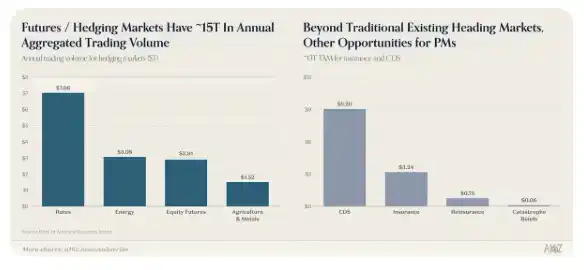
In fact, the "normalization" of prediction markets is already happening.

In the politics-themed roundtable, former Congressman Mondaire Jones mentioned that senior figures in both parties—including President Trump, House Minority Leader Jeffries, and Senate Minority Leader Schumer—have begun citing Kalshi's odds data in public. DDHQ's Scott Tranter also confirmed that prediction market data has now become a standard input within party committees. Meanwhile, Vote Hub announced it has directly integrated Kalshi data into its midterm election forecasting models.

And all of this did not exist at all two years ago. Back then, the most successful traders on Kalshi were still predominantly "amateurs." Now, that term isn't even accurate anymore.

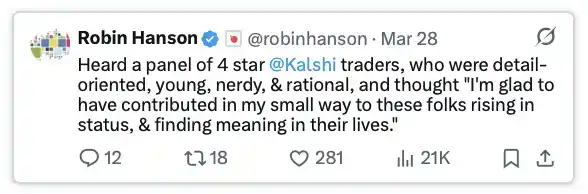
In Kalshi's "The People Behind the Markets" roundtable, four traders shared their career paths—these paths sounded no different from traditional professional traders: one spent 11 years studying the Billboard music charts, another has been refining his skills in prediction markets since 2006, when it was still a "somewhat geeky hobby that barely made money." Notably, none of these four guests came from traditional finance; they came from music, politics, and poker respectively. But they unanimously agreed that the platform truly rewards deep domain knowledge, not glossy resumes.

Prediction markets have come a long way. Initially seen as academic experiments, then as "novelty tools" during elections, later categorized as "sports-betting-like products," their positioning has constantly changed. The clear signal from this conference is: prediction markets are evolving into an infrastructure—for pricing uncertainty, serving a wide range of participants from retail traders to large institutions and diverse application scenarios.
Связанные с этим вопросы

QWhat are the three key changes in the prediction market industry highlighted in the article?

AThe three key changes are: 1) Application scenarios are expanding, with sports remaining the traffic entry point but long-tail markets like entertainment and macro growing faster and beginning to carry institutional demand. 2) Prediction markets provide a tradable price benchmark for events themselves, allowing institutions to directly hedge political or macro risks instead of making secondary bets through related assets. 3) Institutional adoption is progressing from data reference (viewing odds) to system integration and then to actual trading, currently still in the early stages.

QWhy is Kalshi attracting attention from Wall Street according to the article?

AKalshi is attracting Wall Street's attention because it provides a real-time, liquid 'price anchor' for political and macroeconomic events, which previously lacked widely accepted dynamic pricing benchmarks. This allows institutions to trade directly on events or hedge risks in their portfolios. It compresses the two layers of risk (whether the event occurs and the correlation between the event and traded assets) into one layer, making hedging more efficient.

QWhat are the three stages of institutional adoption of prediction markets as described by Luana Lopes Lara?

AThe three stages are: 1) Data access: Integrating prediction prices into institutional workflows, such as portfolio managers routinely checking Kalshi's odds data. 2) System integration: Involving compliance and legal approvals, technical对接, and internal education for introducing a new financial instrument. 3) Actual trading: Institutions start directly hedging risks on the platform, with trading volume and market depth gradually accumulating.

QWhat is a major obstacle for institutional adoption of prediction markets mentioned in the article?

AA major obstacle is the current requirement for full margin trading. For example, a $100 position requires $100 in margin. This is too costly for hedge funds or banks that rely on leverage and capital efficiency, as institutions like Citadel or Millennium would not operate this way. Kalshi is working with the CFTC to introduce margin trading mechanisms.

QHow is the prediction market evolving according to the conclusion of the article?

AThe prediction market is evolving from being seen as an academic experiment, a novelty tool during elections, or a sports-betting-like product into a financial infrastructure for pricing uncertainty. It is becoming a core market tool connecting retail and institutions for hedging and pricing real-world uncertainties, similar to the early development of the options market.

Похожее

AI Relay Stations Spark Heated Debate on Zhihu: Behind Cheap Tokens, What Are Users Really Worried About?

A discussion on Zhihu about "AI relay stations" shifted the niche developer topic of "cheap tokens" into broader user awareness. Users moved beyond simply questioning the legitimacy of these services to focus on practical concerns: Where do cheap tokens truly come from? Is the model being accessed the real one? Can relay stations see prompts, code, and API keys? For occasional users, are the risks worth it? The core debate centered less on price and more on trust. A primary worry is model authenticity—the risk of "model swapping," where users paying for a premium model might be routed to a cheaper one, creating an information asymmetry. Others argued that cost comparisons matter; while cheaper than official pay-as-you-go APIs, relay stations may not be the lowest-cost option versus subscriptions, domestic models, or free tiers, making user needs assessment crucial. Speculation about token sources ranged from legitimate bulk discounts to gray-area methods like account sharing or exploiting regional pricing. This opacity makes risk assessment difficult for users. Data security emerged as a critical concern, especially for enterprise use. When processing sensitive information like code, contracts, or client data, the inability to verify a relay station's data handling, retention, or access policies poses significant compliance and confidentiality risks. The evolving consensus suggests relay stations can be used cautiously for low-sensitivity, disposable tasks (e.g., summarizing public info, simple translation). However, they should not be the default for sensitive, professional, or production workflows involving proprietary data, Agents, or automated systems. Recommendations include avoiding large prepayments, not relying on a single service, using test prompts to monitor quality, anonymizing data where possible, and keeping official channels as backups. Ultimately, the discussion framed tokens not just as a billing unit but as a measure of real cost encompassing price, model integrity, data security, and service stability. The popularity of relay stations highlights user demand for affordable access, but the debate underscores a key trade-off: the savings from cheap tokens may come at the price of trust, transparency, and control over one's data and AI experience.

marsbit9 мин. назад

AI Relay Stations Spark Heated Debate on Zhihu: Behind Cheap Tokens, What Are Users Really Worried About?

marsbit9 мин. назад

In-Depth Research Report on TradFi: The Convergence Wave of Crypto and Traditional Finance

In 2026, the crypto industry is undergoing a profound infrastructure-level transformation—TradFi assets are migrating on-chain at an unprecedented pace. According to CoinGecko's Q1 2026 report, the total value locked (TVL) of tokenized real-world assets (RWA) has surpassed $31 billion, a nearly 4x increase from $7.8 billion at the beginning of 2025, with the sector’s aggregate market capitalization reaching $19.3 billion. Among these, the market cap of tokenized stocks surged from $2 million to $486 million, with Q1 spot trading volume reaching $15.1 billion—a single quarter already surpassing the entire second half of 2025. RWA perpetual contract Q1 trading volume reached a staggering $524.8 billion, far exceeding the $313 billion for all of 2025. Meanwhile, BlackRock's BUIDL fund has reached $2.3 billion in scale and has filed for two new tokenized funds, signaling that the world's largest asset manager's tokenization strategy is evolving from pilot to product suite expansion. HTX, as a core participant in the crypto exchange sector, officially launched TradFi perpetual futures products including NVDA, AAPL, MSFT, META, and SPY in 2026, enabling crypto users to gain 24/7 trading access to core U.S. equities. Boston Consulting Group predicts that global tokenized asset scale could reach $16 trillion by 2030, while McKinsey offers a conservative estimate of approximately $2 trillion. The on-chain migration of TradFi assets is no longer a "future narrative" but a structural transformation unfolding in real time, as crypto exchanges evolve from single crypto asset trading platforms toward "multi-asset-class trading infrastructure."

HTX Learn12 мин. назад

In-Depth Research Report on TradFi: The Convergence Wave of Crypto and Traditional Finance

HTX Learn12 мин. назад

Blocked Its Own Treasure, WeChat AI Steps Up

Tencent's stock surged over 10% on June 2nd amid reports that WeChat, with 1.43 billion monthly users, is finalizing tests for a native AI Agent. The reported feature, accessible by swiping right from the main interface, allows users to issue commands in natural language. The AI then decomposes tasks and automatically calls upon relevant Mini Programs within WeChat to complete actions like ordering food, booking tickets, or making payments, creating a closed-loop service execution system. This strategic shift follows the internal conflict and subsequent "blocking" of Tencent's standalone AI app, Yuanbao, by WeChat for violating sharing rules during a 2026 Spring Festival promotion. The incident highlighted a lack of internal consensus and exposed the weakness of competing in the standalone AI assistant arena against rivals like ByteDance's Doubao (345M MAU) and Alibaba's Qianwen. The new WeChat AI Agent aims to leverage WeChat's unique assets—its massive user base, standardized Mini Program APIs, WeChat Pay, and identity system—to move from simple content generation to actual task execution. Analysts note this changes the competitive landscape from model benchmarks to which AI can connect to more real-world services. However, success depends on key variables: the capability of Tencent's underlying Hunyuan model, managing massive inference costs, and redesigning incentives for Mini Program developers whose traffic might be bypassed. The move is seen as an attempt to keep user service intent within WeChat's ecosystem as AI begins to redefine how users access services.

marsbit1 ч. назад

Blocked Its Own Treasure, WeChat AI Steps Up

marsbit1 ч. назад

ByteDance Adopts Arm CPUs, Jensen Huang: So Sad I Didn't Buy Arm

**Summary:** At Computex 2026, Arm CEO Rene Haas announced that ByteDance and Oracle have adopted Arm's self-designed Arm AGI data center CPU. The company expects significant revenue growth from this product, projecting $20 billion in demand for the 2027/2028 fiscal years. Haas noted that restricting AI-capable CPUs from the US to China is nearly impossible due to their widespread applications. Arm's stock has surged dramatically this year, notably rising 16% after NVIDIA's Arm-based Vera CPU and RTX Spark announcements. A highlight was the informal, humorous on-stage conversation between Haas and NVIDIA CEO Jensen Huang. Huang joked about NVIDIA's failed attempt to acquire Arm and playfully lamented selling his Arm shares. Both executives showed a clear sense of camaraderie and shared regret over the missed merger. Key technical topics were discussed: 1. **AI PC Design:** Huang explained NVIDIA's RTX Spark superchip (with a 20-core Arm CPU) is designed for future AI agents that will autonomously run and use tools on PCs, blending local and cloud processing. 2. **Agent vs. OS:** Huang emphasized the operating system remains crucial, as AI agents rely on its APIs and tools to function. 3. **Growth Constraints:** He identified the shift to "useful AI" that generates profitable tokens as a primary driver for immense, almost limitless, computational demand. Haas outlined Arm's strategy across PC and data centers. For PCs, Arm collaborates with partners like NVIDIA and MediaTek, offering its compute subsystem (CSS) for custom SoCs. In data centers, its Arm AGI CPU (built on TSMC's 3nm process) has gained major partners including OpenAI, Meta, and now ByteDance and Oracle. Arm presented a multi-year roadmap for its in-house CPU line. The article concludes that while GPUs dominated the AI training race, the explosion of AI agents is shifting significant focus to CPUs for inference, state management, and tool orchestration. The industry is trending towards vertical integration, with companies like cloud providers designing chips and chip/IP firms offering full solutions, all competing to deliver more efficient computing per watt.

marsbit1 ч. назад

ByteDance Adopts Arm CPUs, Jensen Huang: So Sad I Didn't Buy Arm

marsbit1 ч. назад

Торговля

Спот
Фьючерсы
活动图片





