A New Paradigm in Tokenomics? When Backpack Makes VCs 'Delay Gratification'

marsbitОпубликовано 2026-02-10Обновлено 2026-02-10

Введение

The article discusses Backpack's innovative tokenomics model, which challenges conventional practices in the cryptocurrency industry. Unlike typical projects where teams and venture capitalists (VCs) receive immediate token allocations, Backpack allocates 100% of liquid tokens to users at TGE. The remaining 37.5% of tokens, traditionally reserved for teams and investors, are locked in a corporate vault and tied to the company’s eventual IPO. This structure ensures that internal stakeholders can only benefit after a successful IPO, with an additional one-year lock-up period post-IPO to prevent early sell-offs. Backpack’s approach emphasizes long-term alignment with user interests and project sustainability. The token distribution prioritizes community incentives, with 25% of tokens released at TGE to reward users and NFT holders. Future unlocks are tied to product milestones, ensuring that new token releases contribute more value to the ecosystem than they dilute the token’s price. Additionally, Backpack prioritizes regulatory compliance, currently serving only 48% of global regions to adhere to legal standards. Its goal is to build a hybrid platform integrating crypto and traditional financial services. Market reactions are mixed: Backpack is reportedly seeking funding at a $1 billion valuation, but predictions about its token FDV reflect uncertainty. Ultimately, Backpack’s model represents a shift toward transparency, long-term value, and user-centric growth in Web3.

In the "Wild West" of cryptocurrency, "founders cashing out and exiting" and "project teams rug-pulling retail investors" have become blatant acts of profit plunder, turning into chronic maladies that shackle the development of Web3. Consequently, "tokenomics" is often seen as an accelerator for team wealth and a touchstone for user confidence.

However, when we turn our attention to Backpack, we see a completely different design: Backpack has chosen a thorny path that directly addresses the industry's pain points: at TGE, all liquid tokens are given to users, while the returns for the team and investors are entirely tied to the company's IPO process.

This move by Backpack abandons the rugged design of "VCs setting up the game, retail investors footing the bill." Whether it ultimately succeeds or not, this is a respectable attempt in the history of cryptocurrency.

Delayed Gratification: The Long-Term Game Between Team and Capital

In Backpack's token economic system, the most attention-grabbing aspect is the strict constraints on returns for the team and investors—no founders, executives, employees, or venture capitalists directly receive token allocations.

As Backpack founder and CEO Armani Ferrante put it, the "escape velocity" Backpack seeks is never about reaching a market cap of billions of dollars or hitting some short-term milestone in user numbers, but about the company successfully completing an IPO in the United States.

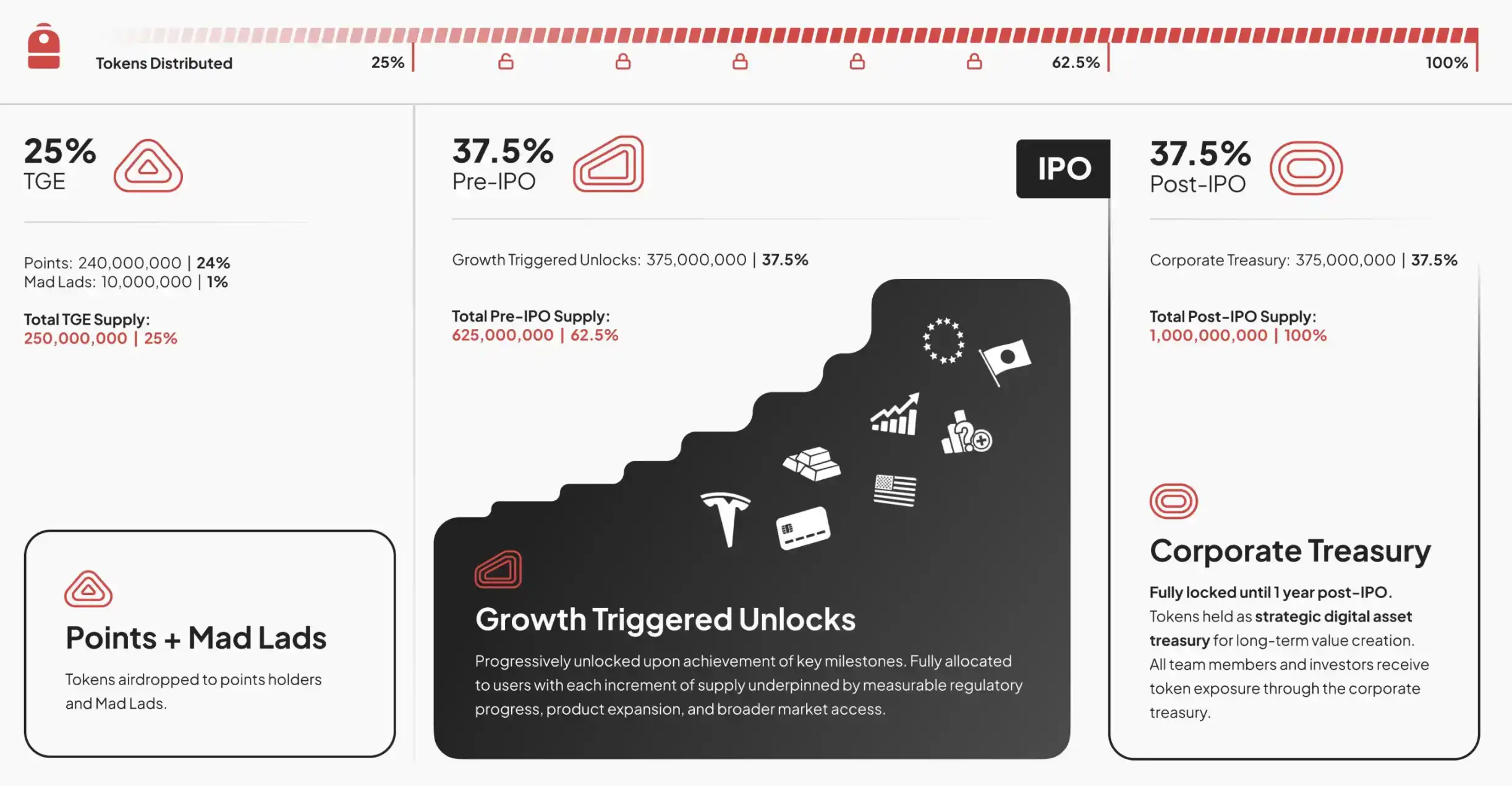
All tokens originally intended for "team incentives" and "investor returns" (37.5% of the total supply) are deposited into the company's "corporate treasury," i.e., on Backpack's balance sheet. Even after a successful IPO, these tokens are subject to a fully locked period of at least one year, further eliminating the possibility of "cashing out immediately upon listing."

This design of "delayed gratification" is the best protection for the project's long-term value. In the crypto industry, too many projects collapse due to the "short-sightedness" of teams and investors—selling tokens too early to cash out, causing token prices to crash, losing user trust, and ultimately leading to demise. Backpack's approach completely severs the path for insiders to "cash out short-term," forcing the team and investors to "sink or swim" with the project.

Of course, an IPO is no easy path. Backpack's founders admit that going public could be imminent, could be far off, or might never happen. But regardless of the outcome, they will give it their all. This "break or break through" determination makes Backpack stand out among the myriad of short-sighted crypto projects, yet it has won the trust of users who truly value long-term value.

User-First Token Distribution: Igniting the Growth Engine with Incentives

In Backpack's tokenomics, all liquid tokens are entirely allocated to users. In Backpack's view, users are the core driving force behind project growth, so tokens should serve as fuel to incentivize user participation and drive product development.

· Total supply of 1 billion tokens, 25% directly released to the community at TGE: Among these, points holders account for 24%, and Mad Lads holders account for 1%.

· Unlocked (37.5%) triggered by key product milestones before IPO. Every market expansion, every new product launch, is an opportunity to incentivize users with tokens, each triggering corresponding token unlocks. This design, through a predictable token unlock model, continuously attracts new users and expands the community scale.

More importantly, according to Armani Ferrante, Backpack has set strict constraints for token unlocks: the new ecological value brought by token unlocks must always be greater than its dilutive effect on the token price.

This design protects the core interests of users while ensuring the project's long-term value is not diluted by short-term unlocking behavior, making token incentives a true catalyst for platform growth, achieving a triple win of "user benefit, ecological value addition, and project growth."

Under Compliance: Slow is Fast

Beyond the innovation in token distribution, another distinctive feature of Backpack is its pursuit of compliance. This stands in stark contrast to the common logic in the industry of "expand first, comply later" and "prioritize scale over compliance."

As Armani Ferrante revealed, "Backpack currently serves only about 48% of regions globally. Behind this seemingly slow expansion lies a pursuit of compliance."

This strategic choice might mean missing market opportunities in the short term, but from a long-term development perspective, it is key to building a trust barrier.

Currently, Backpack's positioning is a compliant crypto exchange, offering cryptocurrency spot, derivatives, and lending services. But it is not content with being a pure cryptocurrency trading platform; it aims to build a compliant platform integrating crypto assets and traditional financial (TradFi) services. To achieve this goal, the team is laying banking rails globally and also plans to gradually launch diversified services like securities products in the future. In January, Backpack also launched a unified margin and cross-collateralization prediction product.

Market Perspective: How to View Backpack's FDV?

The market's attitude towards Backpack also reflects the controversy and potential of its model from the side.

According to Axios citing informed sources, Backpack is negotiating terms for new financing, with a pre-money valuation already reaching $1 billion.

On the prediction market Polymarket, market expectations for Backpack's token show significant volatility: the probability of Backpack's token FDV exceeding $1 billion within one day of listing is 21%, while in November 2025, this probability once reached over 80%. Of course, this volatility largely stems from the inherent uncertainty of the crypto market and also reflects the market's cautious attitude towards the "IPO-bound returns" model.

Summary

When tokens become tools for project teams to cash out, and users become targets to be harvested, the crypto industry loses its original ideals. Backpack's token distribution essentially creates a physical separation between Web2 equity incentives and Web3 token utility.

· For the team: The only way out is to make the product stronger and more compliant until the IPO. If the company fails midway or cannot go public, the equity in the team's hands will be worthless, with no possibility of cashing out.

· For the community: They are no longer the liquidity exit for VCs. Tokens are purely user rewards and ecological tools, not the team's ATM.

Backpack's choice is to redefine the value logic of crypto projects with compliance, transparency, and long-termism, showing us another possibility for the Web3 industry.

As Armani Ferrante said: "We either go big, or we go home." This statement is not only the manifesto of the Backpack team but also a mandatory question for the entire Web3 industry: Do we continue to revel in the speculative bubble,透支行业的信任与未来透支行业的信任与未来 (overdrawing the industry's trust and future原文此处为中文); or do we, like Backpack, choose the harder, slower, but more hopeful path, using long-termism to reconstruct the industry ecosystem?

Of course, an IPO is not easy, and the road is long and arduous, especially in the crypto industry, facing multiple challenges like regulation, market, and competition. Accidents and uncertainties are everywhere.

Связанные с этим вопросы

QWhat is the core innovation in Backpack's token economics model?

ABackpack's token economics model allocates all liquid tokens to users at TGE, while team and investor rewards are entirely tied to the company's IPO process, preventing early insider sales and aligning long-term incentives.

QHow does Backpack ensure that token unlocks benefit the ecosystem without diluting value?

ABackpack sets strict constraints for token unlocks: the new ecological value generated from unlocks must always exceed the dilutive effect on the token price, ensuring user benefits and sustainable growth.

QWhat percentage of the total token supply is allocated to the community at TGE, and how is it distributed?

AAt TGE, 25% of the total 1 billion token supply is allocated to the community: 24% to points holders and 1% to Mad Lads holders.

QWhy does Backpack prioritize compliance in its expansion strategy, and what regions does it currently serve?

ABackpack prioritizes compliance to build long-term trust and regulatory security, currently serving only about 48% of global regions to ensure adherence to local laws before expanding.

QWhat is the significance of tying team and investor rewards to Backpack's IPO instead of token sales?

ALinking rewards to the IPO ensures that team and investors are fully committed to the project's long-term success, as they cannot cash out until after a successful IPO, which may take years or never happen, aligning their interests with sustainable growth.

Похожее

Stuck Polymarket: The Real Test After Riding the Traffic Boom Has Arrived

Polymarket, a leading prediction market platform, is facing significant technical challenges as its growth outpaces its current infrastructure on Polygon. Users are experiencing laggy transactions, unresponsive orders, and delayed confirmations, severely impacting the trading experience. In response, DeFi Engineering VP Josh Stevens outlined a comprehensive engineering overhaul. The plan includes reducing on-chain data delays, fixing order cancellation issues, rebuilding the central limit order book (CLOB), improving website performance, and developing a unified SDK and API. A major revelation was the ongoing "chain migration," indicating a potential move away from Polygon. The core issue is that Polymarket has evolved from a simple prediction market into a high-frequency trading platform, making Polygon's limitations—such as block space, gas fees, and block time—a ceiling for further growth. The migration is not just a simple chain switch but a fundamental rebuild of its trading system to support more complex products like perpetual contracts (Perps). This announcement has sparked competition among chains like Solana, Sui, and Algorand, all vying to host Polymarket. For Polygon, losing this key application, which contributes significantly to its gas fee revenue, would be a major setback. The real test for Polymarket is no longer attracting users but proving it can provide a stable, reliable trading environment that retains them.

Odaily星球日报Только что

Stuck Polymarket: The Real Test After Riding the Traffic Boom Has Arrived

Odaily星球日报Только что

Lowering Expectations for BTC's Next Bull Market

The author, Alex Xu, explains his decision to significantly reduce his Bitcoin holdings (from full to ~30% of his portfolio) during the current bull cycle, citing a lowered long-term outlook for BTC's price appreciation in the next cycle. He outlines six key reasons for this reduced expectation: 1. **Diminished Growth Drivers:** The narrative of exponential user adoption has largely played out with institutional ETF adoption. The next major growth phase—adoption by sovereign national reserves or central banks—seems unlikely in the near future. 2. **Personal Opportunity Cost:** More attractive investment opportunities have emerged in other assets, such as undervalued companies. 3. **Industry-Wide Contraction:** The broader crypto industry is struggling, with most Web3 business models (SocialFi, GameFi, DePIN) failing. This overall萧条 (depression) reduces the fundamental demand and consensus for Bitcoin. 4. **Strain on Major Buyer:** MicroStrategy, a major corporate buyer of BTC, faces rising financing expenses for its debt, which could slow its purchasing rate and create significant marginal pressure on the market. 5. **Increased Competition from Gold:** The emergence of "tokenized gold" has closed the functional gap (portability, divisibility) between physical gold and Bitcoin, offering a strong competitor in the non-sovereign store-of-value space. 6. **Security Budget Concerns:** The block reward halving continues to exacerbate the long-standing issue of funding Bitcoin's network security, with new fee source explorations like Ordinals and L2s largely failing. The author's decision to hold a significant (though reduced) position reflects a cautious, not bearish, outlook. He remains open to increasing his exposure if the fundamental reasons for his skepticism change or if new positive catalysts emerge.

marsbit39 мин. назад

Lowering Expectations for BTC's Next Bull Market

marsbit39 мин. назад

Can Iran 'Control' the Strait of Hormuz?

Iran has announced a comprehensive plan to assert control over the strategic Strait of Hormuz, a critical global oil shipping chokepoint. The proposed measures include requiring all vessels to obtain Iranian permission for passage, imposing fees for security, environmental protection, and navigation management—preferably paid in Iranian rials—and absolutely banning Israeli ships. Vessels from countries deemed hostile by Iran’s top security bodies may also be barred. Analysts suggest Iran’s motives are multifaceted: increasing pressure on the U.S. and Israel by leveraging control over oil transit to influence global prices and inflation; creating a new revenue stream, potentially exceeding $7.7 billion annually, to counter Western sanctions and support postwar reconstruction; and using transit permissions as bargaining chips in future negotiations, notably with the U.S. However, the plan faces significant practical and diplomatic challenges. Enforcing comprehensive interception and fee collection in the busy waterway, patrolled by international military forces, would be difficult. The U.S. has already countering with a blockade of Iranian ports and threats to intercept any ship paying fees, potentially strangling Iran’s oil exports and fee revenue. Broad international opposition, led by European and Gulf states, and legal controversies further complicate implementation. The proposal may ultimately serve more as a negotiating tactic than a feasible policy, with its execution remaining highly uncertain.

marsbit1 ч. назад

Can Iran 'Control' the Strait of Hormuz?

marsbit1 ч. назад

Торговля

Спот
Фьючерсы
活动图片