A Century-Long Journey of an Egg: From Wall Street to Polymarket

marsbitОпубликовано 2026-03-02Обновлено 2026-03-02

Введение

The article traces the historical journey of egg futures, once one of the most active commodities traded on Wall Street. Beginning at the Chicago Butter and Egg Board (which later became the CME), egg futures were highly active in the early 20th century. However, by the 1980s, industrial farming and improved supply chains reduced price volatility, leading to the decline of egg futures trading in traditional markets. In 2013, China’s Dalian Commodity Exchange revived egg futures due to market volatility. More recently, egg price speculation has moved to Polymarket, a prediction market platform. One trader, "xcnstrategy," reportedly earned significant profits by shorting egg price intervals, likely leveraging expertise in commodity markets or agriculture. The piece highlights a broader trend: crypto and prediction markets like Polymarket and Hyperliquid are increasingly serving as 24/7 trading venues for traditional assets—including oil, gold, and forex—especially during periods when conventional markets are closed. This was evident during recent U.S.-Iran tensions when traders used these platforms to hedge and price assets amid traditional market closures. The evolution reflects an ongoing shift in price discovery power from established exchanges to decentralized, always-on crypto markets—echoing the original purpose of futures markets: to manage risk and determine prices.

"We went from eggs to yen"—this financial reminiscence from CME legend Leo Melamed bears witness to a time when eggs were once one of the world's most active futures products.

In the first half of the 20th century, egg futures were among the hottest trading instruments in Chicago. Trading volume in some years was second only to grain varieties, and there were even instances where futures trading far exceeded the volume of physical circulation.

The predecessor of the Chicago Mercantile Exchange (CME), the world's largest derivatives market, was called the "Chicago Butter and Egg Board." This was the foundation of what would later become a derivatives empire, and as the name implies, the exchange initially traded only two things: butter and eggs.

After the 1970s, the U.S. egg-laying industry rapidly industrialized, cold chains matured, and price fluctuations were gradually "smoothed out." As uncertainty began to fade, the noise in the trading pits quieted down. In 1982, egg futures officially exited the Chicago Mercantile Exchange. It didn’t collapse dramatically; rather, it was as if the times quietly turned off the lights.

In 2013, the Dalian Commodity Exchange in mainland China reignited this product. At that time, mainland China's egg-laying industry was still highly fragmented, with sharp price fluctuations, making hedging needs real and urgent.

Egg futures trading did not disappear; it merely migrated. And today, this migration has taken another step forward. The venue for trading egg prices has moved to Polymarket.
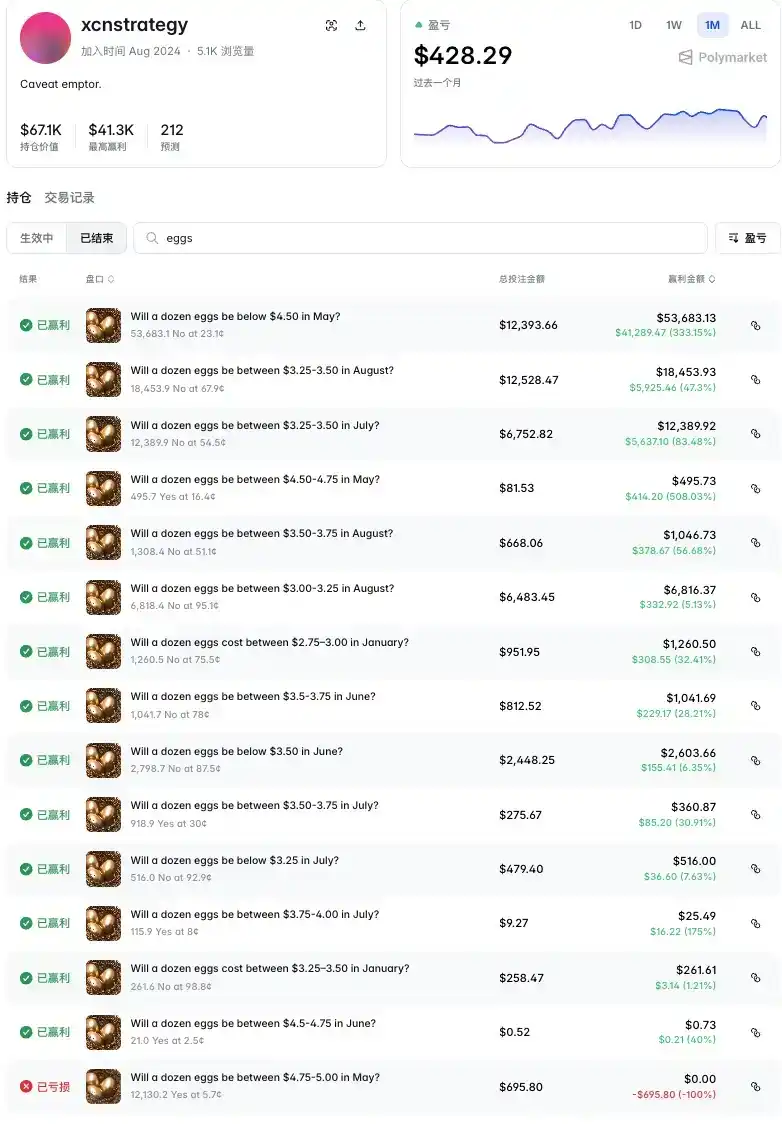
A trader with the ID "xcnstrategy" established positions in multiple expiration months—January, May, June, July, and August—for egg price predictions. The vast majority of these trades were shorting the "Yes" for certain price ranges, meaning betting that eggs would not reach certain price levels. The total betting amount was $44,800, with nearly $100,000 in profits. Out of 15 trades, all but the first were profitable.

The most recent trade was also the most profitable: a $12,393 bet on "No" for "a dozen eggs in May below $4.50," yielding a profit of $41,289 (+333%).

Speculations about xcnstrategy’s true identity, aside from possibly being an "egg enthusiast," include many who believe he is likely someone with a commodities market background or agricultural data research capabilities, analyzing that the U.S. avian flu-induced egg price surge starting in 2025 was a short-term phenomenon and that the market overestimated the probability of sustained high prices. Others think he is an industry insider in the egg supply chain, hedging against the volatility inherent in the industry.
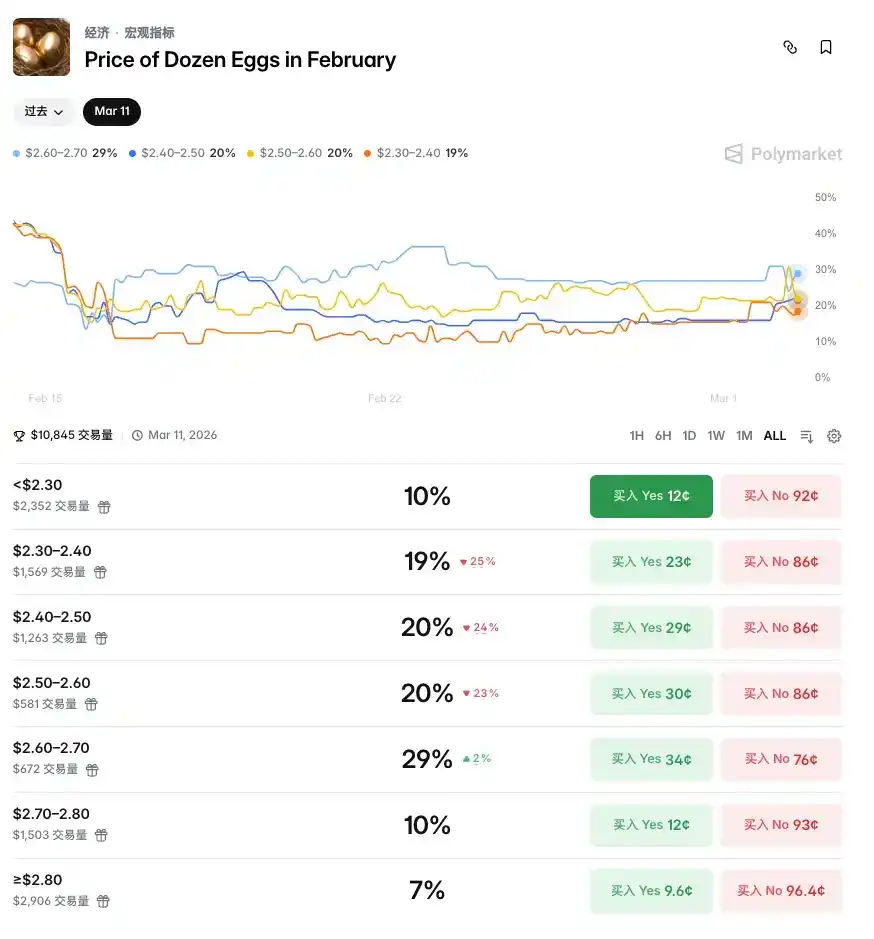
Eggs are just one example. The traditional asset标的 available for trading on Polymarket are far more diverse than one might imagine: from crude oil (CL), gold (GC), silver (SI), and other commodities to various foreign exchange rates and housing data—all can be found as markets on Polymarket.
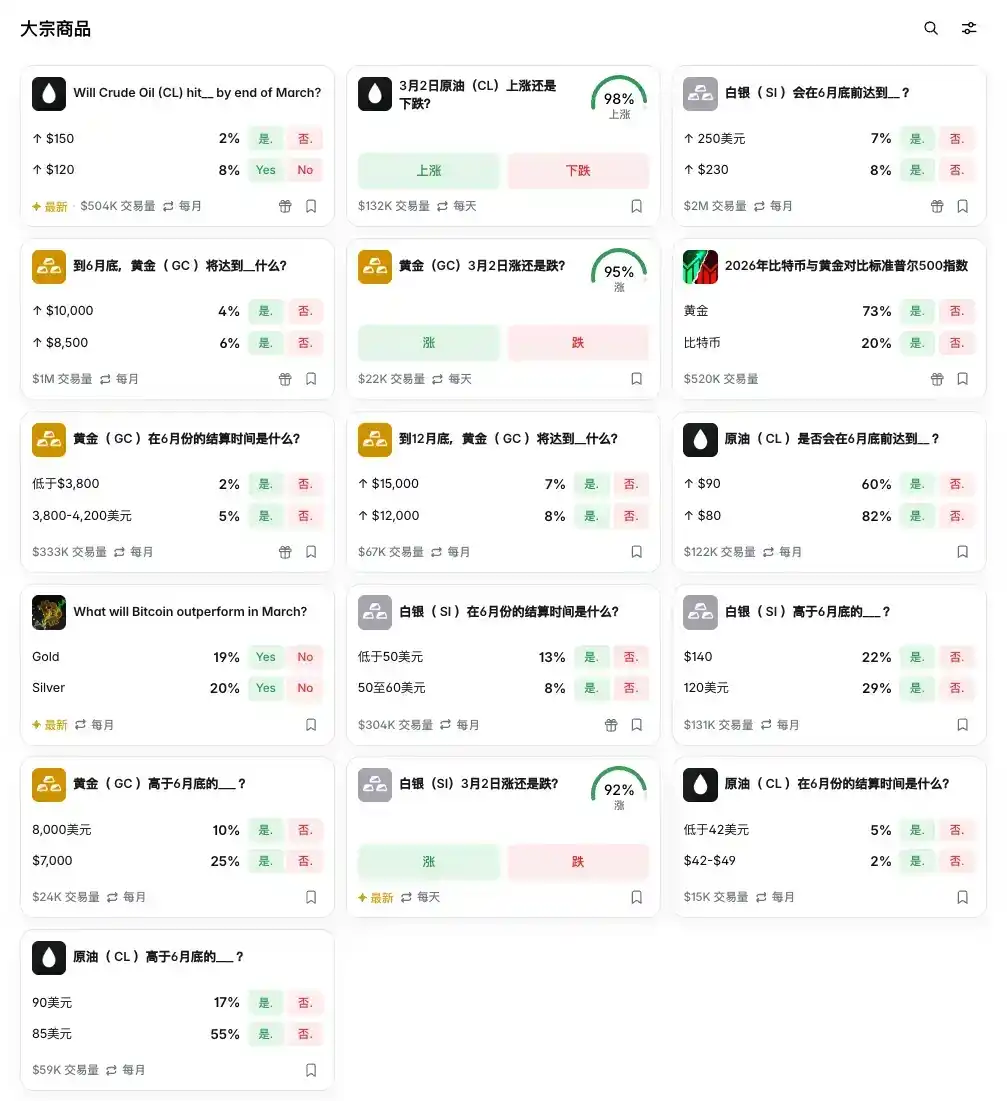
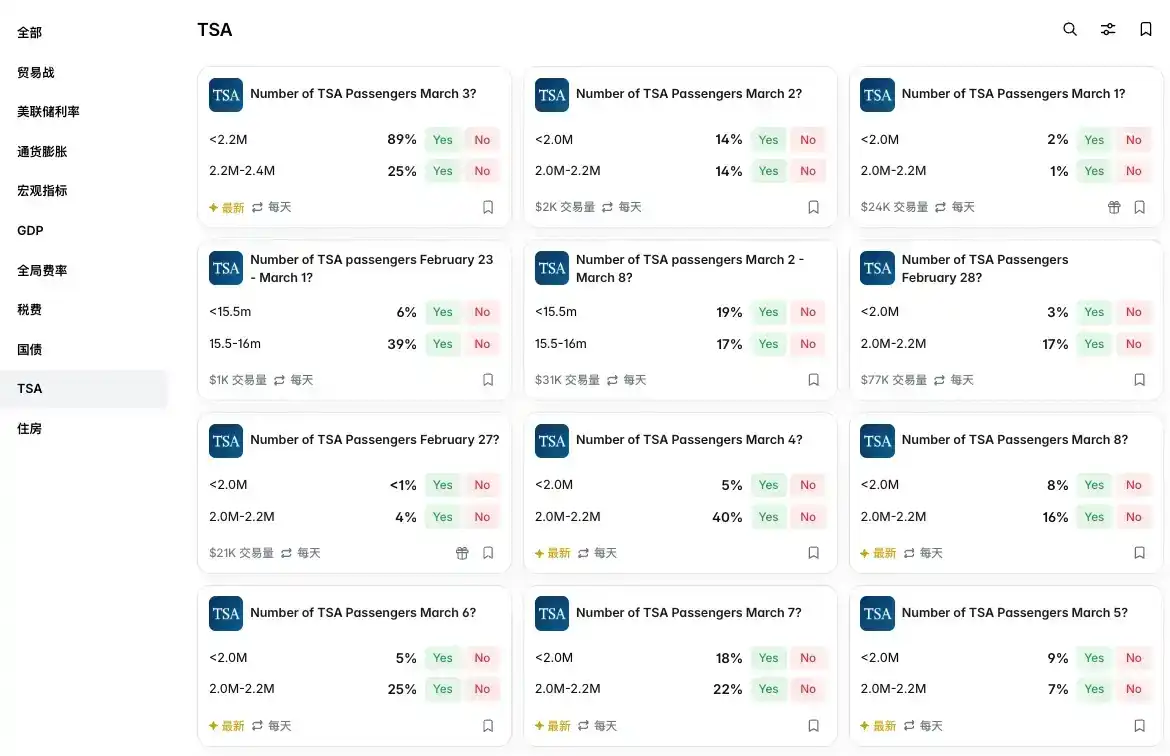
Operating 24/7 without closing is one of the biggest advantages of trading such markets on Polymarket. This advantage is particularly evident during traditional financial market closures, as seen with the U.S.-Iran conflict escalation last weekend.

In this regard, Hyperliquid shares the same advantage. The perpetual contracts on Hyperliquid, linked to crude oil and gold, have no expiration dates and run continuously, 24/7.

This leads to an increasingly hard-to-ignore phenomenon: the crypto market is quietly taking on the price discovery function of traditional financial markets, especially when the latter are closed.

Traditional futures markets have fixed trading hours; CME's crude oil and gold contracts close on weekends, and foreign exchange markets see liquidity dry up late at night. This means that when geopolitical shocks erupt after Friday's close, participants are left in the dark—unable to hedge, express views, or price assets.

Last weekend's U.S.-Iran conflict escalation is the latest validation. According to Bloomberg, around the time the conflict broke out, a large number of traders flocked to Hyperliquid to trade perpetual contracts linked to crude oil and gold to hedge against the geopolitical shock—while traditional markets were shut, crypto derivatives markets were the only place with the lights on. Investment firm executive Avi Felman had previously predicted that "Hyperliquid will become indispensable for fund managers because it’s 24/7." This judgment was concretely validated during this conflict.

At the same time, gold tokenization is accelerating another logic: when gold exists in the form of on-chain tokens and is continuously priced in decentralized markets, it no longer needs to wait for the London Metal Exchange or CME to open. To some extent, the tokenized gold market is acting as a "shadow pre-market" for traditional gold markets, pricing gold over the weekend and allowing price discovery to occur before traditional markets open.

In 2020, then the world's second-largest trading platform, FTX, launched tokenized stocks, allowing platform users to trade Tesla and NVIDIA shares with stablecoins. The idea was to capture pricing power—when U.S. stocks were closed, FTX's Tesla tokens could fill the market void, allowing users to trade Tesla stock when the company announced new models on Saturday, thereby influencing Nasdaq's Monday opening.

Unfortunately, due to liquidity issues, the pricing effect ultimately did not materialize. Six years later, tokenization has come full circle back to this vision. Today, Polymarket and Hyperliquid are viewed not merely as cryptocurrency trading platforms. Polymarket is already officially recognized as a public opinion polling agency and information exchange hub, while Hyperliquid is seen as a new type of full-asset trading platform.

Price discovery power has always been one of the core powers in financial infrastructure.

Back in the day, Chicago butter and egg merchants established the CME because they needed a venue to discover prices and transfer risks. Over a hundred years later, the same logic is replaying on-chain, only the medium has changed.

You might think the market is trading eggs, but in reality, the market is fighting for pricing power.


Связанные с этим вопросы

QWhat was the original name of the Chicago Mercantile Exchange (CME) and what products did it initially trade?

AThe original name was the Chicago Butter and Egg Board, and it initially traded only two products: butter and eggs.

QWhy did the trading of egg futures decline and eventually cease on the CME in 1982?

AThe decline was due to the rapid industrialization of the U.S. egg-laying industry and the maturation of the cold chain, which smoothed out price volatility, reducing the uncertainty and need for hedging, leading to its quiet discontinuation.

QWhat is the significant advantage of trading assets like eggs, oil, and gold on platforms like Polymarket and Hyperliquid compared to traditional markets?

AThe significant advantage is that they operate 24/7, allowing for continuous trading, price discovery, and risk management even when traditional financial markets are closed, such as during weekends or overnight.

QAccording to the article, how did the recent U.S.-Iran conflict demonstrate the value of crypto derivative markets like Hyperliquid?

AWhen the conflict escalated over a weekend, traditional markets were closed, but traders flocked to Hyperliquid to trade perpetual contracts linked to oil and gold, making it the only available venue to hedge risks and express market views, thus validating its role in pricing during off-hours.

QWhat broader financial function are platforms like Polymarket and Hyperliquid increasingly seen as fulfilling, beyond just trading cryptocurrencies?

AThey are increasingly seen as fulfilling the core financial function of price discovery and acting as information hubs or full-asset trading platforms, effectively competing for pricing power that was traditionally held by established exchanges like the CME.

Похожее

Внимание: на этой неделе произойдёт масштабное разблокирование токенов в 10 альткоинах! Вот список по дням и часам

В последнюю неделю рынок криптовалют испытал спад из-за хакерской атаки на аппаратный кошелек ColdCard и влияния геополитических событий. Однако на текущей неделе ожидается масштабное разблокирование токенов в 10 альткоинах, что может оказать значительное влияние на их рынки. Все время указано по UTC+3. Основные события разблокировки: * **4 августа, 03:00:** Lagrange (LGN) – разблокируется токенов на $1,38 млн (15.04% от рыночной стоимости). * **5 августа, 03:00:** Proof (PROOF) – разблокируется на $39,11 млн (119.59%), Power Protocol (POWER) – на $1,62 млн (8.93%), Verona (VERONA) – на $1,37 млн (12.61%). * **5 августа, 11:00:** Ethereum (ENA) – разблокируется на $15,28 млн (1.80%). * **6 августа, 03:00:** Goldfinger (GF) – на $11,52 млн (5.05%). * **7 августа, 03:00:** Infinity (INF) – на $2,31 млн (20.30%). * **8 августа, 03:00:** Stable (STBL) – на $28,75 млн (3.55%). * **9 августа, 03:00:** Name (NAME) – на $48,47 млн (74.54%), Move (MOVE) – на $1,22 млн (3.90%). Особое внимание стоит обратить на проекты Proof и Name, где объем разблокировки существенно превышает текущую рыночную капитализацию. Это не является инвестиционной рекомендацией.

cryptonews.ru1 ч. назад

Внимание: на этой неделе произойдёт масштабное разблокирование токенов в 10 альткоинах! Вот список по дням и часам

cryptonews.ru1 ч. назад

За $100 000 в месяц: Truth Social продает доступ к постам Трампа инвестиционным фирмам

Корпорация Trump Media and Technology Group (TMTG) запустила платный сервис Truth API, предоставляющий институциональным инвесторам и фирмам, занимающимся высокочастотной торговлей, мгновенный доступ к постам самых влиятельных аккаунтов в Truth Social, включая аккаунт экс-президента Дональда Трампа. Стоимость подписки, по данным источников, может достигать $100 000 в месяц. Компания позиционирует это как стратегию по извлечению прибыли из собственных активов. Инициатива вызвала критику со стороны ряда сенаторов-демократов и республиканцев, которые обвинили TMTG в продаже привилегированного доступа к постам президента и потребовали проверки со стороны SEC. В ответ компания заявила о скоординированной кампании по нанесению вреда её бизнесу. Анализ отмечает, что подобный сервис создает архитектуру риска, аналогичную случаям, когда торговые алгоритмы в прошлом вызывали обвал рынков, реагируя на фейковые сообщения в соцсетях. Отсутствие встроенного механизма верификации постов в реальном времени делает платформу потенциальной целью для манипуляций.

cryptonews.ru3 ч. назад

За $100 000 в месяц: Truth Social продает доступ к постам Трампа инвестиционным фирмам

cryptonews.ru3 ч. назад

Дивиденды по привилегированным акциям STRC остаются на уровне 12% несмотря на цену ниже номинала

Хотя привилегированные акции STRC компании Strategy завершили июль значительно ниже номинальной стоимости в $100, инвесторам сообщили, что дивиденд за август останется на уровне 12% и не будет увеличен. Акции закрылись 2 августа на уровне $89.46. Генеральный директор Фонг Ле подтвердил, что корпоративная цель — достичь торговли акциями в диапазоне $99-$100, но не уточнил сроки. В июле компания сообщила о чистом убытке в $8.22 млрд за второй квартал, в основном из-за нереализованных потерь на хранении биткоина. Для обеспечения выплат по привилегированным акциям Strategy создала денежный резерв в $3.75 млрд, которого хватит более чем на два года. Компания также выкупила часть своих привилегированных акций со скидкой и намерена продолжать покупки, пока они торгуются ниже номинала.

cointelegraph5 ч. назад

Дивиденды по привилегированным акциям STRC остаются на уровне 12% несмотря на цену ниже номинала

cointelegraph5 ч. назад

Вывод биткоинов продолжается: 8 лет хранения в холодном кошельке Coldcard закончились нулем

Аппаратный кошелек Coldcard оказался уязвимым, что привело к масштабному выводу средств. По данным Galaxy Research на 2 августа 2026 года, похищено уже более 1367 BTC (около $88.6 млн) с 4585 адресов. Проблема связана не с прошивкой, а с seed-фразами, сгенерированными на уязвимых устройствах в определенный период (Mk2/Mk3 с прошивкой 4.0.1–4.1.9; Mk4/Mk5 до версии 5.6.0; Q до версии 1.5.0Q). Причина — ошибка в интеграции библиотеки libNgU, из-за которой устройство перестало использовать аппаратный генератор случайных чисел, перейдя на предсказуемый программный. Обновление прошивки не меняет существующую seed-фразу, поэтому владельцам необходимо сгенерировать новую на исправленной версии и перевести активы. Статья приводит трагичный пример 39-летнего инвестора, который за 8 лет накопил 2 BTC тяжелым трудом, храня их в Coldcard как защиту от гиперинфляции в своей стране, но потерял все за минуты из-за этой уязвимости. Этот случай показывает, что даже стратегия холодного хранения не является абсолютно надежной, особенно когда уязвимость кроется в самом генераторе случайных чисел внутри изолированного устройства.

cryptonews.ru5 ч. назад

Вывод биткоинов продолжается: 8 лет хранения в холодном кошельке Coldcard закончились нулем

cryptonews.ru5 ч. назад

Торговля

Спот
活动图片




