Dogecoin Price Just Entered A Critical Level, But Analyst Says It’s Not Time To Buy

bitcoinistОпубликовано 2026-06-04Обновлено 2026-06-04

Введение

Dogecoin has returned to a major long-term level on its monthly chart, entering what analyst Trader Tardigrade identifies as a critical resistance zone. Historically, this zone within a massive descending broadening channel has seen only two visits in the past decade—in 2017 and 2020—each followed by a strong rejection and deep correction. The coin has already dropped 8% after testing this area. Crucially, the analyst's chart is inverted; the "resistance" line is actually a bullish support line on a normal price chart. Past rejections from this line preceded major rallies. Therefore, the current price action near $0.0937 is viewed as a return to support, with potential for an upward bounce. A move above $0.10 could signal improving sentiment, while a break above $0.25 would confirm a bounce from support. The inverted chart structure even suggests room for significant upside toward double-digit targets.

Dogecoin has returned to a major long-term level on the monthly chart, setting up another important test for the meme coin after months of weak price action.

The setup was initially noted by crypto analyst Trader Tardigrade on X, who argued that DOGE is now sitting at a critical resistance zone where previous rallies have failed. Dogecoin has visited this price zone only twice in the past decade, and each visit ended the same way.

The Pattern That Has Defined DOGE Since 2015

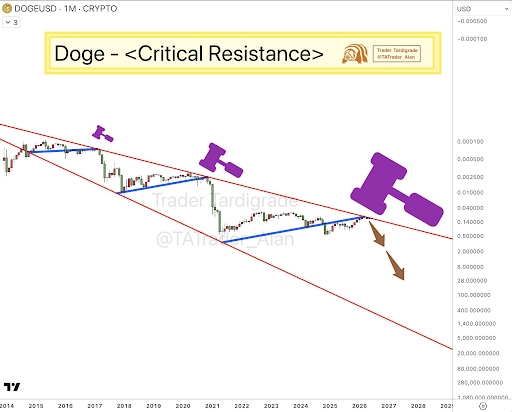
Trader Tardigrade’s long-term Dogecoin chart shows DOGE trading inside a massive descending broadening channel that has shaped price action for years. This channel has shaped Dogecoin’s price action for over a decade now, with two clearly defined red trendlines that widen progressively as time passes.

As shown in the chart below, Dogecoin previously rallied into the upper resistance of this channel in 2017 and in 2020, and both moves ended with strong rejections followed by deep corrections. Now, in 2026, Dogecoin has returned to that same overhead structure for a third time and looks like it is about to reject again. As noted by Trader Tardigrade, this is where we dump Dogecoin.

Source: Chart from Trader Tardigrade on X

Dogecoin has already dropped by 8% over the last three days, a decline that came shortly after DOGE tested that major resistance area, making the pattern a strong warning.

Real Message Behind The Inverted Chart

Trader Tardigrade’s chart presents DOGE/USD on the monthly timeframe, but the price scale is flipped. This means the lower the chart moves, the higher Dogecoin is actually moving in normal market price. Therefore, the red descending line labeled as critical resistance is not a bearish ceiling in the conventional sense, but a bullish line on an inverted chart, and a rejection from it sends the price directly into an upward movement in real terms.

In each of the two previous cases, the 2017 cycle and the 2021 cycle, a rejection from that inverted resistance was followed by a large move downward on the inverted chart, meaning a large rally upward on the normal DOGE chart.

Therefore, the current price action should be looked at as a return to support instead, and the analyst is expecting a bounce to higher price levels. Dogecoin is currently trading at $0.0937, which places it squarely within a support range between $0.09 and $0.10.

A move above $0.10 and into the $0.15 to $0.18 range would be the first indication that sentiment around DOGE is beginning to improve. However, the stronger signal would come from a break above $0.25, as that would make it clearer that DOGE is bouncing from the support structure.

Interestingly, the inverted chart’s structure leaves room for a move into double-digit price targets before Dogecoin reaches the next major trendline.

DOGE trading at $0.09 on the 1D chart | Source: DOGEUSDT on Tradingview.com

Связанные с этим вопросы

QWhat is the critical level that Dogecoin price has just entered, and how significant is it according to the article?

ADogecoin has returned to a major long-term resistance level on the monthly chart, which is a critical price zone it has only visited twice in the past decade. Both previous visits resulted in strong rejections followed by deep corrections, making this level highly significant and a crucial test for DOGE's current price action.

QWho is the analyst mentioned in the article, and what is their key observation about Dogecoin's current chart pattern?

AThe analyst mentioned is Trader Tardigrade on X. Their key observation is that Dogecoin is trading inside a massive descending broadening channel that has shaped its price action for years. DOGE is now testing the upper resistance of this channel for the third time, a zone where previous rallies in 2017 and 2021 failed.

QWhat is unusual about the chart presented by Trader Tardigrade, and how does it change the interpretation of the 'resistance' level?

AThe chart presents DOGE/USD on a monthly timeframe with an inverted price scale. This means the 'descending resistance' line is actually a bullish line on the inverted chart. A rejection from this line on the inverted chart signals a large upward movement for DOGE's actual price. Therefore, the critical level should be viewed as a support zone for a potential price bounce.

QBased on the inverted chart analysis, what price movement is expected for Dogecoin from its current level?

ABased on the inverted chart analysis, a rejection from the 'resistance' (which acts as support on the inverted chart) is expected to lead to a bounce to higher price levels. The analyst anticipates a move upward, with key levels to watch being a break above $0.10, then the $0.15 to $0.18 range, and a stronger signal coming from a break above $0.25.

QWhat is Dogecoin's current price and the key support range mentioned in the article?

ADogecoin is currently trading at $0.0937. The key support range mentioned is between $0.09 and $0.10.

Похожее

STRC Breaks Below $95: Why Does It Continue to Depeg? Is There Default Risk?

"STRC Falls Below $95: Why the Persistent Depegging and Is There Default Risk?" The article discusses the recent decline in the price of STRC, a perpetual preferred stock issued by Strategy (MSTR) designed to trade around a $100 par value. As of publication, STRC traded at $94.65, raising market concerns. STRC is described as a high-yield cash flow product, offering an 11.50% annual dividend paid monthly. Its "preferred" status grants it priority over common stock for dividends and in liquidation. Key reasons cited for the price depegging include: 1. **Bitcoin's Price Drop:** MSTR's assets are heavily tied to Bitcoin (BTC), which fell over 21% from its recent high, pressuring all Strategy-related products. 2. **Competitive Pressure:** Rival Strive Asset Management's similar product, SATA, offers daily dividends and has maintained its $100 par value with a ~13% yield. In response, Strategy has proposed changing STRC's dividend frequency from monthly to bi-weekly, pending shareholder vote. 3. **Technical Selling:** A break below $100 may have triggered algorithmic selling and stop-losses, exacerbating the decline. Regarding default risk, the analysis suggests it is currently low. Strategy founder Michael Saylor confirmed the June 2026 dividend rate remains at 11.50% with no cuts or suspensions. The company's massive reserve of 843,706 BTC provides a significant backstop for its obligations. Industry opinions are mixed. Some analysts view the BTC holdings as reliable support for dividends, while critics like Peter Schiff warn of potential dividend cuts leading to price crashes and lawsuits. Others highlight inflation risk and the company's ability to reduce dividends without a formal default. In summary, STRC's drop is attributed to BTC volatility, competition, and technical factors. While immediate default risk appears contained, the product faces challenges from market conditions and competitive dynamics.

marsbit1 ч. назад

STRC Breaks Below $95: Why Does It Continue to Depeg? Is There Default Risk?

marsbit1 ч. назад

AI Trading Cools, South Korean Stocks Plunge 1.8%, Spot Gold Rises 1%, Bitcoin Dives

A sell-off in AI-related stocks, triggered by Broadcom's disappointing earnings forecast, sent shockwaves through global markets. South Korea's KOSPI led Asia's decline, plunging 1.8% as the risks from concentrated chip stock gains and surging leveraged investments came to the fore. The tech-heavy Nasdaq 100 futures fell 0.5% following Broadcom's 14% after-hours plunge, which signaled a slower-than-expected transition to AI clients. This pullback extended Wall Street's weakness, halting the S&P 500's nine-day rally amid hawkish Fed signals and renewed Middle East tensions. South Korean authorities convened an emergency meeting, pledging "immediate measures" against market volatility and warning of record-high stock margin debt. The adjustment rippled across assets: Bitcoin fell to around $64,000, its lowest since February, while safe-haven gold rose 1% on bargain hunting. Oil prices dipped on Middle East ceasefire news. Market analysts noted the sell-off was driven by profit-taking after massive gains, particularly in chip stocks like Samsung and SK Hynix, which now dominate the KOSPI. Wall Street banks are divided on Korea's outlook, with Goldman Sachs raising its target while Citigroup and others warn of overvaluation and a potential bubble. Bridgewater's Ray Dalio noted that great technological shifts often create bubbles. Meanwhile, Fed officials' hints at potential future rate hikes added to the cautious mood ahead of key U.S. jobs data.

华尔街日报2 ч. назад

AI Trading Cools, South Korean Stocks Plunge 1.8%, Spot Gold Rises 1%, Bitcoin Dives

华尔街日报2 ч. назад

Торговля

Спот
Фьючерсы
活动图片