Shanghai's Leading Large Model Company Initiates A-Share Listing

marsbitОпубликовано 2026-05-30Обновлено 2026-05-30

Введение

Shanghai-based AI large language model leader MiniMax has initiated the process for an A-share listing in China, having filed a pre-IPO tutoring report with the Shanghai Securities Regulatory Bureau on May 29. This move positions it to compete with Zhipu AI for the title of the first major domestic LLM company to list on the A-share market. Having already completed an IPO in Hong Kong in January 2026, MiniMax's stock price has surged approximately 409% since its debut, with its market capitalization reaching around HK$263.45 billion (approximately RMB 227.55 billion) as of May 29. The company's rapid growth is supported by strong business performance. Its Annual Recurring Revenue (ARR) has grown over 100% in the past two months and now exceeds $300 million. It serves over one million global enterprise and developer clients and has around 300 million users worldwide. For the full year 2025, MiniMax reported revenue of $79.038 million, with a gross margin of 25.4%. While it reported an adjusted net loss of $250 million, the loss rate has narrowed significantly year-over-year. On the product front, MiniMax has released several flagship models this year, including MiniMax-M2.5, M2.6, and M2.7, with the first and last being open-sourced. Its models gained significant traction earlier in the year, briefly becoming the top model provider by usage share on the OpenRouter platform in February. The company has also upgraded its AI agent product, now named Mavis, and is preparing to l...

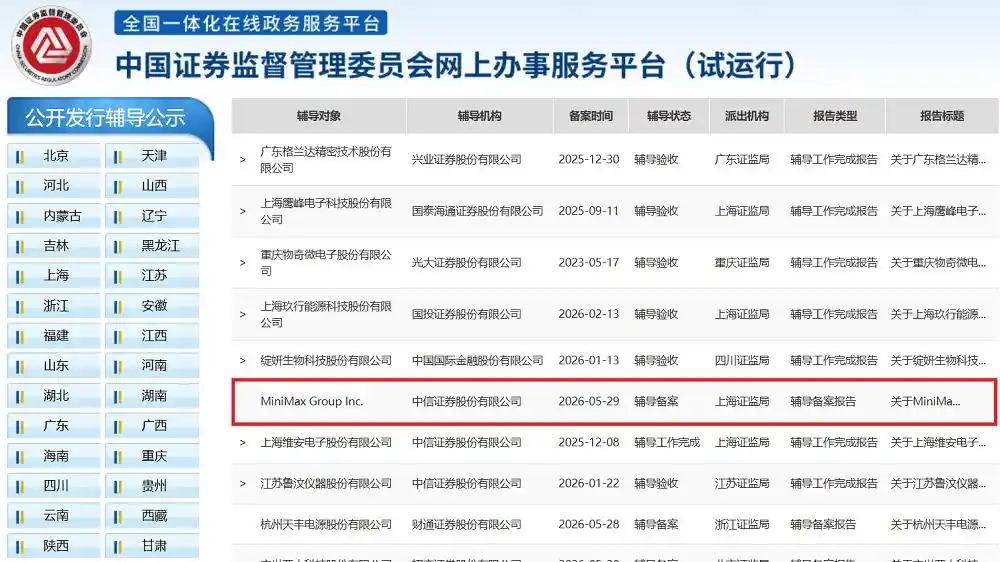
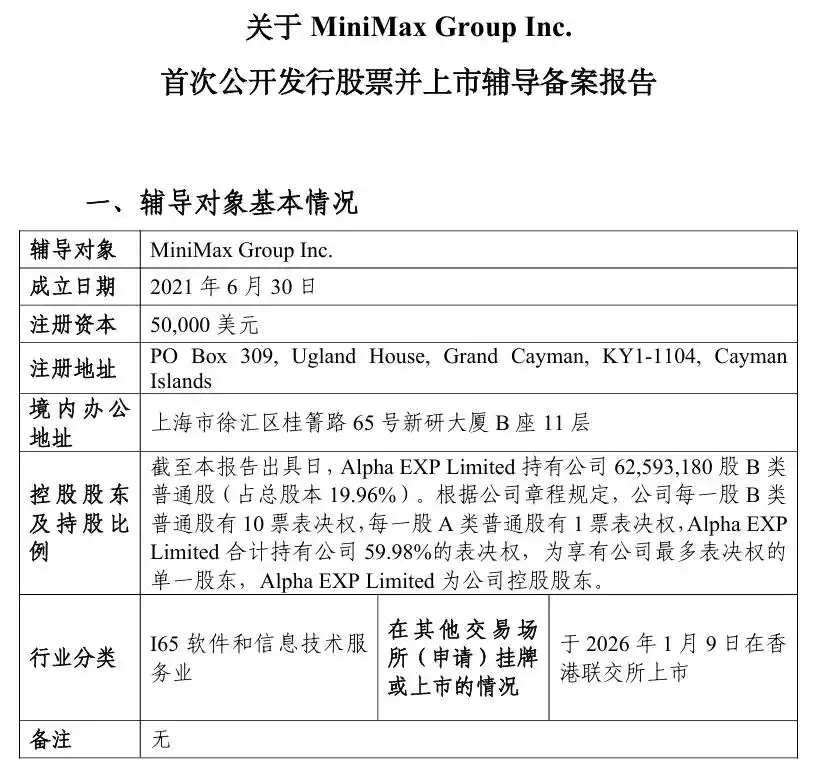
Zhidongxi May 30 report, as shown on the CSRC official website, Shanghai AI large model leader MiniMax submitted an IPO tutoring filing report to the Shanghai Securities Regulatory Bureau on May 29, initiating its A-share listing process, with CITIC Securities serving as the tutoring institution.

This also means that MiniMax, together with Zhipu AI which has also submitted its A-share IPO tutoring filing, will sprint to become the first large model stock on the A-share market.
MiniMax was established in January 2022 and completed its Hong Kong IPO in January this year. After the Hong Kong IPO, MiniMax's stock price skyrocketed. As of the Hong Kong market close on May 29, its stock price was HK$840 (approximately RMB 725.24), up 409.09% compared to the issue price of HK$165 (approximately RMB 142.46), with a market capitalization of HK$263.454 billion (approximately RMB 227.545 billion). Starting from June 8 this year, MiniMax will also be included in the Hang Seng Tech Index.
Behind the surging stock price, there is fundamental business performance as support.

On May 28, MiniMax disclosed some business data. Over the past two months, MiniMax's ARR (Annualized Recurring Revenue) achieved growth exceeding 100%. The number of global enterprise and developer customers served has exceeded one million, a fivefold increase compared to six months ago; its global user base is approximately 300 million.

In March this year, MiniMax released its first annual report after listing. During the earnings call, founder and CEO Yan Junjie revealed that the company's ARR had reached USD 150 million by February 2026.

That is to say, combined with the over 100% growth in the past two months, MiniMax's current ARR has exceeded USD 300 million.

For the full year 2025, MiniMax achieved revenue of USD 79.038 million (approximately RMB 535 million), of which revenue from AI-native products was USD 53.075 million (approximately RMB 359 million), and revenue from the open platform and other AI-based enterprise services was USD 25.963 million (approximately RMB 177 million).

Its gross profit margin improved to 25.4%, with an adjusted net loss of USD 250 million (approximately RMB 1.69 billion), and the loss ratio narrowed significantly year-on-year.
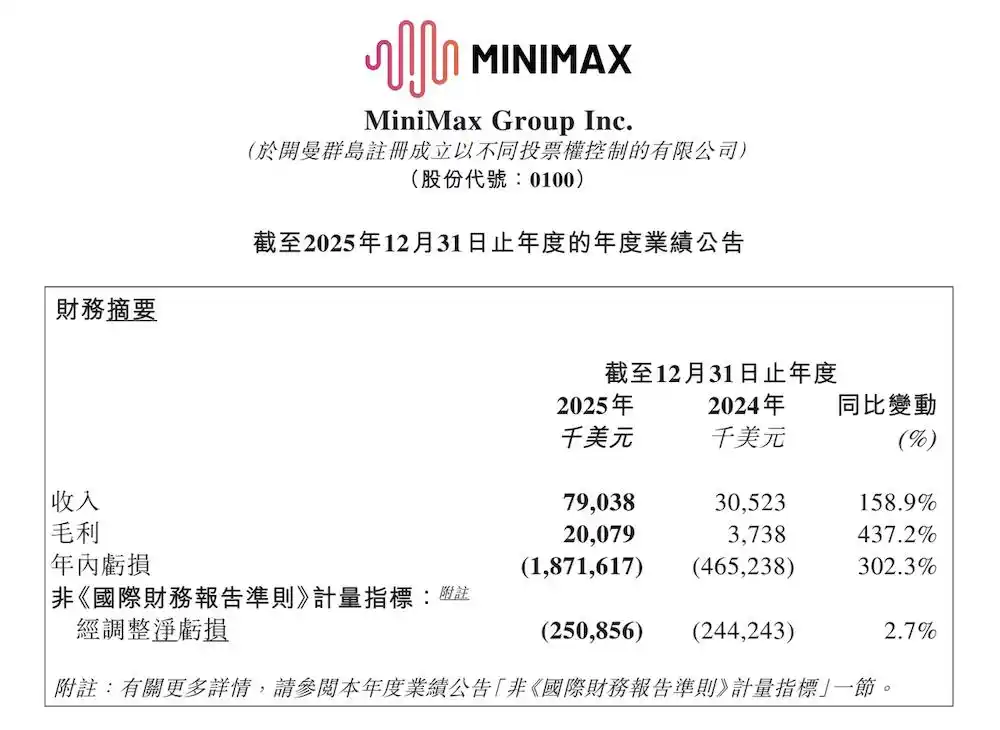
▲ Part of MiniMax's 2025 Financial Data

Regarding products, since the beginning of this year, MiniMax has successively launched three flagship large language models: MiniMax-M2.5, MiniMax-M2.6, and MiniMax-M2.7, and open-sourced the M2.5 and M2.7 models.
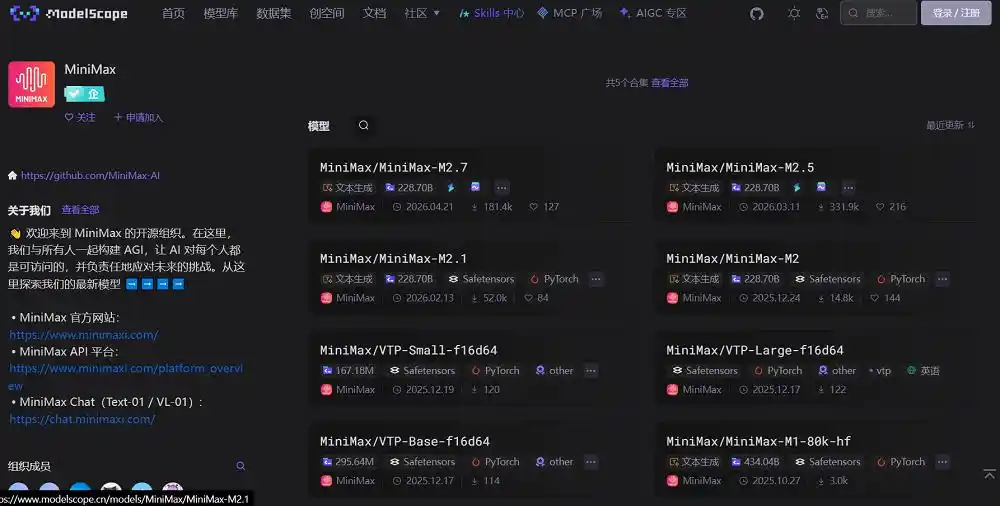
▲ Some open-sourced models from MiniMax (Source: ModelScope)

Thanks to its high cost-performance ratio, MiniMax-M2.5 gained popularity among many developers during the "Lobster Craze" (the open-source AI Agent framework OpenClaw) earlier this year and was even recommended by "Lobster Father" Peter Steinberger in a post.

In mid-February this year, on the AI model aggregation routing platform OpenRouter, MiniMax once became the model vendor with the highest market share, capturing 18.9% of model calls on OpenRouter. However, MiniMax has currently fallen out of the top 10 of this list.
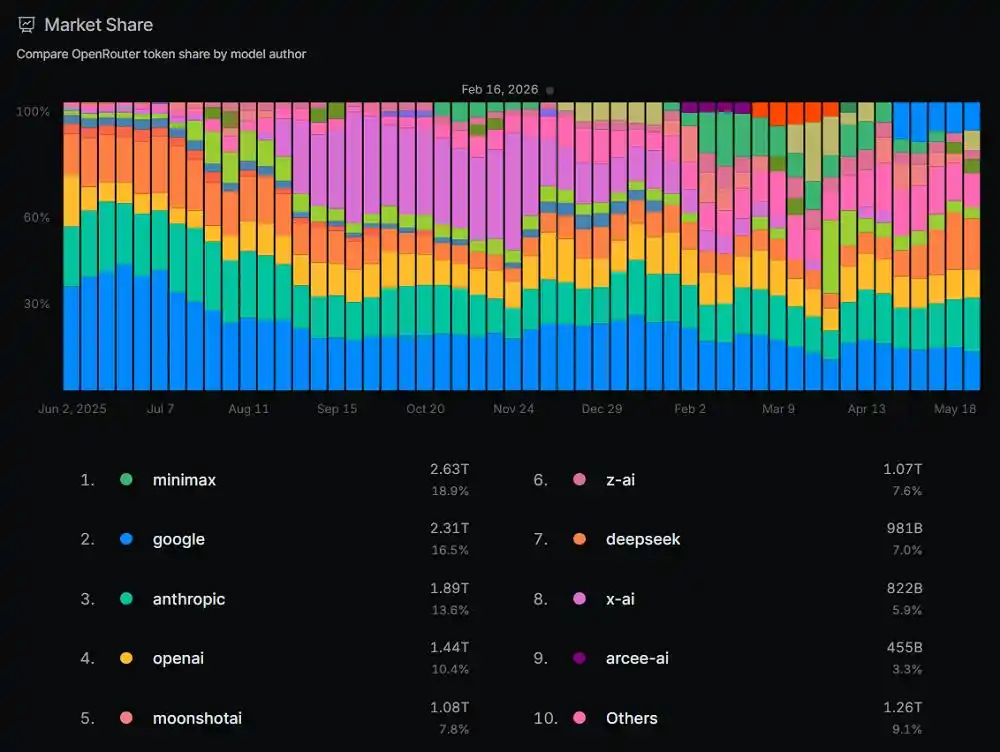
▲ OpenRouter Model Vendor Ranking in mid-February this year (Source: OpenRouter)

Additionally, in May this year, MiniMax upgraded its Agent product and renamed it Mavis, providing a multi-Agent parallel working mode, which can be used to improve the completion rate of complex long tasks.

At the end of May, the MiniMax official account hinted that MiniMax-M3 is即将发布.
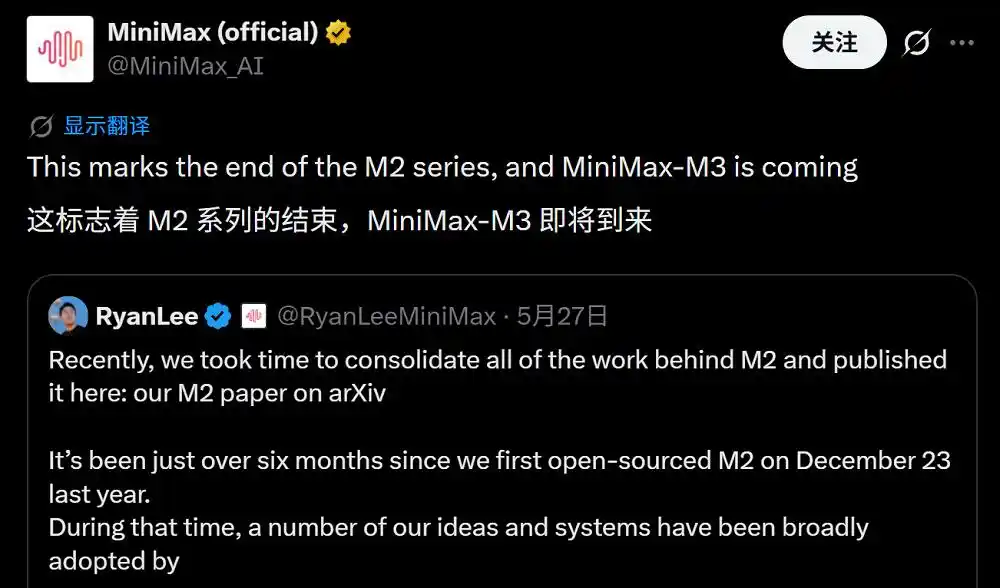
▲ MiniMax official account teases M3 model (Source: X platform @MiniMax_AI)

MiniMax Engineering Head Skyler Miao revealed more technical details about MiniMax-M3. MiniMax-M3 adopts the MiniMax Sparse Attention mechanism. Compared to MiniMax M2, in the Prefilling stage, MiniMax-M3's inference speed when processing 1 million tokens increased to 9.7 times faster; in the Decoding stage, when the KV length reaches 1 million, the speed increased to 15.6 times faster, effectively reducing attention latency.

The MiniMax Sparse Attention mechanism is based on the GQA (Grouped Query Attention) architecture. First, through the Index Branch, it uses compressed index queries (Idx Q) and keys (Idx KV) to calculate block scores and perform max pooling, selecting the Top-k block indices most relevant to the current query. Subsequently, it enters the Sparse Branch, performing sparse attention calculations only on these selected key blocks, thereby significantly reducing computational load.
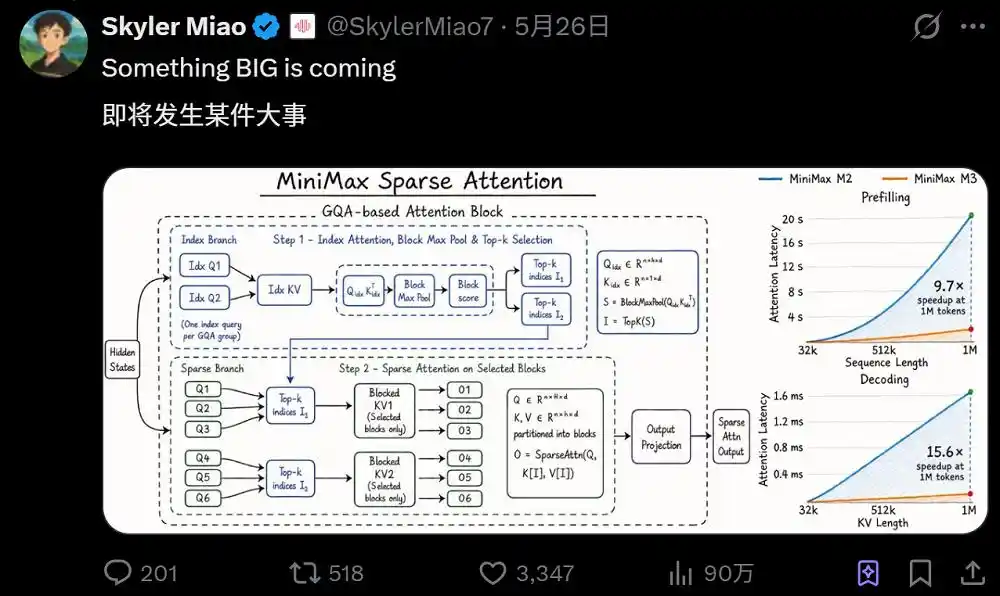
▲ Technical details of MiniMax Sparse Attention (Source: X platform @SkylerMiao7)

Conclusion: China's Leading Large Model Players Rush for Listing

Entering 2026, the moves of China's leading large model companies in the capital market have been accelerating. Besides MiniMax, Zhipu AI submitted its A-share IPO tutoring filing in April 2025 but later completed its IPO in Hong Kong first. In February this year, Zhipu withdrew its previous A-share IPO tutoring filing and registered for a new one, adding Guotai Haitong as a tutoring institution.

Furthermore, Moonshot AI, Stepfun, and 01.ai have also reportedly planned Hong Kong IPOs.

Facing high computing power investments and a not yet fully closed commercialization path, leading large model players are opening up more diverse financing channels through listings.

This article is from the WeChat public account "Zhidongxi" (ID: zhidxcom), author: Chen Junda

Связанные с этим вопросы

QWhat is the significance of MiniMax filing for an A-share IPO, and who else is competing in this process?

AMiniMax's filing for an A-share IPO marks a significant step for the Chinese AI large model sector, potentially allowing it to compete with Zhipu AI to become the first large model company listed on the A-share market. This move is part of a broader trend where top Chinese AI firms like Zhipu, Moonshot AI, StepFun, and 01.AI are also accelerating their capital market activities, such as pursuing IPOs, to secure funding for their compute-intensive operations and commercialization efforts.

QWhat are MiniMax's key financial and business performance highlights as mentioned in the article?

AMiniMax has shown strong financial and business growth. Its ARR (Annual Recurring Revenue) grew over 100% in the past two months, exceeding $300 million, with a global user base of approximately 300 million and over a million enterprise/developer customers. For the full year 2025, revenue was $79.038 million, with a gross margin of 25.4%. The company's adjusted net loss was $250 million, representing a narrowing loss margin. Its Hong Kong-listed stock price has surged 409.09% from its IPO price.

QDescribe the recent product developments and announcements from MiniMax.

ARecently, MiniMax has launched several flagship large language models (MiniMax-M2.5, M2.6, and M2.7), with M2.5 and M2.7 being open-sourced. The company also upgraded its AI Agent product, renaming it 'Mavis,' which supports multi-agent parallel work. Most notably, MiniMax has previewed its upcoming 'MiniMax-M3' model, which reportedly features a 'MiniMax Sparse Attention' mechanism, leading to significant performance improvements such as up to 9.7x faster prefill and 15.6x faster decoding speeds compared to its predecessor.

QWhat was MiniMax's notable achievement in the OpenRouter platform rankings, and what is its current status there?

AIn mid-February, MiniMax briefly became the top-ranked model provider on the AI model aggregation platform OpenRouter, capturing 18.9% of the model calls. However, according to the article, it has since fallen out of the platform's top 10 rankings.

QWhat reasons does the article suggest for the rush of Chinese large model companies like MiniMax to go public?

AThe article suggests that facing enormous compute investment costs and a commercial monetization path that is not yet fully realized, leading large model companies in China are seeking IPOs to open up more diverse and substantial financing channels. This capital is crucial for sustaining their technological development and scaling their operations in a highly competitive and resource-intensive field.

Похожее

From Suppliers to Shareholders: The Big Three Memory Chip Giants Jointly Invest in Anthropic, AI Supply Chain Power Structure Undergoing Reshuffle

For the first time, memory chip giants Micron, Samsung, and SK hynix have jointly invested in the same AI company, Anthropic, as part of its massive $65 billion Series H funding round. This strategic move, positioning the three rival HBM suppliers as "strategic infrastructure partners," highlights a fundamental shift in the AI industry's power dynamics. With HBM (High Bandwidth Memory) being a critically scarce resource essential for AI model training and inference, securing a stable supply has become a key competitive differentiator. By making these chipmakers shareholders, Anthropic aims to lock in this vital component for its rapid expansion, which includes securing major compute commitments from Amazon, Google, and others. For the memory trio, this investment represents a strategic bet on defining the future of AI hardware. Each company gains: SK hynix reinforces its dominant position in the NVIDIA supply chain; Samsung diversifies its client base beyond NVIDIA; and Micron leverages its geopolitical significance as the sole US-based HBM maker. Their collective move signals that competition in AI is evolving beyond model capability to encompass control over the entire compute supply chain—from chips and memory to power and networking. This vertical integration trend, where infrastructure providers become direct stakeholders in AI firms, marks the industry's maturation as AI transforms from a research project into essential global infrastructure, setting the stage for a new era of ecosystem competition.

marsbit22 мин. назад

From Suppliers to Shareholders: The Big Three Memory Chip Giants Jointly Invest in Anthropic, AI Supply Chain Power Structure Undergoing Reshuffle

marsbit22 мин. назад

Investment Philosophy of Gavin Baker, an Early Nvidia Investor: Long AI Infrastructure Bottlenecks, Short Overall Market Risk

Gavin Baker, an early investor in Nvidia and founder of Atreides Management, outlines his investment philosophy: going long on AI infrastructure bottlenecks while hedging against broader market risk. He argues AI is not a bubble but a supercycle driven by constraints in power, wafers (semiconductors), and compute efficiency (tokens per watt). True alpha, he believes, lies not in application-layer companies like OpenAI but in "picks and shovels" providers—companies solving physical bottlenecks in GPU connectivity (e.g., Astera Labs), memory (Micron), inference chips (Cerebras, Positron), advanced manufacturing (TSMC, ASML), and energy supply. His portfolio reflects this barbell strategy: concentrated bets on key infrastructure players alongside a significant put position on the QQQ ETF to hedge overall market downside. Baker contends this cycle differs from the dot-com bubble because demand is fueled by the strong balance sheets of hyperscalers (Google, Meta, Amazon, Microsoft), not debt, and physical supply constraints (e.g., chip manufacturing capacity) prevent runaway overinvestment. He highlights the growing importance of inference (vs. pre-training), vertical/small language models, sovereign infrastructure deployment speed, and the convergence of energy and space (e.g., orbital compute). His long-term view is that performance-per-watt and token cost reduction will dictate winners as AI scaling hits fundamental physical limits.

marsbit1 ч. назад

Investment Philosophy of Gavin Baker, an Early Nvidia Investor: Long AI Infrastructure Bottlenecks, Short Overall Market Risk

marsbit1 ч. назад

Apple Re-invented Image Compression with AI: Same Quality, One-Third the File Size

Apple’s PICO: An AI-Powered Image Codec That Cuts File Size by Two-Thirds at Equal Perceived Quality In 2025, JPEG AI became the first international standard for learned image compression. However, it, like most codecs, still prioritizes mathematical metrics like PSNR over true perceptual quality—what the human eye finds pleasing. Apple researchers have introduced PICO (Perceptual Image Codec), a neural codec designed to optimize for human perception. It tackles key practical challenges: 1) Speed: A novel "one-shot context model" accelerates entropy encoding without sacrificing compression efficiency. 2) Artifacts: A dedicated TextFidelity loss preserves text clarity, and a TilingArtifact loss eliminates color seams between image tiles processed in parallel. 3) Control: It avoids the "hallucinations" common in GAN-based perceptual models. In a large-scale human evaluation (74,925 comparisons), PICO achieved the same perceived quality as standards like AV1, VVC, and JPEG AI while using only 30-43% of the bitrate. It also outperforms other learned perceptual codecs by 20-40%. Remarkably, it runs in 230ms (encode) and 150ms (decode) on an iPhone 17 Pro Max. While less efficient on synthetic graphics, PICO represents a significant shift from optimizing mathematical scores to directly targeting human visual experience, making high-quality perceptual compression practical for consumer devices. The work builds on expertise from WaveOne, whose team joined Apple and previously advanced neural video compression.

marsbit2 ч. назад

Apple Re-invented Image Compression with AI: Same Quality, One-Third the File Size

marsbit2 ч. назад

Торговля

Спот
Фьючерсы

Популярные статьи

Как купить S

Добро пожаловать на HTX.com! Мы сделали приобретение Sonic (S) простым и удобным. Следуйте нашему пошаговому руководству и отправляйтесь в свое крипто-путешествие.Шаг 1: Создайте аккаунт на HTXИспользуйте свой адрес электронной почты или номер телефона, чтобы зарегистрироваться и бесплатно создать аккаунт на HTX. Пройдите удобную регистрацию и откройте для себя весь функционал.Создать аккаунтШаг 2: Перейдите в Купить криптовалюту и выберите свой способ оплатыКредитная/Дебетовая Карта: Используйте свою карту Visa или Mastercard для мгновенной покупки Sonic (S).Баланс: Используйте средства с баланса вашего аккаунта HTX для простой торговли.Третьи Лица: Мы добавили популярные способы оплаты, такие как Google Pay и Apple Pay, для повышения удобства.P2P: Торгуйте напрямую с другими пользователями на HTX.Внебиржевая Торговля (OTC): Мы предлагаем индивидуальные услуги и конкурентоспособные обменные курсы для трейдеров.Шаг 3: Хранение Sonic (S)После приобретения вами Sonic (S) храните их в своем аккаунте на HTX. В качестве альтернативы вы можете отправить их куда-либо с помощью перевода в блокчейне или использовать для торговли с другими криптовалютами.Шаг 4: Торговля Sonic (S)С легкостью торгуйте Sonic (S) на спотовом рынке HTX. Просто зайдите в свой аккаунт, выберите торговую пару, совершайте сделки и следите за ними в режиме реального времени. Мы предлагаем удобный интерфейс как для начинающих, так и для опытных трейдеров.

1.4k просмотров всегоОпубликовано 2025.01.15Обновлено 2025.03.21

Как купить S

Sonic: Обновления под руководством Андре Кронье – новая звезда Layer-1 на фоне спада рынка

Он решает проблемы масштабируемости, совместимости между блокчейнами и стимулов для разработчиков с помощью технологических инноваций.

2.3k просмотров всегоОпубликовано 2025.04.09Обновлено 2025.04.09

Sonic: Обновления под руководством Андре Кронье – новая звезда Layer-1 на фоне спада рынка

HTX Learn: Пройдите обучение по "Sonic" и разделите 1000 USDT

HTX Learn — ваш проводник в мир перспективных проектов, и мы запускаем специальное мероприятие "Учитесь и Зарабатывайте", посвящённое этим проектам. Наше новое направление .

1.8k просмотров всегоОпубликовано 2025.04.10Обновлено 2025.04.10

HTX Learn: Пройдите обучение по "Sonic" и разделите 1000 USDT

Обсуждения

Добро пожаловать в Сообщество HTX. Здесь вы сможете быть в курсе последних новостей о развитии платформы и получить доступ к профессиональной аналитической информации о рынке. Мнения пользователей о цене на S (S) представлены ниже.

活动图片