Crypto.com cuts 12% workforce as CEO warns AI shift is ‘do or die’

ambcryptoОпубликовано 2026-03-19Обновлено 2026-03-19

Введение

Crypto.com has cut roughly 12% of its workforce as part of a strategic shift toward enterprise-wide AI integration, with CEO Kris Marszalek warning that companies slow to adopt AI risk failure. The layoffs target roles incompatible with an AI-focused direction, following the company's acquisition of AI.com for $70 million. This reflects a broader industry trend where crypto firms are combining cost-cutting with AI-driven efficiency, moving beyond purely market-driven layoffs to structural resets. Similarly, Algorand Foundation reduced its workforce by 25%, citing market pressures, though its cuts appear more reactive than strategic. The trend indicates that crypto layoffs are increasingly tied to technological realignment, with AI integration becoming a key competitive factor.

Crypto.com has reduced its workforce by roughly 12% as part of a broader push to integrate artificial intelligence across its operations, with CEO Kris Marszalek warning that companies slow to adopt AI risk being left behind.

In a statement, Marszalek said the firm is moving toward “enterprise-wide AI,” arguing that companies that fail to pivot “will fail,” while those that move quickly could achieve “a level of scale and precision that was previously impossible.”

The layoffs affect roles deemed incompatible with the company’s new AI-focused direction. Affected employees have been notified and are receiving transition support, according to the announcement.

The move follows Crypto.com’s earlier acquisition of the premium domain AI.com, reportedly for $70m, signaling a deeper strategic commitment to artificial intelligence.

AI pivot meets cost discipline

Crypto.com’s decision reflects a growing shift across the crypto industry, where firms are increasingly combining cost-cutting measures with long-term bets on automation and AI-driven efficiency.

Rather than purely reacting to market conditions, the company framed its layoffs as a structural reset — replacing traditional roles with AI-augmented workflows.

This marks a notable evolution from previous crypto downturns, where layoffs were largely tied to collapsing prices and liquidity crises. Now, workforce reductions are also being driven by technological realignment.

Algorand cuts 25% amid market pressure

The trend is not isolated.

On 18 March, the Algorand Foundation confirmed a 25% workforce reduction, citing macroeconomic uncertainty and continued weakness in crypto markets.

The Foundation described the decision as a move to better align resources with long-term priorities, including protocol development and ecosystem growth.

Unlike Crypto.com’s AI-led restructuring, Algorand’s layoffs appear more directly linked to external pressures, including market downturns and funding constraints.


Final Summary

  • Crypto layoffs are increasingly tied to AI-driven restructuring rather than just market downturns, signaling a shift toward leaner, automated operations.
  • Firms that successfully integrate AI while maintaining execution speed may gain a lasting competitive edge in the next market cycle.

Связанные с этим вопросы

QWhat percentage of its workforce did Crypto.com cut as part of its AI integration push?

ACrypto.com cut roughly 12% of its workforce.

QWhat did Crypto.com's CEO, Kris Marszalek, say about companies that are slow to adopt AI?

AKris Marszalek warned that companies that fail to pivot to AI 'will fail', while those that move quickly could achieve 'a level of scale and precision that was previously impossible'.

QWhat significant acquisition did Crypto.com make to signal its strategic focus on AI, and how much did it reportedly cost?

ACrypto.com acquired the premium domain AI.com, reportedly for $70 million.

QHow do the recent layoffs at Crypto.com differ from those in previous crypto downturns, according to the article?

AUnlike previous downturns where layoffs were largely tied to collapsing prices and liquidity crises, the current workforce reductions are also being driven by a technological realignment and a shift towards AI-augmented workflows.

QWhich other crypto organization announced significant layoffs, and what was the percentage of its workforce reduction?

AThe Algorand Foundation confirmed a 25% workforce reduction on 18 March.

Похожее

Zhejiang University Research Team Proposes New Approach: Teaching AI How the Human Brain Understands the World

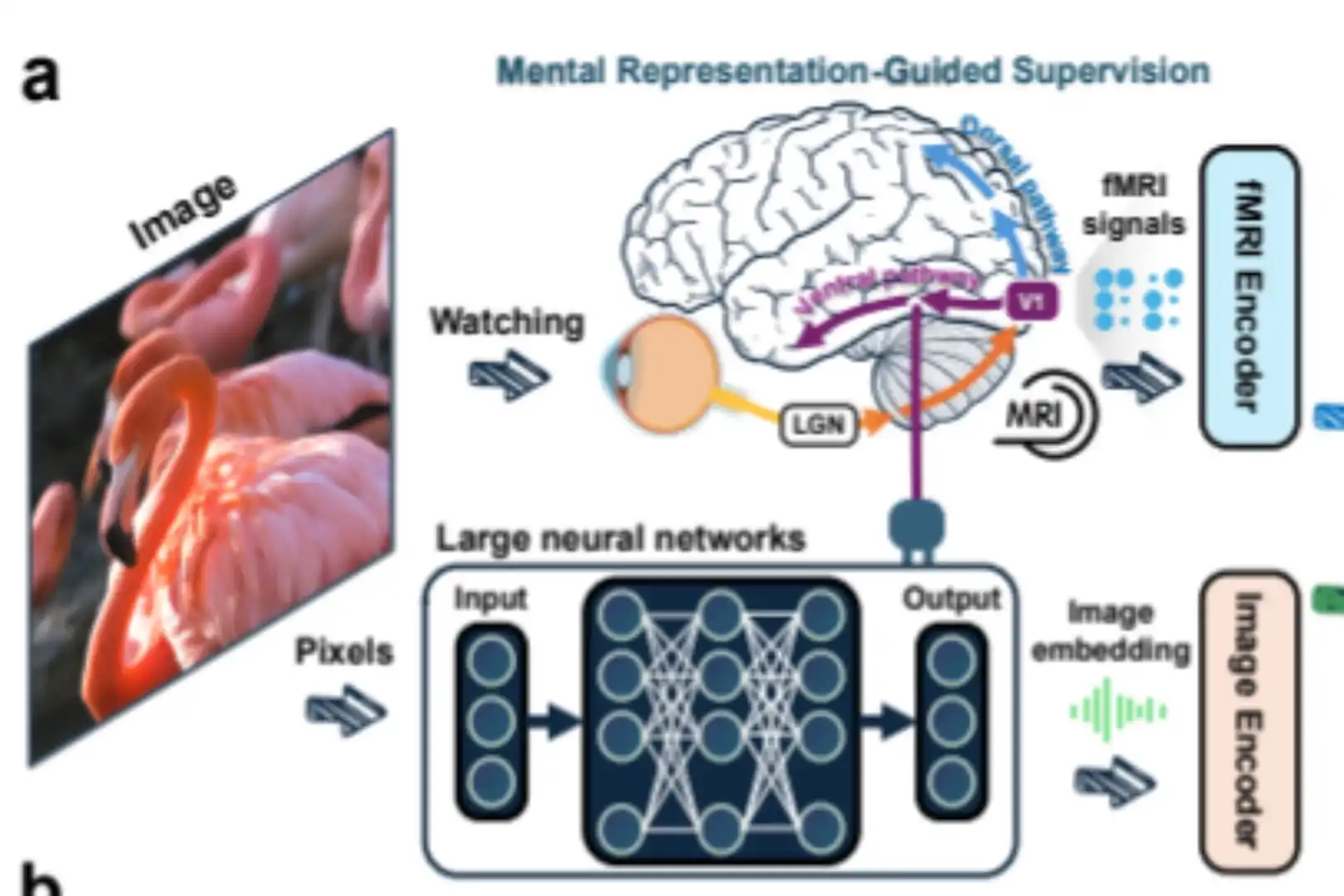
A research team from Zhejiang University published a paper in *Nature Communications* challenging the prevailing notion that larger AI models inherently think more like humans. They found that while model performance on recognizing concrete concepts improved as parameters increased (from 74.94% to 85.87%), performance on abstract concept tasks slightly declined (from 54.37% to 52.82%) in models like SimCLR, CLIP, and DINOv2. The key difference lies in how concepts are organized. Humans naturally form hierarchical categories (e.g., grouping a swan and an owl into "birds"), enabling them to apply past knowledge to new situations. Models, however, rely heavily on statistical patterns in data and struggle to form stable, abstract categories. The team proposed a novel solution: using human brain signals (recorded when viewing images) to supervise and guide the model's internal organization of concepts. This method, termed transferring "human conceptual structures," helped the model learn a brain-like categorical system. In experiments, the model showed improved few-shot learning and generalization, with a 20.5% average improvement on a task requiring abstract categorization like distinguishing living vs. non-living things, even outperforming much larger models. This research shifts the focus from simply scaling model size ("bigger is better") to designing smarter internal structures ("structured is smarter"). It highlights a new pathway for developing AI that possesses more human-like abstract reasoning and adaptive learning capabilities.

marsbit31 мин. назад

Zhejiang University Research Team Proposes New Approach: Teaching AI How the Human Brain Understands the World

marsbit31 мин. назад

Dialogue with Bloomberg ETF Analyst: Why Bitcoin ETF Holders Did Not Sell During the 50% Plunge

In a recent interview on Coin Stories, Bloomberg Intelligence Senior ETF Analyst James Seyffart discussed the resilience of Bitcoin ETF holders, who largely held their positions despite a 50% price drop, contrary to expectations of panic selling. Seyffart noted that while there was a $9 billion outflow from Bitcoin ETFs starting October 10, it was minor compared to the $250-300 billion inflows prior, and outflows have since reversed by $20-25 billion. He attributed this "diamond hands" behavior to educated investors who understand Bitcoin’s volatility and typically allocate only a small portion (e.g., 1-5%) of their portfolios, leading to rebalancing rather than selling during dips. The conversation also covered the entry of major institutions like Morgan Stanley, which is launching its own Bitcoin ETF, leveraging its vast client assets. Seyffart highlighted the growing efficiency of ETFs, with physical redemptions now allowed, potentially enabling direct Bitcoin transfers to holders in the future. However, he expressed concern over the concentration of Bitcoin custody with Coinbase. Additionally, Seyffart discussed the inverse flow trends between Bitcoin and Gold ETFs recently, with Bitcoin acting more like a risk-on growth asset. He remains optimistic about Bitcoin ETFs eventually surpassing Gold ETFs in size due to Bitcoin’s diverse use cases. Finally, he emphasized the importance of diversification in the current volatile market, where traditional hedges have largely failed, and cash.

marsbit1 ч. назад

Dialogue with Bloomberg ETF Analyst: Why Bitcoin ETF Holders Did Not Sell During the 50% Plunge

marsbit1 ч. назад

Who Cannot Be Distilled into a Skill?

"This article explores the concerning trend of AI systems distilling human workers into replaceable 'skills,' using the viral 'Colleague.skill' phenomenon as a key example. It argues that the most diligent employees—those who meticulously document their work, write detailed analyses, and transparently share decision-making logic—are paradoxically the most vulnerable to being replaced. Their high-quality 'context' (communication records, documents, and decision trails) becomes the perfect fuel for AI agents, extracted from corporate platforms like Feishu and DingTalk. The piece warns of a deeper ethical crisis: the reduction of human relationships to functional APIs, as seen in derivatives like 'Ex.skill' or 'Boss.skill,' which reduce complex individuals to mere utilities. This reflects a shift from Martin Buber's 'I-Thou' relationship (seeing others as whole beings) to an 'I-It' dynamic (seeing them as tools). While AI can capture explicit knowledge (written documents, replies), it fails to capture tacit knowledge—the intuition, experience, and unspoken insights that define human expertise. However, a greater danger emerges when AI-generated content, based on distilled human data, is used to train future models, leading to 'model collapse' and homogenized, mediocre outputs—a process likened to 'electronic patina' degrading information over time. The article concludes by noting a small but symbolic resistance, such as the 'anti-distill' tool that generates meaningless text to protect valuable knowledge. Ultimately, it suggests that while AI can capture a static snapshot of a person, humans remain 'fluid algorithms' capable of continuous growth and adaptation, leaving their AI shadows behind."

marsbit1 ч. назад

Who Cannot Be Distilled into a Skill?

marsbit1 ч. назад

Торговля

Спот
Фьючерсы

Популярные статьи

Как купить PUSH

Добро пожаловать на HTX.com! Мы сделали приобретение Push Protocol (PUSH) простым и удобным. Следуйте нашему пошаговому руководству и отправляйтесь в свое крипто-путешествие.Шаг 1: Создайте аккаунт на HTXИспользуйте свой адрес электронной почты или номер телефона, чтобы зарегистрироваться и бесплатно создать аккаунт на HTX. Пройдите удобную регистрацию и откройте для себя весь функционал.Создать аккаунтШаг 2: Перейдите в Купить криптовалюту и выберите свой способ оплатыКредитная/Дебетовая Карта: Используйте свою карту Visa или Mastercard для мгновенной покупки Push Protocol (PUSH).Баланс: Используйте средства с баланса вашего аккаунта HTX для простой торговли.Третьи Лица: Мы добавили популярные способы оплаты, такие как Google Pay и Apple Pay, для повышения удобства.P2P: Торгуйте напрямую с другими пользователями на HTX.Внебиржевая Торговля (OTC): Мы предлагаем индивидуальные услуги и конкурентоспособные обменные курсы для трейдеров.Шаг 3: Хранение Push Protocol (PUSH)После приобретения вами Push Protocol (PUSH) храните их в своем аккаунте на HTX. В качестве альтернативы вы можете отправить их куда-либо с помощью перевода в блокчейне или использовать для торговли с другими криптовалютами.Шаг 4: Торговля Push Protocol (PUSH)С легкостью торгуйте Push Protocol (PUSH) на спотовом рынке HTX. Просто зайдите в свой аккаунт, выберите торговую пару, совершайте сделки и следите за ними в режиме реального времени. Мы предлагаем удобный интерфейс как для начинающих, так и для опытных трейдеров.

428 просмотров всегоОпубликовано 2024.03.29Обновлено 2025.04.02

Как купить PUSH

Обсуждения

Добро пожаловать в Сообщество HTX. Здесь вы сможете быть в курсе последних новостей о развитии платформы и получить доступ к профессиональной аналитической информации о рынке. Мнения пользователей о цене на PUSH (PUSH) представлены ниже.

活动图片